


CPT Code 30801: Superficial turbinate ablation billing guide
CPT Code 30801: Official descriptor and procedure overview The American Medical ...

Last Updated: Nov 27, 2026
HCPCS Code V2743 is a deleted spectacle-lens code that described a glass lens with a tint other than rose 1 or 2, billed per lens. It is not a contact lens code, and it is no longer valid on any claim.
Bill a fixed tint today with V2745, one unit per lens, or a photochromic lens with V2744, the two tint codes CMS lists for lenses. This page covers the old descriptor, why the code was retired, and how to bill a tinted lens correctly now.

HCPCS Code V2743 (tint, glass, other than rose 1 or 2, per lens) is a deleted spectacle-lens tint code, not a contact lens code.
Bill a solid or gradient tint of any color and any lens material with V2745, one unit per lens.
Bill a photochromic lens with V2744, and never add V2745 to the same lens.
Medicare covers a tint only on covered lenses, and only when the treating practitioner documents medical need.
A claim line carrying V2743 today denies as an invalid code, so remove it from charge masters and superbill templates.
V2743 sat in the V2700–V2799 range of the CMS HCPCS Level II code set, which covers spectacle lens additions and other vision supplies. Its descriptor was “Tint, glass, other than rose 1 or 2, per lens,” as listed in the Virginia Medicaid vision services code appendix.
CMS deleted the code long ago, and it has not been reinstated. Current HCPCS code lists carry V2744 and V2745 as the active tint codes, so a claim that reports V2743 today carries an invalid code.
Contact lenses never belonged in this block. They have their own range, V2500–V2599, while V2740–V2745 is a block of tint codes for spectacle lenses.
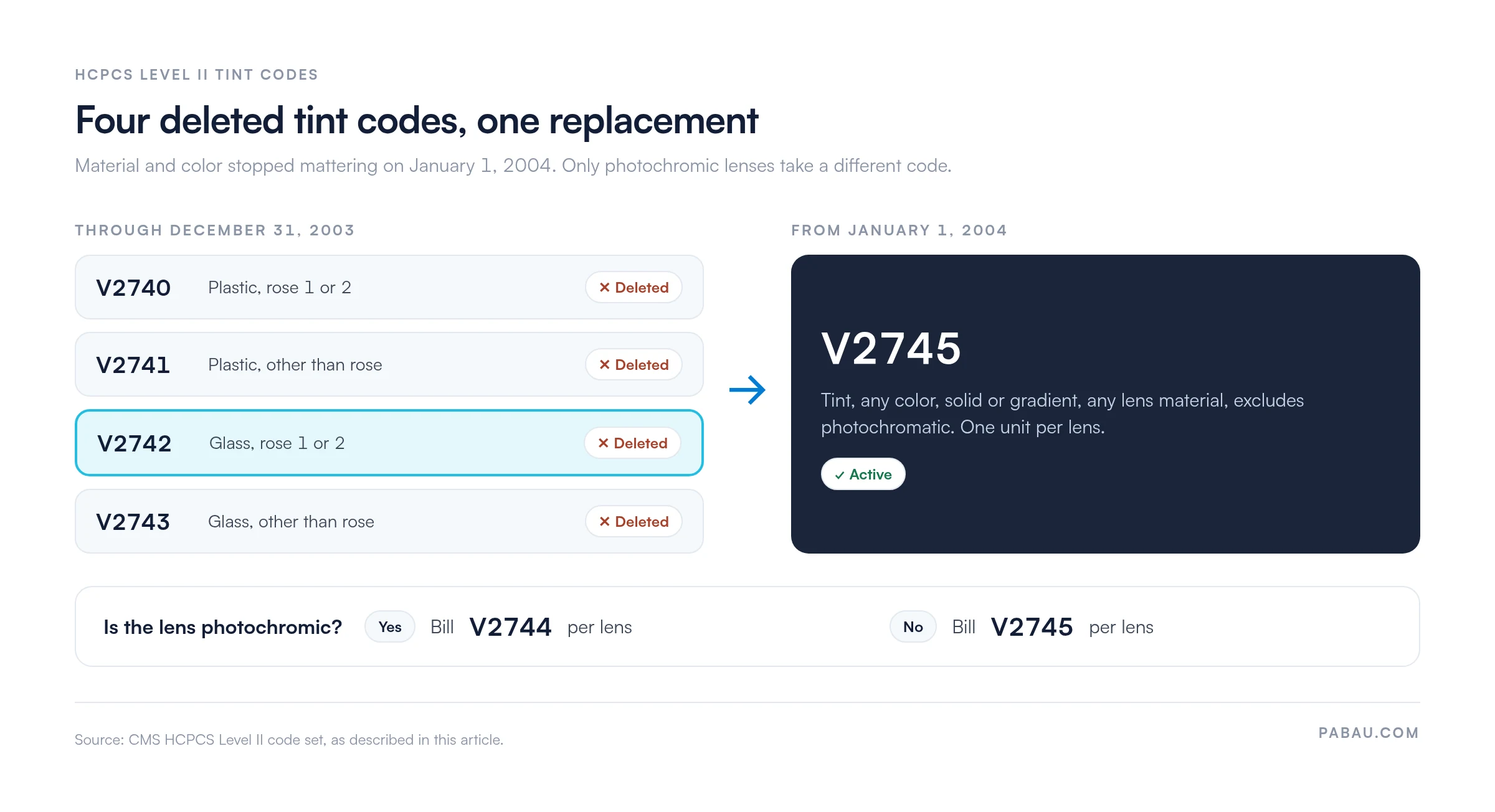
Tint billing was once split four ways, by lens material and by tint color. V2743 was the code for any tint other than rose 1 or 2 on a glass lens. Its three siblings covered plastic lenses and the rose tints.
CMS folded all four material- and color-specific codes into V2745. The current code covers any tint color, solid or gradient, on any lens material. Material and color no longer change the code, so the coder only has to decide whether the tint is photochromic, as the diagram below shows.
A code retired this long ago survives in files that are rarely reopened. Typical sources are an inherited charge master, an old superbill template, or an optical price list copied from one system to the next.
Some coders also mistake V2743 for a catch-all supply code, because its neighbors look like a run of lens add-ons. It never described a contact lens or a miscellaneous supply. When the line reaches the payer, it denies as invalid for the date of service, usually with claim adjustment reason code 181.
The fix is to replace V2743 with V2745, or with V2744 for a photochromic lens, and send a corrected claim.
Search your fee schedule and superbill templates for V2740, V2741, V2742 and V2743 each year when the annual HCPCS update lands. Map every hit to V2745 so a deleted tint code never reaches the claim scrubber.
Choose the tint code by how the lens behaves in light. A fixed tint of any color, solid or gradient, is V2745. A lens that darkens automatically in UV light is V2744.
V2745 and V2744 are additions to a spectacle lens, so they always travel with a base lens code on the same claim. These rules apply to every tint line.
A bilateral single vision pair with a medically necessary fixed tint looks like this on a Medicare claim.
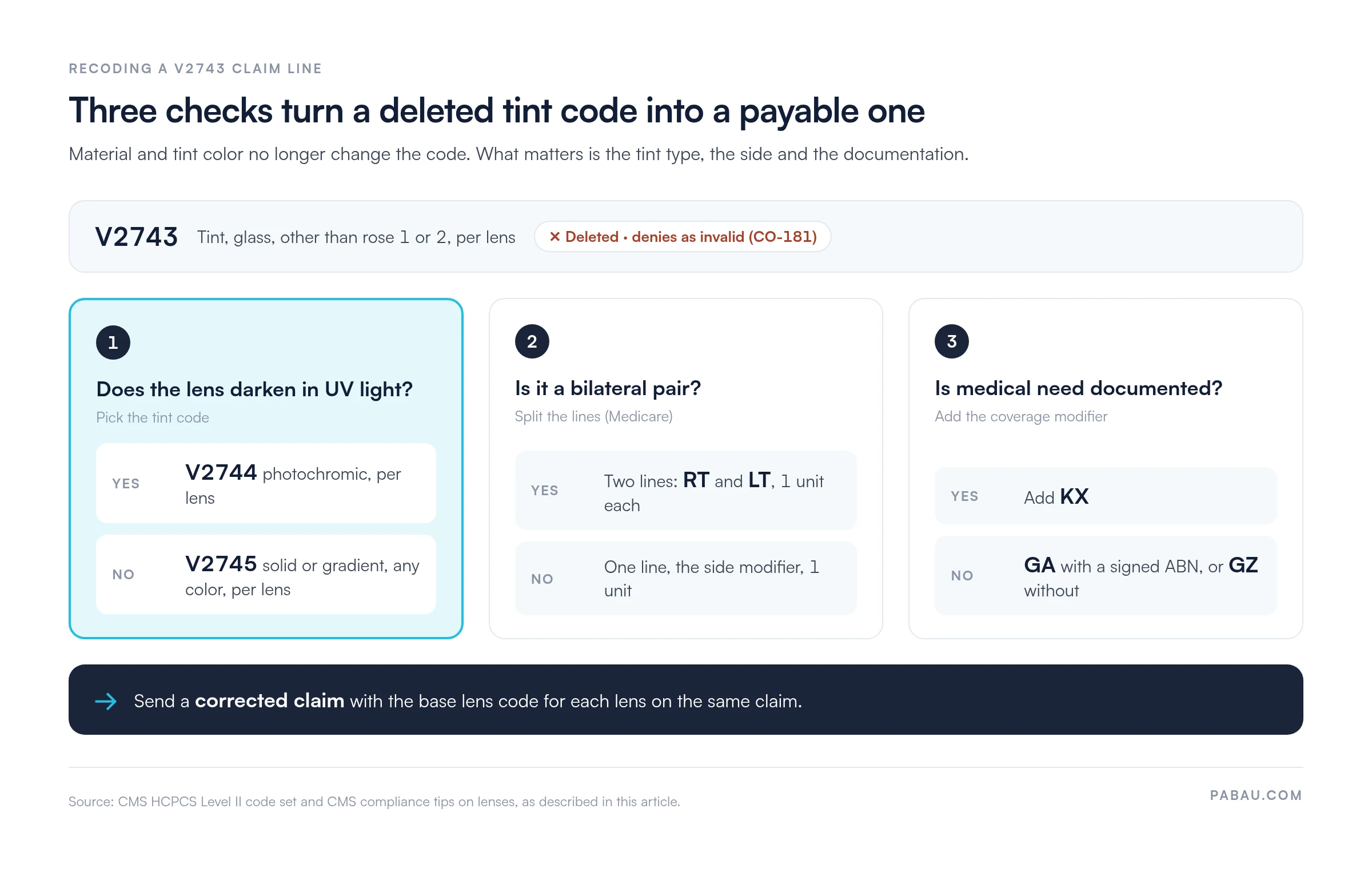
Swap V2745 for V2744 on lines 3 and 4 if the patient chose photochromic lenses. Where the tint lacks documented medical need, drop KX and add GA or GZ instead. The three checks below recode any V2743 line the same way.
Medicare has no routine vision benefit. For a patient with an intraocular lens, coverage is limited to one pair of eyeglasses or contact lenses after each cataract surgery. Prosthetic eyes have a separate benefit, and Medicare pays for polishing one twice a year under HCPCS code V2624.
A tint on covered lenses is paid only when the treating practitioner documents why it is medically necessary. Tinted lenses used as sunglasses are denied, according to the CMS compliance tips on lenses. Commercial vision plans and state Medicaid programs set their own tint benefits.
A tint line survives review when the chart explains why the patient needs it. Keep these records for every tinted lens you bill.
Tint denials follow a short list of causes. The denial reason codes on the remittance tell you which one you are dealing with.
Most of these denials can be caught at charge entry. The code check and the RT/LT split take seconds, while an appeal takes weeks.
In many optometry practices, the tint prescription, the chart note and the fee schedule each sit in a different system. That split is how a deleted code like V2743 lasts for years, copied forward on a price list nobody checks.
Pabau, a practice management platform with claims built in, keeps the clinical record and the billing record in one place. Its claims management software submits from that record, so the biller codes the tint while reading why it was prescribed.
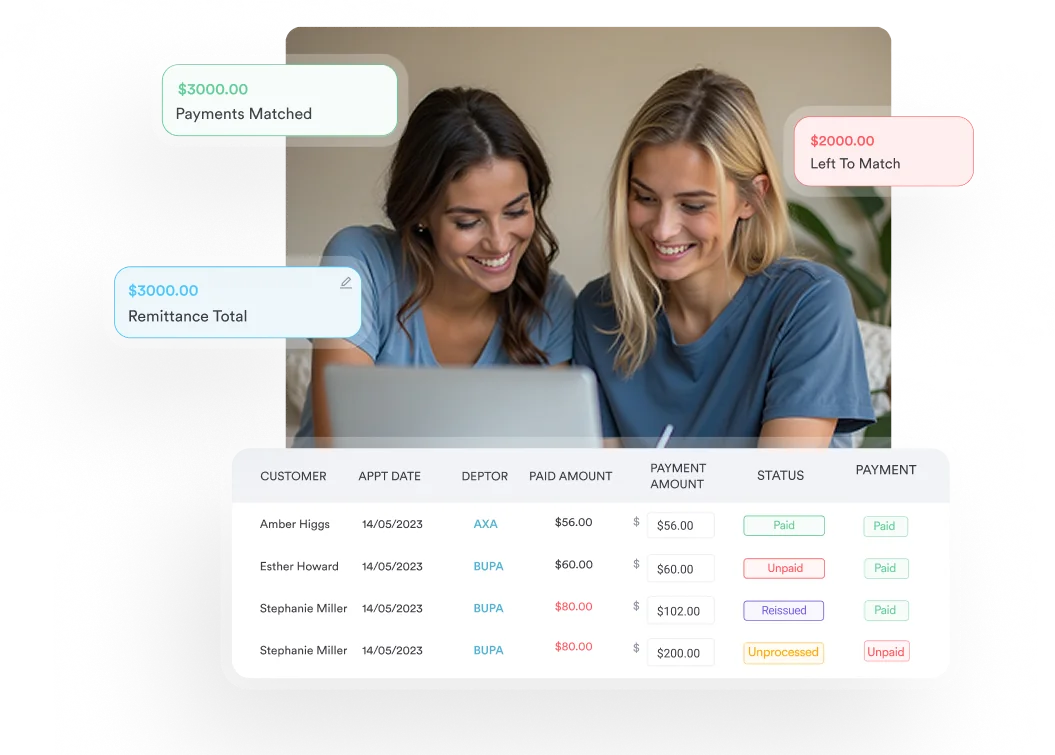
The outcome is fewer invalid-code denials, RT and LT lines split correctly from the start, and audit requests answered from one patient timeline.

Pabau keeps prescriptions, chart notes and claims on one patient timeline. Optical billers code each tint as V2745 or V2744 with the documentation in front of them.

V2743 is a closed question. It was a glass-lens tint code, it is gone, and V2745 bills the same tint today. The work left is making sure the old code has left every template your practice bills from.
Once it has, a tint claim pays on three checks. Confirm fixed or photochromic, split the lenses by side, and document why the patient needs the tint.
Pabau keeps the prescription, the note and the claim together so those checks happen before submission. To see how it handles optical billing end to end, book a demo.

Need a refresher on how payers adjudicate a vision claim? Medical billing fundamentals explains adjudication and where appeals fit in the revenue cycle.
Want audit-ready documentation for tint and coating add-ons? Medical billing compliance covers the records that protect against payer recoupment.
Looking for a clearinghouse that catches deleted HCPCS codes before submission? Medical claims clearinghouses explained shows how claims are scrubbed and routed to payers.
Still finding the plastic rose tint code on old superbills? HCPCS code V2740 explains the deleted rose tint code and what to bill in its place.
No. V2743 was deleted long ago and has not been reinstated. A claim line carrying it today denies as an invalid code.
V2743 described a glass spectacle lens with a tint other than rose 1 or 2, billed per lens. It was one of four material- and color-specific tint codes, V2740 to V2743, that CMS retired together.
No. V2743 was always a spectacle-lens tint code. Contact lenses are coded in the V2500–V2599 range, while V2740–V2745 is a block of tint codes.
V2745 replaced it: addition to lens; tint, any color, solid, gradient or equal, excludes photochromatic, any lens material, per lens. Bill one unit for each tinted lens.
Use V2744, tint, photochromatic, per lens. Do not add V2745 to the same lens, because the V2745 descriptor excludes photochromatic tints.
Only on lenses Medicare already covers, usually after cataract surgery, and only when the treating practitioner documents medical need for the tint. Tinted lenses used as sunglasses are denied.
Bill two units, one per lens. For Medicare, report each lens on its own claim line with RT or LT and one unit.




