CPT Code 31653: EBUS With 3+ Mediastinal Stations
CPT code 31653: Official descriptor and clinical scope CPT code 31653 is the pro...

Last Updated: Oct 20, 2026
V2742 is the deleted HCPCS Level II code for tint, glass, rose 1 or 2, per lens. CMS terminated it on December 31, 2003, so it is invalid for any date of service on or after January 1, 2004.
Bill a solid or gradient tint of any color, on any lens material, with V2745, one unit per lens. Bill a photochromic lens with V2744 instead.
Let Pabau's smart automation suggest the right codes, reduce claim denials, and keep your practice compliant—effortlessly.
Automate repetitive tasks and focus on what matters most—your patients.
Reduce coding errors and ensure compliance with the latest regulations.
Clean claims, fewer denials, and faster reimbursements.
Powerful insights and reporting to help your practice thrive.
HIPAA compliant SOC 2 certified GDPR-compliant Trusted by 4,000+ clinics worldwide

HCPCS Code V2742 (tint, glass, rose 1 or 2, per lens) was deleted for dates of service on or after January 1, 2004.
Bill a solid or gradient tint of any color and any lens material with V2745, one unit per lens.
Bill a photochromic lens with V2744. V2760 is a scratch-resistant coating and never describes a tint.
Medicare covers a tint only on covered lenses, with medical need documented by the treating practitioner and the KX modifier added.
A claim line carrying V2742 today denies as an invalid code, so remove it from charge masters and superbill templates.
HCPCS Code V2742 described one narrow item: a glass spectacle lens with a rose 1 or rose 2 tint, reported per lens. It sat in the V2700–V2799 range of the CMS HCPCS Level II code set. Those codes cover lens additions and other vision supplies, including V2718 for a press-on Fresnel prism lens.
CMS terminated the code on December 31, 2003, and it has not been reinstated. Claims with a date of service on or after January 1, 2004 must report the tint with a current code.
Today, a solid or gradient tint of any color, on any lens material, is billed with V2745, one unit per lens. A photochromic lens is billed with V2744 instead. Polarization is not a tint, so a polarized lens is billed with V2762, one unit per lens.
Before 2004, tint billing was split four ways, by lens material and by tint color. V2742 was the code for a rose tint on a glass lens. Its three siblings covered plastic lenses and tint colors other than rose. One of them, HCPCS code V2741, covered a tint other than rose 1 or 2 on a plastic lens.
From January 1, 2004, CMS folded all four codes into V2745. The new code covers any tint color, solid or gradient, on any lens material. Material and color no longer change the code, so the coder only has to decide whether the tint is photochromic, as the diagram below shows.
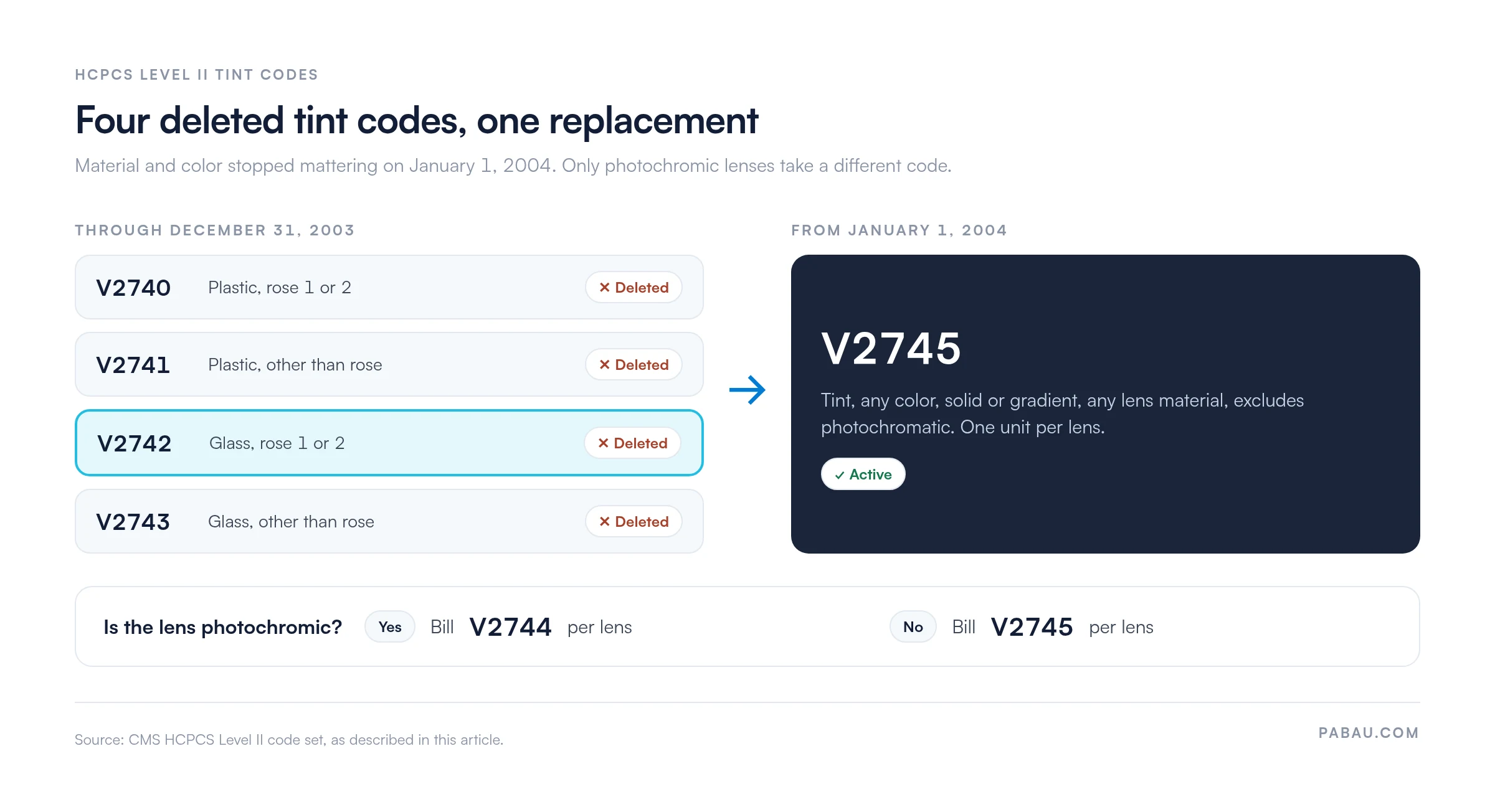
A code deleted more than two decades ago survives in files that are rarely reopened. Typical sources are an inherited charge master, an old superbill template, or an optical price list copied from one system to the next.
When the line reaches the payer, it denies because the code was invalid on the date of service, usually with claim adjustment reason code 181. The fix is to replace V2742 with V2745, or with V2744 for a photochromic lens, and send a corrected claim.
Search your fee schedule and superbill templates for V2740, V2741, V2742 and V2743 each year when the annual HCPCS update lands. Map every hit to V2745 so a deleted tint code never reaches the claim scrubber.
Choose the tint code by how the lens behaves in light. A fixed tint of any color, solid or gradient, is V2745. A lens that darkens automatically in UV light is V2744.
V2760 is sometimes mistaken for a photochromic code. It describes a scratch-resistant coating only, and the Medicare refractive lens policy treats that coating as noncovered. A mirror coating is another add-on that coders fold into the tint line by mistake. It bills on V2761, one unit per lens.
V2745 is an addition to a lens, so it always travels with a base lens code on the same claim. These rules apply to every tint line.
A bilateral single vision pair with a medically necessary fixed tint looks like this on a Medicare claim.
Swap V2745 for V2744 on lines 3 and 4 if the patient chose photochromic lenses. Where the tint lacks documented medical need, drop KX and add GA or GZ instead.
Medicare has no routine vision benefit. It covers spectacle lenses as prosthetic devices after cataract surgery, under the CMS Benefit Policy Manual, Chapter 15. A patient with an intraocular lens gets one pair of glasses or contact lenses after each cataract surgery.
A tint on those lenses is covered only when it is medically necessary and the treating practitioner documents why. Tinted sunglasses prescribed on top of an aphakic patient’s regular lenses are denied, per the DME MAC Refractive Lenses policy article (A52499).
For Medicare, the lens diagnosis comes first, because a tint cannot be covered on a lens that is not. Commercial vision plans and state Medicaid programs set their own tint benefits. Check the patient’s tint benefit before the order goes to the lab, not after dispensing.
A tint line survives review when the chart explains why the patient needs it. Keep these records for every tinted lens you bill.
Practice management software like Pabau can capture the tint prescription and the clinical indication on digital forms at the visit, before the claim is built.

The tint line sits alongside the base lens and frame codes below. For the tint and coating additions themselves, see the comparison table above.
Tint denials follow a short list of causes. The denial reason codes on the remittance tell you which one you are dealing with.
Most of these denials can be caught at charge entry. The code check and the RT/LT split take seconds, while an appeal takes weeks.
In many optometry practices, the tint prescription, the chart note and the fee schedule each sit in a different system. That split is how a deleted code like V2742 lasts for years. The price list gets copied forward and is never checked against the note.
Pabau keeps the clinical record and the billing record in one system. The prescription, the note that documents photophobia and the tint line on the invoice sit on the same patient timeline. Its claims software for optometrists submits from that record, so the biller codes the tint while reading why it was prescribed.
The outcome is fewer invalid-code denials, RT and LT lines split correctly from the start, and audit requests answered from one place.


Pabau keeps prescriptions, chart notes and claims on one patient timeline. Optical billers code each tint as V2745 or V2744 with the documentation in front of them.

The answer on V2742 is short. The code is gone, and V2745 took its place in 2004. The harder work is making sure the old code has left every template your practice bills from.
Once it has, a tint claim pays on the same three checks. Confirm fixed or photochromic, split the lenses by side, and document why the patient needs the tint.
Pabau keeps the prescription, the note and the claim together so those checks happen before submission. To see how it handles optical billing end to end, book a demo.

Need a refresher on how payers adjudicate a vision claim? Medical billing fundamentals explains adjudication and where appeals fit in the revenue cycle.
Want audit-ready documentation for tint and coating add-ons? Medical billing compliance covers the records that protect against payer recoupment.
Looking for a clearinghouse that catches deleted HCPCS codes before submission? Medical claims clearinghouses explained shows how claims are scrubbed and routed to payers.
No. V2742 was deleted for dates of service on or after January 1, 2004, and it has not been reinstated. A claim line carrying it today denies as an invalid code.
V2742 described a glass lens with a rose 1 or rose 2 tint, billed per lens. It was one of four material- and color-specific tint codes, V2740 to V2743, that CMS retired together.
V2745 replaced it: addition to lens; tint, any color, solid, gradient or equal, excludes photochromatic, any lens material, per lens. Bill one unit for each tinted lens.
Use V2744, tint, photochromatic, per lens. Do not add V2745 to the same lens, because the V2745 descriptor excludes photochromatic tints.
V2745 is a tint, while V2760 is a scratch-resistant coating, per lens. V2760 describes no tint at all, and Medicare’s refractive lens policy treats it as noncovered.
Only on lenses Medicare already covers, usually after cataract surgery, and only when the treating practitioner documents medical need for the tint. Add the KX modifier when that documentation exists.
Bill two units, one per lens. For Medicare, report each lens on its own claim line with RT or LT and one unit.