

CPT Code 30801: Superficial turbinate ablation billing guide
CPT Code 30801: Official descriptor and procedure overview The American Medical ...

Last Updated: Nov 27, 2026
V2624 is the HCPCS Level II code for polishing/resurfacing of ocular prosthesis.
Ocularists bill V2624 when they remove deposits and scratches from a prosthetic eye the patient already wears. The service restores a smooth, glossy finish. It is maintenance on an existing prosthesis, and a new custom plastic eye is billed as V2623.
Medicare's Eye Prostheses LCD (L33737) covers polishing and resurfacing twice per year. Each claim line needs an RT or LT modifier for the eye treated, and other payers set their own frequency limits.
Let Pabau's smart automation suggest the right codes, reduce claim denials, and keep your practice compliant—effortlessly.
Automate repetitive tasks and focus on what matters most—your patients.
Reduce coding errors and ensure compliance with the latest regulations.
Clean claims, fewer denials, and faster reimbursements.
Powerful insights and reporting to help your practice thrive.
HIPAA compliant SOC 2 certified GDPR-compliant Trusted by 4,000+ clinics worldwide

HCPCS code V2624 covers polishing and resurfacing of an ocular prosthesis the patient already wears.
Medicare’s Eye Prostheses LCD (L33737) covers V2624 twice per year, while other payers set their own limits.
A new custom plastic prosthetic eye is billed as V2623, and enlarging or reducing an existing one is V2625 or V2626.
Every V2624 claim line needs an RT or LT modifier, and Medicare rejects lines billed without one.
Z97.0, presence of artificial eye, is the usual ICD-10-CM pairing for a routine polishing visit.
HCPCS code V2624 is the Level II code for polishing and resurfacing of an ocular prosthesis.
Medicare’s Eye Prostheses LCD (L33737) covers this service twice per year for a patient who wears a prosthetic eye. The code describes work on a prosthesis the patient already owns, and a new eye is billed under a different code.
Protein deposits, scratches and dulling build up on the surface of an acrylic eye with daily wear. An ocularist removes them and restores a smooth, glossy finish, which helps the eyelids glide over the prosthesis. V2624 is the code for that maintenance visit.
V2624 sits in the V2623 to V2629 range for eye prosthetics and services. The HCPCS code library groups it with the other vision codes. The table below shows each code in the range.
V2624 is billed for polishing an eye the patient already has, and V2623 is billed for making a new custom plastic one. The two codes never describe the same service. If the ocularist fabricates a replacement, the claim is V2623, even when the old eye was also polished at that visit.
The five-year rule belongs to the prosthetic eye itself. It does not limit polishing, which Medicare pays on its own twice-a-year cycle.
Medicare covers V2624 twice per year. LCD L33737 covers eye prostheses for a patient with absence or shrinkage of an eye, and polishing sits inside that benefit. A third polishing claim in the same year will be denied as not reasonable and necessary.
Medicaid programs and commercial plans set their own frequency limits, which can differ from Medicare’s. Check the patient’s benefit during insurance eligibility verification, before the visit is booked.
Track the date of each polishing visit per eye. That date is what decides whether the next claim falls inside the payer’s limit.
A V2624 claim needs a record that shows why the prosthesis was polished and when. Medicare’s DME contractors can ask for these records after payment, so keep them with the patient’s file.
A note that shows symptoms, such as discharge or eyelid irritation, supports the visit better than a note that only says “polished”. Record the finding first, then the work done.
Every V2624 claim line needs an RT or LT modifier. The Medicare Eye Prostheses policy article (A52462) says claims billed without them will be rejected as incorrect coding.
The Eye Prostheses policy article does not ask for a KX modifier. Add GA only when a signed Advance Beneficiary Notice is on file, such as for a third polishing visit in a year.
Z97.0, presence of artificial eye, is the usual diagnosis for a routine V2624 visit. The Medicare policy article lists no required ICD-10-CM codes for eye prostheses, so check each payer’s own policy. Report the code that matches the reason for the visit.
Z44.2- carries an Excludes1 note for Z97.-, so the two are not reported together. Pick Z44.2- when the visit is a fitting or adjustment, and Z97.0 when it is routine maintenance. Make sure the side in the diagnosis matches the RT or LT modifier.
Most V2624 denials come from frequency, modifiers or a code that does not match the service. The table below lists each cause and its fix. For appeals, see our guide to denial management in healthcare.
Use V2624 when the prosthesis fits but its surface needs work. Use V2625 or V2626 when the ocularist changes its size to match a changed socket. Medicare covers one enlargement or reduction without extra documentation, and further changes need records that show medical necessity.
Three questions, asked in order, settle the code for a replacement, size-change or polishing visit.
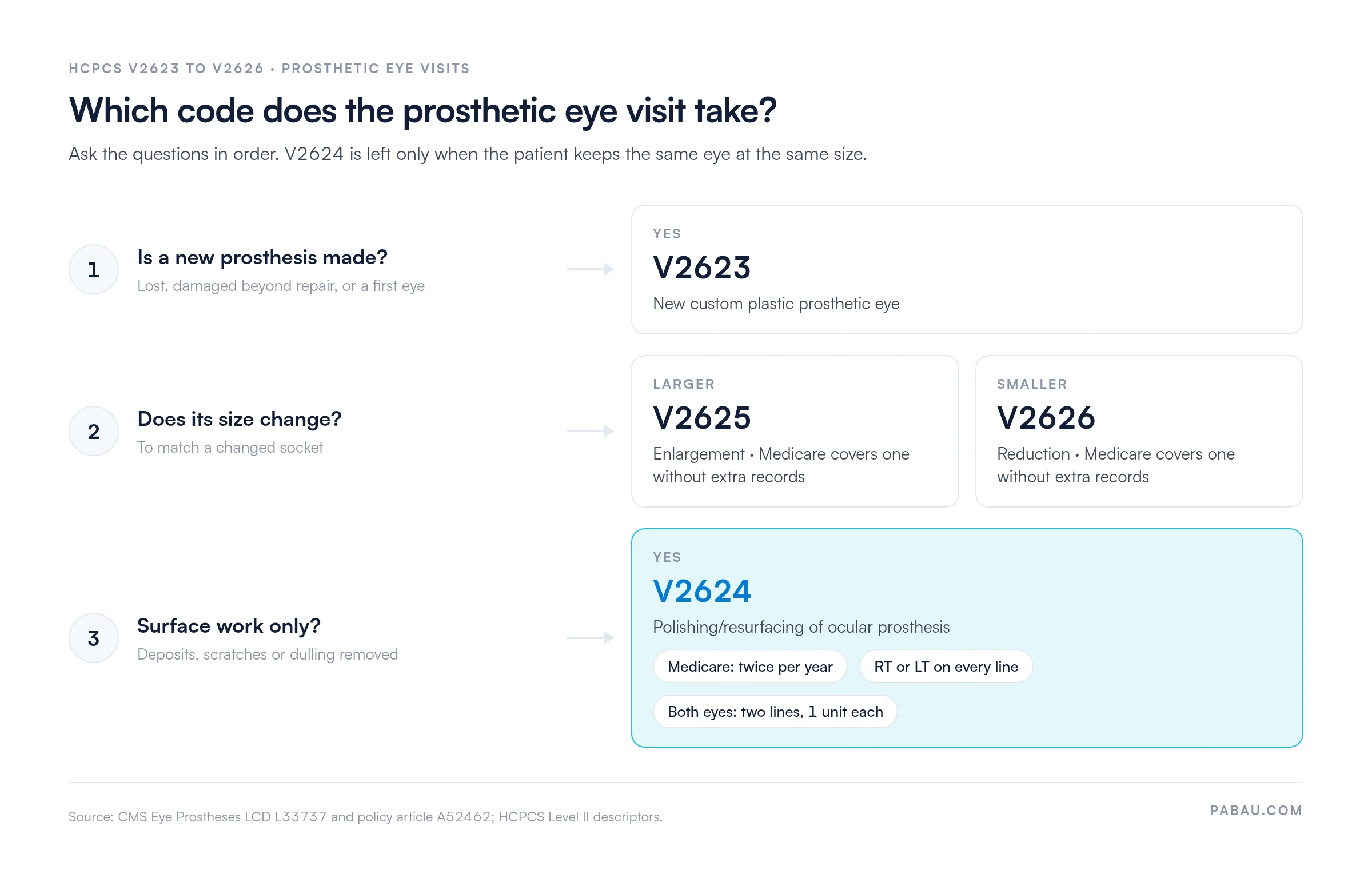
The table below maps common visits to the code each one takes.
Book the next polishing visit before the patient leaves, and set it at least six months out for Medicare patients. A booked return date keeps each eye inside the twice-a-year limit and gives the patient a reason to come back.
Ocularists and eye practices bill V2624 on a repeat cycle, so the key fact is when each eye was last polished. When that date sits in a paper chart, a claim inside the frequency limit is easy to send by mistake.
Pabau, a practice management platform with insurance billing, keeps each visit, note and claim on the patient’s record. Your team can see past polishing visits before booking the next one. In the US, Pabau sends CMS-1500 claims through the Claim.MD clearinghouse and runs eligibility checks before the visit.
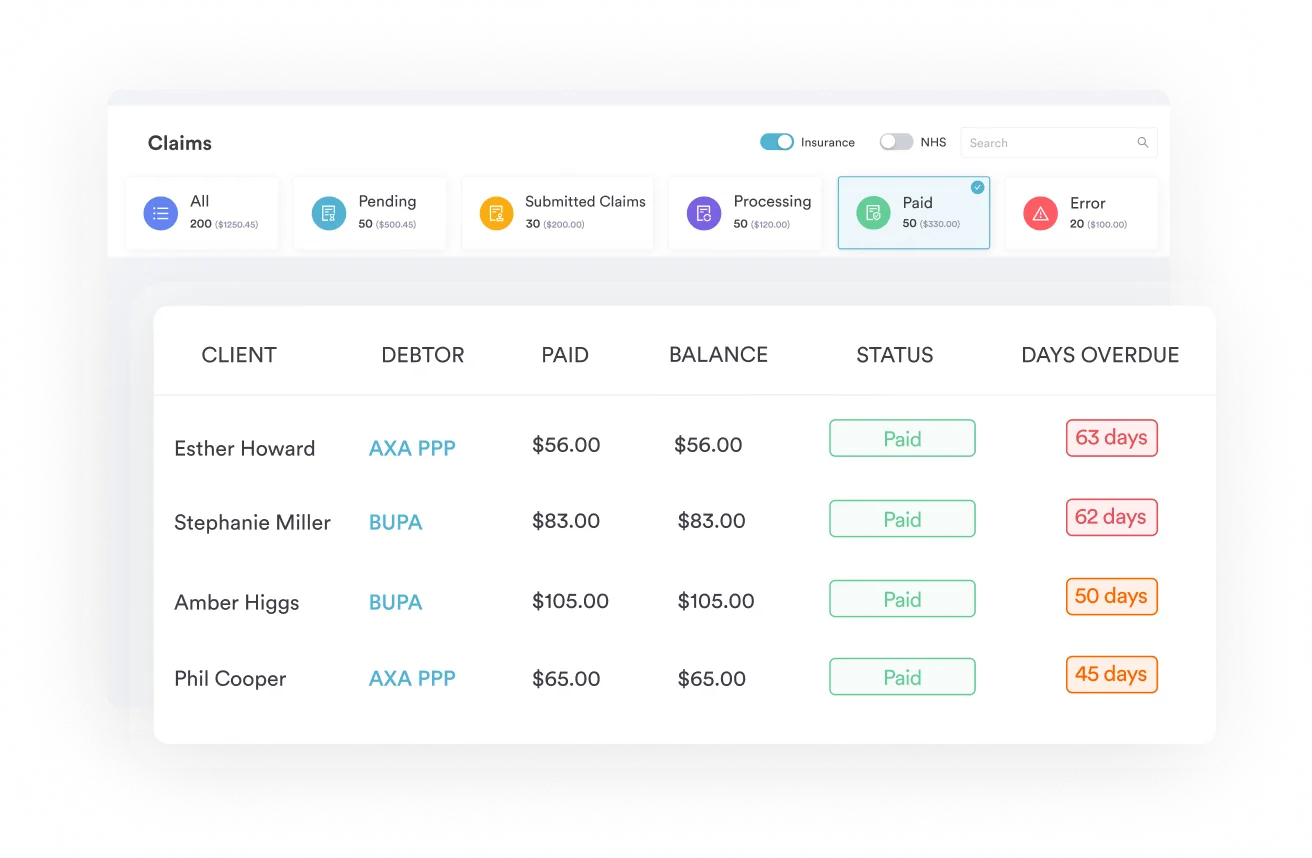
Remittances come back into Pabau, so a rejected line is visible next to the visit that produced it. See how claims management software handles the full cycle from claim to payment.

Pabau keeps each visit, note and claim on the patient’s record and sends US claims through Claim.MD. See how it fits your practice.

V2624 pays reliably when the claim describes maintenance on an eye the patient already wears. Check the last polishing date for that eye, add the right side modifier and pair it with Z97.0.
If a new eye or a size change is needed, move to V2623, V2625 or V2626 instead. To see how Pabau keeps polishing dates, orders and claims together, book a demo.

Billing a new prosthetic eye? HCPCS code V2623 covers fabrication of a custom plastic prosthetic eye.
Enlarging the prosthesis? HCPCS code V2625 explains enlargement of an ocular prosthesis and its Medicare limit.
Reducing the prosthesis? HCPCS code V2626 covers reduction of an ocular prosthesis for a smaller socket.
Chasing a denied claim? Denial management in healthcare walks through appeals and how to track denial patterns by payer.
HCPCS code V2624 covers polishing and resurfacing of an ocular prosthesis the patient already wears. The ocularist removes deposits and scratches and restores a smooth finish. It does not cover a new prosthetic eye, which is billed as V2623.
No. V2624 is a maintenance code for polishing and resurfacing an existing prosthesis. HCPCS has no separate code for a custom glass eye. A new custom plastic eye is V2623, and other types fall under V2629.
Medicare pays for V2624 twice per year under the Eye Prostheses LCD (L33737). Medicaid programs and commercial plans set their own limits, so check the patient’s plan before booking.
V2623 is a new custom plastic prosthetic eye, and V2624 is polishing or resurfacing of an existing one. Bill V2623 when a replacement is made and V2624 when the current eye only needs maintenance.
Every V2624 claim line needs RT or LT for the eye treated. For both eyes, bill two lines with RT and LT and 1 unit each. Add GA only when a signed Advance Beneficiary Notice is on file.
Z97.0, presence of artificial eye, is the usual pairing for routine polishing. Use Z44.21 or Z44.22 when the visit includes fitting or adjustment, and do not report Z44.2- with Z97.0.
Keep the standard written order, the diagnosis, the eye treated and the surface findings. Record the work performed, the last polishing date for that eye and proof of delivery.
Bill V2625 when the prosthesis is enlarged and V2626 when it is reduced to fit a changed socket. V2624 is only for surface work on a prosthesis that still fits.




