CCSD Code H3334: Low anterior resection billing guide
CCSD Code H3334: Definition and clinical scope CCSD Code H3334 covers an open an...

Last Updated: Oct 16, 2026
V2762 is the HCPCS Level II code for polarization, any lens material, per lens. It covers the polarizing filter added to a prescription lens. Each lens is one unit, billed on top of the separate base lens code.
V2762 sits in the V2700-V2799 vision services range alongside tint, UV, and anti-reflective add-ons. Medicare Part B excludes it as routine vision, so Medicare claims carry modifier GY with no ABN required. Commercial and vision benefit plans set their own coverage and allowables.
Let Pabau's smart automation suggest the right codes, reduce claim denials, and keep your practice compliant—effortlessly.
Automate repetitive tasks and focus on what matters most—your patients.
Reduce coding errors and ensure compliance with the latest regulations.
Clean claims, fewer denials, and faster reimbursements.
Powerful insights and reporting to help your practice thrive.
HIPAA compliant SOC 2 certified GDPR-compliant Trusted by 4,000+ clinics worldwide

V2762 covers polarization on any lens material and is billed per lens, not per pair.
Medicare Part B excludes routine vision under Section 1862(a)(7), so no ABN is required and Medicare claims carry modifier GY.
Missing or misapplied modifiers, especially EY and GY, cause many V2762 claim denials.
Pabau, the practice management platform we build, submits, tracks, and validates claims through clearinghouse integrations before they reach the payer.
HCPCS Code V2762 is an add-on vision services code whose official descriptor reads: Polarization, any lens material, per lens. It is billed per lens on top of the separate base lens code, and Medicare Part B excludes it as routine vision. Three elements in the descriptor drive billing decisions.
V2762 is maintained by the Centers for Medicare and Medicaid Services (CMS) HCPCS Workgroup, which issues annual updates to the HCPCS Level II code set. The descriptor has been stable in its current form. Still, verify the effective date against the current CMS HCPCS release before applying it to a new year’s claims.
Coverage criteria for V2762 are narrow by design. The code captures only the polarization treatment itself. The base lens, frame, and every other treatment on the order are coded separately.
A polarized lens ordered with an anti-reflective coating requires both V2762 and V2750, each billed per lens. Payers expect each add-on on its own line, so never fold the coating into the V2762 line.
The V2700-V2799 block covers lens treatments and modifications that sit on top of a base lens. V2762 occupies a specific position within that range alongside other add-on codes that coders often conflate.
V2744 (photochromic tint) is the code most often confused with V2762. Both change how the lens handles light. Photochromic lenses darken in UV light, while polarization blocks reflected glare. The two can be applied to the same lens, but check the payer’s stacking rules before submitting.
Billing HCPCS Code V2762 correctly requires matching documentation to the claim before submission. Skipping any of the six steps below invites a denial. A structured medical billing workflow flags add-on code requirements at the point of dispensing, before end-of-day batch processing.
Run a pre-submission audit on every V2762 line. Confirm the unit count matches the lens count and check the modifier against the payer’s rules. Then verify the base lens code appears on the same claim. Catching these three items before transmission prevents the most common V2762 rejections.
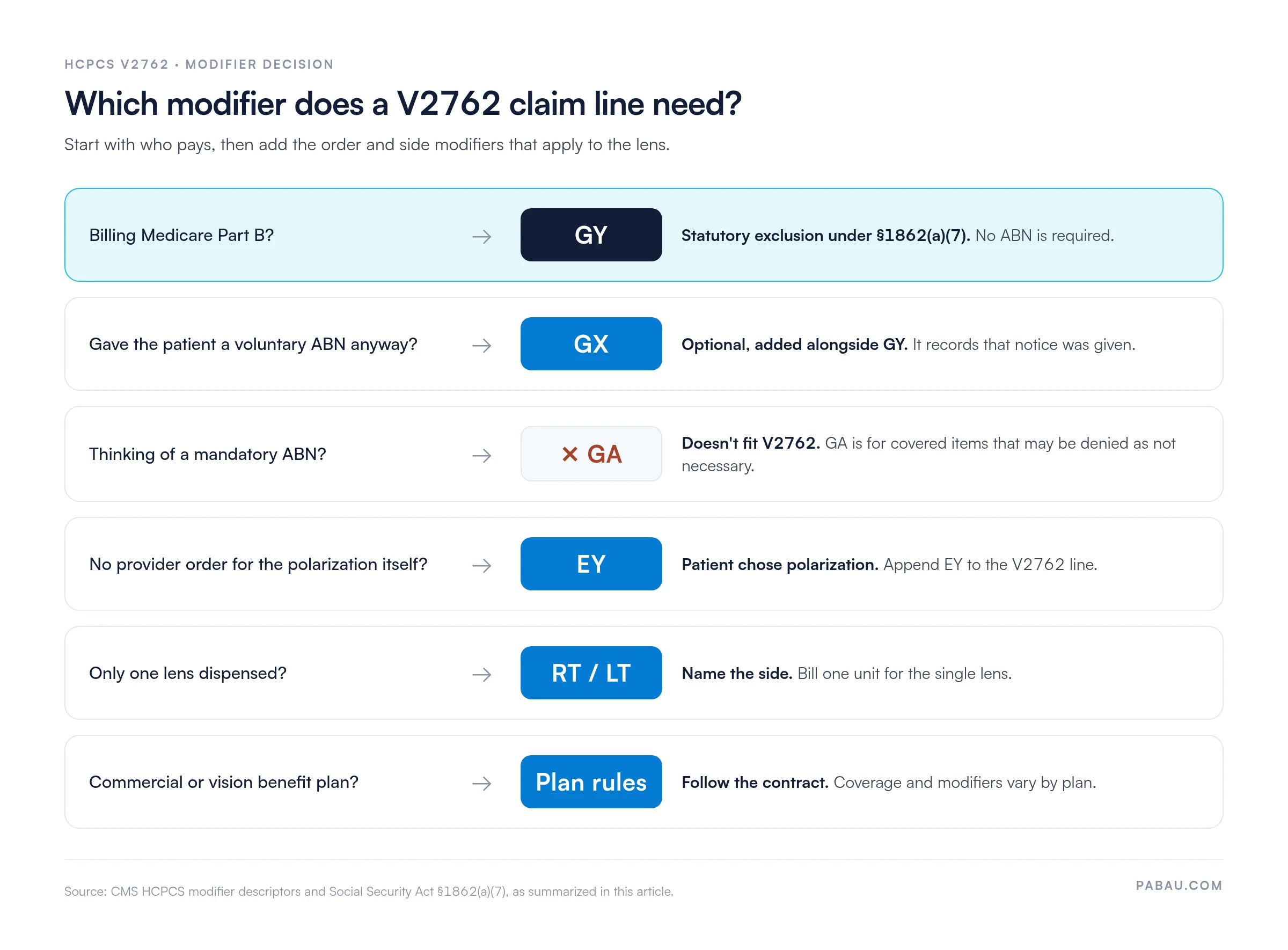
Modifier EY signals that no physician order exists for the item or service billed. For V2762, the question is whether the prescribing provider specifically ordered polarized lenses or whether the patient (or dispenser) elected polarization independently.
When the polarization choice is patient-driven with no provider order, EY must appear on the claim line. Leaving it off when it applies causes a denial you could have prevented.
Medicare treats polarization as a statutory exclusion, so GY is the modifier that fits a V2762 claim to Medicare. No Advance Beneficiary Notice (ABN) is required. You can still give a voluntary ABN to set expectations, and then report GX alongside GY.
GA belongs to a mandatory ABN for a covered item that Medicare may deny as not reasonable and necessary, so it doesn’t fit V2762. Verify EY against current CMS guidance and the payer’s local coverage determination (LCD) before each submission. The chart below maps each billing situation to its modifier.
Medicare does not reimburse V2762 under Part B because polarized lenses are classified as a routine vision benefit, which Medicare Part B excludes. The reimbursement question for V2762 therefore falls almost entirely to private payers and Medicaid managed care plans. Rates vary significantly by contract.
To check fee schedule applicability for V2762 in your jurisdiction, start with the CMS Physician Fee Schedule lookup tool. The annual CMS HCPCS release files are the other official reference. Always verify rates against your current payer contracts, because published national averages rarely match contracted allowables.
V2762 denials cluster around a small set of recurring errors. Most are preventable with a pre-submission checklist. Denial management in healthcare starts with recognizing these patterns before claims leave your practice management system.
Several V2700-range codes describe lens treatments that sit close to polarization but serve different functions and bill under different rules. HCPCS lookup tools list each code in isolation, so the table below sets the distinctions side by side as they matter on a claim.
The V2744 mix-up deserves a closer look. Many coders see “tint” in the V2744 descriptor and assume a polarized lens, which looks tinted, belongs there. It doesn’t. V2744 covers photochromic tint only, and a solid or gradient tint is V2745.
A non-photochromic polarized lens with a tinted appearance is coded V2762, not V2744. Submitting V2744 for it creates a descriptor mismatch that triggers denial on clinical review. To confirm the current descriptor before coding, check the AAPC HCPCS code lookup or the PGM Billing HCPCS lookup tool.
Build a laminated quick-reference card for your dispensing counter listing V2744, V2745, V2750, V2755, V2762, and V2782 with a one-line distinction between each. Opticians who select lens treatments before sending orders to billing prevent most code-confusion denials at the source.
Medicare Part B excludes routine vision services under Section 1862(a)(7) of the Social Security Act. Polarized lenses billed under V2762 fall within this exclusion. Medicare treats them as a comfort or convenience enhancement rather than a treatment for a medical condition. This applies regardless of the patient’s diagnosis or the lens material used.
Because the exclusion is statutory, practices don’t need an Advance Beneficiary Notice of Noncoverage before dispensing polarized lenses to Medicare Part B beneficiaries. Report V2762 with modifier GY. Medicare then denies the line as excluded, and the patient is responsible for the cost.
A voluntary ABN is optional, and if you give one, add GX alongside GY. It still helps the patient conversation, because it sets out the cost in writing before the lenses are ordered. Sound medical billing compliance means filing any signed notice with the dispensing encounter in the patient record.
Many optical billing teams check V2762 lines by hand. Someone matches the unit count to the lens order, confirms the base lens code, and picks the Medicare modifier. When one slips, the rejection comes back days later and the claim has to be reworked and resubmitted.
Pabau, the practice management platform we build, moves that follow-up into one place. Its centralized claims management submits and tracks claims through clearinghouse integrations. Each claim is validated before it goes out, so a missing membership number or authorization code is caught at your desk.
Your team sees every claim’s status on one screen, so a rejected V2762 line gets corrected and resent quickly. Your billers keep the coding decisions, while submission and follow-up run from one workflow.

Pabau’s claims management submits, tracks, and validates claims through clearinghouse integrations. Your optical billing team catches a missing membership number or authorization code before a V2762 claim goes out.

V2762 rejections usually start at the dispensing counter, where the lens order is first recorded. Fix the order form so it captures lens count, base material, and every add-on, and your billers code from a complete record.
For Medicare patients, settle the cost conversation before the frames are fitted. No ABN is required for this exclusion, but a clear word about out-of-pocket cost prevents a dispute when the bill arrives.
The trade-off is a few extra fields at dispensing in exchange for fewer reworked claims. Book a demo to see how Pabau keeps your vision claims moving from submission to payment.

Want to reduce claim rejections across all code types? Submitting a clean claim walks through the documentation and formatting requirements that prevent rejections before they reach the payer’s adjudication system.
Dispensing a high-index polarized lens? HCPCS code V2782 explains how the high-index lens code is billed alongside V2762.
HCPCS Code V2762 is the billing code for polarization applied to any lens material, billed per lens. Optical shops and optometry practices use it to bill the polarization added to a base prescription lens, separate from frames, tints, or coatings.
Modifier EY is appended to V2762 when no physician or qualified non-physician practitioner has specifically ordered the polarization. It signals that the patient elected polarization independently and no provider order exists for that specific item or service.
No. Medicare Part B excludes routine vision services under Section 1862(a)(7) of the Social Security Act, and polarized lenses fall within that exclusion. No ABN is required, so report V2762 with modifier GY. A voluntary ABN is optional, and if you give one, add GX alongside GY.
V2744 covers photochromic tint, which darkens in UV light. V2755 covers UV-blocking lenses, and V2762 covers polarization filters that reduce reflected glare. All three can be applied to the same lens and billed as separate add-on lines, each per lens.
The most frequent causes are a missing EY modifier, one unit billed for a pair, and V2762 folded into the base lens code. Medicare Part B claims also fail without modifier GY, and some commercial plans treat polarization as cosmetic. A pre-submission checklist catches each of these.
Most commercial payers and vision benefit plans (VSP, EyeMed, Spectera) accept V2762; Medicare Part B does not. Medicare Advantage plans vary by individual plan. Medicaid coverage depends on the state. Verify coverage in the relevant payer contract, provider portal, or Evidence of Coverage document before dispensing.