CPT code 90473: Nasal and oral vaccine billing guide
CPT code 90473 covers one nasal or oral vaccine per visit CPT code 90473 reports...

Last Updated: Oct 16, 2026
V2745 is the HCPCS Level II code for addition to lens; tint, any color, solid, gradient or equal, excludes photochromatic, any lens material, per lens.
It's billed per lens alongside a separately billed base lens code, and photochromatic tints go to V2744 instead. Medicare pays it only when the treating practitioner documents medical necessity and the base lens itself qualifies for coverage.
Let Pabau's smart automation suggest the right codes, reduce claim denials, and keep your practice compliant—effortlessly.
Automate repetitive tasks and focus on what matters most—your patients.
Reduce coding errors and ensure compliance with the latest regulations.
Clean claims, fewer denials, and faster reimbursements.
Powerful insights and reporting to help your practice thrive.
HIPAA compliant SOC 2 certified GDPR-compliant Trusted by 4,000+ clinics worldwide

HCPCS Code V2745 is a per-lens add-on for a solid or gradient tint in any color, on any lens material.
Photochromatic tints are excluded from V2745 and billed under V2744 instead.
V2745 never stands alone, so it must sit on the same claim as a separately billed base lens code.
Medicare covers the tint only when medical necessity is documented, and tinted lenses used as sunglasses are denied as noncovered.
Pabau’s claims management software helps practices pair V2745 with its base lens, units, and modifiers before submission.
HCPCS Code V2745 is the Level II code for a lens tint in any color, solid or gradient, on any lens material, billed per lens. It is an add-on, so it always rides on a separately billed base lens code for the spectacle or contact lens being tinted.
The code sits in the V-code range that the Centers for Medicare and Medicaid Services, or CMS, maintains for vision services. Photochromatic tints that darken in ultraviolet light are excluded by the descriptor itself and belong under V2744.
The most common V2745 error is treating it as a stand-alone or catch-all code. It describes one feature of a lens, so the claim also needs the lens it was added to. For how an add-on line moves from charge entry to payment, see this overview of medical billing.
V2745 covers the tint applied to a lens, not the lens itself. One unit equals one tinted lens, whatever the color, density, or lens material.
Key rule: V2745 is never a catch-all for vision supplies. If the item is not a fixed tint on a lens, another code applies. Billing V2745 for photochromatic lenses misstates the item and invites a denial.
V2745 has no diagnosis of its own. The ICD-10 codes on the claim must justify two things: the base lens, and the clinical need for a tint on that lens.
For Medicare, the base lens question comes first. The CMS refractive lenses policy article A52499 covers lenses only for pseudophakia, aphakia, and congenital aphakia. Without one of those diagnoses, Medicare denies the base lens and the tint with it.
Flag: a light-sensitivity diagnosis supports the tint, but it cannot rescue a base lens Medicare does not cover. Those condition codes matter most for commercial plans and state Medicaid programs with their own tint criteria.
The record has to show why this patient needs a tinted lens rather than a clear one. Thorough records also support medical billing compliance during retrospective audits.
The following elements should appear in the patient record before the claim is submitted:
Common documentation miss: the prescription names the tint, but no note explains why it is medically needed. Without that note, a tint looks like a patient preference, and payers treat it that way.
Medicare covers a V2745 tint only when the treating practitioner documents medical necessity and the base lens qualifies under the prosthetic lens benefit. Under A52499, tinted lenses used as sunglasses, prescribed on top of regular lenses for a pseudophakic patient, are denied as noncovered.
V2745 claims go to your jurisdiction’s DME Medicare Administrative Contractor, or DME MAC. Payment follows the CMS DMEPOS fee schedule, which updates every year.
Important: never quote a V2745 payment amount to patients or staff without checking the current-year DMEPOS file. Rates change each January 1.
Before billing V2745 to Medicare, check two points. First, confirm the base lens has a covered aphakia or pseudophakia diagnosis. Second, confirm the chart explains why a fixed tint is needed and that the lenses are not sunglasses. That two-minute check prevents the most common Medicare denials for this code.
Commercial vision plans such as VSP, EyeMed, and Spectera usually treat a tint as a lens option under the materials benefit. The member often pays a set copay or the amount above an allowance. Medical plans apply the same medical-necessity test Medicare uses.
Practical note: treat the table as a starting framework, not a policy reference. Confirm tint coverage at eligibility verification for every patient.
V2745 sits among several per-lens add-ons that describe different lens features. A lens can carry more than one, as long as each feature was dispensed and documented. Each one still rides on a base lens code, so an oversize lens billed as V2780 needs that base line too.
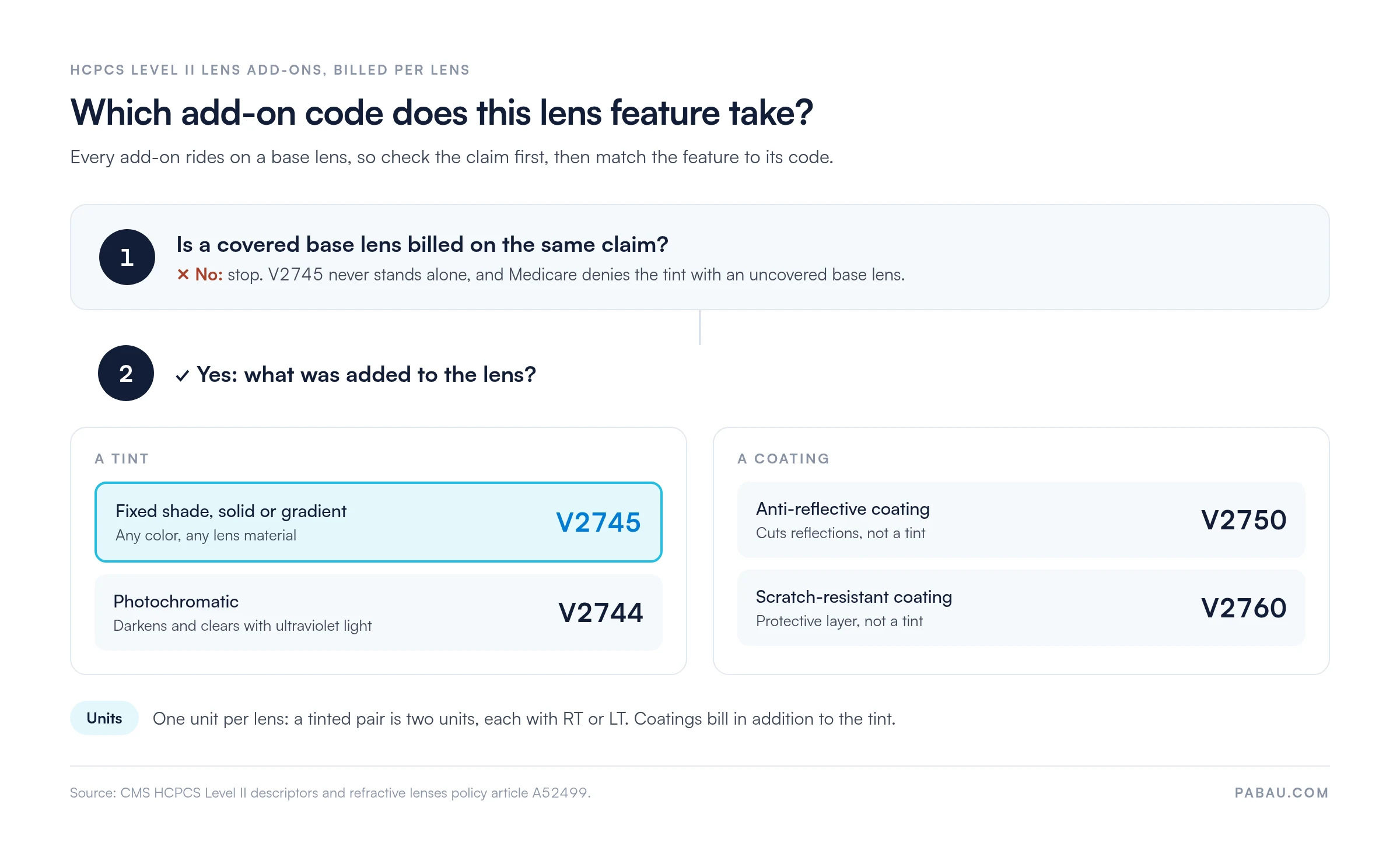
Decision rule: if the lens changes shade with light, bill V2744. If the shade is fixed, bill V2745. Coatings such as V2750 are billed in addition to the tint, each with its own documentation. Older tint codes such as V2742 are deleted, so a fixed tint on any lens material now goes to V2745.
The diagram below puts the base lens check and the four per-lens add-ons in the order a coder meets them on the claim.
V2745 denials follow predictable patterns, and most are cheaper to prevent than to appeal. The table draws on Medicare lens policy and guidance on denial management in healthcare. For the remittance codes themselves, see this list of common medical billing denial codes.
Set up a lens add-on rule in your practice management system. Any V2745 line without a base lens code on the same claim should be held for review. A 60-second check at submission prevents a multi-week denial cycle.
Accurate V2745 billing depends on the claim line matching the lens order. The tint, base lens, units, and modifiers must all agree with what was dispensed.
In Pabau, the practice management platform we build, billing staff attach V2745 to the encounter with its claims management software. They link the supporting ICD-10 codes and append modifiers inside the same claim workflow. Required fields are validated before transmission, so a tint line without its base lens is caught at the desk.

When entering V2745, confirm these claim fields are populated correctly:
Practices that dispense many tinted lenses can save a claim template that pairs V2745 with its usual base lens codes. That cuts data entry and stops the add-on from going out alone.

Pabau’s claims management software pairs lens add-on codes like V2745 with their base lens, units, and modifiers. Catch tint coding errors before they reach the payer.

HCPCS Code V2745 pays for a fixed tint on a lens, so it only works when the lens itself is covered and on the claim. Treat it as one feature of a lens order, and the coding decisions follow from what was dispensed.
Pabau’s claims management tools give optical and ophthalmic practices a claim workflow that validates code, diagnosis, and modifier fields before transmission. To see how it handles lens add-on billing, book a demo.

Billing polarized sunglasses alongside a tint? HCPCS code V2762 covers polarization per lens, which payers treat as a separate add-on from a solid or gradient tint.
Patient asked for a mirrored finish over the tint? HCPCS code V2761 explains how mirror coating is billed and documented per lens.
Adding a protective coating to the same lens order? HCPCS code V2760 sets out when scratch-resistant coating is billable and when plans bundle it.
Not sure whether an optical extra has its own code? HCPCS code V2797 covers vision supplies that are a component of another HCPCS vision code.
V2745 covers a solid or gradient tint in any color, added to a lens of any material, billed per lens. It excludes photochromatic tints, which are billed under V2744.
No. V2745 describes one specific lens feature, a fixed tint. Contact lenses with no specific code go to V2599, and other vision items go to V2799.
Medicare covers the tint only when the treating practitioner documents medical necessity and the base lens is covered. Tinted lenses used as sunglasses, prescribed in addition to regular lenses, are denied as noncovered.
For Medicare, the base lens needs a pseudophakia or aphakia diagnosis such as Z96.1, H27.00-H27.03, or Q12.3. Light-sensitivity diagnoses such as photophobia or albinism document why the tint is needed.
V2744 is for photochromatic lenses that darken in ultraviolet light. V2745 is for a fixed solid or gradient tint that does not change. Billing the wrong one misstates the lens dispensed.
Bill one unit per tinted lens. A tinted pair is two units, with each lens identified by the RT or LT modifier.
Common reasons are a missing base lens on the claim, no documented medical necessity, sunglasses use, and missing KX, GA, GZ, RT, or LT modifiers. Billing photochromatic lenses as V2745 is another frequent cause.