CPT Code 51705: Change of cystostomy tube, simple
CPT Code 51705 at a glance CPT Code 51705 reports a simple change of a cystostom...

Last Updated: Oct 16, 2026
HCPCS Code V2741 is a deleted vision code. CMS retired it with the rest of the V2740 to V2743 tint family, effective for dates of service from January 1, 2004. A tinted lens is billed today with V2745, one unit per lens, or with V2744 when the lens is photochromic.
A claim line that still carries V2741 denies as an invalid code. Recode the line to V2745 or V2744, keep one unit per lens, and resubmit it as a corrected claim.

HCPCS Code V2741 was deleted for dates of service on or after January 1, 2004, with the rest of the V2740 to V2743 tint codes.
Bill a solid or gradient tint of any color, on any lens material, with V2745, one unit per lens.
Bill a photochromic lens with V2744, and never add V2745 to the same lens.
Medicare excludes routine eyeglasses, so it covers a tint only on lenses covered after cataract surgery, with medical need documented.
Remove V2741 from charge masters and superbill templates, because any claim line carrying it denies as an invalid code.
HCPCS Code V2741 sat in the V2700–V2799 range of the CMS HCPCS Level II code set, which holds lens additions and other vision supplies. It was one of four tint codes, V2740 to V2743, that split tint billing by lens material and tint color.
CMS deleted all four codes effective January 1, 2004, and V2741 has not been reinstated. Current references, such as the AAPC deleted-code entry for V2741, list it without its original descriptor. This guide does not quote one, because no date of service after 2003 can carry the code anyway.
Before 2004, the tint code changed with the lens material and the tint color. A coder needed the lab order to choose between four codes for what was, clinically, the same addition to a lens.
From January 1, 2004, CMS folded the family into V2745. Its descriptor covers any tint color, solid or gradient, on any lens material. The one coding decision left is whether the lens is photochromic, which moves it to V2744, as the diagram below shows.
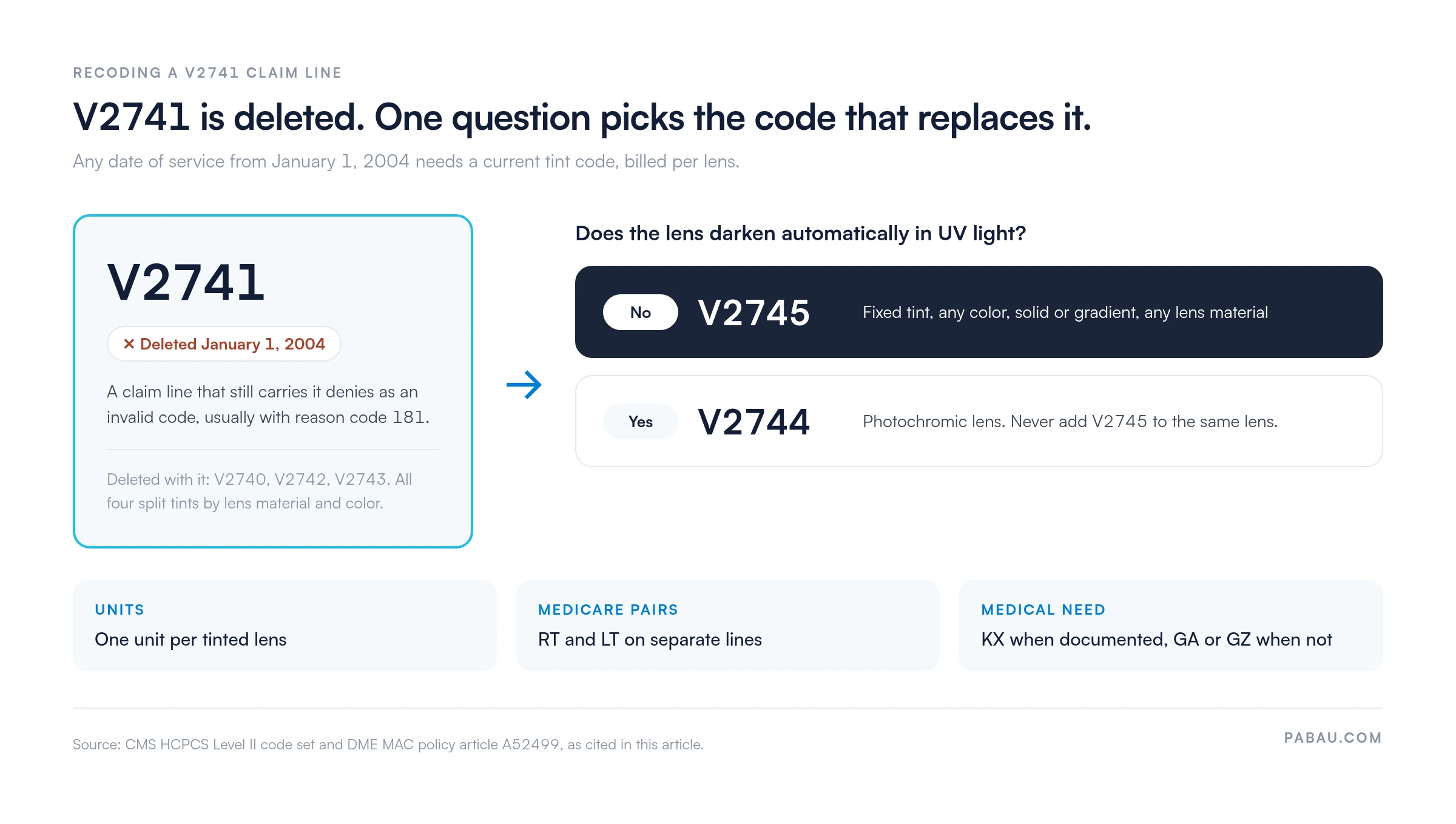
Some older billing guides describe V2741 as a gradient or variable tint code. No active code is reserved for gradient tints. A gradient tint is billed with V2745, exactly like a solid tint of any color.
A code deleted more than two decades ago survives in files that are rarely reopened. Typical sources are an inherited charge master, an old superbill template, or an optical price list copied from one system to the next.
When the line reaches the payer, it denies because the code was invalid on the date of service, usually with claim adjustment reason code 181. The fix is to replace V2741 with V2745, or with V2744 for a photochromic lens, and send a corrected claim.
Search your fee schedule and superbill templates for V2740, V2741, V2742 and V2743 each year when the annual HCPCS update lands. Map every hit to V2745 so a deleted tint code never reaches a claim.
Choose the tint code by how the lens behaves in light. A fixed tint of any color, solid or gradient, is V2745. A lens that darkens automatically in UV light is V2744.
V2760 describes a scratch-resistant coating only, never a tint. V2780 is an oversize lens, per lens, which is a separate addition from any tint or coating.
V2745 is an addition to a lens, so it always travels with a base lens code on the same claim. These rules apply to every tint line.
A bilateral single vision pair with a medically necessary fixed tint looks like this on a Medicare claim.
Swap V2745 for V2744 on lines 3 and 4 if the patient chose photochromic lenses. Where the tint lacks documented medical need, drop KX and add GA or GZ instead.
Medicare excludes routine eye care. The CMS Benefit Policy Manual, Chapter 16, §90 lists eyeglasses, contact lenses and routine eye exams among the routine services Medicare does not pay for.
The exception is lenses after cataract surgery. Chapter 15 of the same manual treats these lenses as a prosthetic device. It covers one pair of eyeglasses or contact lenses after each cataract surgery with an intraocular lens.
A tint on those lenses is covered only when it is medically necessary and the treating practitioner documents why. The DME MAC Refractive Lenses policy article (A52499) sets out those conditions, including the KX modifier.
For Medicare, the lens diagnosis comes first, because a tint cannot be covered on a lens that is not. Medicare Advantage plans, commercial vision plans and state Medicaid programs set their own tint benefits. Check the patient’s tint benefit before the order goes to the lab.
A tint line survives review when the chart explains why the patient needs it. Keep these records for every tinted lens you bill.
The tint line sits alongside the base lens and frame codes below. For the tint and coating additions themselves, see the comparison table above.
Tint denials follow a short list of causes. The denial reason codes on the remittance tell you which one you are dealing with.
Most of these denials can be caught at charge entry. The code check and the RT/LT split take seconds there, while a denied line waits for a corrected claim and another payment cycle.
In many practices, the tint prescription, the chart note and the fee schedule sit in separate systems. A price list copied forward from year to year is how a code deleted in 2004 still reaches a claim.
Pabau, the practice management platform we build, keeps the prescription, the chart note and the invoice on one patient timeline. Its claims management software submits claims from that record and tracks each one after it goes out. The biller enters the tint line with the note that explains it on the same screen.
The outcome is less rekeying between systems and a clear view of which tint claims are still open.

Pabau keeps prescriptions, chart notes and claims on one patient timeline, then submits each claim and tracks its status. See how it fits your practice.

V2741 has been gone since 2004, and V2745 now covers the tints its code family once split by material and color. The work left is removing the old code from every template your practice bills from.
After that, a tint claim pays on three checks. Confirm whether the tint is fixed or photochromic, split the lenses by side, and document why the patient needs the tint.
Pabau keeps the prescription, the note and the claim together, then submits and tracks the claim. To see how it handles optical billing, book a demo.

Need a broader overview of medical billing fundamentals? What is medical billing explains the end-to-end claims process for practice billing teams.
Dealing with a high volume of optical claim denials? Denial management in healthcare covers systematic approaches to reducing denial rates and improving first-pass rates.
Want to understand clean claim requirements before submission? Clean claim essentials outlines the data elements that must be correct for a claim to process without edits.
Billing the tint that replaced V2741? HCPCS code V2745 explains how to bill a fixed tint of any color, one unit per lens.
Adding an oversize lens to the same order? HCPCS code V2780 explains when an oversize lens is billed and what Medicare needs to see.
No. V2741 was deleted for dates of service on or after January 1, 2004, and it has not been reinstated. A claim line carrying it today denies as an invalid code.
V2745 replaced it: addition to lens; tint, any color, solid, gradient or equal, excludes photochromatic, any lens material, per lens. Bill one unit for each tinted lens.
No. A gradient tint is billed with V2745, the same code as a solid tint of any color. No active code is reserved for gradient tints alone.
Use V2744, tint, photochromatic, per lens. Do not add V2745 to the same lens, because the V2745 descriptor excludes photochromatic tints.
Medicare excludes routine eyeglasses under Chapter 16, section 90 of its Benefit Policy Manual. A tint is covered only on lenses Medicare already covers, usually after cataract surgery, with medical need documented and KX added.
V2745 is a tint, V2760 is a scratch-resistant coating and V2780 is an oversize lens, each billed per lens. Neither V2760 nor V2780 describes a tint.
Bill two units, one per lens. For Medicare, report each lens on its own claim line with RT or LT and one unit.