CPT Code 19499: Unlisted breast procedure
What is CPT code 19499? CPT code 19499 is the unlisted procedure code for the br...

Last Updated: Oct 16, 2026
V2215 is the HCPCS Level II code for lenticular (myodisc), per lens, bifocal. It covers one high-minus bifocal spectacle lens with a myodisc design, so a pair is billed as two units.
Coders most often confuse it with V2115, the single-vision myodisc code, and V2315, its trifocal counterpart. All three share the same lens design, so the focal segment count on the lab order decides the code. V2221 is another near miss, because it describes a bifocal lenticular lens with no myodisc specification.
Let Pabau's smart automation suggest the right codes, reduce claim denials, and keep your practice compliant—effortlessly.
Automate repetitive tasks and focus on what matters most—your patients.
Reduce coding errors and ensure compliance with the latest regulations.
Clean claims, fewer denials, and faster reimbursements.
Powerful insights and reporting to help your practice thrive.
HIPAA compliant SOC 2 certified GDPR-compliant Trusted by 4,000+ clinics worldwide

V2215 describes one lenticular (myodisc) bifocal spectacle lens, billed per lens rather than per pair.
Use V2215 only when the lab order specifies a myodisc design and the prescription includes a bifocal segment.
Most V2215 claims are for high myopia (H52.1x) and go to vision, Medicaid, or commercial plans.
Medicare covers V2215 only in the uncommon post-cataract case where the patient still needs high-minus correction.
Practice management software like Pabau keeps the prescription, lens order, and claim in one patient record, so billers can check the lens design before coding.
HCPCS Code V2215 is the Level II code for one lenticular (myodisc) bifocal spectacle lens, billed per lens. Its official descriptor reads Lenticular (myodisc), per lens, bifocal.
The code is active and valid for 2026. Its descriptor and category have not changed since it was added to the V-series ophthalmic supply range. You can verify current status at any time through the AAPC HCPCS code lookup or the CMS HCPCS Level II code files.
V2215 belongs to the HCPCS Level II V-series, which covers spectacle lenses, contact lenses, and low-vision aids. These fall under the DMEPOS (Durable Medical Equipment, Prosthetics, Orthotics and Supplies) benefit.
CMS updates the V-series every year, so check the CMS HCPCS Level II annual update file to confirm the code carries forward unchanged.
V2215 covers exactly one bifocal spectacle lens built in a lenticular (myodisc) design. It is dispensed for a patient whose spherical correction is too high for a standard full-aperture lens blank. The myodisc design concentrates the optical correction in a smaller central disc, reducing edge thickness and weight for high-minus prescriptions.
High-plus prescriptions, such as aphakic ones, use a separate plus-lenticular design. A “bifocal” segment (near addition) must be present. A single-vision lenticular lens for the same patient takes V2115 instead.
Five codes sit close to V2215 in the V-series, and they split on three points: lens design, number of focal segments, and optical purpose. Many billers pick a code because the order mentions “a lenticular lens.” Skipping the check on design and segment count is the most common reason V2215 claims are returned.
The table below shows the decisive split, and the diagram after it turns that split into two questions to ask of the lab order.
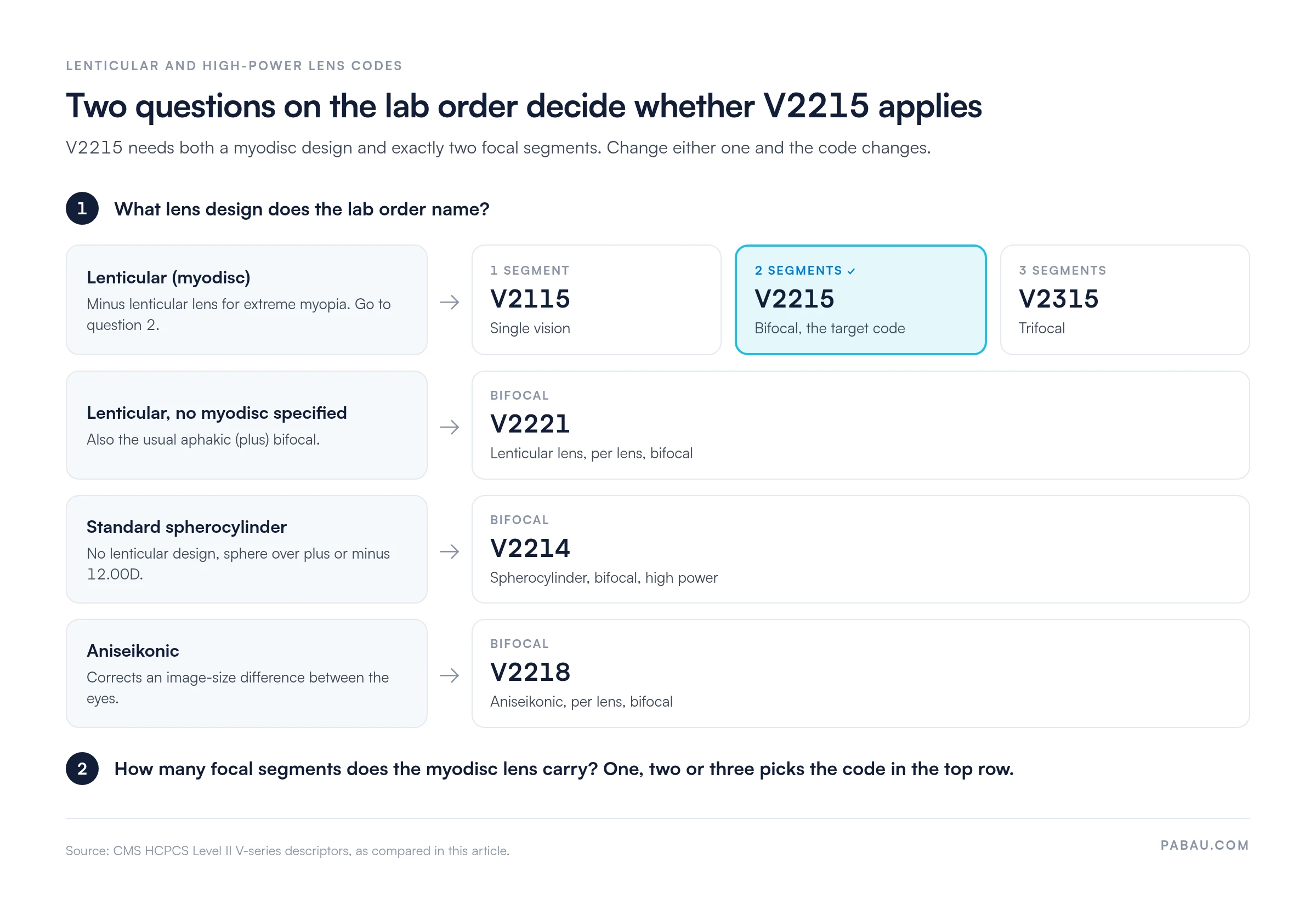
V2221 is the closest neighbor, because it is the other lenticular bifocal code. V2215 applies only when the lab order specifies a myodisc design. A lenticular bifocal ordered without that specification takes V2221.
V2221 is also the usual code for an aphakic bifocal, which needs plus lenticular power. V2214 covers a high-power bifocal made as a standard spherocylinder lens, with no lenticular design at all. Outside those five, V2430 covers a full-field bifocal made with a variable aspheric surface, with no lenticular design.
V2218 is bifocal too, but it is not a lenticular code. It corrects aniseikonia, a condition where the brain perceives two images of different sizes due to unequal magnification between the eyes. The lens design addresses that size difference rather than extreme refractive error.
If the dispensing note describes a myodisc design for high myopia, V2215 applies. If it describes size-equalization optics, V2218 is correct.
V2215 is billed per lens. Dispensing a pair means submitting the code twice on separate claim lines, each with quantity 1, or on one line with quantity 2. The most common unit error is entering a quantity of 1 for a pair. That underbills the claim and can lead to a secondary denial when the patient expects full coverage.
Before submitting a V2215 claim, confirm the dispensing provider is enrolled with the payer as an optical supplier or a DMEPOS supplier. Claims from non-enrolled providers are denied regardless of clinical appropriateness. Medical claims management software that checks required claim details before submission catches missing fields. Enrollment status still has to be confirmed with the payer directly.
Medicare excludes routine vision care from Part B coverage. Routine vision covers the refraction, eyeglass dispensing, and related optical supplies a beneficiary receives for ordinary refractive error. V2215 claims submitted for a standard high-myopia prescription, without a qualifying covered condition, are denied under this exclusion. Whether Medicare pays depends on the narrow exception below.
Medicare Part B pays for corrective lenses only after cataract surgery. The benefit covers patients left aphakic by lens removal. It also covers pseudophakic patients, who receive one pair of eyeglasses or contact lenses after each surgery with an intraocular lens (IOL) implant. CMS sets out this prosthetic lens benefit in the Medicare Benefit Policy Manual, Chapter 15, §120.
V2215 rarely fits this benefit. A myodisc is a minus lenticular lens for extreme myopia, usually beyond about −12.00 diopters. An aphakic eye is strongly farsighted, so it is fitted with a plus lenticular lens instead. The usual aphakic bifocal code is V2221, not V2215.
Medicare covers V2215 only in the uncommon post-cataract case where the patient still needs high-minus correction. One example is an extremely myopic patient who keeps a high minus prescription after lens removal. Another is a pseudophakic patient (Z96.1) with a large residual minus error.
The DME MAC Refractive Lenses LCD (L33793) and its Policy Article (A52499) list H27.00–H27.03, Q12.3 and Z96.1 as supporting diagnoses. They set no diagnosis limits by lens style, so an aphakia code on a V2215 claim is not barred. Outside Medicare, most V2215 claims are for high myopia (H52.1x) and go to vision plans, Medicaid or commercial payers.
Medicaid vision benefits vary significantly by state. Rhode Island’s EOHHS provider manual explicitly covers optometric bifocal procedure codes including the V2215 range. Other state Medicaid programs may cover lenticular bifocal lenses as a medically necessary supply with documentation of high myopia. Some limit coverage to lower-cost standard lenses.
Check the specific state’s Medicaid provider manual or call the payer’s provider relations line before assuming coverage. Never generalize one state’s policy to a patient in another state.
Check the CMS DMEPOS fee schedule lookup at cms.gov before billing V2215 to a Medicare beneficiary. Allowable amounts vary by MAC locality and change each calendar year. Quoting a patient an out-of-pocket estimate based on last year’s allowable can lead to billing disputes.
Prior authorization requirements depend on the payer and, for Medicaid, the state plan. There is no universal rule that V2215 always requires prior authorization (PA) or never requires it. Insurance eligibility verification at the time of scheduling is the practical way to surface PA requirements before the lens is ordered and dispensed.
When PA is required, submit the optical prescription showing the sphere power that calls for a lenticular design. Include the relevant ICD-10 code and any clinical notes the payer requests. Turnaround for standard PA requests typically runs three to five business days. Some Medicaid programs also require the lens to be approved before it is ordered from the lab.
After wrong code selection, incomplete documentation is the next most common reason V2215 claims are denied. A superbill that captures every required element at the point of dispensing reduces post-submission retrieval requests. Each of the following must be in the patient record before submission.
Store these documents securely so they can be retrieved within the payer’s audit window, typically seven years for Medicare providers.
The five patterns below account for most V2215 rejections in optometry billing queues. Each one can be fixed at the front desk or at claim build.
Reviewing the common denial codes on returned remittances helps billing teams build targeted edit rules in their practice management system. Those rules flag V2215 claims before they leave the queue. A pre-submission edit that checks for RT/LT modifiers and a linked ICD-10 code catches most of the high-volume errors automatically.
Every V2215 claim line needs a linked ICD-10 code. An ICD-10 code that does not clinically support a high-prescription lenticular lens is an audit trigger and a denial risk.
High myopia (H52.1x) is the primary pairing. The post-cataract codes apply only to the uncommon Medicare case described above. Diagnosis linkage is checked at claim build and again during payer edits.
Always use the most specific code available. H52.11 and H52.12 are preferred over H52.13 when billing on separate lines with RT and LT modifiers.
Payers that perform automated code-pair edits check that the laterality in the ICD-10 code matches the modifier on the V2215 claim line. A mismatch is a low-cost denial to generate on the payer side and a slow correction on the billing side.
Most post-cataract bifocals are plus lenticular lenses and take V2221, not V2215. Bill V2215 to Medicare only when the post-cataract prescription is high minus. Keep the operative report and that prescription in the file, because DME MAC reviewers may request both. A missing operative report can reverse a claim even after payment.
The facts that decide a V2215 claim usually live in three different places. The lens design and the bifocal add sit on the lab order. The sphere power is in the exam record, and the code is often picked from memory at billing.
Practice management software like Pabau keeps the prescription, the lens order, and the claim in one patient record. The biller adds the HCPCS code, the RT or LT modifier, and the linked ICD-10 code against that same record. That makes it quick to confirm the order says myodisc and bifocal before choosing between V2115, V2215, and V2315.
Before a claim can be sent, Pabau checks that required details such as membership numbers and authorization codes are complete. In the US, claims go out through Claim.MD, with real-time eligibility checks and claim status tracked in one dashboard.
The result is fewer V2215 claims returned for the wrong lens code, a missing modifier, or a unit error. Billing staff catch the mismatch before the claim leaves the queue, which costs far less than working a denial.

Pabau checks each claim for missing details before it’s sent. It routes the claim to the patient’s insurer on file, so your team spends less time on rework.

Before you code a high-minus bifocal, check the lab order for a myodisc design and a bifocal segment. If both are there, V2215 is the code. If either is missing, the answer is V2115, V2315, V2221, or V2214, and the diagram above shows which.
Coverage deserves the same check before the lens is ordered. Outside the rare post-cataract case, Medicare won’t pay for V2215, so confirm the vision plan, Medicaid program, or commercial payer first. Get an ABN signed whenever Medicare coverage is uncertain.
Keeping the prescription, lens order, and claim in one record makes both checks quick. Book a demo to see how Pabau handles vision supply claims for your optometry practice.

Need a starting point for optometry billing workflows? What is medical billing walks through the core revenue cycle steps that apply across every specialty, including vision supply claims.
Dealing with a high denial rate on vision claims? Denial management in healthcare covers the systematic approach to tracking, categorizing, and resolving rejected claims before they age out.
Want to understand how insurance eligibility connects to prior auth? Insurance eligibility verification explains how real-time eligibility checks surface PA requirements and coverage limits at scheduling.
Want more V2215 claims paid on first submission? What is a clean claim in medical billing lists the fields a payer checks before it accepts a claim.
Collecting lens details at the point of dispensing? What is a superbill explains how one form captures the codes, units, and diagnosis a payer needs.
HCPCS code V2215 covers one bifocal spectacle lens built in a lenticular (myodisc) design, billed per lens. It is used when the prescription is too high for a standard full-aperture lens blank. It does not cover single-vision myodisc lenses (V2115), trifocal myodisc lenses (V2315), or aniseikonic lenses (V2218). Frames and contact lenses are billed under their own codes.
V2215 is billed per lens. Dispensing both eyes means submitting two units, either on separate claim lines with RT and LT modifiers or on one line with quantity 2. Billing a pair as a single unit of one is an underbilling error and a common denial trigger.
Medicare covers V2215 only after cataract surgery, and only in the uncommon case where the patient still needs high-minus correction. Routine vision care, including standard high-myopia glasses, is excluded. Most post-cataract patients need plus lenticular lenses, so the usual aphakic bifocal code is V2221. V2215 is mainly billed for high myopia (H52.1x) to vision plans and commercial payers.
V2215 is for a lenticular (myodisc) bifocal lens prescribed for high refractive error such as severe myopia. V2218 is for an aniseikonic bifocal lens designed to correct image-size disparity between the two eyes, a different optical problem. Both are bifocal codes, but the clinical indication and lens optics are distinct. Using V2218 for a high-minus patient is a code-selection error.
Yes. V2215 covers the lens only. A separate V-series frame code (typically V2020 or V2025) is billed on its own claim line to cover the frame. The two codes do not bundle and should not be combined on a single line. Payer coverage for the frame may differ from lens coverage, so verify both benefits at eligibility check.
The most frequent denial comes from billing V2115, the single-vision myodisc code, when the lens has a bifocal segment and needs V2215. Other common causes are billing a pair as one unit and submitting to Medicare without a covered exception. Missing or expired prescription documentation also drives denials. So does skipping prior authorization with a Medicaid plan that requires it. Reviewing denial codes on returned remittances shows which pattern is driving volume for a specific payer.