CCSD code L6530: Revision femoral bypass graft
CCSD code L6530: Definition and clinical scope CCSD code L6530 carries the offic...

Last Updated: Nov 13, 2026
Billable Code
V2600 is the HCPCS Level II code for hand held low vision aids and other nonspectacle mounted aids.
It covers aids the patient holds or clips on, such as hand-held magnifiers and hand-held or clip-on telescopes. Spectacle mounted aids bill under V2610 or V2615 instead. Traditional Medicare denies all three as noncovered, so most V2600 claims go to Medicaid or a commercial plan that covers low vision aids.
Let Pabau's smart automation suggest the right codes, reduce claim denials, and keep your practice compliant—effortlessly.
Automate repetitive tasks and focus on what matters most—your patients.
Reduce coding errors and ensure compliance with the latest regulations.
Clean claims, fewer denials, and faster reimbursements.
Powerful insights and reporting to help your practice thrive.
HIPAA compliant SOC 2 certified GDPR-compliant Trusted by 4,000+ clinics worldwide

HCPCS code V2600 covers hand held low vision aids and other nonspectacle mounted aids, such as hand-held magnifiers and hand-held or clip-on telescopes.
V2600 is one of three low vision aid codes. Spectacle mounted aids bill under V2610 (single lens) or V2615 (telescopic and compound lens systems).
Traditional Medicare denies V2600 as noncovered under policy article A52499, because its eyewear benefit only covers patients missing the natural lens of the eye.
The same policy exempts V2600 from the RT and LT modifier rule, so a hand-held aid is billed without a laterality modifier.
Pabau, the practice management platform we build, checks each low vision aid claim for missing details before it goes to Medicaid or a commercial plan.
HCPCS code V2600 is the Level II supply code for hand held low vision aids and other nonspectacle mounted aids. The DME MAC Refractive Lenses policy article (A52499) groups it with V2610 and V2615 as the three low vision aid codes.
The code covers magnifying devices that the patient holds in the hand or clips onto a pair of glasses. Hand-held magnifiers, hand-held telescopes and clip-on near telescopes are the usual examples.
These aids serve patients whose vision loss can no longer be corrected with standard glasses, contact lenses or surgery. V2600 covers the device only. It has never described a spectacle lens, so lens orders belong in the V2100 to V2499 lens codes.
Use this table as a quick check before a V2600 line goes on a claim. CMS publishes the HCPCS code set each year, so confirm the descriptor against the release for the date of service.
V2600 applies when the prescribed aid is held or clipped on rather than built into a spectacle frame. Typical devices include:
Billed under other codes:
Payer code lists can stretch the descriptor. New York Medicaid’s vision care procedure code list places a hand-held telescope, a 3.5X clip-on near telescope and an aspheric hand magnifier under V2600.
The same list also puts microscopic plastic prism spectacles under V2600, a device that looks spectacle mounted. Read the CMS descriptor first, then the payer’s own list, before you choose between V2600 and V2610.
The low and near vision aid range holds three of the HCPCS Level II codes CMS maintains. How the aid is mounted decides between them, not the strength of its magnification. That one choice also settles the fitting code and the Medicare modifier rule.
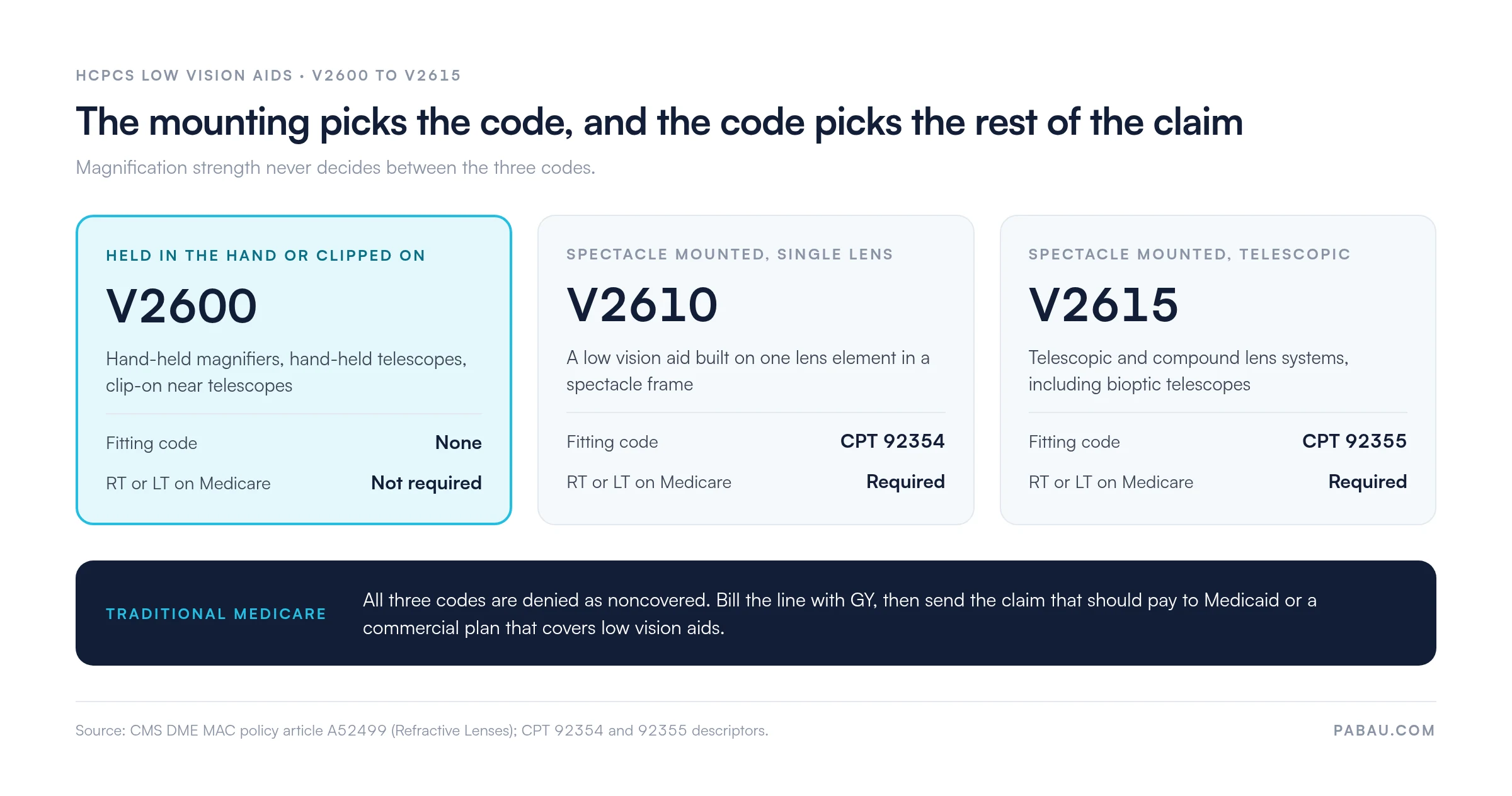
The table lists the official descriptor behind each code.
A frame-mounted aid built on one lens element moves to V2610, fitted under CPT 92354. A spectacle mounted telescope or compound system moves to V2615, fitted under CPT 92355.
Pair V2600 with a diagnosis of permanent visual impairment. Category H54 records how severe the impairment is. A second code names the eye disease behind it, and the H54 “code first” note puts that cause in the first position.
Refractive error codes in H52 do not support a low vision aid, because glasses correct those conditions. Aphakia codes (H27.0-) open Medicare’s benefit for refractive lenses only, never for V2600.
Record best-corrected visual acuity for each eye, so the H54 category on the claim matches the measurement in the chart.
Traditional Medicare does not pay for V2600. Policy article A52499, the companion to LCD L33793, states that “Low vision aids (V2600, V2610, V2615) will be denied as noncovered.”
The reason is the benefit itself. Medicare covers eyewear as a prosthetic device only after surgical removal or congenital absence of the natural lens. A magnifier prescribed for macular degeneration sits outside that benefit, however strong the clinical case.
Send a V2600 claim to traditional Medicare only when the patient or a secondary payer needs the denial on file. The claim that should pay belongs with the payer whose benefit includes the aid.
Some Medicaid programs and commercial plans cover low vision aids, and their rules differ by state and by plan. New York Medicaid pays for low vision aids only to self-employed optometrists certified to perform low vision examinations.
New York also asks you to bill each aid with its specific description and the maximum fee listed for it. A claim that names only the code leaves the payer guessing which device it is paying for.
Commercial plans decide case by case whether low vision aids sit inside the benefit. Confirm coverage, the fee basis and any approval rule before you dispense. Insurance eligibility verification at the patient level is the cheapest place to catch a plan exclusion.
Approval rules come from the payer, not from the code. Traditional Medicare has no approval step for V2600, because the item is excluded by statute. Medicaid programs and commercial plans set their own rules, and some require approval before the aid is dispensed.
When a payer does ask for approval, the request usually needs:
Each step below covers a point where a V2600 claim tends to break down.
A record that is complete before submission is what turns a V2600 line into a clean claim.
V2600 is the device line only. CPT has no fitting code for a hand-held aid, because both low vision fitting codes describe spectacle mounted systems:
A 92354 or 92355 line beside V2600 tells the payer the claim describes two different devices. Expect that claim to come back for correction.
V2600 denials come from coverage and code choice far more often than from clinical detail. The table maps each problem to the claim adjustment reason code (CARC) you are likely to see.
Denial management works best when you track these codes by payer. A 96 from Medicare on V2600 is the expected result, while a 16 from Medicaid means the claim itself needs fixing.
Keep a short list of the low vision aids you stock, with the code each payer uses for each one. A clip-on telescope or a pair of prism spectacles can sit under V2600 for one payer and a spectacle mounted code for another. Checking that list at dispensing prevents the most common recode.
A practice dispenses low vision aids in small numbers, and each claim goes to a payer with its own rules. When one comes back weeks later, the billing team has to rebuild which plan, code and approval applied.
In Pabau, the claim sits beside the patient record. Pabau’s claims management software checks every claim for missing or invalid details before it leaves Pabau. A V2600 line without its H54 diagnosis is fixed in-house, before a payer sees it.
After submission, the claims dashboard tracks each claim from Pending to Paid and flags the ones that need action. You see at once whether a magnifier was paid in full or left a balance for the patient.

Pabau checks each V2600 claim for missing details before submission and tracks it through to payment. A hand-held aid claim reaches the right payer complete, and you see the outcome without chasing it.

V2600 is a device code with a short list of payers. It describes hand-held and clip-on low vision aids, never a spectacle lens, and traditional Medicare will not pay for it.
Most of the billing work therefore happens before the order. Find the plan whose benefit covers the aid, check the code that plan lists it under, and get any approval in writing.
Treat a Medicare V2600 line as a GY denial for the record, and check the mounting before you pick the code. Book a demo to see how Pabau validates and tracks low vision aid claims from submission to payment.

Need a broader medical billing overview? What is medical billing explains the end-to-end revenue cycle, from superbill to payment posting.
Struggling with denial patterns across HCPCS codes? Denial management in healthcare covers root-cause analysis and systematic appeal workflows.
Want to understand what a clean claim looks like in practice? Clean claim walks through the data elements payers validate before adjudication.
Billing frames alongside a low vision aid? HCPCS code V2020 covers spectacle frames, which A52499 also exempts from the RT and LT rule.
HCPCS code V2600 covers hand held low vision aids and other nonspectacle mounted aids. Typical devices are hand-held magnifiers, hand-held telescopes and clip-on near telescopes. The code sits in the V2600 to V2615 low vision range and has never described a spectacle lens.
No. Traditional Medicare denies V2600, V2610 and V2615 as noncovered under the Refractive Lenses policy article (A52499). Its eyewear benefit only covers patients missing the natural lens of the eye. Report V2600 with the GY modifier, and the patient is liable for the charge.
The mounting decides the code. V2600 covers aids held in the hand or clipped on. V2610 covers single lens spectacle mounted aids, and V2615 covers telescopic and compound lens systems mounted in spectacles.
No. The Medicare Refractive Lenses policy article exempts V2600 from its RT and LT modifier rule, along with frame codes V2020 and V2025. Follow a Medicaid or commercial payer’s own policy if it asks for laterality.
Use an H54 visual impairment code, such as H54.2X- for low vision in both eyes. Sequence the underlying cause first, such as macular degeneration (H35.31-, H35.32-), glaucoma (H40.11-) or diabetic retinopathy (E11.35-). Refractive error codes in H52 do not support a low vision aid.
Most denials come from billing traditional Medicare as if it covered the aid, or from a plan that excludes low vision aids. Others follow a missing prior approval, a refractive error diagnosis, or a spectacle mounted device billed under V2600.
It depends on the payer. Traditional Medicare has no authorization step, because low vision aids are excluded by statute. Medicaid programs and commercial plans set their own approval rules, so confirm them before you dispense the aid.