HCPCS Code E0272: Foam rubber mattress billing guide
HCPCS Code E0272: official descriptor and code overview HCPCS Code E0272 is the ...

Last Updated: Nov 6, 2026
V2615 is the HCPCS Level II code for a telescopic or other compound lens system prescribed as a low vision aid. It covers distance vision telescopes, near vision telescopes and compound microscopic lens systems, such as the bioptic telescopes fitted for permanent vision loss.
V2615 closes the V2600 to V2615 low and near vision aid range, after hand-held aids (V2600) and single lens spectacle mounted aids (V2610). Traditional Medicare denies all three as noncovered, so V2615 claims go to Medicaid or a commercial plan whose benefit includes low vision aids.
Let Pabau's smart automation suggest the right codes, reduce claim denials, and keep your practice compliant—effortlessly.
Automate repetitive tasks and focus on what matters most—your patients.
Reduce coding errors and ensure compliance with the latest regulations.
Clean claims, fewer denials, and faster reimbursements.
Powerful insights and reporting to help your practice thrive.
HIPAA compliant SOC 2 certified GDPR-compliant Trusted by 4,000+ clinics worldwide

HCPCS code V2615 covers telescopic and other compound lens systems, such as bioptic telescopes, near vision telescopes and compound microscopic lens systems.
V2615 closes the V2600 to V2615 low and near vision aid range, which holds three codes: V2600, V2610 and V2615.
Traditional Medicare denies V2615 as noncovered, so a claim sent to Medicare carries the GY modifier and the patient is liable.
Lenticular spectacle lenses are not V2615. They bill under lens codes such as V2121, V2221 and V2321.
Pabau’s claims management software checks each claim for missing or invalid details before submission and tracks it from Pending to Paid.
HCPCS code V2615 is the Level II supply code for a telescopic or other compound lens system prescribed as a low vision aid. Its official descriptor, maintained by CMS, reads “Telescopic and other compound lens system, including distance vision telescopic, near vision telescopes and compound microscopic lens system.”
A compound system magnifies with two or more optical elements working together. A bioptic telescope set into the upper part of a spectacle lens is the best-known example. Near vision telescopes for reading and microscopic lens systems mounted in a frame fall under the same code.
These devices serve patients whose vision loss can no longer be corrected with standard glasses, contact lenses or surgery. The code covers the device itself. Fitting it is a separate professional service, reported with CPT 92355.
The table below sets out the billing attributes of HCPCS code V2615 for quick reference when you prepare a claim.
V2615 applies when the prescribed device magnifies through a telescope or another multi-element lens system mounted in spectacles. It covers three device types named in the descriptor:
Billed under other codes:
Payers do not all draw the V2610 and V2615 line in the same place. New York Medicaid’s vision care procedure code list lists a bioptic system with one telescope under V2610 and a two-telescope bioptic under V2615.
Read the CMS descriptor alone and a single bioptic telescope looks like a V2615 item. Check the payer’s own code list before you bill a monocular telescope.
The chart below runs the choice in order. How the device is mounted and built picks the code and its fitting service, and the payer decides who pays.
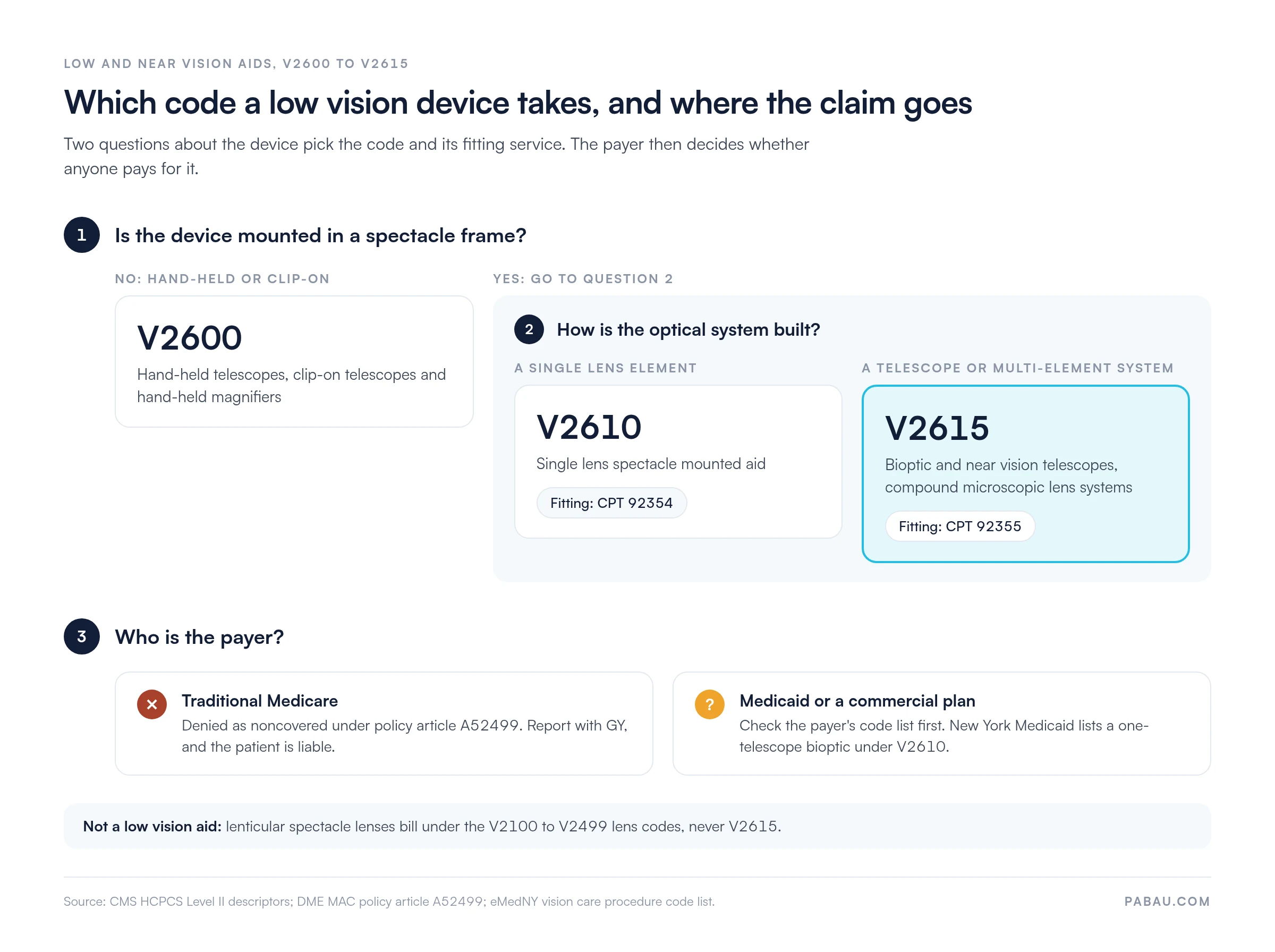
The low and near vision aid range holds only three codes. V2612, V2614 and V2616 do not exist, so a claim or crosswalk that lists them is working from bad data.
The AAPC Codify HCPCS lookup lists the same three codes under “Low and Near Vision Aids V2600-V2615”. Our HCPCS code V2610 guide covers the single lens code in detail.
A lenticular lens is a high-power spectacle lens, not a low vision aid. It bills per lens under V2115 or V2121 for single vision, V2215 or V2221 for bifocal, and V2315 or V2321 for trifocal. The myodisc codes (V2115, V2215, V2315) and the lenticular lens codes (V2121, V2221, V2321) sit in the spectacle lens ranges, far from V2615.
A V2615 claim needs a diagnosis that shows permanent visual impairment. Category H54 records the level of impairment, and a second code records the disease that caused it. H54 carries a “code first” instruction, so the underlying cause is sequenced ahead of the H54 code.
In H54, low vision means categories 1 and 2 and blindness means categories 3, 4 and 5. Record best-corrected visual acuity for each eye, because the category in the code has to match the measurement in the chart. Payers that cover V2615 may accept a narrower list of diagnoses, so check the policy before you dispense.
Traditional Medicare does not cover V2615. The DME MAC Refractive Lenses policy article (A52499) states that “low vision aids (V2600, V2610, V2615) will be denied as noncovered.”
The policy explains why. The Medicare prosthetic benefit for eyewear is limited to patients with congenital absence or surgical removal of the lens of the eye.
That benefit covers lenses for aphakia, which is lenticular and spectacle lens territory. A telescope prescribed for macular degeneration falls outside it, however strong the clinical case.
Medicaid programs set their own low vision rules, and they vary by state. New York Medicaid reimburses low vision aids to self-employed optometrists certified to perform low vision examinations. Its vision care procedure code list asks you to bill each aid with its specific description and the maximum fee listed for it.
Commercial and vision plans decide case by case whether low vision aids sit inside the benefit. Confirm coverage, the fee basis and any prior approval rule with the plan before you order the device. A telescope system is usually ordered for one patient, so a denied claim is hard to recover by returning stock.
Payers that cover V2615 set their own documentation rules, so build this record first and then check it against the payer’s policy. Submitting a clean claim means the record is complete before the claim goes out.
Keeping this file in order also supports medical billing compliance if a payer audits the claim later.
Before you order a V2615 device, write down three answers from the payer. Does the plan cover low vision aids, which code does it list this device under, and does it need prior approval? Those answers decide the claim before the device ships.
V2615 denials cluster around coverage and code choice more than clinical detail. The table maps the usual problems to the claim adjustment reason code (CARC) you are likely to see, drawing on denial management in healthcare.
Reading denial codes in medical billing at the CARC level tells you which fix applies. A 96 on a Medicare V2615 claim is the expected result, while a 16 from Medicaid means the claim itself needs correcting.
V2615 is the device line only. The professional work around it goes on separate lines:
Match the fitting code to the device code. A 92354 fitting next to a V2615 device tells the payer the two lines describe different systems.
A practice dispenses few telescope systems, and each one is a costly device ordered for one patient. When a claim comes back weeks later, the billing team has to rebuild which payer, which code and which approval applied.
Pabau, the practice management platform we build, keeps the claim beside the patient record. Its claims management software checks every claim for missing or invalid details before it leaves Pabau. An incomplete V2615 claim is fixed in-house before a payer sees it.
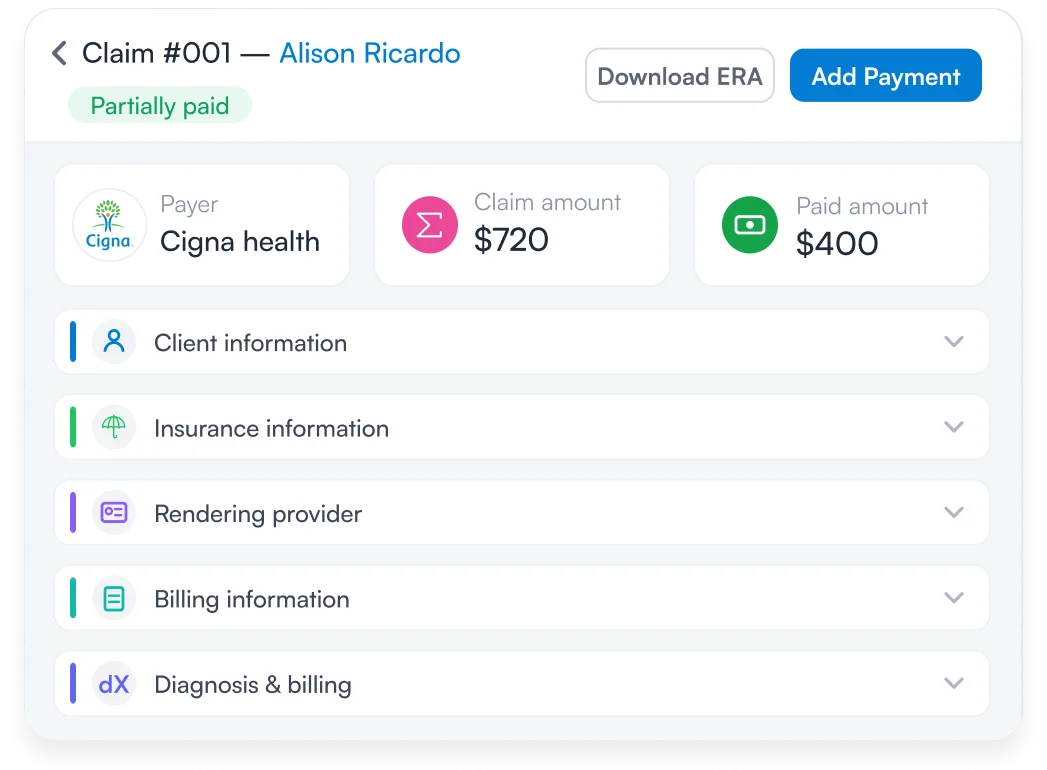
After submission, the claims dashboard tracks each claim from Pending to Paid and flags the ones that need action. When the payer remits, you record the payment once and match it to each invoice it covers. You see straight away whether a V2615 device was paid in full or left a balance for the patient.
That loop is the core of revenue cycle management for a low-volume, high-cost device line.

Pabau’s claims management software checks every claim for missing or invalid details before submission. It tracks each claim from Pending to Paid and matches insurer payments to invoices.

V2615 is a narrow code with an unusual payer map. The device is a telescope or compound lens system, never a lenticular spectacle lens, and traditional Medicare will not pay for it. The billing work moves to the front: finding the payer that covers the device and the code it lists it under.
Before you order, confirm the plan covers low vision aids and whether it lists a one-telescope bioptic under V2610 or V2615. Get any approval it needs in writing. Book a demo to see how Pabau validates and tracks low vision aid claims from submission to payment.

Building a clean-claim submission process? Submitting a clean claim outlines the documentation and coding checks that prevent rejections at the payer gateway.
Looking up another vision supply code? The HCPCS code library indexes every Level II code page, including the V-code lens and low vision ranges.
HCPCS code V2615 is the Level II code for a telescopic or other compound lens system used as a low vision aid. It covers distance vision telescopes, near vision telescopes and compound microscopic lens systems. Bioptic telescopes are the most common example.
No. Traditional Medicare denies V2600, V2610 and V2615 as noncovered under the Refractive Lenses policy article (A52499). Its eyewear benefit is limited to patients missing the natural lens of the eye. Report V2615 with the GY modifier, and the patient is liable for the charge.
No. V2615 is a low vision aid code. Lenticular spectacle lenses bill per lens under V2115 or V2121 for single vision, V2215 or V2221 for bifocal, and V2315 or V2321 for trifocal.
V2610 covers single lens spectacle mounted low vision aids. V2615 covers telescopic and other compound lens systems. Payers can differ on monocular telescopes: New York Medicaid lists a one-telescope bioptic under V2610 and a two-telescope bioptic under V2615.
The fitting is reported with CPT 92355, fitting of a spectacle mounted low vision aid, telescopic or other compound lens system. CPT 92354 is the single element fitting code and pairs with V2610. The low vision exam goes on its own line.
Use an H54 visual impairment code, such as H54.2X- for low vision in both eyes. H54 has a code first instruction, so sequence the underlying cause ahead of it. Common causes include macular degeneration (H35.31-, H35.32-), glaucoma (H40.11-) and diabetic retinopathy (E11.35-).