HCPCS code J1180: Dyphylline injection billing guide
What HCPCS code J1180 covers: the official descriptor explained HCPCS code J1180...

Last Updated: Oct 16, 2026
V2115 is the HCPCS Level II code for a lenticular (myodisc) single-vision spectacle lens, billed per lens.
Coders assign it from the lens design on the lab order, whatever the dioptric power. A myodisc lens carries its correction in a small central zone surrounded by a non-correcting carrier. A full-aperture high-minus lens takes a sphere or spherocylinder code from V2100-V2114 instead, and bifocal or trifocal myodiscs take V2221 or V2321.
Let Pabau's smart automation suggest the right codes, reduce claim denials, and keep your practice compliant—effortlessly.
Automate repetitive tasks and focus on what matters most—your patients.
Reduce coding errors and ensure compliance with the latest regulations.
Clean claims, fewer denials, and faster reimbursements.
Powerful insights and reporting to help your practice thrive.
HIPAA compliant SOC 2 certified GDPR-compliant Trusted by 4,000+ clinics worldwide

HCPCS Code V2115 covers lenticular myodisc single-vision lenses only, and the lens design decides the code at any power.
Bill per lens, not per pair, with the code on two claim lines carrying RT and LT modifiers for a bilateral fitting.
Bifocal and trifocal myodisc lenses have their own codes, V2221 and V2321, so check the segment type before coding.
Medicare Part B excludes routine spectacle lenses, so V2115 is usually payable only under the post-cataract lens benefit.
Practice management software like Pabau checks units and laterality modifiers on V-code claims before submission.
HCPCS Code V2115 is the official CMS HCPCS Level II code for a lenticular myodisc single-vision spectacle lens, billed per lens. It sits in the V2100-V2199 single-vision lens range, inside the V-code vision services block (V2020-V2799).
The code applies only when the dispensed lens has a myodisc design. A full-aperture high-minus lens takes a sphere or spherocylinder code instead. Such a lens with high sphere and low cylinder, for example, bills V2111. The same sphere band with 4.25D to 6.00D of cylinder bills V2113.
A myodisc lens places its refractive correction in a small central optical zone, typically 20-40 mm in diameter, surrounded by a thinner non-correcting carrier lens.
This design is used for patients with high myopia, usually above -10.00 diopters, where a full-aperture lens would be impractically thick and heavy. The carrier dramatically reduces lens weight and edge thickness compared with a standard minus lens at the same prescription.
V2115 applies only when the lens is manufactured in a lenticular or myodisc design. A high-minus aspheric lens does not qualify, even in a high-index material. Coders assign the code from the lens design on the lab order, so the prescription power alone never settles it.
The single-vision spectacle lens range runs from V2100 to V2199. V2100-V2102 cover plain sphere lenses, V2103-V2114 cover spherocylinder lenses, and V2115 onward covers specialty designs such as lenticular and aniseikonic lenses. Bifocal lenses sit in a separate range, V2200-V2299. The table below maps the neighboring codes coders most often confuse with V2115.
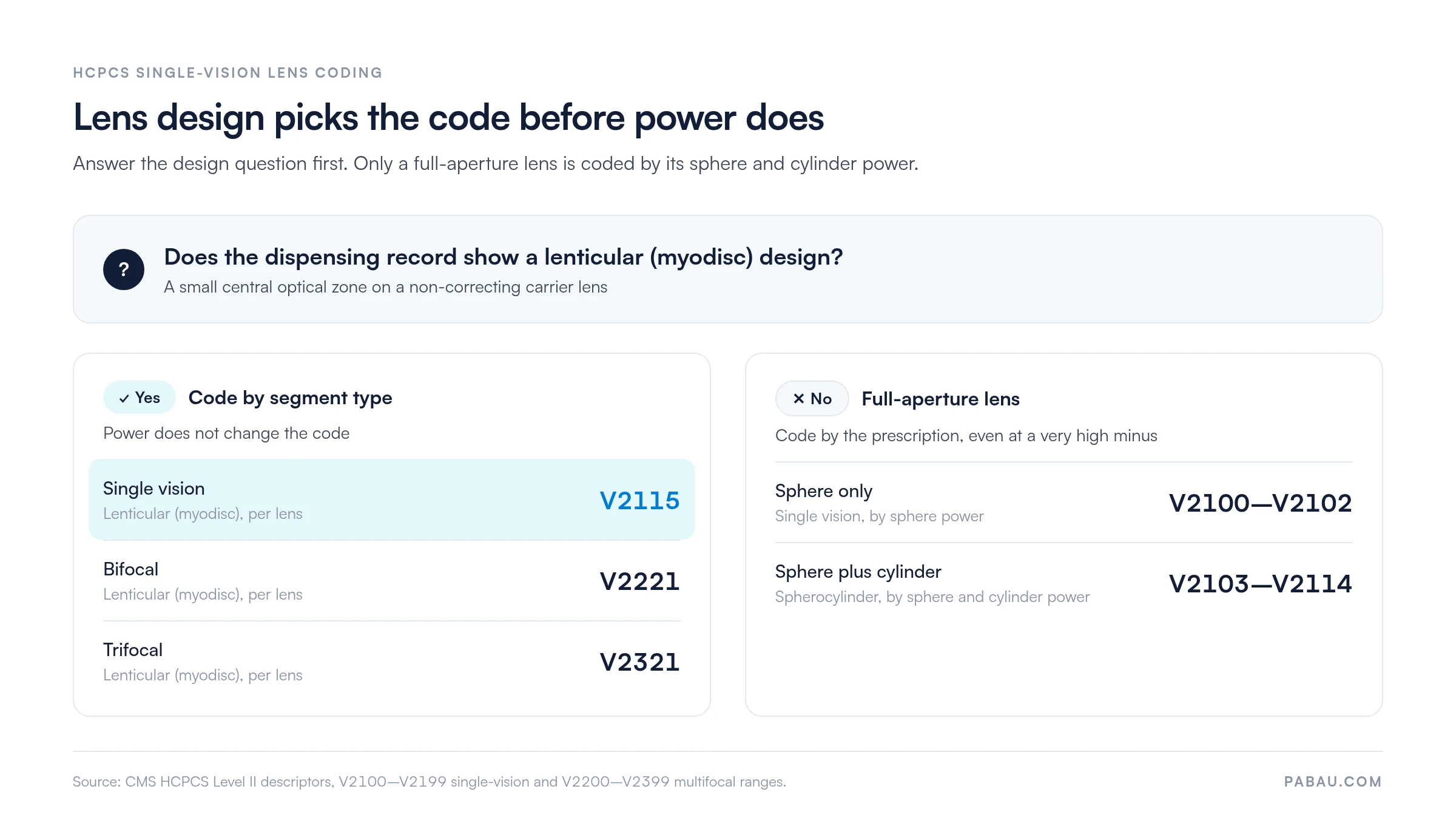
Key rule: power alone never selects V2115. If the dispensing record shows a myodisc design and a single-vision prescription, V2115 is correct at any power. A full-aperture lens is coded by its prescription instead, such as V2102 for a plain sphere up to ±20.00 D.
Coding therefore runs in a fixed order, shown below: lens design first, then either the segment type or the power.
V2115 follows standard HCPCS Level II vision-code billing conventions. The most common billing error is submitting one unit for a bilateral pair, which understates the claim and may trigger an edit.
For a repeatable workflow, optical practice claims software with built-in HCPCS validation catches unit and modifier errors before submission. Structure each claim as follows.
Submitting a clean claim for V2115 requires the dispensing record, a valid prescription, and the correct diagnosis code on the same claim. Missing any of these elements is the primary cause of first-pass denials.
Run a pre-submission edit check for laterality modifiers on all V2xxx claims. A missing RT or LT modifier on a V2115 line often sends the claim to manual review. It is also one of the easiest errors to catch before submission.
Medicare pays V2115 from the CMS DMEPOS fee schedule, which covers prosthetic lenses, not from the Physician Fee Schedule. Allowable amounts vary by state and change each January. Check the current-year file before quoting a patient an out-of-pocket estimate.
Medicare Part B coverage caveat: Medicare Part B does not cover routine eyeglasses. The exception is the prosthetic lens benefit after cataract surgery, described in Chapter 15 of the Medicare Benefit Policy Manual. After surgery with an intraocular lens implant, Medicare covers one pair of standard frames and lenses or one pair of contact lenses. If that patient needs a myodisc design, for example because of pre-existing high myopia, V2115 may be billable under this exception.
Any other Medicare use of V2115 needs documented medical necessity beyond routine refractive error. Outside Medicare, segment patients by payer type before dispensing. Medicaid coverage varies by state. Some state plans cover medically necessary spectacle lenses at a fixed fee, while others exclude specialty lens designs.
Commercial plans generally cover V2115 when the employer benefit includes vision coverage, subject to copays and plan maximums. Confirm active coverage and benefit limits at each visit, before the lens is ordered.
Payer audits of V2115 claims check three records: the prescription, the dispensing record, and the diagnosis that establishes medical necessity. If any one is missing, post-payment review can end in a recoupment demand. Keep these minimum elements on file for every specialty lens claim.
Prior authorization (PA) requirements for V2115 vary by payer class and individual plan. There is no universal rule, so check the specific plan’s authorization schedule before dispensing.
A V2115 PA request should include the prescription and the specific ICD-10 code. Add a clinical note explaining why a standard lens design cannot meet the patient’s visual needs. Most payers approve within three to five business days when documentation is complete on first submission.
V2115 denials follow predictable patterns, and most trace back to one of six root causes. The corrective action for each one below resolves most first-pass rejections and cuts down on appeals. Sorting your V2115 rejections by reason code shows which pattern costs your practice the most.
For denials citing CARC 96 (non-covered charge), compare the patient’s Explanation of Benefits with their vision and medical benefits to confirm whether coverage exists. Every reason code in the table is explained in our guide to denial codes in billing.
Every V2115 claim must carry at least one ICD-10-CM diagnosis code that establishes medical necessity for the myodisc lens. A refractive-error code that does not reflect the patient’s clinical picture is a common audit trigger.
The codes below are the diagnoses that most logically support a lenticular myodisc prescription. Always use the most specific code the documentation supports, as the ICD-10-CM Official Guidelines require.
Specificity note: where a patient has high myopia in one eye only, use H52.11 or H52.12. Either code is more specific than H52.13 and matches the claim line’s RT or LT modifier. Payers increasingly flag diagnosis-modifier mismatches as a reason to request documentation. Aligning the laterality of the ICD-10 code with the modifier on each line reduces review risk.
Without a pre-submission check, V2115 errors tend to surface on the remittance. A missing LT modifier or a single unit billed for a pair then costs a resubmission and weeks of waiting for payment.
Practice management software like Pabau keeps the prescription, the dispensing notes, and the claim on one patient record. Its claims tools flag unit and modifier errors before submission and track each claim’s status afterward.
Fewer V2115 lines come back denied, and when an auditor asks, the signed prescription is already attached to the patient’s file.

Pabau’s claims management tools support HCPCS V-code billing, track claim status, and flag modifier errors before submission. Your optical practice spends less time chasing denials.

Code V2115 from the lab order, not the prescription. If the order says myodisc and the lens is single vision, the code is V2115 at any power. If the order shows a bifocal or trifocal segment, the claim needs V2221 or V2321 instead.
The costly mistakes are a single unit billed for a pair, a missing laterality modifier, and a full-aperture lens billed as a myodisc. Each one is cheaper to catch before submission than to appeal afterward.
Book a demo to see how Pabau checks V-code units and modifiers before your optical claims go out.

Need a framework for reducing claim rejections across your practice? Denial management in healthcare covers the systematic approach practices use to categorize, track, and resolve rejected claims.
Want to understand how HCPCS codes fit into the broader billing process? Medical billing workflow explained walks through the full claim lifecycle from coding to payment posting.
Looking for guidance on keeping claims clean before submission? Submitting a clean claim outlines the elements every claim must have to pass first-pass adjudication.
Building an audit-ready encounter record for lens claims? What is a superbill? explains how one document ties the service date, codes, and diagnosis together.
Worried about post-payment review on specialty lens claims? Medical billing compliance explains the documentation and audit habits that keep claims defensible.
HCPCS Code V2115 covers a lenticular (myodisc) single-vision spectacle lens, billed per lens. The code applies only when a myodisc lens design is dispensed, typically for patients with high myopia. It does not apply to high-minus full-aperture lenses of any material or index.
V2115 is billed per lens. For a bilateral pair, submit the code on two separate claim lines: one with modifier RT and one with modifier LT. Billing a single unit for a pair is a frequent cause of claim underpayment or rejection.
Use V2115 when the dispensed lens is a myodisc or lenticular design, with a central optical zone surrounded by a non-correcting carrier. V2110-V2113 are for full-aperture spherocylinder (toric) lenses, selected by the prescription’s sphere and cylinder power. The lens design, not the power, determines which code applies.
Medicare Part B generally excludes routine spectacle lenses. The exception is the post-cataract benefit, which covers one pair of eyeglasses or contact lenses after cataract surgery with an intraocular lens. If that patient also needs a myodisc design, V2115 may be billable under this exception. Outside this narrow scenario, Medicare Part B does not cover V2115.
Prior authorization requirements vary by payer. Medicare does not use a PA process for the post-cataract spectacle benefit. Many state Medicaid programs and some commercial plans require PA for specialty lens designs including myodisc. Always verify with the specific payer before dispensing.
The most commonly paired codes are H52.13 (myopia, bilateral), H52.11 (myopia, right eye), H52.12 (myopia, left eye), and H27.00-H27.03 (aphakia by laterality). Always use the most specific laterality-matched code available and confirm it aligns with the RT or LT modifier on the claim line.