HCPCS Code E0272: Foam rubber mattress billing guide
HCPCS Code E0272: official descriptor and code overview HCPCS Code E0272 is the ...

Last Updated: Nov 6, 2026
S0595 is the HCPCS Level II code for dispensing new spectacle lenses for a patient-supplied frame.
It reports the dispensing service when new lenses go into eyeglass frames the patient already owns, so no frame code goes on the claim. The lenses bill on their own lines, one per eye. As a temporary national S code with coverage indicator I, S0595 is never paid by traditional Medicare.
Let Pabau's smart automation suggest the right codes, reduce claim denials, and keep your practice compliant—effortlessly.
Automate repetitive tasks and focus on what matters most—your patients.
Reduce coding errors and ensure compliance with the latest regulations.
Clean claims, fewer denials, and faster reimbursements.
Powerful insights and reporting to help your practice thrive.
HIPAA compliant SOC 2 certified GDPR-compliant Trusted by 4,000+ clinics worldwide

HCPCS code S0595 reports dispensing new spectacle lenses into a frame the patient already owns, so the claim carries no frame code.
The lenses bill on their own lines, one per eye with RT and LT, alongside the single S0595 dispensing line.
CMS lists S0595 with coverage indicator I, not payable by Medicare, so traditional Medicare never pays it.
S0595 is a vision supply code with no drug component, so it needs no NDC and pairs with refractive diagnoses such as H52.-.
Pabau, the practice software we build, keeps the prescription, the lens order, and the claim on one patient record.
HCPCS code S0595 is the Level II temporary national code for dispensing new spectacle lenses into a frame the patient supplies. It sits in the S-code series, which runs from S0012 to S9999. CMS added it on April 1, 2005, and it is still active.
The official descriptor reads Dispensing new spectacle lenses for patient supplied frame. The CMS short descriptor is “New lenses in pts old frame.” It describes a dispensing service, not a product, so the lenses themselves and any frame stay off the S0595 line.
The Blue Cross Blue Shield Association and other private payers created the S codes for their own reporting needs. CMS publishes them in the HCPCS file but doesn’t pay them. S0595 sits in the S0500-S0596 vision supplies range and carries coverage indicator I, which means not payable by Medicare.
The CMS HCPCS quarterly update file holds the full record for the code. The fields below summarize it.
S0595 covers the work of dispensing new prescription lenses into eyeglass frames the patient brings in. That work includes checking the frame, mounting the lenses, and fitting the finished glasses. The lenses, any lens add-ons, and any new frame each take their own code.
The frame rows catch the most frequent mistake. S0595 exists because no frame is dispensed. If the practice also sells a frame for the same pair, the frame code replaces S0595 rather than joining it.
A lens-only order is usually three claim lines. S0595 reports the dispensing once, and each lens takes its own line because the V-code lens descriptors are written per lens. Billing S0595 by itself leaves both lenses unpaid.
Whether the patient brought the frame decides which of those lines belong on the claim, as the diagram below shows.
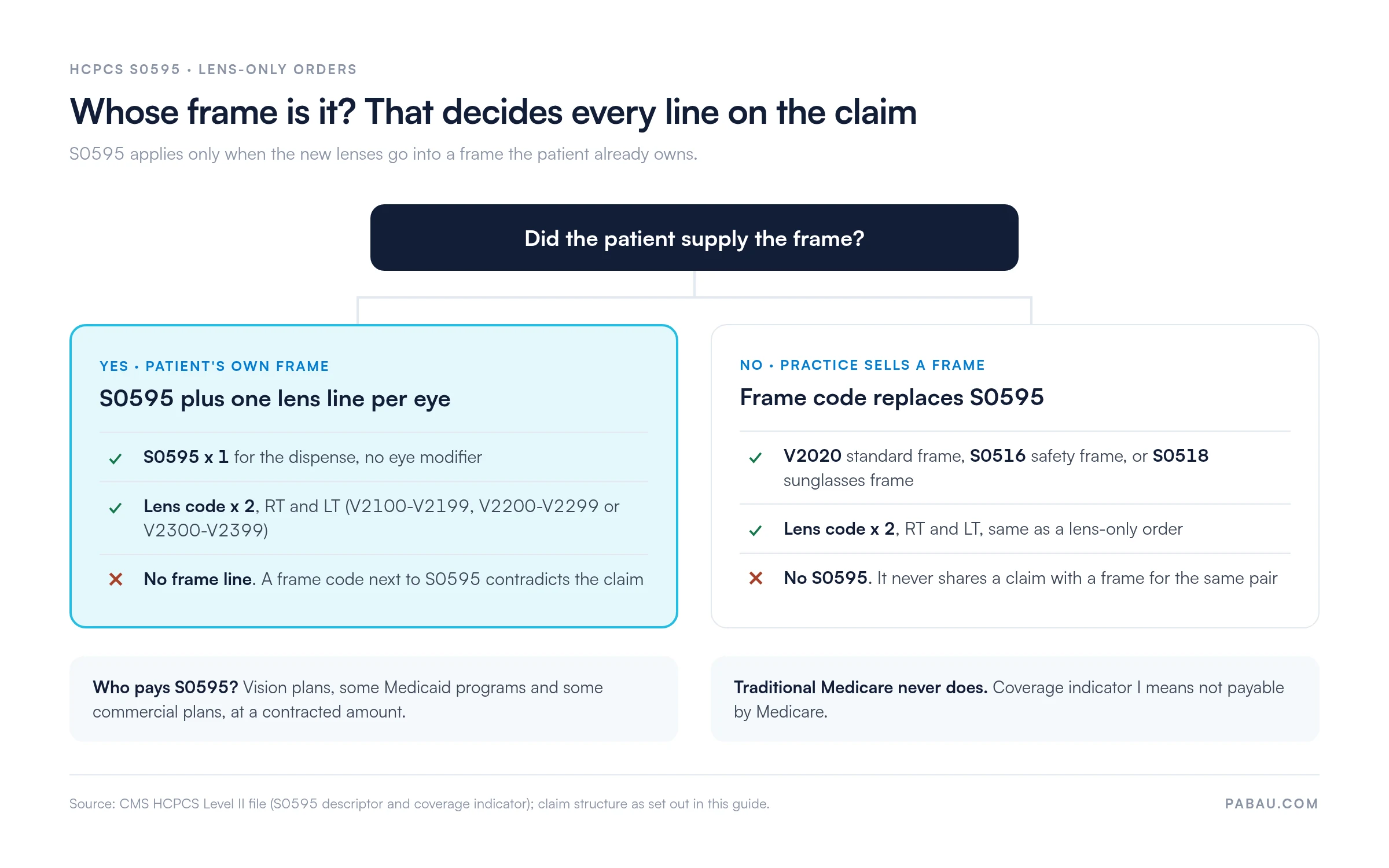
The RT and LT modifiers belong on the lens lines. One dispense serves the whole pair, so the S0595 line takes no eye modifier unless the payer’s manual asks for one.
Our guide to HCPCS code V2100 covers the most common single vision lens line in detail.
S0595 is easy to confuse with frame codes and with the CPT spectacle fitting codes. The table sets out what each one reports and how Medicare treats it.
S0595 and V2020 never share a claim for the same pair. One reports that the patient brought a frame, and the other reports that the practice sold one. Our HCPCS code S0518 guide shows the same split for sunglasses frames.
S0595 and the 92340-92342 fitting codes overlap in purpose. Some plans want S0595 for a patient-supplied frame, while others want the CPT fitting code or a dispensing fee code of their own. The plan’s vision manual decides which one goes on the claim.
Before you take the patient’s frame, check its condition and note it in the record. A worn hinge or a cracked eyewire can fail during mounting. Have the patient sign that the practice isn’t liable for frame damage, and record whether the frame is still suitable for the new lens type.
Traditional Medicare doesn’t pay S0595. CMS gives the code coverage indicator I, and Medicare doesn’t accept S codes on any claim. Medicare’s eyeglass coverage is limited to one pair after cataract surgery that implants an intraocular lens.
Even that post-cataract pair isn’t billed with S0595. Its lenses take V-code lens lines, and a supplied frame goes on a V2020 line. If the patient keeps their own frame, the dispensing has no Medicare-payable code, so the practice collects from another payer or the patient.
No national payment rate exists for S0595, so each payer sets its allowed amount by contract. Running insurance eligibility verification before the lenses are ordered confirms the lens benefit and when it was last used.
Pair S0595 with the ICD-10-CM code for the refractive error that the new lenses correct. Where the payer treats eyewear as a routine vision benefit, the eye examination encounter code is often enough. Use the most specific code the prescription supports, including laterality.
S0595 has no drug, injectable, or medical treatment component. Diagnoses outside the eye and vision chapters rarely support it, and a mismatched pairing invites a diagnosis-inconsistent denial.
A defensible S0595 claim shows that the frame was the patient’s own, which lenses went into it, and why. Keep these elements in the patient record before the claim goes out:
Payers audit small vision codes under the same medical billing compliance rules as large procedures. A lens-only claim without a note about the patient’s frame is hard to defend in a post-payment review.
Submit S0595 claims on a CMS-1500 paper form or an 837P electronic transaction. The fields below reflect common payer expectations, so confirm each plan’s own rules before you submit.
No frame line belongs on the claim. If one appears next to S0595, the claim contradicts itself and is likely to deny.
Most S0595 denials trace back to the payer, a frame line on the claim, or the benefit period. The CARC codes below are typical, though payers vary in which code they return.
Reading medical billing denial codes correctly decides the response. A CO-96 from Medicare confirms the non-coverage, so it needs no appeal. A CO-119 means the lens frequency limit was reached, so recoding won’t get it paid.
Each check below targets one of the denial reasons in the table above. Run them on every lens-only order.
Clean lens claims go through without manual review. Running these checks inside a clean claim workflow keeps the audit trail in one place.
Optical practices often record the prescription in one system and bill the lenses from another. The frame note, the lens types, and the eye modifiers get retyped between the two. Each retype is another chance to add a frame line the patient never bought.
In Pabau, the prescription and the dispensing note sit on the same patient record as the invoice. Checkout adds the S0595 dispensing and both lens lines to one invoice. Your billing team then codes the claim from the dispensing record, with no retyping.
Pabau’s claims management software flags denials as they arrive and tracks each submission’s status. A monthly review of denied S0595 lines then runs from a saved report, not a spreadsheet.

Pabau links the prescription, checkout, and claims on one patient record, so your optical claims carry S0595 and every lens line. See how it works for your practice.

Treat every lens-only order as a dispense plus two lens lines, with no frame code. S0595 on its own never pays for the lenses.
Then settle who pays before the lenses are ordered. Traditional Medicare never will, and plans differ on whether they want S0595 or their own dispensing code. A quick benefit check turns a likely denial into a price the patient agrees to at the counter.
Get both steps right and an S0595 claim seldom needs an appeal. Book a demo to see how Pabau keeps prescriptions, checkout, and optical claims on one patient record.

Want to understand how medical billing works end to end? What is medical billing covers the full revenue cycle from patient registration through remittance posting.
Getting consistent denials and unsure where the breakdown is? Denial management in healthcare walks through how to build a systematic denial prevention and appeal process.
Looking to improve clean-claim rates across your payer mix? Clean claim submission outlines the field-level requirements that prevent the most common rejections before they reach the payer.
HCPCS code S0595 covers dispensing new spectacle lenses into a frame the patient already owns. It reports the dispensing service only. The lenses bill on separate lines, and no frame code goes on the claim.
No. CMS lists S0595 with coverage indicator I, not payable by Medicare, and traditional Medicare doesn’t accept S codes. Some Medicare Advantage plans with supplemental vision benefits use their own code lists, so check the plan directly.
No. S0595 means the patient supplied the frame. If the practice sells a new frame, bill V2020, S0516, or S0518 for it and drop S0595.
Bill S0595 once for the dispensing, then one lens code for each eye with RT and LT. Single vision lenses use V2100-V2199, bifocals V2200-V2299, and trifocals V2300-V2399.
Use the refractive error the lenses correct, such as H52.0- for hypermetropia, H52.1- for myopia, H52.2- for astigmatism, or H52.4 for presbyopia. Under a routine vision benefit, Z01.00 or Z01.01 often fits.
Keep a dispensing note stating the patient supplied the frame, the signed spectacle prescription, and the lens type for each eye. Add the refractive diagnosis, the dispense date, and any authorization number. S0595 has no drug component, so no NDC applies.
The most common causes are billing traditional Medicare, a used-up lens benefit, and a frame code billed on the same claim. A plan that wants its own dispensing code also denies S0595. Read the CARC on the remittance before you respond.