HCPCS Code Q4185: Cellesta flowable amnion billing guide
HCPCS Code Q4185: definition and official descriptor HCPCS Code Q4185 is the Lev...

Last Updated: Nov 20, 2026
S0580 is the HCPCS Level II code for a polycarbonate lens, listed in addition to the basic code for the lens. It is an add-on, so it never appears on a claim by itself.
Bill one S0580 per polycarbonate lens beside its basic lens line. Medicare does not pay S-codes, so the code goes to Medicaid programs and vision plans. Each of them sets its own criteria for impact-resistant lenses.
Let Pabau's smart automation suggest the right codes, reduce claim denials, and keep your practice compliant—effortlessly.
Automate repetitive tasks and focus on what matters most—your patients.
Reduce coding errors and ensure compliance with the latest regulations.
Clean claims, fewer denials, and faster reimbursements.
Powerful insights and reporting to help your practice thrive.
HIPAA compliant SOC 2 certified GDPR-compliant Trusted by 4,000+ clinics worldwide

HCPCS code S0580 reports a polycarbonate lens and is always listed in addition to the basic code for the lens
Bill S0580 once per polycarbonate lens, so a pair of glasses usually carries two units next to two basic lens lines
Medicare does not pay S0580 and reports polycarbonate lenses with V2784 instead, covered only for patients with working vision in one eye
Medicaid programs and vision plans set their own polycarbonate criteria, such as a minimum lens power, monocular vision or a seizure or motor disorder
The most common S0580 errors are billing it alone, billing it to Medicare, and using it where the payer wants V2784
HCPCS code S0580 is the add-on code for a polycarbonate spectacle lens. Its official descriptor reads: Polycarbonate lens (list this code in addition to the basic code for the lens). Centene’s optical hardware policy (CP.VP.06) lists it with that wording beside its sibling, S0581.
The code never stands alone. The basic lens code describes the prescription, such as single vision, bifocal or trifocal. S0580 then tells the payer the lens is made of polycarbonate rather than standard plastic.
S0580 is a temporary national S-code. The Blue Cross Blue Shield Association (BCBSA) maintains S-codes for private payers, and CMS publishes them in the HCPCS Level II code set. Medicare does not pay them.
Polycarbonate is an impact-resistant lens material. Payers treat it as a medical upgrade only for patients whose eyes need extra protection, which is why criteria matter more than the code itself.
Every S0580 line rides on a basic lens line. The basic code carries the lens type and power, while S0580 carries the material upgrade. A claim with S0580 and no basic lens code fails the add-on rule.
The basic lens codes S0580 usually sits next to include:
Because each basic lens code is reported per lens, S0580 follows the same count. A pair of polycarbonate single vision glasses therefore runs as two basic lens units and two S0580 units.
Some payers want the add-on split into one RT line and one LT line instead of two units on a single line. Follow the payer’s vision manual on that point, because both formats are in use.
Build the basic lens code and S0580 as a pair in your claim template. When the optician picks polycarbonate, both lines load together, and the add-on cannot go out without its lens.
Two codes describe the same lens material. S0580 is the temporary S-code add-on, and V2784 is the permanent V-code for a polycarbonate or equal lens, any index, per lens.
Centene’s CP.VP.06 lists both codes, so one payer can accept either. The payer’s fee schedule decides which one pays. Billing S0580 to a plan that only lists V2784 returns a denial for an invalid or non-covered code. The chart below maps each payer type to the polycarbonate code it pays.
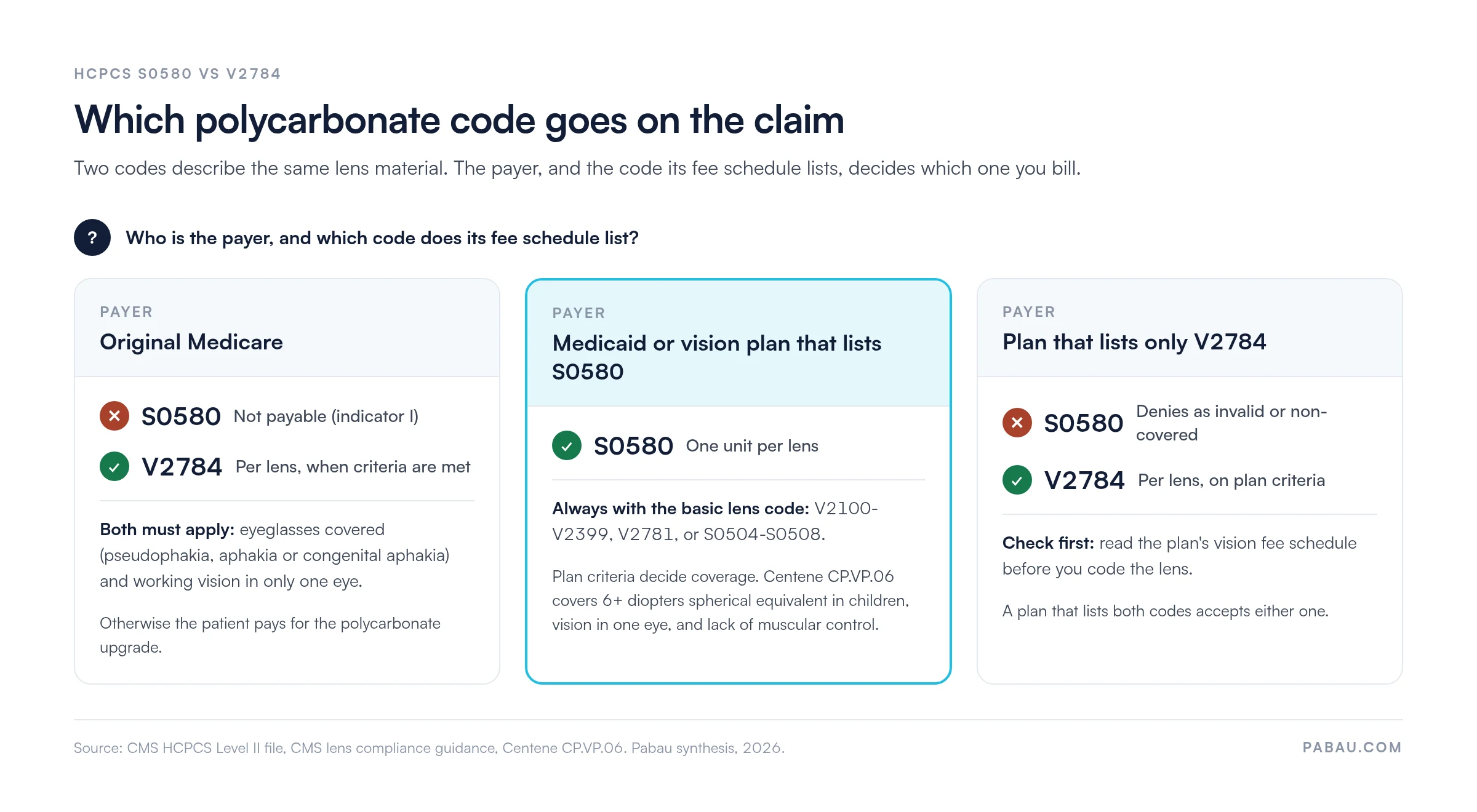
Medicare does not pay S0580. The HCPCS file gives it coverage indicator I, not payable by Medicare, and that applies to S-codes as a group.
Medicare reports polycarbonate lenses with V2784 under the Refractive Lenses LCD (L33793). CMS compliance guidance on lenses limits V2784 to patients with working vision in only one eye. When that criterion is met, both lenses are covered.
Eyeglasses themselves are covered only after cataract surgery or when the natural lens is missing. CMS limits covered diagnoses to pseudophakia, aphakia and congenital aphakia. A Medicare patient outside those rules who wants polycarbonate pays for the upgrade.
Medicaid programs and vision plans write their own criteria for S0580. Centene’s CP.VP.06 is a typical example, and it covers polycarbonate lenses for three groups:
State rules can differ from a plan’s own policy. The same Centene policy notes that Texas Medicaid pays for polycarbonate when lens power in at least one meridian reaches -5.25 or +4.00 diopters.
Where a state Medicaid manual conflicts with a plan policy, the state manual takes precedence. Check the state manual and the plan policy before you promise a patient coverage.
Medicare assigns no payment amount to S0580. Medicaid programs and vision plans pay it from their own fee schedules, and the amounts vary by state, plan and contract.
Some plans pay the add-on only when the patient meets the medical criteria. Others treat polycarbonate as a covered upgrade for every child, or as a patient-paid option for adults. Read the allowed amount from the payer’s current fee schedule, not from an aggregator site.
Lens claims lean on laterality modifiers. S0580 itself has no modifier requirement in the HCPCS file, so the payer’s manual sets the rule.
Do not use modifier 50 for a pair of lenses. Lens codes are reported per lens, so the pair is shown with two units or with an RT line and an LT line.
The record has to show why this patient needs polycarbonate, not only that the lab made it. Payers that apply criteria review these items:
H54.413A, H54.42A3, G80.9 and G40.909 appear on Centene’s CP.VP.06 list. H52.13 and H52.03 are common refractive-error codes used to document a high prescription, not listed by Centene. Treat all six as examples rather than a complete list, and confirm the codes your payer accepts before you submit.
A refractive error code alone does not prove the lens-power criterion. The prescription values on file carry that proof.
The S0500-S0599 range holds temporary vision codes for lenses, frames and contact lens services. These are the codes most often billed beside S0580 or confused with it.
S0581 is the sibling most often confused with S0580. Use S0580 when the upgrade is the polycarbonate material, and S0581 only when the payer defines the lens as nonstandard.
The steps below cover a polycarbonate pair for a patient with a Medicaid or vision plan. Step two is the one that prevents a wrong-code denial.
S0580 denials follow a short list, and most are preventable before submission. A clean claim pairs every add-on with the lens it modifies.
A denied add-on line is easy to miss, because the basic lens line on the same claim still pays. Match the reason code on the remittance against a list of medical billing denial codes to see which error fired. Denial management in healthcare covers how to work these partial denials before the appeal window closes.
An add-on code is easy to drop because it depends on another line. An optician picks the material, the lab makes the lens, and the S0580 line is forgotten on the claim.
Pabau, the practice software we build for medical and eye care teams, keeps the prescription, the lens order and the invoice on one patient record. Its claims management software submits the claim and shows its status and remittance, so your billers know when an S0580 add-on needs a second look.
When a patient pays for polycarbonate as an upgrade, checkout invoices the add-on and records the payment. The self-pay upgrade and the insured lens pair then sit on the same patient record.

Pabau holds the prescription, the lens order and the invoice on one patient record. Its claims management submits each claim and shows its status and remittance, so lens add-ons get followed up.

S0580 is a material add-on, and its value depends on the code beside it. Pair it with the basic lens code, match the units to the lens count, and keep it off Medicare claims.
Coverage is decided by the payer’s criteria rather than the code. Check the plan or state manual first, document the prescription and diagnosis that meet it, and use V2784 wherever the payer lists it instead.
Book a demo to see how Pabau keeps lens orders, add-on codes and payments on one record.

Billing a nonstandard lens instead? HCPCS code S0581 covers the sibling add-on and when payers accept it.
Billing polycarbonate to Medicare? HCPCS code V2784 explains the permanent polycarbonate code and its one-eye criterion.
Want fewer add-on denials? Clean claim standards explains what makes a claim pass initial payer edits.
HCPCS code S0580 is the add-on code for a polycarbonate lens. It is listed in addition to the basic code for the lens and never billed alone. It is a temporary national S-code in the S0500-S0599 vision range.
No. S0580 carries coverage indicator I, not payable by Medicare. Medicare reports polycarbonate lenses with V2784 instead, and covers them only for patients with working vision in one eye when eyeglasses are covered.
Both describe a polycarbonate lens. S0580 is a temporary S-code add-on used by some Medicaid programs and vision plans. V2784 is the permanent per-lens code that Medicare uses. The payer fee schedule decides which one to bill.
Bill one unit per polycarbonate lens, matching the basic lens lines. A pair of glasses usually carries two units. Some payers want separate RT and LT lines instead, so check the vision manual.
It depends on the state and plan. Centene policy CP.VP.06 covers children with a prescription of 6 diopters or more, patients with vision in one eye, and patients lacking muscular control. Texas Medicaid uses its own lens-power threshold.
The usual causes are billing S0580 without a basic lens code, billing it to Medicare, or using it where the plan lists V2784. Units that do not match the lens count and undocumented criteria also trigger denials.