HCPCS code K0552: Non-insulin infusion pump cartridge guide
HCPCS code K0552: Definition and code description HCPCS code K0552 describes sup...

Last Updated: Nov 23, 2026
S0516 is the HCPCS Level II code for safety eyeglass frames.
It bills the frame alone, one unit per frame, so each lens goes on its own line. As a temporary national S code, S0516 is never paid by traditional Medicare. Medicaid, commercial, and vision plans set their own rules, and Medi-Cal requires prior authorization with medical justification.
Let Pabau's smart automation suggest the right codes, reduce claim denials, and keep your practice compliant—effortlessly.
Automate repetitive tasks and focus on what matters most—your patients.
Reduce coding errors and ensure compliance with the latest regulations.
Clean claims, fewer denials, and faster reimbursements.
Powerful insights and reporting to help your practice thrive.
HIPAA compliant SOC 2 certified GDPR-compliant Trusted by 4,000+ clinics worldwide

HCPCS code S0516 bills a safety eyeglass frame only, so the code carries no lens and goes on the claim as one unit per frame.
A pair of safety glasses usually takes three claim lines: S0516 for the frame and one lens code for each eye.
CMS lists S0516 with coverage indicator I, not payable by Medicare, so traditional Medicare never pays it.
Standard eyeglass frames bill as V2020 and sunglasses frames as S0518, so confirm the frame type before you code.
Medi-Cal requires a TAR with medical justification for S0516 and prices the frame manually from the invoice.
HCPCS code S0516 is the Level II temporary national code for safety eyeglass frames. It sits in the S-code series, which runs from S0012 to S9999. The CMS HCPCS quarterly update file shows it was added on July 1, 2001, and it is still active in the October 2026 release.
The official descriptor is three words long: Safety eyeglass frames. It describes only the frame. There is no lens in the code and no per-lens or per-pair wording, so practices report one unit for each frame dispensed.
Private payers created the S codes for their own reporting needs, and CMS publishes them in the HCPCS file without paying them. Every code in the S0500-S0596 vision supply range, S0516 included, carries coverage indicator I. That indicator means not payable by Medicare.
No national payment amount exists for S0516. Each commercial plan, vision plan, and state Medicaid program sets its own rate or prices the frame by invoice. The fields below come from the October 2026 CMS file.
S0516 covers the frame of a pair of safety glasses, whether the lenses that go into it are plano or prescription. Lenses, lens add-ons, and other frame types each take their own code. A tint is one of those add-ons, and the old rose tint code V2740 was deleted in 2004. The table maps the items an optical practice dispenses most often.
The S0595 row catches a frequent mistake. When a patient brings their own safety frame for new lenses, the practice dispenses no frame. S0516 then has no place on the claim.
A complete pair of safety glasses is usually three claim lines, because S0516 covers the frame alone. The lens codes in the S0500-S0596 range are written per lens, so each eye gets its own line or unit.
The RT and LT modifiers belong on the lens lines. A V-code lens line, such as V2306 for a trifocal, carries its eye modifier the same way. One frame serves both eyes, so the S0516 line takes no eye modifier unless the payer asks for one. Medi-Cal, for example, wants NU on a new frame and RA on a replacement.
S0580 joins the claim when the safety lenses are polycarbonate, since its descriptor says to list it in addition to the basic lens code. Our guide to HCPCS code S0510 covers the non-prescription lens lines in detail.
Put together, the frame choice and the lens lines form a two-step build that applies to every pair of safety glasses you dispense.
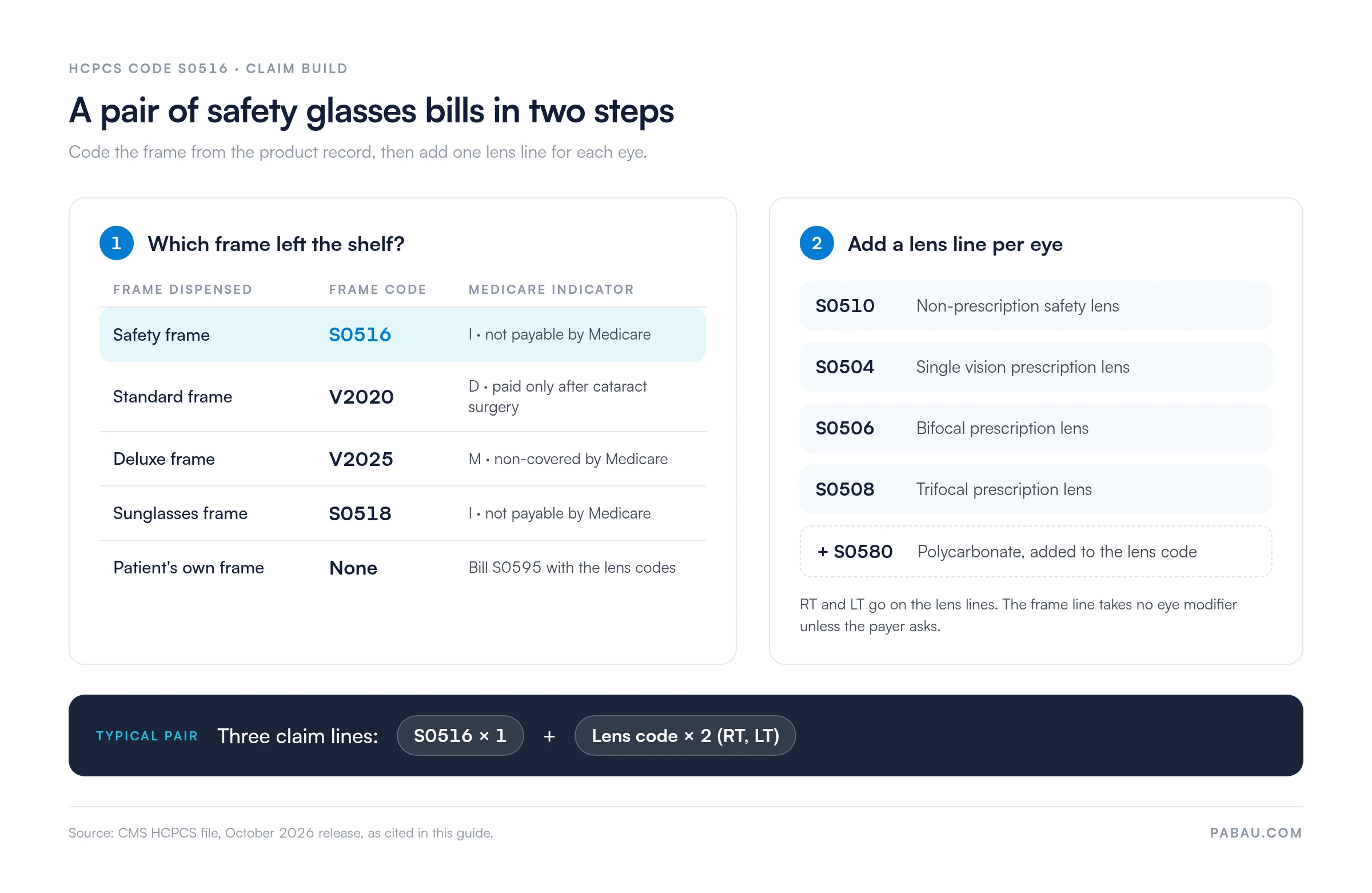
The frame’s purpose decides the code. Safety frames take S0516, standard eyeglass frames take V2020, and sunglasses frames take S0518. Each descriptor below is quoted from the October 2026 CMS HCPCS file, with its Medicare coverage indicator.
V2020 is the default for an ordinary eyeglass frame. It is also the only frame code Medicare can pay, and then only after cataract surgery. Billing S0516 for a standard frame invites a denial or a recode request.
S0518 is the frame code coders swap with S0516 most often. Payer policy treats the two differently. The Centene and Envolve Vision optical hardware policy (CP.VP.06) sets medical necessity criteria for safety frames but names none for sunglasses frames.
Code the frame from the product record, not from the patient’s description. A frame sold as an impact-rated safety frame takes S0516. A dress frame fitted with impact-resistant lenses is still a standard frame, so the frame line stays V2020.
Traditional Medicare does not pay S0516. Its CMS coverage indicator is I, not payable by Medicare. Medicare covers eyeglasses only as one pair with standard frames after each cataract surgery that implants an intraocular lens. That post-cataract frame bills as V2020, not S0516.
The eyeglass frames section of the Medi-Cal Vision Care provider manual lists S0516 beside V2020 and V2025. Its billing rules for the safety frame are strict:
That manual section is dated August 2020, so confirm the current DHCS version before you submit. Medi-Cal managed care members follow their health plan’s vision rules instead.
Running insurance eligibility verification before the frame is ordered shows whether the plan lists S0516 and needs authorization. It also shows when the last frame was paid.
Pair S0516 with the ICD-10-CM code that explains why the patient needs an impact-resistant frame. The Centene and Envolve policy lists qualifying codes for its two safety-frame indications. The table samples that list.
Other payers keep their own lists, and many publish none for S0516. Medi-Cal asks for medical justification on the TAR instead, so the clinical note has to make the case for the safety frame.
A defensible S0516 claim shows what the frame was, why it was dispensed, and which lenses went into it. Keep these elements in the patient record before the claim goes out:
Centene’s policy states that practices keep the material invoice and a detailed item description for every manually priced code. A frame claim without the invoice is hard to defend in a post-payment review.
Most S0516 denials trace back to the payer, the frame type, or a missing authorization. The CARC codes below are typical, though payers vary in which code they return.
Reading medical billing denial codes correctly decides the response. A CO-96 from Medicare confirms the non-coverage, so it needs no appeal. A CO-197 means the authorization was missing, so recoding the frame won’t get it paid.
These checks take a couple of minutes and prevent most of the denials above. Run them on every claim that carries a safety frame.
Clean frame claims usually clear without manual review. Running these checks inside a clean claim workflow keeps the audit trail in one place.
Optical practices often sell frames from one system, chase authorizations in another, and bill from a third. The frame type, the TAR number, and the supplier invoice get retyped at each step. Each retype is another chance to bill a standard frame as S0516.
In Pabau, the practice software we build, frames sit in inventory with their supplier cost and product details. Selling one at checkout draws it from stock and adds it to the patient’s invoice. Your billing team then codes from the item that left the shelf.
Pabau’s claims software for practices tracks each submission’s status and flags denials as they arrive. A rejected frame line then gets worked while the invoice and authorization are still at hand.

Pabau links frame inventory, checkout, and claims on one patient record, so your optical claims carry the right frame code and every lens line. See how it works for your practice.

Treat every S0516 dispense as a three-line claim from the start. The frame code alone never pays for a finished pair of safety glasses.
Then settle who pays, and on what paperwork, before the frame is ordered. Traditional Medicare never will. Medi-Cal and many Medicaid plans pay only with an approved authorization, a qualifying reason, and the invoice.
Get the authorization and the frame record right, and an S0516 claim seldom needs an appeal. Book a demo to see how Pabau keeps frame stock, checkout, and optical claims on one patient record.

Need a framework for managing claim rejections systematically? Denial management in healthcare covers how to build a denial tracking and appeal workflow that reduces write-offs across your payer mix.
Want frame claims that survive a payer audit? Medical billing compliance covers the documentation standards that keep manually priced claims defensible.
New to the claims cycle behind optical billing? Medical billing fundamentals explains the end-to-end claims lifecycle from superbill to remittance.
Fitting prescription safety lenses? HCPCS code S0504 covers the single vision lens line that most often sits beside S0516.
Dispensing polycarbonate lenses? HCPCS code S0580 explains how the add-on lens code is billed with the basic lens.
HCPCS code S0516 covers a safety eyeglass frame, billed as one unit per frame. It does not include the lenses, which bill separately per lens. Standard eyeglass frames use V2020, and sunglasses frames use S0518.
No. CMS lists S0516 with coverage indicator I, not payable by Medicare. Medicare pays for one pair of standard frames after cataract surgery, and those bill as V2020. Some Medicare Advantage plans carry their own vision benefits, so check the plan directly.
S0516 is for safety eyeglass frames built for impact protection. V2020 is for standard eyeglass frames. Medicare can pay V2020 after cataract surgery but never pays S0516, and Medi-Cal requires authorization for S0516 only.
S0516 is for safety eyeglass frames, and S0518 is for sunglasses frames. Both bill one unit per frame, and neither is payable by Medicare. The frame record decides which code applies.
Yes. The Medi-Cal Vision Care manual requires a 50-3 TAR with medical justification for S0516. The frame is priced manually from the wholesale price, so the claim needs an attached invoice or catalog page.
The most common causes are billing traditional Medicare, a missing authorization, and a missing invoice for a manually priced frame. A standard frame coded as S0516 and absent medical necessity notes also trigger denials.