

CPT Code 30801: Superficial turbinate ablation billing guide
CPT Code 30801: Official descriptor and procedure overview The American Medical ...

Last Updated: Nov 27, 2026
Q4161 is the HCPCS Level II code for Bio-ConneKt wound matrix, per square centimeter. It is an add-on supply code, listed in addition to the primary skin substitute application procedure. It reports the acellular collagen matrix itself, one unit per sq cm applied, not the work of applying it.
The application goes on the same claim under CPT 15271–15278, chosen by wound site and total wound size. For 2026, Medicare pays Q4161 as an incident-to supply at a flat rate of about $127.14 per sq cm, and discarded product is not billable.
Let Pabau's smart automation suggest the right codes, reduce claim denials, and keep your practice compliant—effortlessly.
Automate repetitive tasks and focus on what matters most—your patients.
Reduce coding errors and ensure compliance with the latest regulations.
Clean claims, fewer denials, and faster reimbursements.
Powerful insights and reporting to help your practice thrive.
HIPAA compliant SOC 2 certified GDPR-compliant Trusted by 4,000+ clinics worldwide

HCPCS Code Q4161 reports Bio-ConneKt wound matrix per sq cm, and it always goes on the same claim as an application code from CPT 15271–15278.
Bill one Q4161 unit per sq cm of product applied, and choose the CPT code by wound site and total wound surface area.
For 2026, Medicare pays Q4161 as an incident-to supply at about $127.14 per sq cm, and discarded product is not billable.
Prior authorization and conservative-care requirements come from each payer’s policy, so check the payer and any applicable LCD before the application visit.
In Pabau, the practice records the prior authorization code, dates and sessions on the case, and gets a warning when one is missing.
HCPCS Code Q4161 is the Level II supply code for Bio-ConneKt wound matrix, billed per square centimeter (sq cm) of product applied.
CMS’s HCPCS quarterly update files list it as an add-on code, reported in addition to the primary application procedure. The Centers for Medicare & Medicaid Services (CMS) maintains the HCPCS Level II code set and publishes changes to it every quarter.
Q4161 describes the supply, while a CPT code describes the procedure of applying it. Both belong on the same claim. The application CPT code tells the payer what was done, and Q4161 tells the payer which product was used and how much. Submitting one without the other is a common and avoidable denial trigger.
Q4161 covers the product, not its application. It reports Bio-ConneKt wound matrix, an acellular collagen matrix, while the application itself is billed with a CPT code from 15271–15278. It is typically used on diabetic foot ulcers (DFUs) and venous leg ulcers (VLUs) that have not healed with standard care.
Coverage depends on the payer’s policy. Where an applicable LCD or payer policy is in force, it usually asks for documented wound measurements and photographs. It also expects a trial of conservative wound care and a physician order naming the product. Many of these policies set that trial at four weeks.
Coverage policies for skin substitutes usually list the chronic wound types they cover. A claim for a wound outside that list is likely to be denied. Acute surgical wounds healing by primary intention are a typical example. The new DFU and VLU skin substitute LCDs were withdrawn on December 24, 2025, before they took effect. Novitas, First Coast and CGS keep older skin substitute policies, so check which rules your contractor and each commercial payer apply.
Each Q4161 unit represents one sq cm of Bio-ConneKt wound matrix applied to the wound. The wound measurement and the size of the product opened must both appear in the medical record on the date of service.
Use this process for unit calculation:
Worked example: A wound measures 3.5 cm x 4 cm = 14 sq cm. The practice opens a 16 sq cm sheet, applies 14 sq cm, and discards 2 sq cm. Bill 14 units of Q4161 to Medicare, with no JW or JZ modifier. A payer that still follows the JW policy would expect 14 units on one line and 2 units with JW on a second line.
Always document wound measurements in length x width format in the clinical note, not just the total area. Reviewers cross-check the note against the billed units. A note with only the total area can trigger an audit query even when the math is correct.
HCPCS Code Q4161 is a supply code, not a procedure code, so the application needs a companion CPT code on the same claim. Using Q4161 without an application code leads to a denial for a missing procedure. Submitting the CPT code without Q4161 leaves the product unpaid. The right application code depends on two facts from the note, as the grid below shows.
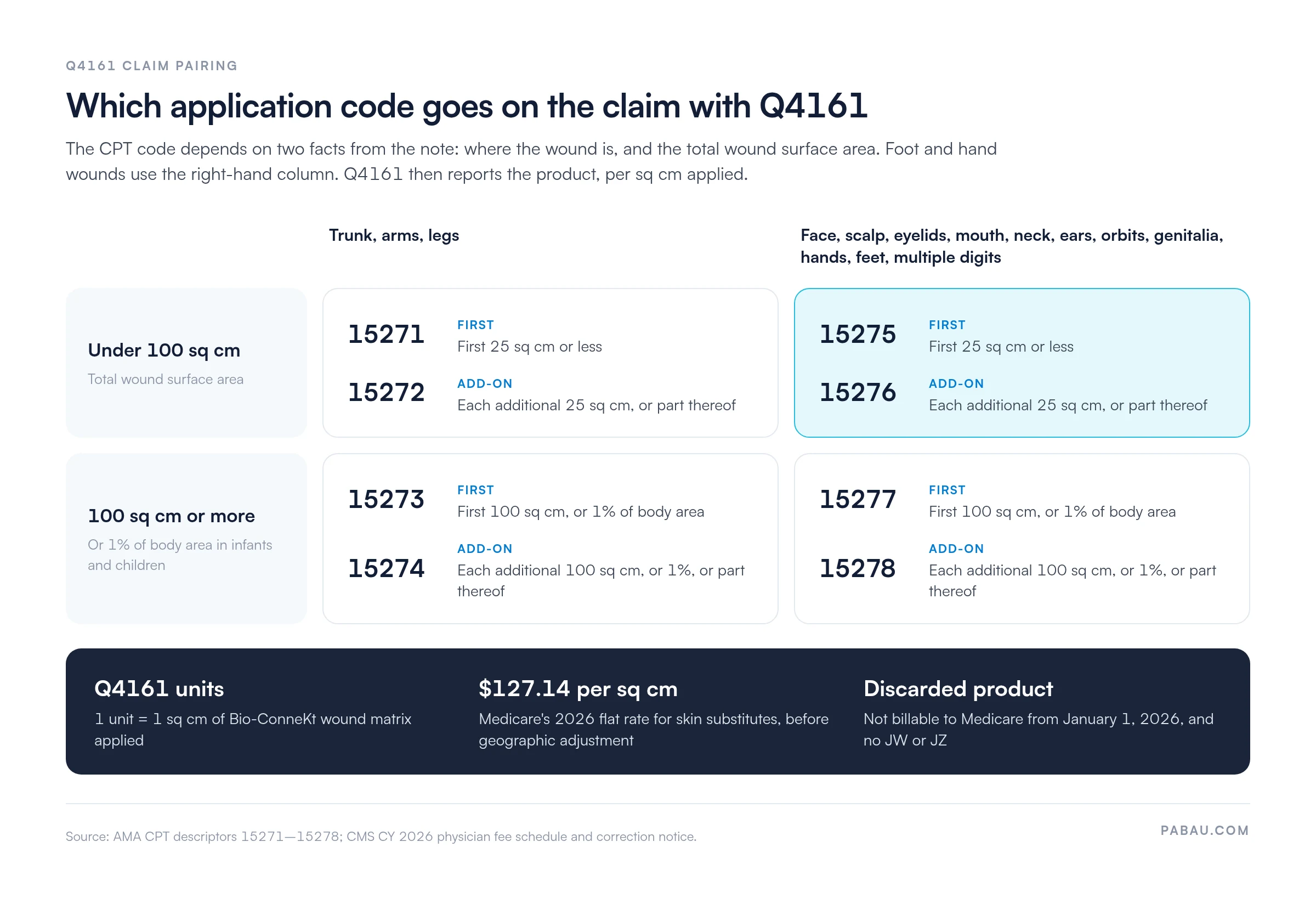
Wounds under 100 sq cm in total use the 25 sq cm codes. Wounds of 100 sq cm or more use the 100 sq cm codes. The full set of application codes:
Check the current National Correct Coding Initiative (NCCI) edits for the application code and any same-day service, such as debridement. Modifier 59 belongs only where an edit allows it and the services are genuinely distinct. Use the AAPC HCPCS code lookup to cross-reference current code descriptor details.
The Q4100-series skin substitute codes are product-specific, so each Q-code maps to one named product. When the billed code does not match the product on the invoice, the payer denies the line. These are the codes most often confused with Q4161:
The product name on the invoice and label decides the Q-code, not the wound type or location. Bio-ConneKt bills as Q4161, while a flowable such as WoundEx Flow bills as Q4162. Surgigraft sheets follow the same rule and are reported per square centimeter under Q4183. Verify the mapping in the CMS quarterly HCPCS file, the PGM Billing HCPCS lookup tool or our HCPCS guides for billers before each claim cycle.
Three modifiers come up with Q4161, and Medicare now treats two of them differently from other payers. Since January 1, 2026, Medicare claims for non-BLA skin substitutes such as Q4161 carry neither JW nor JZ. APMA’s summary of the CMS change confirms that only the administered units can be billed.
Commercial and Medicaid plans set their own wastage rules. A payer that applies the CMS drug-waste policy expects JZ when nothing is discarded, and JW on a separate line for the discarded amount. Check each payer’s skin substitute policy, and record the opened, applied and discarded amounts in the note either way.
Q4161 can be billed in a physician office or a hospital outpatient department. In 2026, Medicare pays the product separately in both settings at the same flat per-sq-cm rate.
Q4161 falls in the 510(k) category, one of the three groups CMS uses for skin substitutes alongside PMA and 361 HCT/P products. Confirm the current-quarter OPPS Addendum B entry before billing in a hospital outpatient setting. Use the CMS Physician Fee Schedule search to check the office-setting payment for the year.
Since January 1, 2026, Medicare pays skin substitutes such as Q4161 as incident-to supplies under the physician fee schedule, replacing payment at ASP plus 6%. The CY 2026 rule set one flat rate per sq cm, and a November 2025 correction notice fixed it at $127.14 per sq cm. The rate is adjusted for geography, so the amount paid varies by locality.
CMS’s CY 2027 final rules, released in November 2026, keep the sheet-product rate at $127.14 per sq cm. The CrossCoder crosswalk tool can help verify APC assignment alongside code descriptors. For the annual and quarterly code files, refer to the CMS HCPCS coding and billing page.
Commercial payers reimburse Q4161 at their contracted rate. Some still pay skin substitutes on their own fee schedule, while others have moved to a flat per-sq-cm rate in line with Medicare. Verify each payer’s contract terms before projecting revenue on these claims. Check Medicare Informatics HCPCS tables for historical payment data comparisons.
Prior authorization (PA) for HCPCS Code Q4161 is required by many commercial payers and Medicare Advantage plans. Traditional Medicare generally does not require PA for skin substitutes outside the WISeR model. The CMS WISeR model has run in Arizona, New Jersey, Ohio, Oklahoma, Texas and Washington since January 1, 2026. It adds PA for skin substitutes only in those states where an active skin substitute LCD applies.
For payers that do require PA, the submission package typically includes:
Verify requirements per payer and per claim, because PA policies can change mid-year. Thorough insurance eligibility checks before each application visit confirm active coverage and PA requirements before the product is opened.
Every Q4161 claim needs a medical record that can survive a post-payment review. A missing element is enough for a denial or recoupment, even when the product was clinically appropriate and correctly coded. The billing compliance requirements for skin substitute claims are among the most documentation-heavy in outpatient wound care.
A diabetic foot ulcer in type 2 diabetes is usually coded as E11.621. A second code then identifies the ulcer site and depth. Check that both appear on the policy’s covered list before the claim goes out. If the ulcer sits on a previous skin graft site, the ulcer codes still lead and Z94.5 can follow to record the graft history.
Skin substitute claims draw close payer scrutiny because they combine product cost, unit math and medical necessity rules. These are the most common Q4161 denial triggers, with the corrective action for each. Building denial management workflows into the pre-submission check stops most of them before they reach the payer.
Run a short pre-submission check on every Q4161 claim. Confirm the PA covers this Q-code and that any required care trial is documented. Then check that units match the product applied and the companion CPT code is present. Finally, confirm the wastage follows the payer’s rule and the ICD-10 code is on the covered list. Each step takes under a minute, while a denied claim can take hours to appeal.
The documentation and pre-submission steps for Q4161 repeat at every application visit. Spread across paper notes, payer portals and spreadsheets, those steps are where authorizations lapse and photos go missing. Pabau, a practice management platform, keeps those records together alongside its insurance claims software.
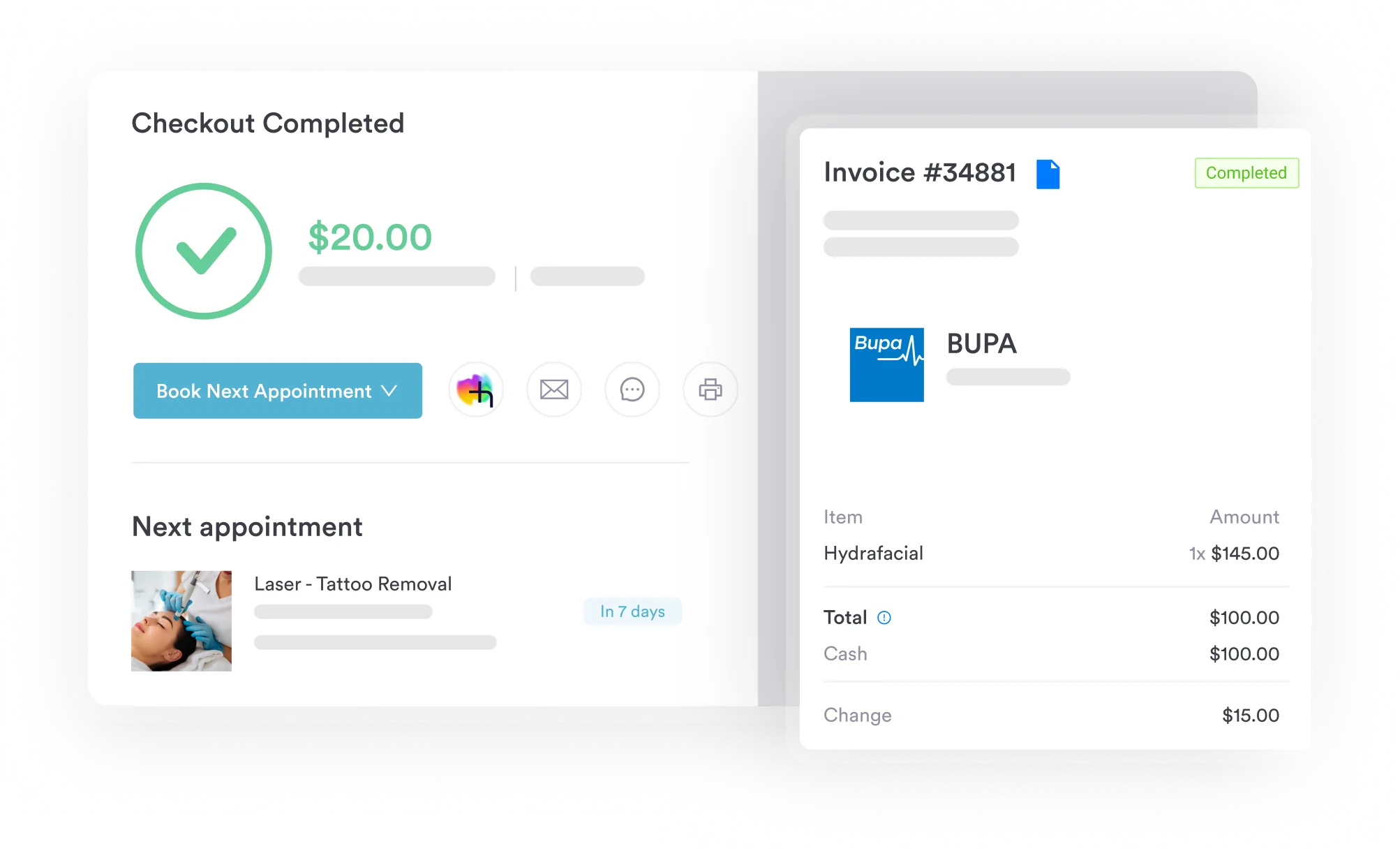
In Pabau, the practice records the prior authorization code, its dates and the number of sessions on the patient’s case. A warning appears when an authorization is missing. Before-and-after wound photos are captured and tied to the patient record, next to the visit notes and the physician order.
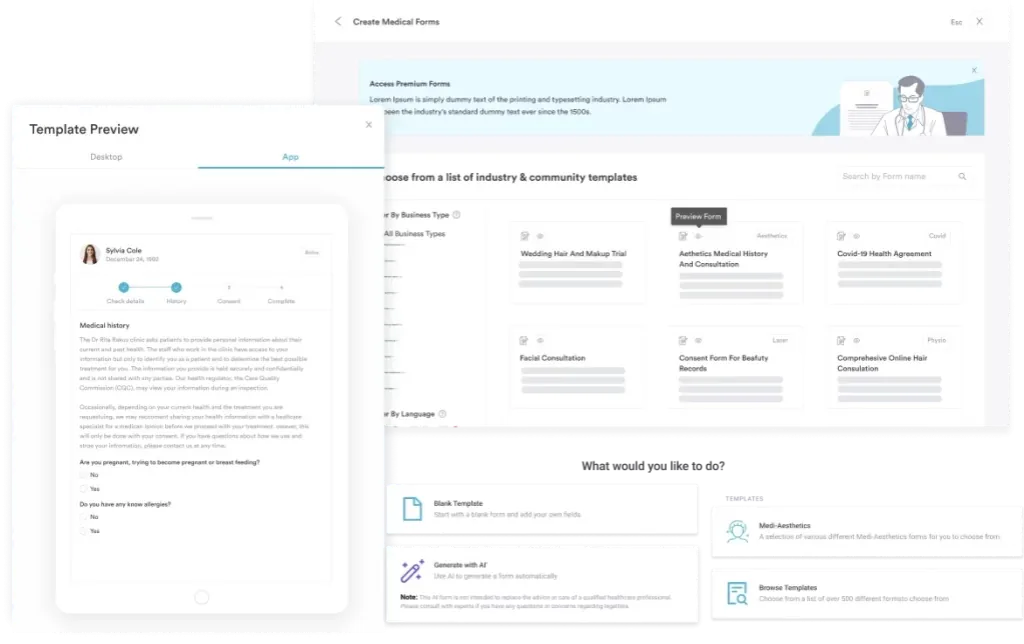
US practices send claims through Claim.MD as CMS-1500/837P claims, with eligibility checks and ERA remittances in the same workflow. The coder still enters the units and any payer-specific modifiers, but works from one patient record. That consistency helps keep clean claim submission the norm for Q-code claims.

Pabau tracks prior authorization codes, dates and sessions on the patient’s case and warns you when one is missing. Wound photos, trial notes and orders stay on the same record as the claim.

From 2026, Q4161 billing runs on new Medicare rules. Medicare now pays a flat rate per sq cm, discarded product earns nothing, and JW and JZ are gone from Medicare claims. Practices that still bill from an ASP-era checklist will under-document waste for commercial payers and over-bill it to Medicare.
Rebuild the checklist around two records: the product size opened and the area applied. With those in the note, the CPT size band, the units and each payer’s wastage rule follow directly. Book a demo to see how Pabau keeps authorizations, wound photos and claims on one record for your wound care practice.

Billing a neighboring skin substitute? HCPCS code Q4163: Woundex and BioSkin billing guide covers the per-sq-cm sheet product next to Q4161 in the code set.
Working with amniotic membrane products? HCPCS code Q4160: NuShield billing guide explains the units and documentation for NuShield.
Need a compliant billing workflow for other wound care codes? Denial management in healthcare covers the full workflow for identifying, appealing, and preventing denied claims across code types.
Trying to understand payer coverage requirements before submitting? Billing compliance requirements outlines the documentation and coverage standards wound care practices need to meet.
Looking to streamline your entire revenue cycle? What is revenue cycle management explains how to connect clinical documentation, coding, and collections into one accountable workflow.
HCPCS Code Q4161 covers Bio-ConneKt wound matrix, billed per square centimeter of product applied. It is used on chronic wounds such as diabetic foot ulcers and venous leg ulcers. It covers the product, not its application. The application is billed on the same claim with a CPT code from 15271–15278.
One unit equals one square centimeter of product applied. Measure the wound length and width, choose a product size that covers it, and bill the sq cm applied. The note should record the wound measurements, the size opened and any amount discarded.
For Medicare claims from January 1, 2026, Q4161 carries neither JW nor JZ, and discarded product is not billable. Payers that still apply the JW/JZ policy expect JZ when nothing is discarded, and JW on a separate line for waste. Modifier 59 applies only when an NCCI edit allows it and the services are distinct.
Many commercial payers and Medicare Advantage plans require prior authorization for Q4161. Traditional Medicare generally does not, outside WISeR states with an active skin substitute LCD. Where an applicable LCD or payer policy is in force, it often requires a four-week conservative wound care trial first.
POS 11 (physician office) and POS 22 (hospital outpatient) are both valid. In 2026, Medicare pays Q4161 separately in both settings at a flat rate of about $127.14 per sq cm. In the hospital outpatient setting, it sits in APC 6001 for 510(k) skin substitute products.
Q4161 denials commonly trace back to documentation. Typical causes are a missing prior authorization or a required care trial the notes don’t show. Units that don’t match the product applied are another. A pre-submission check of each item prevents most of them.




