CPT code 21011: Excision of soft tissue tumor of the face
CPT code 21011: Official descriptor and procedure overview CPT code 21011, as pu...

Last Updated: Oct 8, 2026
Q4162 is the HCPCS Level II code for woundex flow, bioskin flow, 0.5 cc.
Application is now reported with HCPCS G0681-G0684 rather than the CPT 15271-15278 series. The product itself is packaged into that application service instead of being paid separately.
Let Pabau's smart automation suggest the right codes, reduce claim denials, and keep your practice compliant—effortlessly.
Automate repetitive tasks and focus on what matters most—your patients.
Reduce coding errors and ensure compliance with the latest regulations.
Clean claims, fewer denials, and faster reimbursements.
Powerful insights and reporting to help your practice thrive.
HIPAA compliant SOC 2 certified GDPR-compliant Trusted by 4,000+ clinics worldwide

HCPCS Code Q4162 covers WoundEx Flow and BioSkin Flow, a non-sheet flowable skin substitute billed in 0.5 cc units
Since January 1, 2026, application of a flowable product is reported with G0681-G0684; CPT 15271-15278 now covers sheet products only
Q4162 is packaged into the application service, so the product line does not generate its own Medicare allowance
The flat national rate of about $127.14 per sq cm applies to sheet products under APCs 6000, 6001 and 6002, not to Q4162
JW and JZ modifiers are rejected on skin substitute claims for dates of service from January 1, 2026
The skin substitute LCDs due to start in 2026 were withdrawn in December 2025; Novitas, First Coast and CGS apply their existing policies
Pabau’s claims management tools support HCPCS Q-code entry and documentation capture for wound care billing
HCPCS Code Q4162 is the CMS-assigned Level II code for WoundEx Flow and BioSkin Flow, 0.5 cc. The Centers for Medicare and Medicaid Services (CMS) maintains the Q4100-Q4200 series as temporary codes for individual skin substitute products. Q4162 sits in the non-sheet branch of that series, which matters for both the unit count and the payment route.
A flowable product is supplied as a volume, not as a sheet cut to the wound. That is why the descriptor names a volume of 0.5 cc and why the unit count is not a square-centimeter figure.
Key facts for any Q4162 claim:
Because Q-codes are temporary designations, always verify the descriptor against the current CMS HCPCS quarterly release before submitting claims. Codes in this series can be reassigned, retired, or have their descriptors updated mid-year.
Medicare no longer pays Q4162 as a separately payable biological. Since January 1, 2026, CMS treats most non-BLA skin substitute products as incident-to supplies rather than as drugs priced from average sales price (ASP). Q4162 is a non-sheet product, and non-sheet products stay packaged into the application service for CY 2026.
The change came from two final rules: the CY 2026 Physician Fee Schedule rule (CMS-1832-F) and the CY 2026 OPPS and ASC rule (CMS-1834-FC).
For sheet products, CMS deliberately unpackaged the product cost into three new APCs, 6000, 6001 and 6002, each carrying status indicator S1. Those APCs pay a single flat national rate of roughly $127.14 per square centimeter for CY 2026.
That flat per-square-centimeter rate does not reach Q4162. It applies to sheet products, and a flowable product is not billed by surface area at all. Reading the 2026 model as one rate for every skin substitute is a common and expensive mistake. The comparison below sets the old rules against the current ones, line by line.
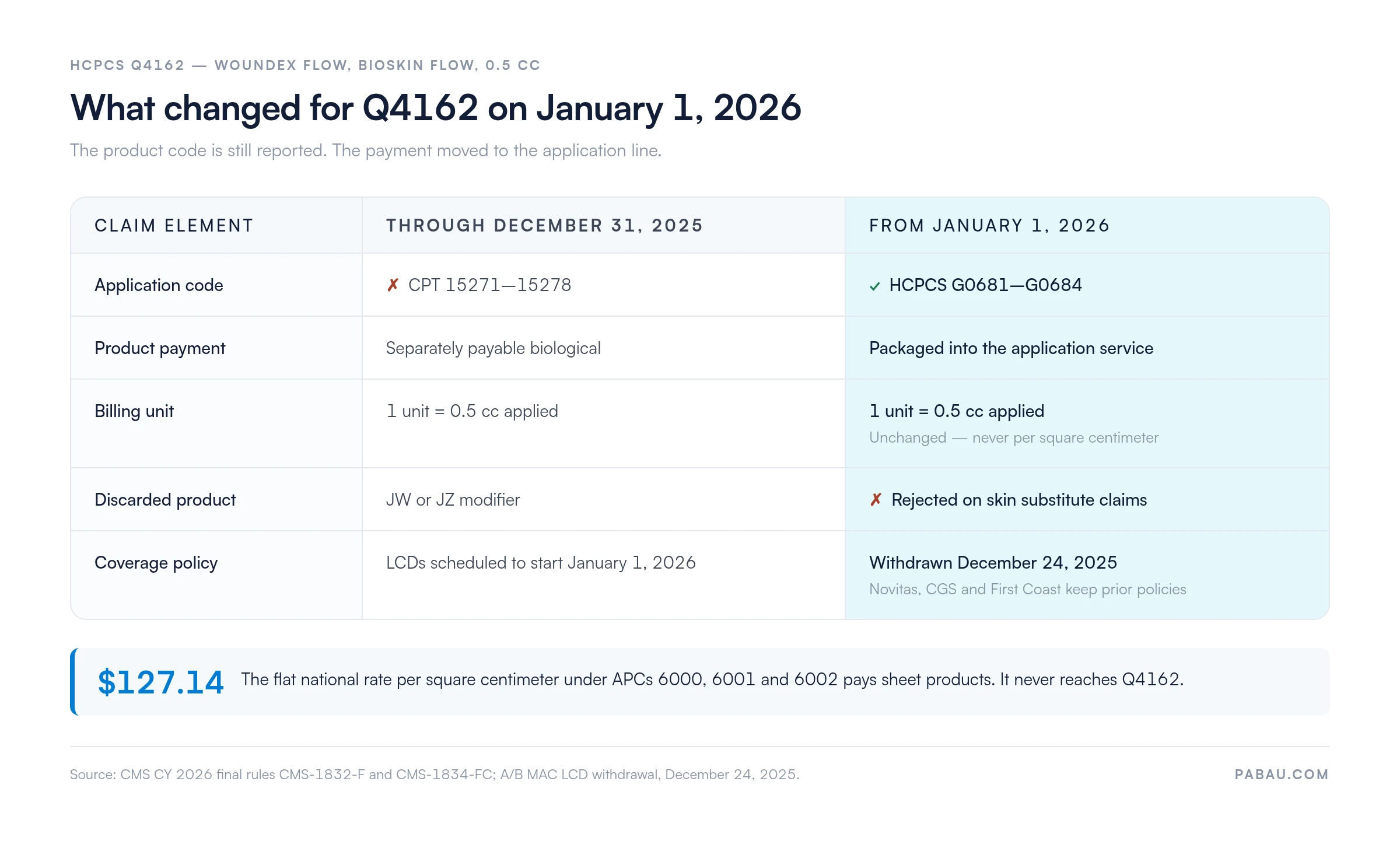
Payment arrives through the application code, not through the product code. In the office setting, the non-sheet application codes G0681-G0684 carry their own relative value units and are paid under the Physician Fee Schedule.
The allowed amount reflects those RVUs, the documented wound surface area, the local geographic indices, and the annual conversion factor.
Q4162 is still reported on the claim, with units, on the same date of service as the application code. It does not generate a separate allowance of its own. In the hospital outpatient setting the packaging is tighter still, since CMS assigned the non-sheet application codes a packaged status indicator effective April 1, 2026.
Only products licensed under Section 351 of the Public Health Service Act remain on ASP-based separate payment. Q4162 is not one of them, so a prior-year ASP figure for this code no longer predicts what Medicare will pay.
Discarded product is no longer billable either. The JW and JZ modifiers are not permitted on skin substitute claims. Claims carrying either modifier are rejected for dates of service on or after January 1, 2026. Bill only the volume actually administered.
Checking the remittance advice after adjudication is the fastest way to confirm which line paid. On a correctly built 2026 claim, the payment sits on the G-code line and the Q4162 line adjudicates at zero.
There is no current Local Coverage Determination governing skin substitute grafts and cellular or tissue-based products. The A/B MACs withdrew the LCDs that were scheduled to take effect on January 1, 2026, and CMS announced the withdrawal on December 24, 2025.
Coverage now rests on the policies that were already in force. Three contractors kept theirs: Novitas Solutions, CGS Administrators, and First Coast Service Options. Their retirement dates were removed, so practices in those jurisdictions follow the same criteria they used before.
The remaining jurisdictions have no published skin substitute LCD. There, each claim is judged case by case against the reasonable-and-necessary standard, which puts more weight on the medical necessity narrative in the chart.
Billing HCPCS Code Q4162 correctly means pairing it with a non-sheet application code and converting the volume applied into 0.5 cc units. The discarded-portion modifiers stay off the claim. Missing any one of these steps is enough to trigger a denial.
Accurate billing starts at the point of service. Capturing wound measurements and the volume applied electronically at the visit reduces transcription errors before the claim ever reaches the payer.
The diagnosis codes accepted alongside Q4162 now depend on which MAC processes the claim. Novitas, CGS and First Coast each publish a covered diagnosis list in the skin substitute policy they retained.
In every other jurisdiction there is no published list, so the diagnosis has to carry medical necessity on its own. The table below shows the categories that appear most often on paid wound care claims.
Check your contractor’s coverage page each time it is revised. A retained policy can still be updated, and a diagnosis that was accepted under an earlier version may have been dropped. Each ulcer code carries its own laterality and staging requirements, which the ICD-10-CM code library sets out in full.
Medicare sets the floor for Q4162 coverage, but commercial payers often apply stricter criteria. Many have not adopted the 2026 packaging model at all. Checking eligibility before each visit reveals whether the plan covers skin substitutes, and whether prior authorization is required.
Common payer policy variations to track:
Keeping payer-specific policy documentation current beats applying one set of Medicare rules to every submission. Reconfirm the policy at each renewal cycle, since skin substitute criteria were widely rewritten during 2026.
Identify which MAC processes your claims before you rely on any covered diagnosis list. Novitas, CGS and First Coast kept their existing skin substitute policies after the 2026 LCDs were withdrawn in December 2025. The other jurisdictions have no published LCD at all, so the medical necessity narrative in the chart carries the whole claim.
Documentation problems sit close behind unit and application-code errors as a cause of Q4162 denials. The progress note has to stand alone as evidence of medical necessity. An auditor reading only the chart note should see why a flowable skin substitute was the right choice.
A complete Q4162 claim package includes:
Build an encounter form that captures wound dimensions and applied volume alongside the Q-code line. It cuts the documentation burden at billing time and keeps unit counts tied to the clinical record.
The Q4100-Q4200 series assigns a unique code to each skin substitute product. Q4162 is not interchangeable with the others, even where the products look clinically similar. The sheet and non-sheet split matters most, because it decides both the unit of measure and the application code series.
Confirm the current descriptor for Q4162 with the AAPC HCPCS code lookup, then cross-reference it against the product you actually applied.
Most Q4162 denials are preventable, and since January 2026 most of them share one root cause. The claim was built on the payment model that applied before the rules changed. Robust denial management strategies cut the time spent on rework and speed up payment.
A clean claim means every field is correct before it leaves your system. For Q4162 that covers the application code, the 0.5 cc unit count, and the ICD-10 pairing. It also covers the place of service, the supporting documentation, and the absence of a JW or JZ modifier.
Wound care practices billing HCPCS Code Q4162 run a multi-step documentation and billing workflow that breaks easily at any point. Practice management software like Pabau keeps that workflow in one system.
Its claims management software supports HCPCS Q-code entry alongside the companion application code, so both lines land in a single encounter record.
Wound dimensions and the volume applied get recorded digitally at the point of service, which keeps the figures tied to the claim. That is what stops the unit-count and application-code errors behind most Q4162 denials. Digital forms capture product lot numbers and application dates inside the clinical note, so the audit trail builds itself.
The result is a shorter path from application to payment. Your coder opens the encounter, finds the wound area and the volume applied already recorded, and builds both claim lines from the same note. Nobody has to chase the treating clinician for a measurement two weeks after the visit.
Build a 2026 Q4162 checklist into your pre-submission workflow. Confirm the wound surface area in sq cm, the application code from G0681-G0684, and the volume converted to 0.5 cc units. Then check that no JW or JZ modifier is on the claim. Both lines belong on the same date of service, with an ICD-10 your MAC supports. Running this before submission catches the errors that followed the January 2026 payment change.

Pabau’s claims management tools let wound care practices capture HCPCS Q-code entries, document wound measurements, and submit clean claims without switching between systems.

HCPCS Code Q4162 changed direction on January 1, 2026. The product code is still reported, but payment now runs through the G0681-G0684 application line rather than the product line. Most denials this year trace back to a claim built on the older model. That usually means a CPT application code, units counted by surface area, or a JW modifier on discarded product.
So the work to do now is unglamorous. Rebuild your Q4162 claim template around the G-code, retrain whoever enters units, and forecast revenue from the application allowable rather than the product. Practices that do this once stop rewriting the same denial every month.
Pabau’s claims management tools help wound care practices enter HCPCS Q-codes accurately and capture wound measurements and applied volume at the point of care. That record becomes the audit-ready documentation behind a clean claim. Book a demo to see how the Q4162 workflow would run in your practice.

Need a compliance overview for billing workflows? Medical billing compliance outlines the documentation and audit standards that apply to HCPCS and CPT claims.
Looking for a full HCPCS code reference? Medical billing fundamentals explains how HCPCS Level I and Level II codes fit within the overall billing framework.
HCPCS Code Q4162 is the CMS Level II Q-code for WoundEx Flow and BioSkin Flow, 0.5 cc. It identifies a non-sheet, flowable skin substitute, and one unit equals 0.5 cc of product applied. Unlike sheet products in the Q4100-Q4200 series, it is not billed by the square centimeter.
Report Q4162 with the volume applied converted into 0.5 cc units, so 2 cc equals 4 units. Pair it with an application code from the G0681-G0684 non-sheet series on the same claim and the same date of service. CPT 15271-15278 no longer applies to flowable products. Leave the JW and JZ modifiers off, attach a supported ICD-10 code, and match the place of service to the setting.
Q4162 can be covered, but no Local Coverage Determination governs it right now. The A/B MACs withdrew the skin substitute LCDs that were set to start on January 1, 2026, and CMS announced that on December 24, 2025. Novitas, CGS and First Coast continue to apply their pre-existing skin substitute policies. Every other jurisdiction judges each claim case by case against the reasonable-and-necessary standard.
There is no separate rate for Q4162 itself. Since January 1, 2026, CMS pays most non-BLA skin substitutes as incident-to supplies, and non-sheet products like this one stay packaged into the application service. The payment sits on the G0681-G0684 line, priced from its RVUs under the current-year Physician Fee Schedule. The flat national rate of about $127.14 per sq cm covers sheet products under APCs 6000, 6001 and 6002, and it does not apply here.
No. The JW and JZ modifiers are not permitted on skin substitute claims. Claims carrying either one are rejected for dates of service on or after January 1, 2026. Bill only the volume actually administered to the wound. Discarded product cannot be billed under any circumstance, and it cannot be folded into the administered unit count either.
Document the wound measurement in centimeters at each application, the volume of product applied in cc, and the product label or lot number. Add evidence of prior conservative wound care and a medical necessity narrative. That narrative carries extra weight in jurisdictions with no published skin substitute policy. Commercial payers may also want prior authorization records and step therapy documentation.
Each code in the Q4100-Q4200 series is assigned to a named product, and the sheet or non-sheet split drives the billing. Q4162 is flowable, billed per 0.5 cc, and applied under G0681-G0684. Sheet products such as Q4101 for Apligraf or Q4107 for GRAFTJACKET are billed per sq cm and applied under CPT 15271-15278. Billing the wrong Q-code for the product applied triggers a denial and a compliance correction.