CCSD code H4430: Examination of rectum under anaesthetic
CCSD code H4430 pays for the examination alone CCSD code H4430 is the UK private...

Last Updated: Oct 20, 2026
Q4160 is the HCPCS Level II code for nushield, per square centimeter (add-on, list separately in addition to primary procedure).
Q4160 denials cluster at three points: the unit count, a missing companion CPT code, and thin medical necessity documentation. It also covers what the record has to show before a claim goes out.
Q4160 is a product supply code. It reimburses for the NuShield graft itself, not for the act of applying it. The application procedure requires a separate companion CPT code, covered in the companion CPT section below.
Let Pabau's smart automation suggest the right codes, reduce claim denials, and keep your practice compliant—effortlessly.
Automate repetitive tasks and focus on what matters most—your patients.
Reduce coding errors and ensure compliance with the latest regulations.
Clean claims, fewer denials, and faster reimbursements.
Powerful insights and reporting to help your practice thrive.
HIPAA compliant SOC 2 certified GDPR-compliant Trusted by 4,000+ clinics worldwide

HCPCS code Q4160 describes NuShield amniotic membrane allograft, billed per square centimeter as a skin substitute under Medicare’s Q-code series
CMS now pays Q4160 at one geographically adjusted national rate of $127.14 per square centimeter, in both hospital outpatient and physician-office settings
The high-cost vs low-cost classification and the C5271-C5278 application codes were retired on January 1, 2026, so guidance built around them is out of date
Choose the companion CPT code from 15271-15278 by anatomic site group and total wound surface area, not by surgical versus non-surgical wound type
Pabau’s claims management software captures Q4160 units, companion CPT pairings, and wound measurement records in a single workflow, reducing rework at submission
NuShield is an amniotic membrane allograft derived from placental tissue. Amniotic membrane grafts contain growth factors, cytokines, and extracellular matrix components that are thought to support wound healing by reducing inflammation and promoting tissue regeneration. The precise regulatory classification under FDA 361 HCT/P rules should be confirmed with the manufacturer before clinical use.
Clinically, NuShield is used across a range of chronic and acute wound types where standard care has failed to achieve adequate closure. Common applications include:
Medicare coverage for NuShield depends on the applicable Local Coverage Determination (LCD) issued by the Medicare Administrative Contractor (MAC) for the beneficiary’s jurisdiction. Coverage criteria vary by MAC, so confirming the relevant LCD before billing is essential. Do not assume universal Medicare coverage for any specific wound type.
CMS pays Q4160 at a single national rate of $127.14 per square centimeter, adjusted for geographic locality. That rate applies in the hospital outpatient department and in the physician office alike. It took effect on January 1, 2026 and remains in force.
The CY2026 OPPS/ASC and Physician Fee Schedule final rules rebuilt skin substitute payment. CMS unpackaged sheet-form skin substitutes, so the product is now paid separately from the application procedure. It then gave every in-scope product status indicator S1 and sorted them into three new Ambulatory Payment Classifications by FDA regulatory pathway.
All three groupings pay the same per-square-centimeter amount for CY2026. The FDA pathway therefore decides which APC a product lands in, not what it earns. Q4160 is a 361 HCT/P sheet allograft, which puts NuShield squarely in scope for the new methodology.
One figure needs care. The CY2026 Physician Fee Schedule final rule of October 31, 2025 listed $127.28 per square centimeter. A CMS correction notice dated November 28, 2025 aligned the fee schedule with the OPPS amount of $127.14. Bill against $127.14, and treat any source still quoting $127.28 as superseded.
Until the end of 2025, CMS sorted skin substitutes into high-cost and low-cost groups against a cost threshold it recalculated each year. High-cost products drew separate payment. Low-cost products were packaged into the application procedure, and the facility absorbed any amount above the composite rate.
That model was retired effective January 1, 2026, and the low-cost application codes C5271 through C5278 were deleted with it. A MASS Coalition and CAMPs challenge to the new policy was dismissed on jurisdictional grounds in the Northern District of Texas. No delay, injunction, or rescission followed, so the CY2026 framework stands.
Any payer policy, coding crosswalk, or internal billing sheet that still sorts NuShield as high-cost or low-cost is out of date. Rewrite it before the next claim goes out, and check that nobody on the billing team is still working from a 2025 cheat sheet.
The amount Medicare pays for Q4160 no longer depends on the setting. CMS pays the same national rate in the hospital outpatient department and in the physician office, subject to geographic adjustment. What still differs between the two is how the claim is assembled and who carries the product cost.
In a hospital outpatient department or ambulatory surgery center, the facility bills Q4160 alongside the companion application CPT code. Q4160 carries status indicator S1, so the product is paid separately rather than packaged into the application APC. Payment is the locality-adjusted national rate multiplied by the square centimeters of NuShield applied.
Packaging under the old low-cost designation no longer happens, and the C-codes that supported it were deleted for 2026. A facility that budgeted for packaged payment on some skin substitutes should revisit those assumptions.
In the physician office, Q4160 is paid under the Medicare Physician Fee Schedule at the same $127.14 per square centimeter, adjusted for locality. CMS matched the two settings deliberately, which removes the site-of-service arbitrage the old classification produced. Confirm the locality-adjusted amount in the current fee schedule file before you bill.
Match the remittance line for Q4160 against the units you billed on every claim. A short payment usually means the unit count was cut, not that the rate changed. Catching that at posting is far cheaper than appealing it later.
Rates are revisited each year in the OPPS and Physician Fee Schedule final rules. The $127.14 figure is the CY2026 amount, and it applies until CMS publishes a new one. Quoting a prior year’s rate as current is a common and expensive billing error.
Before submitting any Q4160 claim, check the place of service code and the unit count. Place of service no longer changes the per-square-centimeter rate, but it still routes the claim to the correct fee schedule and edit set. A wrong place of service remains one of the most common avoidable denial reasons for skin substitute Q-codes.
Q4160 covers the NuShield product only. A separate CPT code is required to bill the application procedure. The correct companion code depends on exactly two variables. The first is the anatomic site group of the wound. The second is the total wound surface area, measured in square centimeters.
There is no surgical versus non-surgical split inside 15271 to 15278. That distinction belongs to the separate surgical preparation codes 15002 through 15005, which describe preparing the wound bed rather than applying the graft. Conflating the two families is a reliable way to pick the wrong code.
The grid below turns those two variables into a single lookup, and marks the split that does not exist.
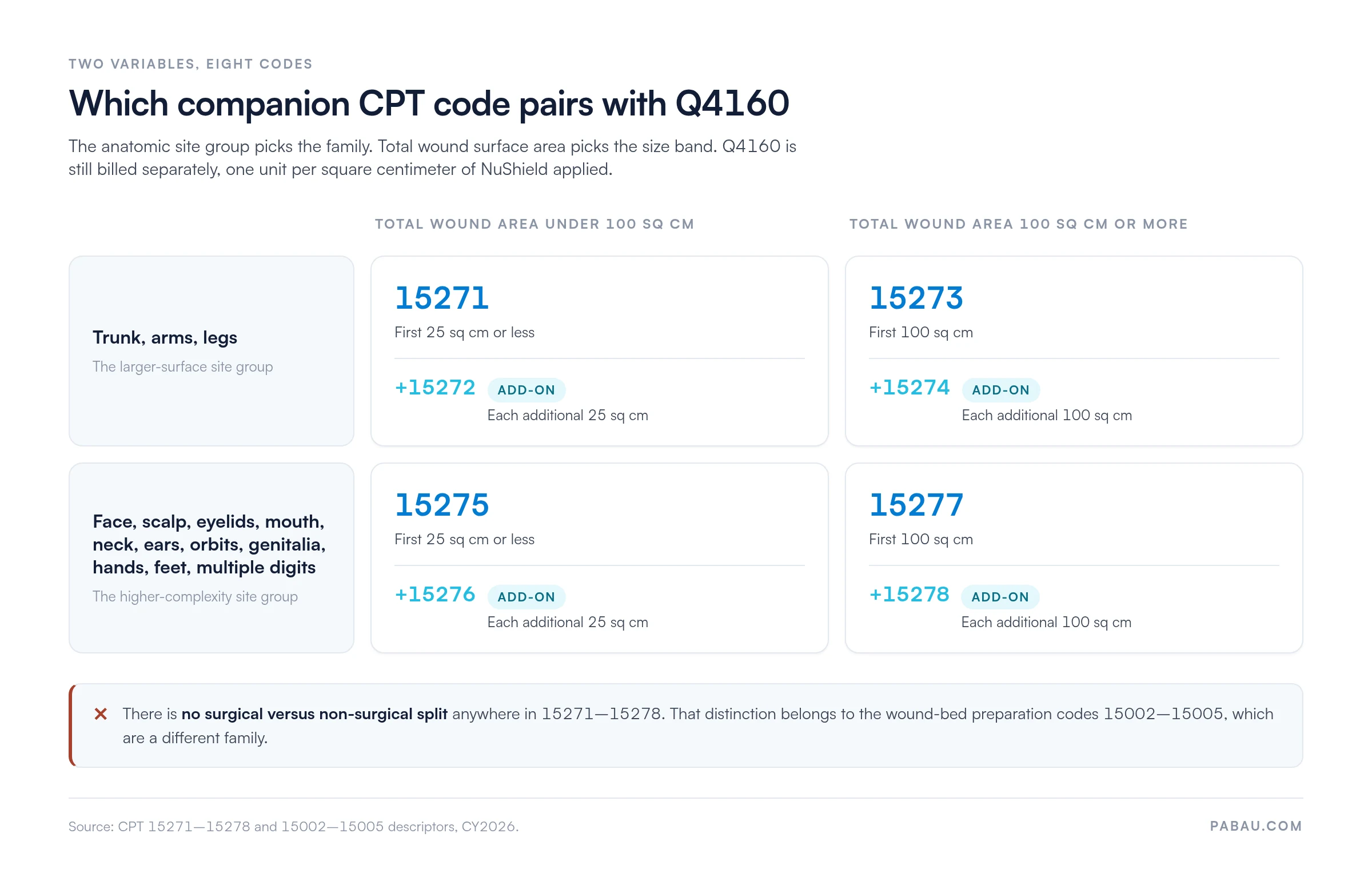
Worked example: A 30 sq cm ulcer on the calf falls in the trunk, arms, and legs group and under 100 sq cm total. Bill 15271 for the first 25 sq cm, plus one unit of 15272 for the remaining 5 sq cm. Q4160 is billed separately at 30 units, one per square centimeter of NuShield applied.
The low-cost application codes C5271 through C5278 were deleted effective January 1, 2026. Strip them from charge masters, order sets, and payer crosswalks, because a claim that still carries one will reject.
Verify all CPT-to-HCPCS pairings against current National Correct Coding Initiative (NCCI) edits before submission. Bundling rules change annually, and an edit that was not active last year may deny a claim this year. The AAPC Codify HCPCS lookup includes bundling edit information alongside code descriptors.
Q4160 claims require documentation that supports both the product’s use and the quantity billed. Incomplete records are the second most common denial trigger for skin substitute codes, behind unit calculation errors.
A Q4160 claim clears on the first pass when all of the following sit in the patient record before submission:
Digital wound documentation forms prompt clinicians to capture every required field at the point of care. That reduces retrospective record requests, and it keeps claims from going out with missing data.

Skin substitute billing has one of the highest denial rates in wound care. Most errors are preventable with the right pre-submission checks. Here are the mistakes that surface most often with Q4160 claims.
Q4160 is billed per square centimeter of product applied, so the unit count must match the documented wound area. If the wound measures 3 cm by 4 cm, the correct unit count is 12, not 1.
Billing a single unit for the whole application, whatever the wound size, is the most common Q4160 error. It underpays the practice, and it leaves a discrepancy against the documented wound size that auditors spot quickly. A pre-submission unit check belongs in the billing workflow for that reason alone.
Q4160 alone does not describe a complete billable service. Submitting the supply code without the application CPT code results in a denial because the claim lacks the procedure that justifies the supply. Always check that the companion CPT (15271-15278) is on the same claim as Q4160.
Two mistakes account for most companion CPT denials. The first is treating a hand, foot, or facial wound as a trunk, arm, or leg wound. That points the claim at 15271 instead of 15275. The second is ignoring the 100 sq cm threshold and billing 15271 where 15273 applies.
A third error is inherited from older guidance that split these codes by surgical versus non-surgical wound type. No such split exists in CPT, and coding to it produces a mismatch the payer catches. Reviewing your denial codes by wound site often shows the same mismatch repeating across a practice.
Many MAC LCDs require evidence that the wound did not respond to at least 4 weeks of standard care before a skin substitute is used. If the clinical note does not document prior treatment failure, the claim may be denied on medical necessity grounds. Clinical appropriateness will not save it. Write the practice’s documentation standard against the LCD language for your own MAC jurisdiction.
The CY2026 OPPS/ASC and Physician Fee Schedule final rules changed skin substitute billing more than any update in the past decade. Five points matter for a practice billing Q4160.
Wound care teams that bill skin substitutes should book a fixed review of the OPPS and Physician Fee Schedule final rules every fall. The Q-code series and its companion CPT codes deserve their own line on that review.
Medicare’s CY2026 allowable for Q4160 is $127.14 per square centimeter before geographic adjustment. The locality multiplier for the servicing address turns that into the amount on the remittance. Two practices can therefore post different totals for the same graft.
For commercial payers, Q4160 coverage and reimbursement vary widely. Some insurers follow Medicare rates, others negotiate separate schedules, and a few exclude amniotic membrane products from coverage entirely. Verify commercial coverage before applying NuShield, and obtain prior authorization where the policy requires it.
Key steps for confirming Q4160 rates before a claim goes out:
When submitting Q4160 claims with multiple units, include the wound measurement calculation in the billing notes. Some payers request this as supporting documentation during pre-payment review. Having it ready reduces delay without requiring a separate records request.
Q4160 is one of many skin substitute Q-codes in the HCPCS Level II series. Each Q-code describes a specific product and is not interchangeable with another. Using the wrong Q-code for the product applied is a billing error, even if both products are amniotic membrane allografts. The CY2026 flat rate does not change that, because the claim still has to name the product that was used.
Always use the product-specific Q-code. Q4100 (not otherwise specified) is a catch-all used when no product-specific code exists. Because Q4160 exists for NuShield, Q4100 is not appropriate for NuShield billing. Confirm the current Q-code assigned to a specific skin substitute product before billing it, because product-to-code assignments do change.
The rule reaches beyond amniotic membrane products. Keramatrix and Kerasorb are keratin-based skin substitutes, and they bill under Q4165, also per square centimeter.
Product form matters too. Epifix sheet grafts bill under Q4186, while the injectable form carries its own code, Q4145. Check the form on the product packaging before you pick between them.
Truskin is another product with a dedicated code. It bills under Q4167, so the Q4100 catch-all does not apply to it.
The per-square-centimeter unit on Q4160 ties billing accuracy directly to clinical documentation. If wound measurements are not captured at the point of care, the billing team goes back to the clinical note for them.
They then calculate the unit count by hand and cross-check it against the documented dimensions. That step introduces transcription errors and delays submission.
Practice management software like Pabau closes that distance by holding both records in one system. Pabau’s claims management software connects patient records and measurement tracking to claim generation. When wound dimensions are documented in the patient record, the Q4160 unit count follows from them without a manual step.
Beyond unit calculation, integrated practice management supports skin substitute billing through:
Revenue cycle work in wound care comes down to shortening the distance between what happens clinically and what gets submitted. The unit calculation error alone costs a practice money every time wound measurements get retyped into a billing system by hand.

Pabau’s digital documentation tools record wound dimensions at the point of care. Q4160 unit counts and companion CPT selections then pull through to your claims workflow automatically. No transcription, no rework.

HCPCS code Q4160 is straightforward in concept and demanding in execution. The per-square-centimeter unit structure, the companion CPT pairing rules, and the LCD-driven medical necessity criteria each create a point where a claim can fail. The CY2026 payment overhaul adds another. Any process still built around high-cost and low-cost classification now produces wrong answers.
Pabau’s claims management tools connect point-of-care documentation to the billing workflow, so the unit count on the claim matches the wound the clinician measured.
Book a demo with the team to see how Pabau handles Q4160 unit calculation, companion CPT pairing, and claim checks.

Billing a wound of 100 sq cm or more? CPT code 15273 covers the first 100 sq cm of skin substitute application on the trunk, arms, and legs.
Want to reduce claim denial rates across your wound care billing? Denial management in healthcare covers the systematic approach to tracking, appealing, and preventing claim denials.
Looking for a structured approach to wound care documentation compliance? Medical billing compliance practices outlines what documentation standards apply to HCPCS supply codes and how to audit your records before submission.
HCPCS code Q4160 is used to bill for NuShield amniotic membrane allograft, a skin substitute product applied to chronic or acute wounds. It is billed per square centimeter of product applied. A companion CPT application code from 15271-15278 must appear on the same claim.
Neither. CMS retired the high-cost versus low-cost classification for skin substitutes on January 1, 2026. Q4160 is now paid at a single geographically adjusted national rate of $127.14 per square centimeter. That rate applies in both hospital outpatient and physician-office settings. The old classification is history, not current guidance.
CPT codes 15271-15278 are billed alongside Q4160 for the application procedure. The correct code depends on the anatomic site group and the total wound surface area, not on whether the wound is surgical. Codes 15271-15274 cover trunk, arms, and legs. Codes 15275-15278 cover the face, scalp, eyelids, mouth, neck, ears, orbits, genitalia, hands, feet, and multiple digits.
Documentation must include wound measurements in centimeters, the underlying ICD-10 diagnosis, and product lot information. You also need evidence of prior standard wound care failure, typically 4 weeks per MAC LCD requirements. A physician order and the application clinical note are required too. Missing any of these elements commonly results in a medical necessity denial.
Medicare pays Q4160 at $127.14 per square centimeter for CY2026, adjusted for geographic locality. The same rate applies under OPPS in the hospital outpatient department and under the Physician Fee Schedule in the office. The product is paid separately from the application CPT code, and rates are revisited each year.
The CY2026 final rules retired the high-cost versus low-cost model and unpackaged sheet-form skin substitutes. CMS also deleted application codes C5271-C5278 and set one national rate of $127.14 per square centimeter. Q4160 is grouped in the 361 HCT/P pathway APC with status indicator S1. Coverage still follows your MAC’s LCD.
Use $127.14. The CY2026 Physician Fee Schedule final rule of October 31, 2025 published $127.28 per square centimeter. A CMS correction notice on November 28, 2025 aligned the fee schedule with the OPPS amount of $127.14. Sources still quoting $127.28 have not picked up that correction.