ICD-10 Code Z66: Do not resuscitate status
ICD-10 code Z66 is the billable ICD-10-CM diagnosis code for do not resuscitate ...

Last Updated: Nov 25, 2026
Billable Code Specific Code
Z94.5 is the billable ICD-10-CM code for skin transplant status. It records that a patient has had a skin graft and that the graft is currently stable.
Coders often confuse it with the T86.82- series (complications of skin graft) or with active wound codes that belong as the primary diagnosis. The code sits in Chapter 21 of ICD-10-CM. It is almost always sequenced as a secondary code behind the reason for the encounter.
Let Pabau's smart automation suggest the right codes, reduce claim denials, and keep your practice compliant—effortlessly.
Automate repetitive tasks and focus on what matters most—your patients.
Reduce coding errors and ensure compliance with the latest regulations.
Clean claims, fewer denials, and faster reimbursements.
Powerful insights and reporting to help your practice thrive.
HIPAA compliant SOC 2 certified GDPR-compliant Trusted by 4,000+ clinics worldwide

Z94.5 records a prior skin transplant with no current complication. It is not used when the graft is failing, infected or rejected.
The code is billable in the FY2027 ICD-10-CM code set and covers autografts and allografts of any thickness.
Z94.5 is almost always a secondary code. The reason for the encounter, such as wound care or a follow-up exam, is listed first.
A documented graft complication takes a T86.82- code, and Z94.5 stays off the claim for that encounter.
Pabau, a practice management platform with claims management built in, checks each claim for missing or invalid details before you submit it.
ICD-10 Code Z94.5 is the billable ICD-10-CM status code for a patient who has had a skin transplant and whose graft is now stable. Its official descriptor is “Skin transplant status,” and the FY2027 ICD-10-CM tabular list also places “autogenous skin transplant status” under it. The code applies only while no failure, rejection or other graft complication is documented. It sits in block Z77-Z99 within Chapter 21, Factors influencing health status and contact with health services.
Z94.5 has no subcategories by graft type or thickness. The Z94 category includes an organ or tissue replaced by a heterogenous or homogenous transplant. One code therefore covers autografts, allografts, split-thickness grafts and full-thickness grafts alike. Practices treating post-burn reconstruction patients, cancer excision closures or chronic wounds that needed grafting will see this code regularly.
The CDC/NCHS ICD-10-CM code files list Z94.5 as valid and billable for FY2027, the code set in effect since October 1, 2026. The FY2027 addenda made no change to it. Under Section I.C.21 of the ICD-10-CM Official Coding Guidelines, status codes like Z94.5 report a health state that affects care. They add context to the reason for the encounter and do not replace it.
Check Z94.5 against the new code set at the start of each fiscal year. CMS and NCHS publish updated ICD-10-CM files for October 1 every year. The Z94 family has been stable, but a quick check keeps a retired or restructured code off your claims.
Z94.5 captures the status of a skin transplant when the graft is functioning without documented complication. The code applies regardless of whether the original transplant used the patient’s own tissue or donor tissue.
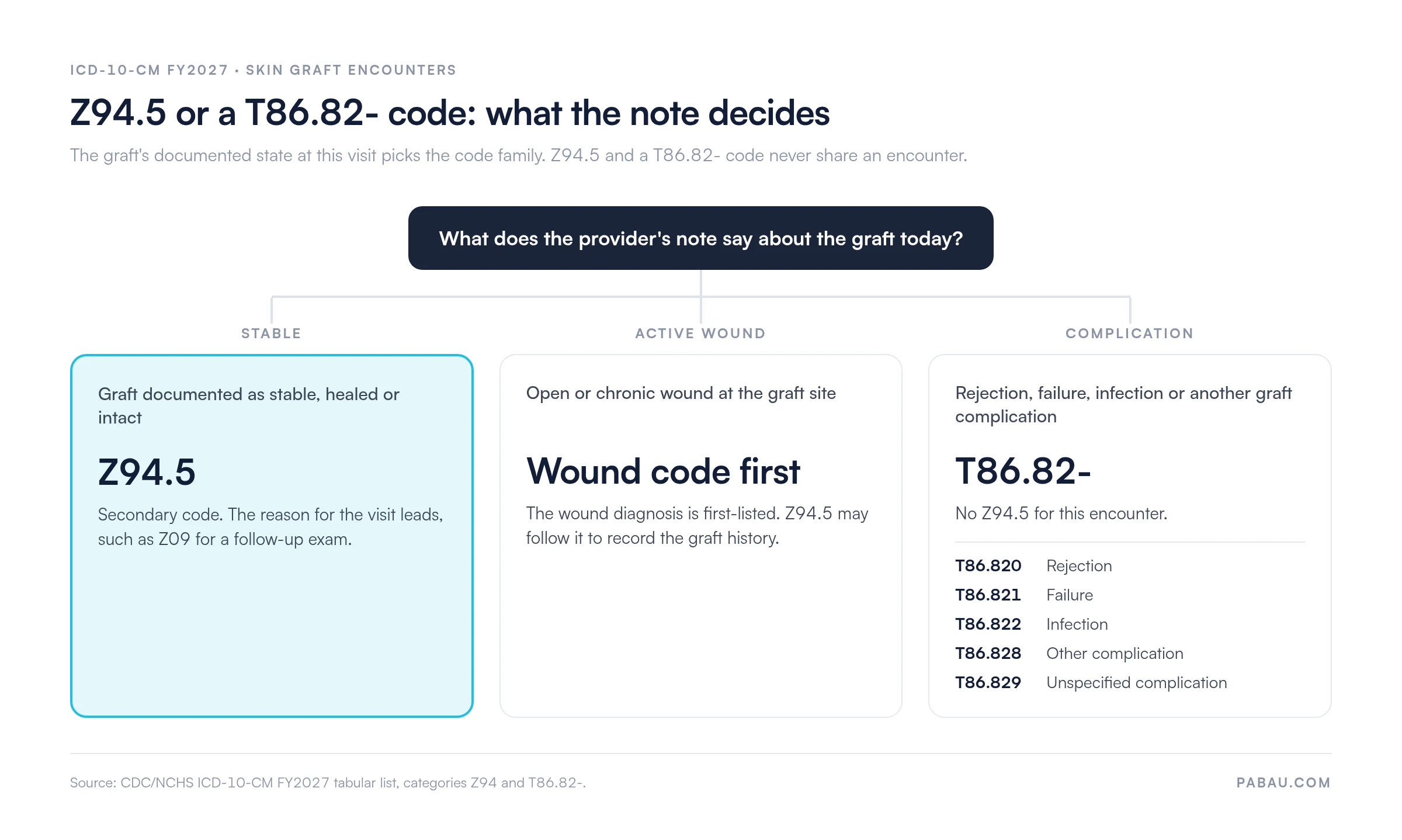
The Z94 category carries an Excludes1 note for complications of the transplanted organ or tissue, which sends coders to the Alphabetical Index. For a skin graft, that index entry leads to T86.82-. Z94.5 and a T86.82- code therefore never appear together for the same encounter, and the diagram below shows how the note decides between them.
Z94 is the parent category for transplanted organ and tissue status across all organ systems. Knowing the full sibling list prevents miscoding a skin graft as a corneal or bone transplant status.
The AAPC Codify ICD-10-CM lookup displays inclusion notes and Excludes1/Excludes2 flags for each code in the Z94 family. Use it to confirm the correct sibling code during review.
Z94.5 is almost always a secondary code. The ICD-10-CM Official Coding Guidelines establish that status codes document a patient’s background health state. The reason for the encounter drives the principal or first-listed diagnosis.
Listing Z94.5 first when a wound care or complication code should lead is a sequencing error that gets claims denied. The CMS ICD-10-CM coding guidelines and annual updates are the authoritative reference for sequencing logic under Chapter 21.
Z94.5 surfaces across several encounter types. Knowing which clinical contexts require the code prevents both undercoding (missing relevant history) and overcoding (applying it when a complication code is more accurate).
A Z94.5 code is supportable only when the medical record explicitly documents the history of a skin transplant. Vague references to “previous surgery” or “wound history” are not sufficient. Good medical billing compliance starts with what the clinician writes.
The record should contain all of the following:
Clean claim submission for a Z94.5 encounter depends on the chart. Before the claim goes out, confirm the documentation supports every code on it.
Z94.5 is a diagnosis code and always pairs with one or more CPT procedure codes. The table below lists the CPT codes that appear most often on the same claim, confirmed against the AMA CPT codebook. The grafting surgery itself, such as 15100, is billed without Z94.5, because the status code starts at follow-up.
When submitting claims that pair wound debridement CPT codes with Z94.5, check National Correct Coding Initiative (NCCI) edits for bundling. Some debridement and E&M combinations trigger edits that need a modifier to unbundle appropriately. Pabau’s claims software for practices routes US claims through Claim.MD, a clearinghouse connected to thousands of US payers. Its claim validation catches missing or invalid details before you submit.
Z94.5 alone does not establish medical necessity. The primary diagnosis drives the necessity determination, and payer requirements vary considerably by plan type and MAC jurisdiction.
Medicare: Multiple Medicare Administrative Contractors (MACs) have issued Local Coverage Determinations (LCDs) for skin substitute grafts. These LCDs specify the diagnosis codes that support coverage and the documentation required to demonstrate medical necessity.
Z94.5 may appear as a secondary diagnosis in the covered-diagnosis list, but the wound or clinical condition code drives the coverage determination. Check the relevant MAC’s LCD for your jurisdiction before billing.
Medicaid: Prior authorization requirements for skin graft-related services vary significantly by state. Some state programs require PA for wound debridement when a prior graft is documented; others do not. Verify with the specific state program.
Commercial payers: Many commercial plans require prior authorization for active skin graft procedures but not for follow-up wound care encounters. When Z94.5 appears as secondary on a wound care claim, PA is typically not triggered by the status code itself. For medical billing fundamentals across payer types, confirming benefits and PA requirements at or before the time of service reduces post-claim denials.
Denials on claims carrying Z94.5 cluster around a small set of avoidable errors. For broader context on managing these rejections, denial management workflows and common medical billing denial codes are worth reviewing alongside this reference.
Choosing between Z94.5 and the T86.82- family changes the clinical picture the claim presents to the payer. That picture drives the coverage decision, so the choice has to match the note.
The clinical record is the deciding document. When the provider’s note describes the graft as stable and intact, Z94.5 is correct. When it describes failure, infection, rejection or any other active pathology of the graft, the appropriate T86.82- code is correct. Z94.5 then stays off the claim for that encounter. A documented rejection, for example, is coded T86.820.
The WHO ICD-10 browser provides the international classification context, while the CDC’s ICD-10-CM edition governs US billing.
Audit a sample of claims carrying Z94.5 quarterly. Focus specifically on encounters where a T86.82- code also appears in the same chart during the same visit period. Any encounter where both a status code and a complication code could be argued means the clinical documentation needs to be clearer before billing.
A Z94.5 follow-up claim usually fails on detail rather than on the code itself. A diagnosis pointer is missing, a payer field is blank, or the note never confirmed the graft was stable. Checking every follow-up claim by hand for those slips takes time your billing team rarely has.
Pabau keeps the graft history, the visit note and the claim in one patient record. Its claim validation flags missing or invalid details before you submit, and Claim.MD then carries the claim to the payer. Eligibility checks and ERA remittances run through the same connection.
Your coders can then spend their review time on the documentation question that decides between Z94.5 and T86.82-.

Pabau sends US claims through Claim.MD to thousands of payers and flags missing or invalid details before you submit. See how it fits skin graft and wound care billing.

Z94.5 rarely causes trouble on its own. Denials come from claims where the note never says the graft is stable, or where a complication code sits beside it. Treat the provider’s description of the graft as the deciding fact, and query the provider before billing when that description is missing.
Build that check into every graft follow-up and the status code stops being a denial risk. The trade-off is one extra documentation review on each graft follow-up, and it is the step that keeps those claims out of appeal.
Pabau checks each claim for missing or invalid details before you submit it. Book a demo to see how it supports skin graft and wound care billing in your practice.

Need to know what a clearinghouse checks before a claim reaches the payer? Pabau’s Claim.MD clearinghouse guide explains how claim validation works across US payers.
Coding the follow-up visit itself? ICD-10 code Z09 covers the follow-up exam code that often leads a Z94.5 claim.
Billing debridement at a graft site? CPT code 97597 sets out the documentation and add-on rules for open wound debridement.
Looking for a framework for denial prevention across code types? Revenue cycle management fundamentals covers the full workflow from coding to payment posting.
Need the ERA and remittance side of the billing cycle? Electronic remittance advice explained details how 835 ERA files close the loop on submitted claims.
ICD-10 Code Z94.5 is the billable ICD-10-CM diagnosis code for skin transplant status. It documents that a patient has received a skin graft and has no graft complication coded at this encounter. It belongs to Chapter 21 of ICD-10-CM and is used as a secondary code to provide clinical context for the encounter.
Yes, Z94.5 is a valid, billable ICD-10-CM code in the FY2027 code set, in effect since October 1, 2026. It has been a stable, unrevised code since ICD-10-CM implementation, and the FY2027 addenda made no change to it.
Yes, follow-up visits after skin grafting are one of the primary use cases for Z94.5 as a secondary code. The follow-up encounter code (Z09) or the clinical reason for the visit leads as the principal diagnosis. Z94.5 is listed additionally to document the graft history.
Z94.5 has no subcategory by graft source or thickness, so it applies to autografts, allografts, split-thickness grafts, and full-thickness grafts alike. The graft type should still be documented in the medical record for audit purposes, even though the code itself does not distinguish between them.
Z94.5 documents a stable skin graft with no active complication. T86.820–T86.829 document skin graft complications, including rejection, failure and infection. An Excludes1 note on category Z94 keeps the two families off the same claim for the same encounter.
Common companions include 97597-97598 for wound debridement at the graft site, 99213-99215 for E&M at follow-up visits, and 15271-15278 for skin substitute graft applications. The initial grafting CPT codes (15100, 15200) are procedure codes billed at the time of surgery, not at status-code follow-up encounters.