

HCPCS Code E0272: Foam rubber mattress billing guide
HCPCS Code E0272: official descriptor and code overview HCPCS Code E0272 is the ...

Last Updated: Nov 6, 2026
J7607 is the HCPCS Level II code for levalbuterol, inhalation solution, compounded product, administered through DME, concentrated form, 0.5 mg.
It bills per 0.5 mg, so units equal the milligrams dispensed divided by 0.5. Medicare's nebulizer LCD (L33370) denies compounded inhalation solutions, J7607 included, as not reasonable and necessary.
Let Pabau's smart automation suggest the right codes, reduce claim denials, and keep your practice compliant—effortlessly.
Automate repetitive tasks and focus on what matters most—your patients.
Reduce coding errors and ensure compliance with the latest regulations.
Clean claims, fewer denials, and faster reimbursements.
Powerful insights and reporting to help your practice thrive.
HIPAA compliant SOC 2 certified GDPR-compliant Trusted by 4,000+ clinics worldwide

HCPCS code J7607 covers levalbuterol inhalation solution that a pharmacy compounded in concentrated form, administered through DME and billed per 0.5 mg.
Units equal the total milligrams dispensed divided by 0.5, so a 1.25 mg dose bills as 2.5 units.
Medicare’s nebulizer LCD (L33370) denies compounded inhalation solutions, J7607 included, as not reasonable and necessary, so a signed ABN and the GA modifier matter.
FDA-approved levalbuterol bills under J7612 (concentrate) or J7614 (unit dose), and compounded unit-dose levalbuterol bills under J7615.
Pabau, the practice software we build, keeps the order, signed ABN, and claim in one patient record before each J7607 claim goes out.
HCPCS code J7607 is the Level II code for levalbuterol inhalation solution, compounded product, administered through DME, concentrated form, per 0.5 mg.
It is maintained by the Centers for Medicare and Medicaid Services (CMS). The code took effect on January 1, 2007, and remains active for 2026.
Levalbuterol is the R-enantiomer of albuterol, a short-acting bronchodilator given by nebulizer. Two words in the descriptor decide the code. “Compounded” means a pharmacy prepared the solution instead of dispensing an FDA-approved final product. “Concentrated” means the solution needs a diluent, such as saline, before it goes into the nebulizer.
Change either word and the code changes. The FDA-approved concentrate is J7612, and compounded levalbuterol in unit-dose form is J7615.
J7607 covers one product: levalbuterol concentrate that a pharmacy compounded and a DMEPOS supplier dispensed for nebulizer use. A different molecule, source, or form sends the claim to another code.
Four HCPCS codes cover levalbuterol inhalation solution, and all four bill per 0.5 mg. Two variables separate them: who made the solution and whether it is a concentrate or a unit dose.
Albuterol has its own four-code set, billed per 1 mg. J7609 is the compounded unit dose, J7610 the compounded concentrate, J7611 the FDA-approved concentrate, and J7613 the FDA-approved unit dose.
Pick the molecule first, then the source, then the form. The pharmacy invoice and the product label answer all three questions, and the grid below turns the levalbuterol answers into a code.
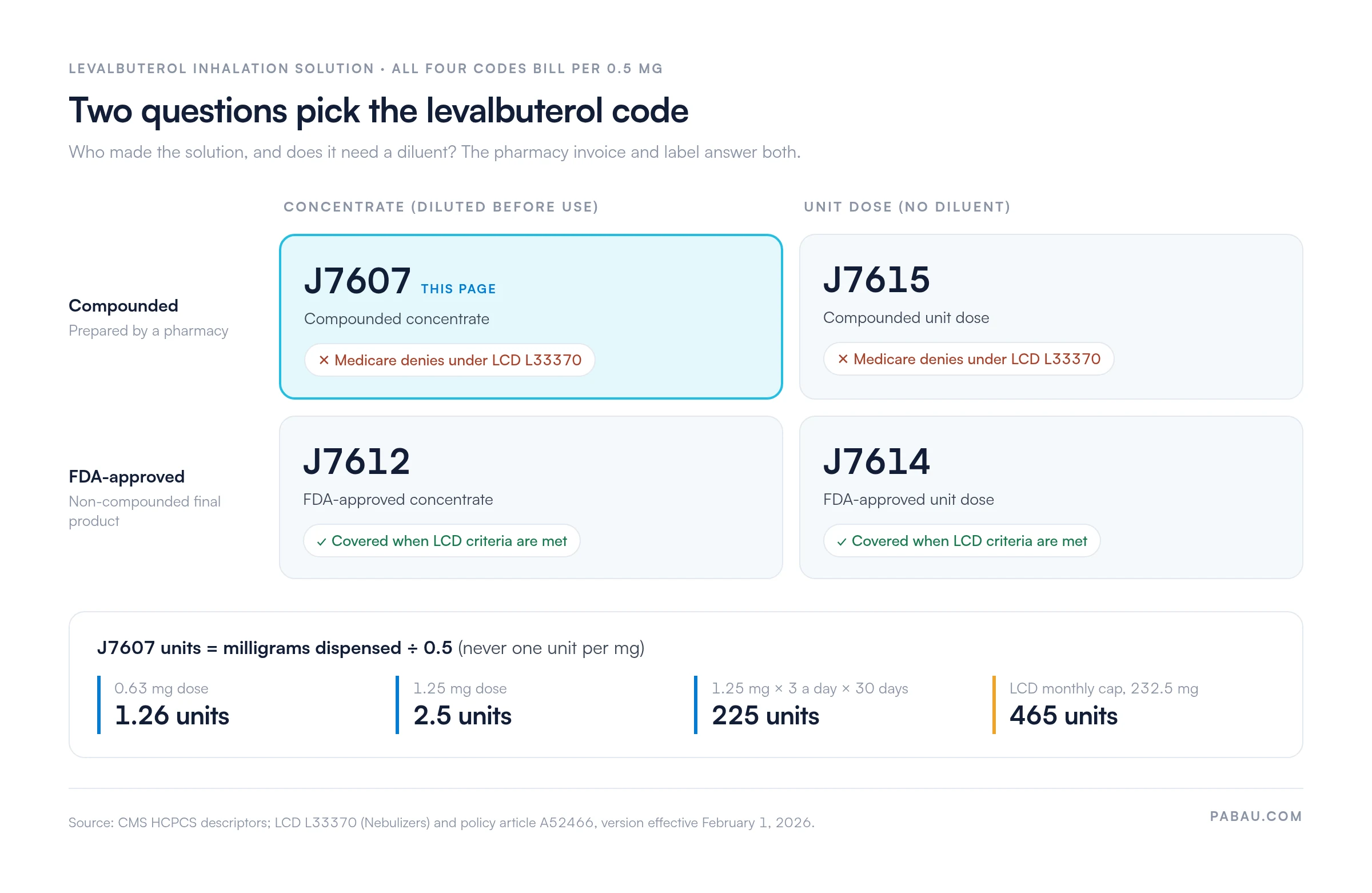
J7607 is billed per 0.5 mg of levalbuterol, so units equal the total milligrams dispensed divided by 0.5. A DMEPOS supplier usually bills a month’s supply, so count every dose dispensed for that billing period.
Common levalbuterol doses and their unit counts:
The most common unit error is billing one unit per milligram, a habit carried over from the albuterol codes. That halves the unit count on every claim. Some DME MACs expect whole units, so check your jurisdiction’s billing instructions for fractional totals.
LCD L33370 caps levalbuterol at 232.5 mg, or 465 units, per month. The cap drops to 39 mg, or 78 units, when levalbuterol is a rescue drug alongside formoterol or arformoterol.
Medicare handles nebulizer drugs used with home DME under the Part B DME benefit, and the DME MAC processes the claim. The governing policy is LCD L33370, Nebulizers, with its policy article A52466.
That LCD lists J7607 among the compounded inhalation solutions that “will be denied as not reasonable and necessary.” In practice, Medicare fee-for-service does not pay for J7607, however carefully the claim is built.
The covered route for levalbuterol is an FDA-approved product under J7612 or J7614. The LCD covers those for obstructive pulmonary disease when its criteria are met.
An enrolled DMEPOS supplier bills J7607 to the DME MAC on the CMS-1500 form or its electronic equivalent, the 837P. The supplier must hold active DMEPOS enrollment and meet the CMS supplier standards.
When a patient still wants the compounded product, the supplier should have them sign an Advance Beneficiary Notice of Noncoverage (ABN) before dispensing. The claim line then carries the GA modifier, and the patient becomes liable for the denied amount. Without a valid ABN, the line takes GZ and the supplier absorbs the loss.
The other LCD and policy article rules still shape the claim:
The DME MACs revise LCD L33370 several times a year, and the current version took effect on February 1, 2026. Confirm the active version in the CMS Medicare Coverage Database before each policy review. Adding that check to your medical billing compliance routine stops refills from shipping under a superseded version.
J7607 has no flat national rate to quote. The CMS HCPCS file gives it pricing indicator 51 (drugs) and Medicare coverage code C, which means carrier judgment.
On Medicare fee-for-service the price rarely comes into play, because LCD L33370 denies the line. What the supplier collects then depends on the ABN, and the patient pays under GA.
Commercial plans and state Medicaid programs set their own rates for compounded inhalation drugs. Check the payer contract or the state fee schedule before you quote a patient a monthly cost.
Every record below should be on file before the drug ships, rather than assembled after a request for records arrives. A missing order or ABN is what turns an expected Medicare denial into a supplier write-off.
J7607 denials cluster around a predictable set of billing errors. On Medicare, the medical necessity denial is expected, so the work is making sure liability lands with the right party. Effective denial management starts before submission, so the table pairs each error with its usual remark code and fix.
Our guide to denial codes explains the CARC and RARC codes behind each remark in this table.
J7607 is a concentrated form code, so the KO, KP, and KQ unit-dose modifiers do not apply. Policy article A52466 limits them to unit-dose codes, because a concentrate needs a separate diluent at administration.
J7607 does need one of three liability modifiers. A52466 rejects nebulizer claim lines without KX, GA, or GZ as missing information.
Billing a compounded product under J7612 to avoid the denial misrepresents what was dispensed. That kind of error attracts fraud and abuse review, so confirm the source on every refill.
Build the ABN into intake for every Medicare patient whose order specifies compounded levalbuterol. A signed ABN before the first shipment lets the supplier bill the patient after the expected denial. Without it, each month’s J7607 line becomes a write-off under GZ.
Every J7607 claim carries a diagnosis code describing the condition that needs nebulizer therapy. On Medicare, no diagnosis makes J7607 payable, because the LCD denies compounded solutions. The diagnosis still matters for commercial payers, and for any switch to J7612 or J7614.
Always pull the current LCD and policy article for your DME MAC jurisdiction to confirm the diagnosis groups for levalbuterol. The AAPC HCPCS code lookup is a quick cross-check on a code’s current descriptor.
R06.2 (wheezing) is a symptom code, so it fits only until the prescriber records a definitive diagnosis. Using it as the primary diagnosis on repeated claims for a patient with an established respiratory condition is a red flag in post-payment review.
A J7607 claim depends on paperwork from several sources. The order comes from the prescriber, the invoice from the compounding pharmacy, and the ABN from the patient. When those live in separate systems, a missing ABN usually surfaces only after the denial.
Pabau keeps forms, orders, and claims together in the patient record. Staff can send the ABN as a digital form for signature before dispensing. Pabau’s claims management software then validates each claim before it goes out and shows its status from pending to paid.
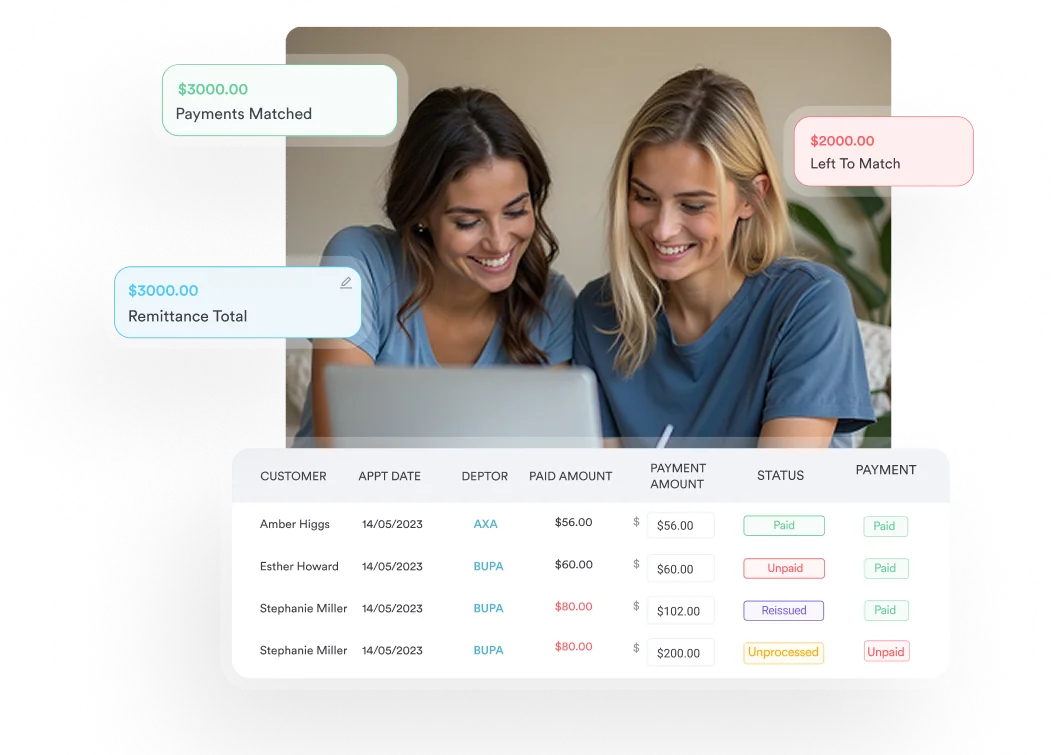
The result is an ABN on file before the first shipment, so an expected Medicare denial lands with the right party. Billing staff can then put their time into claims Medicare will pay.

Pabau keeps orders, signed ABNs, and claims together in the patient record. DME billing teams can see missing paperwork before a J7607 claim goes out.

The decision on J7607 happens before the claim, when the order specifies a compounded concentrate. Medicare will deny the line under LCD L33370, so the open question is who carries that cost.
If the prescriber can switch to an FDA-approved product, J7612 or J7614 opens a covered route. If the patient needs the compounded product, an ABN before dispensing and the GA modifier keep the supplier from absorbing the denial. Either way, count units at 0.5 mg each, never 1 mg.
Keeping the order, the signed ABN, and the claim in one patient record puts each piece on file before submission. Book a demo to see how Pabau keeps DME drug claims documented from the first order onward.

Need a clean claims workflow for DME billing? What is revenue cycle management explains how end-to-end RCM processes reduce HCPCS claim errors and improve collection rates.
Dealing with repeated denials across claim types? What makes a clean claim covers the pre-submission checks that prevent the most common HCPCS and CPT rejections.
Want to understand how electronic remittance works after J7607 claims are paid? Electronic remittance advice (ERA) breaks down how to read 835 files and match payments to submitted HCPCS codes.
HCPCS code J7607 covers levalbuterol inhalation solution that a pharmacy compounded in concentrated form, administered through DME and billed per 0.5 mg. FDA-approved levalbuterol concentrate bills under J7612, and compounded unit-dose levalbuterol bills under J7615.
J7607 is compounded levalbuterol concentrate, while J7612 is the FDA-approved, non-compounded concentrate. Both bill per 0.5 mg. Medicare’s nebulizer LCD covers J7612 when its criteria are met but denies J7607 as not reasonable and necessary. Check the pharmacy invoice before you choose the code.
Bill 2.5 units, because one unit of J7607 equals 0.5 mg of levalbuterol. Divide the total milligrams dispensed by 0.5 to get the units. Some DME MACs expect whole units, so check your jurisdiction’s rounding instructions before submitting.
No. Traditional Medicare does not require prior authorization for J7607, but LCD L33370 denies compounded inhalation solutions as not reasonable and necessary. Get a signed ABN before dispensing and append the GA modifier. Medicare Advantage plans set their own rules, so verify with each plan annually.
Only if the office is an enrolled DMEPOS supplier. For Medicare, nebulizer drugs for home use are billed to the DME MAC on the CMS-1500 or 837P by an enrolled supplier. Offices without that enrollment coordinate billing through a DME supplier.
Nebulizer drugs used with home DME fall under the Part B DME benefit, so J7607 claims go to the DME MAC. Under that benefit, LCD L33370 denies compounded inhalation solutions, J7607 included, as not reasonable and necessary.




