

HCPCS code E0198: Water pressure pad billing guide
HCPCS code E0198 is a water pad for a standard mattress HCPCS code E0198 is the ...

Last Updated: Oct 13, 2026
J7614 is the HCPCS Level II code for levalbuterol, inhalation solution, fda-approved final product, non-compounded, administered through dme, unit dose, 0.5 mg.
Four HCPCS codes describe levalbuterol, and J7612 and J7615 are the two most often billed by mistake. It also covers how to pick the right code when a concentrate or a compounded product is in front of you.
Let Pabau's smart automation suggest the right codes, reduce claim denials, and keep your practice compliant—effortlessly.
Automate repetitive tasks and focus on what matters most—your patients.
Reduce coding errors and ensure compliance with the latest regulations.
Clean claims, fewer denials, and faster reimbursements.
Powerful insights and reporting to help your practice thrive.
HIPAA compliant SOC 2 certified GDPR-compliant Trusted by 4,000+ clinics worldwide

HCPCS code J7614 describes levalbuterol inhalation solution, FDA-approved, non-compounded, administered through DME, in 0.5 mg unit doses
One billable unit equals 0.5 mg. Divide the milligrams dispensed by 0.5, then round per your MAC’s rules
Every unit-dose Xopenex strength bills under J7614, including the 0.31 mg, 0.63 mg, and 1.25 mg vials. J7612 covers the concentrate, which has to be diluted before nebulizing
J7614 requires a valid written physician order, a supporting diagnosis (asthma or COPD), and proof of dispensing through DME to pass audit
Practice management software like Pabau validates required claim fields before submission, so a missing modifier or quantity stops with you
HCPCS code J7614 is a Level II alphanumeric code maintained by the Centers for Medicare and Medicaid Services (CMS). It covers levalbuterol hydrochloride inhalation solution, sold under the brand name Xopenex.
The drug has to be an FDA-approved, non-compounded final product administered through durable medical equipment (DME). Two qualifiers define it. The product has to be a ready-to-use unit dose rather than a concentrate, and 0.5 mg is the billing unit rather than a product strength.
That second qualifier is the one that trips people up. Xopenex unit-dose vials are sold at 0.31 mg, 0.63 mg, and 1.25 mg, and none of those is 0.5 mg. All of them still bill under J7614, using however many 0.5 mg units the dispensed dose works out to.
The table below captures the essential reference data coders and DME suppliers need at a glance.
One billable unit of HCPCS code J7614 equals 0.5 mg of levalbuterol. To find the number of units to submit, divide the total milligrams dispensed by 0.5. The division is simple. The rounding step is where claims go wrong.
Worked examples, using the strengths Xopenex is actually dispensed in:
Rounding rules vary by Medicare Administrative Contractor (MAC). Most MACs round a fractional unit up to the next whole unit, but confirm the policy for your jurisdiction before you apply it.
Check the quantity dispensed against the written order before you calculate units. Document the math in the claim notes so a post-payment reviewer can follow it.
The 0.5 mg unit belongs to J7614 alone. Every J-code sets its own increment in its descriptor, so read it rather than carrying a rounding habit over from J0132 or J1556.
HCPCS code J7614 is billed by whoever dispenses the drug, and that entity has to be enrolled as a DMEPOS supplier. Understanding medical billing fundamentals for DME drug codes means keeping track of several moving parts. Those are who submits, how units appear on the claim, and what modifiers control payment.
Submitting claims through a medical claims clearinghouse adds an electronic validation layer that can catch unit-quantity mismatches before the claim reaches the MAC.
Modifier use on J7614 follows DMEPOS drug billing conventions. Applying the wrong modifier, or omitting a required one, is one of the fastest routes to claim denial.
Those three modifiers are the ones that apply to nebulizer drug claims. Select based on whether the patient receives J7614 alone or in combination with another inhalation drug during the same treatment session. Your MAC’s LCD will specify which modifier applies to the scenario being billed.
File the NDC from the dispensing label alongside the units billed. The NDC proves the product was an FDA-approved unit-dose vial rather than a concentrate or a compounded solution. It is also the first thing an auditor asks for.
Medicare covers J7614 under the DMEPOS benefit when specific medical necessity criteria are met. Insurance eligibility verification before dispensing is essential. Confirm that the patient’s plan covers nebulizer drug therapy.
Then confirm the prescribing diagnosis sits on the covered list. Those two checks head off the most common reason for J7614 non-payment.
Build the coverage checklist into the intake workflow. A missing order or an uncovered diagnosis then surfaces before you dispense, rather than in a post-payment review two years later.
Incomplete documentation is the leading cause of J7614 claim denials that cannot be overturned on appeal. Every element below must be in the patient file before the claim leaves the billing system. Submitting a clean claim on the first pass requires treating this checklist as a pre-submission gate, not an afterthought.
A structured dispensing record that captures all of the above at the point of dispensing cuts the back-and-forth with auditors. Build these fields into your intake and dispensing workflow, and the file is complete by the time the claim is generated.
The ICD-10-CM diagnosis code paired with J7614 must support medical necessity for levalbuterol inhalation therapy. The table below lists the codes most commonly accepted by Medicare MACs, sourced from Noridian and findacode.com crosswalk data.
Always select the most specific ICD-10-CM code the clinical documentation supports. Coding unspecified COPD when the record documents an acute exacerbation leaves claim value on the table. J44.1 is the code that pairs most often with J7614. A vague diagnosis also weakens the medical necessity argument in an audit.
Medicare reimburses J7614 under the CMS DMEPOS fee schedule, which varies by geographic jurisdiction. Payment rules differ by category across that schedule. J7614 sits in the drug supply category, not in the equipment categories that codes like K0843 fall under.
Important caveats on reimbursement rates for J7614:
Tracking per-unit reimbursement alongside your dispensing volume gives billing managers an early warning when a rate change starts to squeeze margin on levalbuterol claims. Reading the remittance advice after each payment cycle is the fastest way to catch a shift in allowed amounts.
Four HCPCS codes describe levalbuterol inhalation solution, and two variables separate them. The first is whether the product is compounded or an FDA-approved finished product. The second is whether it arrives as a ready-to-use unit dose or as a concentrate that has to be diluted first.
Strength is not one of the variables. A 0.31 mg vial and a 1.25 mg vial carry the same code, and a 1.25 mg concentrate does not. The grid below sorts all four codes on those two axes.
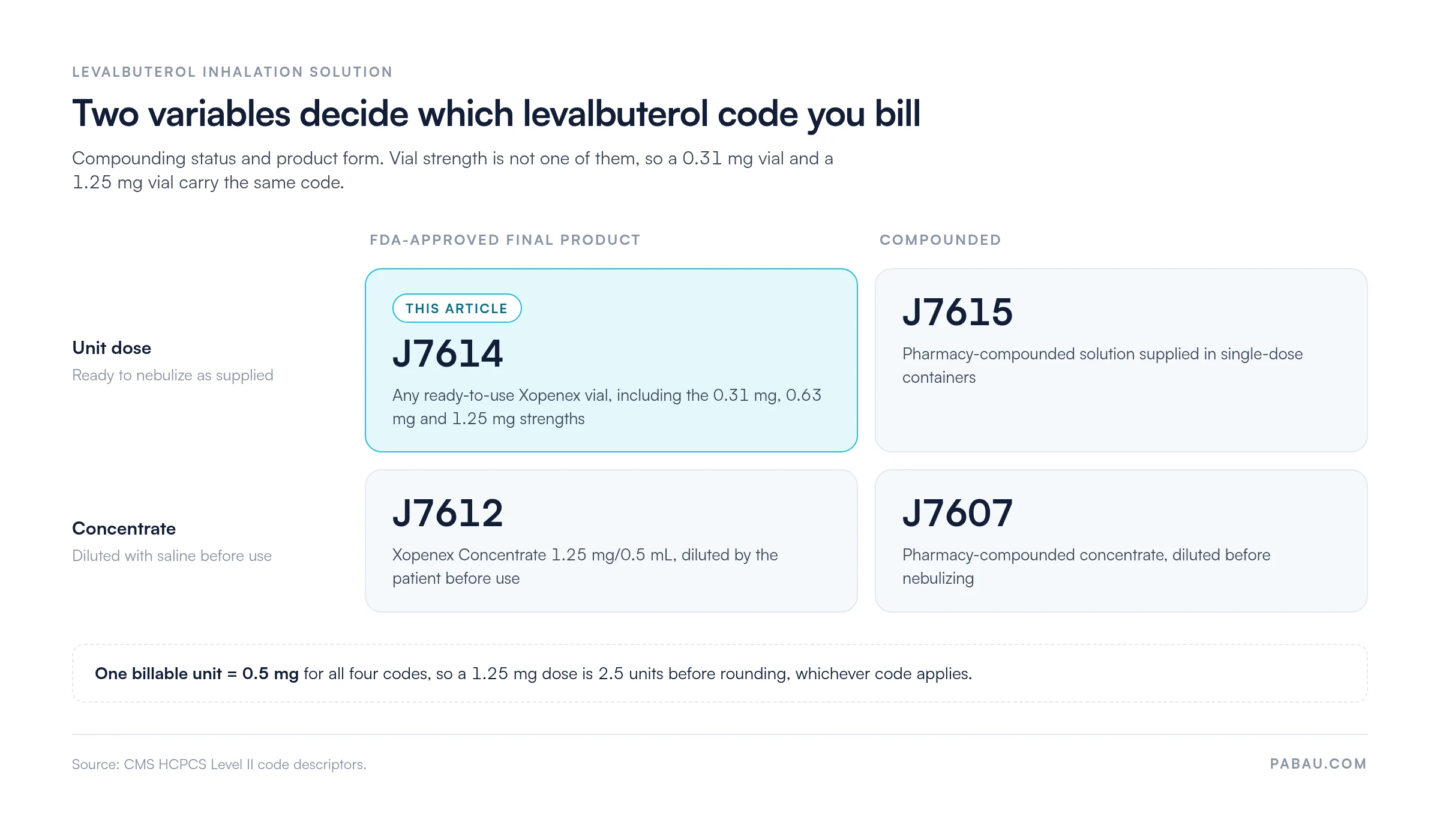
All four codes share the same 0.5 mg billing unit, so the unit math from the section above does not change when the code does. A 1.25 mg unit-dose vial is 3 units of J7614 after rounding. The same 1.25 mg drawn from Xopenex Concentrate is 3 units of J7612.
You may still see J7616 listed as a levalbuterol code in older references and third-party crosswalks. It never was one. J7616 described albuterol up to 5 mg with ipratropium bromide up to 1 mg. CMS deleted it effective January 1, 2006 and replaced it with J7620.
The NDC on the dispensing label settles the code every time. It identifies the manufacturer, the product, and the package size. That tells you the FDA-approval status, and whether what you dispensed was a unit dose or a concentrate.
The rules above are the straightforward part. The patterns below are what drives denials and post-payment demands on levalbuterol claims.
A pre-claim checklist that touches each of these points catches most J7614 errors before they reach the payer. Map the denial codes returned on levalbuterol claims back to the root causes above, and the feedback loop closes. More than three denials on one error type in a quarter points at the workflow rather than at a person.
Formal denial management applied to J7614 claims recovers a meaningful share of revenue that would otherwise be written off.
Nearly every error above is clerical rather than clinical. The dispensed quantity is in the supplier record, the NDC is on the vial label, and the signed order is in the chart. The claim still goes out wrong because those three pieces sit in three different places.
Practice management software like Pabau keeps them together. The claim screen pre-fills from the client record, and HCPCS and ICD-10-CM lookup libraries sit right beside it. A coder can confirm that J7614 is the unit-dose code without leaving the chart.
The same claim screen serves a primary care team running GP practice software and an IV therapy clinic that bills drugs by the milligram. Both need the units, the modifier, and the diagnosis to agree before the claim leaves the building.
Required fields get validated before a claim can be sent. A missing modifier or an empty quantity stops with you instead of with the payer. US claims then go out through our Claim.MD integration, which brings eligibility checks, claim status, and remittance posting back the same way.
What no software should do is pick your rounding policy for you, because that is a MAC-specific rule your billing lead owns. Record the milligrams dispensed at the point of dispensing, and the units, the modifier, and the documentation all follow from one number.

Pabau’s claims management tools help DME suppliers and practice billing teams catch unit calculation errors and apply the right modifiers. Submit clean J-code claims the first time, and see how the platform handles nebulizer drug billing end to end.

HCPCS code J7614 is narrow in definition but wide in the number of ways it can go wrong. The unit math, the line between a unit dose and a concentrate, the modifier, and the documentation checklist are each a separate failure point. Getting all four right on the same claim, every time, takes a workflow rather than individual vigilance.
Pabau’s claims management software supports DMEPOS billing teams by structuring the claim submission process around these validation points. See how it handles J-code billing by booking a demo with the team.

Billing the nebulizer supplies alongside the drug? HCPCS code A7005 walks through the administration set, its coverage rules, and how it pairs with a drug claim.
Coding another bronchodilator given in the office? HCPCS code J0280 covers aminophylline, its unit definition, and the documentation payers ask for.
Need the clinical record that supports an asthma claim? Our asthma action plan template captures triggers, medication steps, and escalation thresholds in one form.
Documenting a COPD patient on long-term nebulizer therapy? The COPD nursing care plan sets out assessments, interventions, and outcomes you can file against the diagnosis.
Coding COPD outside the ICD-10 world? ICD-11 CA22 explains how the diagnosis is structured for primary care under ICD-11.
HCPCS code J7614 is a Level II code for levalbuterol inhalation solution. The descriptor covers the FDA-approved, non-compounded product administered through durable medical equipment (DME), in 0.5 mg unit doses. Enrolled DME suppliers bill it for Medicare and Medicaid beneficiaries who need levalbuterol, sold as Xopenex, delivered by nebulizer.
One unit of J7614 equals 0.5 mg of levalbuterol. To calculate units, divide the total milligrams dispensed by 0.5. A 1.25 mg dose equals 2.5 units, and most MACs require rounding up to 3 units. Verify the rounding rules with your own Medicare Administrative Contractor before billing.
J7614 covers the FDA-approved, non-compounded unit-dose vial. J7612 covers the FDA-approved concentrate, which has to be diluted before nebulizing. J7615 covers a compounded unit dose, and J7607 the compounded concentrate. All four use the same 0.5 mg billing unit, so the NDC on the label decides the code, not the strength of the vial.
No. J7616 was deleted from HCPCS effective January 1, 2006, and it never described levalbuterol. It covered albuterol up to 5 mg with ipratropium bromide up to 1 mg, which CMS replaced with J7620. Any reference that still pairs J7616 with levalbuterol is out of date.
Yes. Medicare covers J7614 under the DMEPOS benefit when the medical necessity criteria are met. The patient needs a covered diagnosis, typically asthma (J45.xx) or COPD (J44.xx). A valid written physician order has to be on file. The drug must be dispensed through a covered DME nebulizer. Some MACs also require prior authorization for quantities above a monthly threshold.
Three modifiers cover almost every J7614 claim. KO marks a single drug unit dose formulation. KP marks the first drug of a multiple drug unit dose, and KQ the second or subsequent drug. Select KO when the patient receives J7614 alone. Use KP and KQ when J7614 is combined with another nebulizer drug in the same session. Missing or incorrect modifiers are a leading cause of J7614 denials.
Medicare reimburses J7614 under the DMEPOS fee schedule, which CMS updates quarterly and refreshes comprehensively each January. Rates vary by jurisdiction, and competitive bidding does not apply to inhalation drugs. Because the figures move, look up the current amount on the CMS DMEPOS fee schedule for your jurisdiction rather than trusting a published number.



