CCSD code H4430: Examination of rectum under anaesthetic
CCSD code H4430 pays for the examination alone CCSD code H4430 is the UK private...

Last Updated: Oct 20, 2026
J7612 is the HCPCS Level II code for levalbuterol, inhalation solution, fda-approved final product, non-compounded, administered through dme, concentrated form, 0.5 mg.
Let Pabau's smart automation suggest the right codes, reduce claim denials, and keep your practice compliant—effortlessly.
Automate repetitive tasks and focus on what matters most—your patients.
Reduce coding errors and ensure compliance with the latest regulations.
Clean claims, fewer denials, and faster reimbursements.
Powerful insights and reporting to help your practice thrive.
HIPAA compliant SOC 2 certified GDPR-compliant Trusted by 4,000+ clinics worldwide

HCPCS Code J7612 covers levalbuterol inhalation solution, concentrated form, 0.5 mg per unit. The product must be FDA-approved and non-compounded, dispensed through a DME nebulizer rather than a retail pharmacy.
One billing unit equals 0.5 mg. Divide the dose prescribed per treatment by 0.5 mg, then multiply by treatments per day and days supplied.
The true sibling of J7612 is J7614, the levalbuterol unit dose code. Both are DME codes at 0.5 mg per unit and differ only by concentrated versus ready-to-use form. J7611 is the albuterol concentrate code, not a levalbuterol code.
The KO, KP, and KQ modifiers never belong on J7612. CMS policy article A52466 restricts them to unit dose form codes such as J7614 and states they are not used with concentrated form codes.
There is no CMN for this code. CMS discontinued Certificates of Medical Necessity and DME Information Forms for dates of service on or after January 1, 2023. CMS-484 was the oxygen form in any case. Medical necessity now rests on a Standard Written Order plus the clinical record.
Practice management software like Pabau keeps the order, the clinical note, and the claim line in one patient record. The detail behind a drug claim is then easy to retrieve when a payer asks.
HCPCS Code J7612 describes: Levalbuterol, inhalation solution, FDA-approved final product, non-compounded, administered through DME, concentrated form, 0.5 mg. Every word in that descriptor carries billing weight. Breaking it down:
Levalbuterol is a short-acting beta-2 agonist (SABA) prescribed for bronchospasm associated with COPD, asthma, and other obstructive airway disease. Dispensed as a concentrated solution for a home nebulizer, it falls under the CMS HCPCS Level II J-code family rather than CPT.
The clinical distinction that drives the code choice is simple. Concentrated levalbuterol has to be diluted with sterile saline before it goes in the nebulizer cup. In contrast, the unit dose form (J7614) is ready to use as packaged. When a diluent is supplied for the concentrate, it is billed separately under A4218, the metered dose sterile saline code.
One billing unit of HCPCS Code J7612 equals 0.5 mg of levalbuterol concentrated inhalation solution. Getting the unit count right prevents the most common arithmetic denial on this code.
Unit calculation formula: divide the total milligrams of levalbuterol prescribed per treatment session by 0.5 mg. A standard adult prescription of 1.25 mg per treatment works out to 2.5 units per session. Round to the nearest whole unit under your DME MAC rounding policy. Typical regimens run two to four times daily. Multiply the per-session unit count by treatments per day, then by the days in the billing period.
Overbilling units beyond the prescribed dose exposes the supplier to recoupment at audit. Meanwhile, underbilling leaves revenue uncollected. Therefore, verify the unit count against the written order before each claim goes out. Practice management software like Pabau stores the order, the clinical note, and the submitted claim line in one patient record. Claims management software that holds all three makes a dose-to-units mismatch easy to spot before submission.
Medicare Part B covers HCPCS Code J7612 under the DME benefit. The patient needs a documented medical need for nebulized levalbuterol, and the supplier must meet DMEPOS accreditation requirements. Claims go to the Durable Medical Equipment Medicare Administrative Contractors (DME MACs), which operate in four jurisdictions: A, B, C, and D.
Fee schedule rates vary by jurisdiction and are updated each January 1, with quarterly revisions during the year. Never rely on a static dollar figure from a secondary source. Pull the current rate from the CMS DMEPOS fee schedule file, or from your DME MAC fee lookup, selecting the applicable state and effective date. Note that DMEPOS drug rates do not come from the physician fee schedule, which is a common place to look up the wrong number.
Medicaid coverage for J7612 varies by state. Most programs follow the general Medicare framework but apply their own prior authorization rules, quantity limits, or formulary restrictions. Commercial payers may cover the code, route the same drug to a different code, or require a step-therapy trial of albuterol before approving levalbuterol. Therefore, verify coverage with each payer before dispensing.
Before billing J7612 to Medicare, confirm the supplier holds current DMEPOS accreditation and that the nebulizer itself is on file under E0570, nebulizer with compressor. A J-code claim from a non-accredited supplier will deny no matter how good the documentation is.
Modifier selection on J7612 is mostly a question of what does not belong on the claim. The KO, KP, and KQ modifiers that DME MACs use to sort multi-drug nebulizer regimens are reserved for unit dose form codes. J7612 is a concentrated form code, so it never carries one of them.
CMS says this directly in DME MAC policy article A52466 (Nebulizers). Whenever a unit dose form code is billed it must carry KO, KP, or KQ. Those modifiers are not used with the concentrated form codes. As a result, appending KO to J7612 introduces an error that the claim edits will catch. If the patient is receiving ready-to-use unit dose vials, the code is J7614, and that claim does take the modifier.
JW and JZ are the discarded-drug pair, and a drug billing page has to get them right. JW goes on a separate claim line carrying the quantity discarded from a single-dose container. The quantity dispensed stays on its own line without it. JZ is the attestation that no amount was discarded.
A52466 notes that DME MACs expect rare use of JW. The unit of service for a DMEPOS drug code usually matches or exceeds what the vial holds. Multi-dose vials are never eligible for discarded-drug payment at all.
Two further points are easy to miss. CMS added a case on January 1, 2025. JW is now required when a supplier does not administer the drug but discards part of it during preparation. Separately, where the unit of service already covers the full vial, do not bill the discarded remainder as an extra unit with JW. That creates an overpayment.
Read the current Nebulizers policy article (A52466) before you build a modifier rule into your billing system. The DME MACs revise it regularly.
Start with what is no longer required. CMS discontinued Certificates of Medical Necessity (CMNs) and DME Information Forms (DIFs) for all claims with dates of service on or after January 1, 2023. As a result, a claim that still carries CMN or DIF information is rejected and returned to the supplier. CMS-484 was the oxygen CMN specifically, so it never applied to nebulizer drugs or equipment. Any billing guide that lists it for J7612 is wrong on two counts.
What replaces the form is the record itself. Medical necessity for J7612 rests on a Standard Written Order that meets 42 CFR 410.38, supported by clinical documentation in the treating practitioner medical record. A complete file for J7612 includes:
The practical effect of the CMN retirement is that audits now look straight at the chart. There is no form to sign that substitutes for a thin progress note. If your denial playbook still contains a step called locate the CMN, replace it.
Check instead that the SWO is complete and dated before the first dispensing. Then check that the clinical note behind it supports the dose billed. A checklist built around these six items removes most preventable J7612 denials. Full detail on the change is in CMS MLN Matters SE22002.
Levalbuterol concentrated inhalation solution is prescribed for reversible bronchospasm associated with obstructive airway disease. The DME MAC nebulizer policy lists the ICD-10 codes that support medical necessity. J7612 sits in the same coverage group as J7611, J7613, J7614, and J7620.
Covered diagnoses in that group include:
The medical record has to explain why a nebulizer is the right delivery device. Three notes commonly do it:
Without one of them, the MAC can deny J7612 as not reasonable and necessary even when the diagnosis code appears on the covered list. Check the current LCD and policy article for your jurisdiction before relying on any diagnosis list, including this one. The covered ranges are revised periodically.
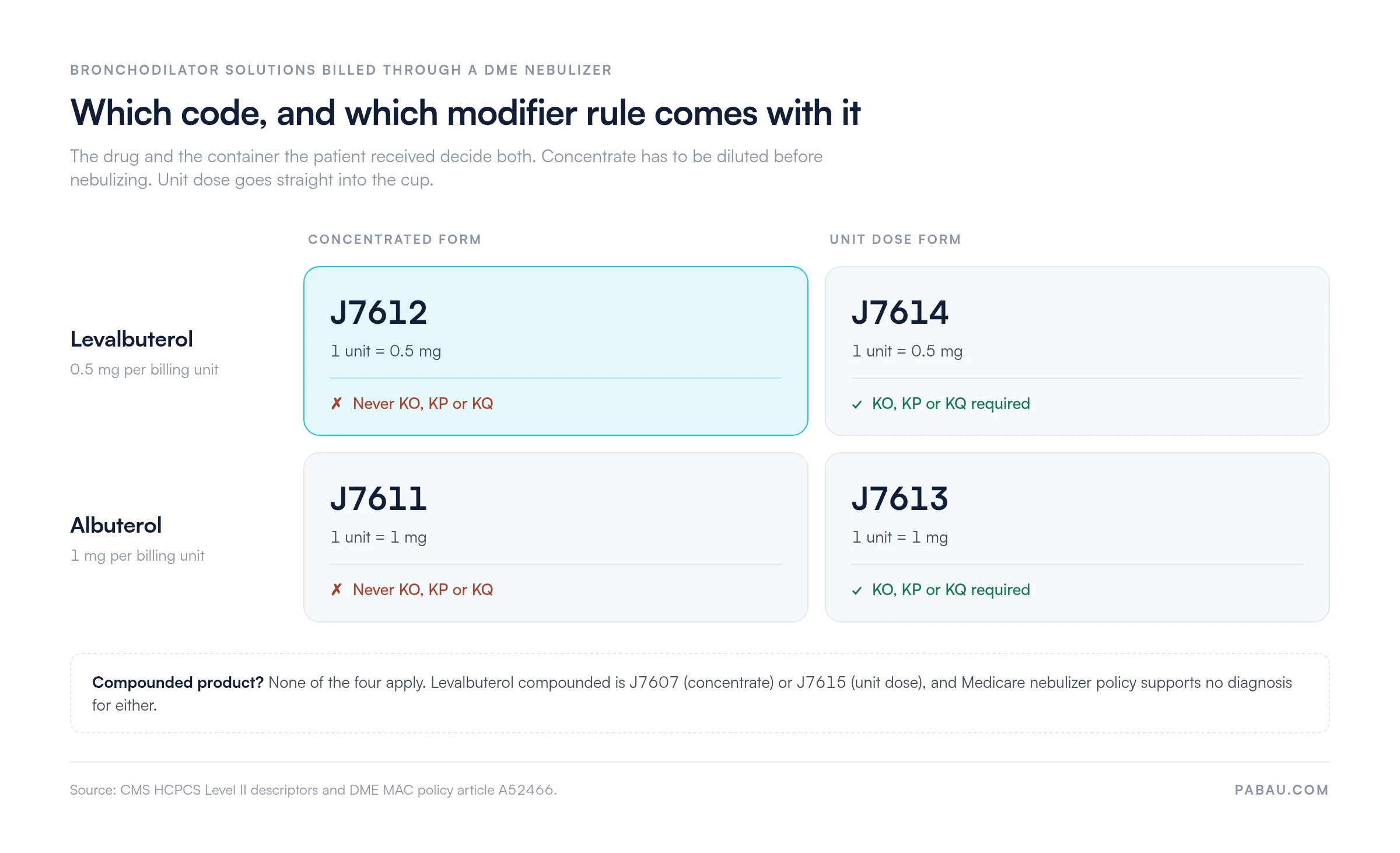
Two HCPCS codes cover FDA-approved levalbuterol dispensed through DME, and they differ by exactly one thing: the form the patient receives. J7612 is the concentrate. J7614 is the ready-to-use unit dose. Both are DME codes billed by a DMEPOS supplier to the DME MAC, and both bill at 0.5 mg per unit.
J7611 is the code most often dragged into this comparison by mistake, and it is not a levalbuterol code at all. It covers albuterol inhalation solution in concentrated form at 1 mg per unit. Treat it as the albuterol analog of J7612 rather than a sibling of it, and the confusion clears up.
The practical rule is simple. Look at the container the patient received. Concentrate that needs saline before it can be nebulized is J7612. A pre-filled vial that goes straight into the cup is J7614.
The dispensing channel does not decide it, since both are DME codes billed by a DMEPOS supplier. The modifier consequence follows the same split. The grid below sets out the drug, the form, the per-unit quantity, and the modifier rule for all four codes.
Many DME MACs require the National Drug Code (NDC) on the claim line alongside HCPCS Code J7612. The NDC identifies the exact FDA-approved product dispensed and confirms the claim meets the non-compounded, final-product requirement written into the descriptor.
The following FDA-approved levalbuterol hydrochloride concentrated inhalation solution products commonly crosswalk to J7612. Always verify the current NDC against the product dispensed and against your MAC reporting requirements before submitting:
Pull current NDC numbers from the NLM HCPCS lookup API or the FDA DailyMed database rather than a static list. NDCs change when manufacturers update packaging, and an inactive NDC is a denial trigger that forces a corrected claim. Confirm your MAC format requirement, typically an 11-digit NDC in 5-4-2 format, before filing.
J7612 cannot be billed in isolation from the wider DME framework. Drug reimbursement depends on supplier-side requirements that sit outside the clinical documentation discussed above.
HCPCS coding verification for DMEPOS products runs through the CMS Pricing, Data Analysis and Coding (PDAC) contractor rather than an individual DME MAC. Its DME Coding System (DMECS) is where a product code is confirmed. That matters when you are confirming the equipment code that pairs with a J7612 drug claim, which is E0570, nebulizer with compressor.
Older billing guides also list E0571, but that code was deleted in 2011 and is no longer valid for any date of service. Some MACs deny a drug claim when no nebulizer equipment claim is on file for the patient, so check the pairing first. The denial codes reference lists the CARC and RARC codes that come back on equipment-drug pairing denials.
HCPCS Code J7612 denials cluster around a predictable set of errors. Each one below maps to a fix that stops it recurring:
Run a monthly J7612 claim audit comparing dispensed units per patient against the quantity on the written order. A pattern of over-billing inside one product family is a common trigger for DME MAC probe audits. Catching unit discrepancies internally costs far less than answering a post-payment demand letter.
An audit of a J7612 claim asks for three documents at once. The supplier has to produce the Standard Written Order, the note that supports the dose, and the proof of delivery for that dispensing. When those sit in a billing system, a shared drive, and a scanner folder, assembling them takes most of a day.
Pabau keeps them on one patient record instead. The order and the clinical note live on the chart, and uploaded delivery paperwork attaches to the same patient. The submitted claim line sits beside both. Answering a records request stops being a reconciliation exercise across three systems.
Claim submission and status tracking run through Pabau’s billing integration, so a rejected J7612 line stays visible against the patient it belongs to. When the MAC queries a month’s unit count, the written order that authorized it is on the same record. Refill contact notes sit there too, which is the documentation auditors ask for on a recurring drug supply.

Pabau keeps patient records, clinical notes, and claim submission in one system, so the documentation behind a billed drug stays attached to the chart. See how billing looks when charge capture and claim tracking live in the same place as the clinical record.

J7612 is a straightforward code to bill correctly, and a very easy one to bill wrong. In fact, almost every failure point is clerical. The form dispensed, the unit arithmetic, the modifier set, and the order paperwork are all settled before anyone opens the claim.
So the work sits upstream of billing. Capture the NDC at the point of dispensing, and check the unit count against the written order. Keep the SWO and the supporting note on the record. Do that consistently and the denials that cluster on this code mostly stop arriving.
One point is worth carrying forward. The retired CMN is not coming back, so audits now read the chart directly. The quality of the progress note behind a J7612 claim is what decides whether it survives review.
Pabau keeps orders, clinical notes, and claim lines in one patient record. That is where the detail behind a drug claim sits when a payer asks for it. To see how it fits the way your practice bills, book a demo.

Dispensing ready-to-use vials instead of concentrate? HCPCS Code J7614 covers the levalbuterol unit dose code and the KO, KP and KQ modifiers it requires.
Need to understand how denial codes work after a J7612 rejection? Denial codes in medical billing explains CARC and RARC denial reason codes and how to action them.
Want to reduce claim rework across your entire billing cycle? Revenue cycle management explained covers the end-to-end process from eligibility through final payment posting.
Looking for a structured approach to medical billing compliance? Medical billing compliance outlines the documentation standards that hold up when a payer audits your claims.
HCPCS Code J7612 is the billing code for levalbuterol inhalation solution, concentrated form, 0.5 mg per billing unit. The descriptor also requires an FDA-approved final product, non-compounded, administered through DME. DMEPOS-accredited suppliers use it to bill Medicare Part B and other payers for levalbuterol concentrate dispensed for use in a home nebulizer.
One billing unit equals 0.5 mg of levalbuterol concentrated inhalation solution. To calculate units, divide the total milligrams prescribed per treatment session by 0.5. A 1.25 mg dose per session equals 2.5 units, so follow your DME MAC rounding policy. Then multiply by treatments per day and days supplied.
A Standard Written Order that meets 42 CFR 410.38. It must carry the beneficiary identifier, order date, item description, quantity, and the treating practitioner name, NPI, and signature. You also need clinical notes supporting the diagnosis and the dose billed. Add proof of current DMEPOS accreditation, a signed proof of delivery for each dispensing, and refill contact records. Report the NDC on the claim line where the MAC requires it.
No. J7611 covers albuterol inhalation solution, FDA-approved final product, non-compounded, administered through DME, concentrated form, 1 mg per unit. It is the albuterol counterpart of J7612 rather than a levalbuterol code, and the per-unit quantity differs as well. Billing guides that list J7611 among the levalbuterol codes are wrong.
FDA-approved levalbuterol hydrochloride concentrated inhalation solution products, including Xopenex concentrate by Sunovion and its generic equivalents, crosswalk to J7612. Verify the current NDC in the FDA DailyMed database or the NLM HCPCS lookup tool. NDCs change with packaging updates, and an inactive NDC triggers a claim rejection.