ICD-10 Code R63.4: Abnormal weight loss
ICD-10 Code R63.4: Definition, billability, and code structure ICD-10 code R63.4...

Last Updated: Nov 13, 2026
Billable Code Specific Code
J45.902 is the billable ICD-10-CM code for unspecified asthma with status asthmaticus. It applies when the physician documents status asthmaticus but does not classify the asthma as intermittent or persistent.
Status asthmaticus is a prolonged, severe attack that does not respond to initial bronchodilator therapy and needs escalated treatment. A worsening that does respond is an acute exacerbation, coded J45.901. When the record states severity, the matching code is J45.22, J45.32, J45.42, or J45.52.
Let Pabau's smart automation suggest the right codes, reduce claim denials, and keep your practice compliant—effortlessly.
Automate repetitive tasks and focus on what matters most—your patients.
Reduce coding errors and ensure compliance with the latest regulations.
Clean claims, fewer denials, and faster reimbursements.
Powerful insights and reporting to help your practice thrive.
HIPAA compliant SOC 2 certified GDPR-compliant Trusted by 4,000+ clinics worldwide

J45.902 is the billable code for unspecified asthma with status asthmaticus, used when the record does not state asthma severity.
Status asthmaticus differs from an acute exacerbation because the bronchospasm is prolonged and does not resolve with initial bronchodilator treatment.
Assign J45.902 only when the physician documents status asthmaticus but omits severity. If severity is documented, use J45.22, J45.32, J45.42, or J45.52 instead.
Pabau’s claims management sends US claims through Claim.MD, with eligibility checks before submission.
ICD-10 Code J45.902 is the billable diagnosis code for unspecified asthma with status asthmaticus. Its official descriptor, “Unspecified asthma with status asthmaticus,” sits under J45.90 in CMS’s ICD-10-CM code files. It is a billable, specific code (six characters, fully specified) and can appear on a claim as a valid diagnosis.
The code sits within the J45.9x subgroup (unspecified asthma). Per the CMS ICD-10-CM guidelines, that subgroup covers asthma the physician has not classified as intermittent or persistent. The physician’s documentation sets the “unspecified” designation, so a coder cannot pick it as a shortcut.
Status asthmaticus is a prolonged asthmatic state that does not respond to initial bronchodilator therapy, distinguishing it from a standard acute exacerbation. The National Asthma Education and Prevention Program (NAEPP) defines it as a severe, persistent attack resistant to repeated doses of short-acting beta-agonists. Treatment then escalates to systemic corticosteroids, IV magnesium, heliox, or hospitalization.
J45.902 applies when the following clinical picture is documented:
The key word is “unspecified.” If the physician documents “moderate persistent asthma with status asthmaticus,” the correct code is J45.42, not J45.902. “Unspecified” describes what the record leaves out about severity and says nothing about how unwell the patient is.
The J45 category carries official ICD-10-CM instructional notes that apply to J45.902 and every other J45.x code. Coders must review these notes before assigning the code, particularly the Excludes1 list, which prohibits dual coding with certain related conditions.
The Excludes2 note at J45 lists conditions that are not part of the asthma category but can exist alongside it. Each one may be coded together with J45.902 when the record documents both:
J45 also tells coders to add a code for eosinophilic asthma (J82.83) when it is documented. The same note covers tobacco exposure, use and dependence (Z77.22, P96.81, Z87.891, Z57.31, F17.-, and Z72.0).
Always check the current FY ICD-10-CM tabular list for J45 Excludes1 and Excludes2 notes before coding. CMS releases updated guidelines each October, and instructional notes can change. Relying on memory for exclusion rules is a common source of audit exposure.
The three J45.9x codes, J45.901, J45.902, and J45.909, are frequently miscoded because all three share the “unspecified” severity designation. The clinical distinction turns on a single documented factor: What happened during the encounter.
Between J45.901 and J45.902, the deciding factor is the response to treatment. An acute exacerbation is a worsening that typically responds to standard treatment. Status asthmaticus means the initial treatment has failed. A patient who presents with wheezing, receives a nebulizer treatment, and improves is an exacerbation. A patient who fails two or more SABA treatments and requires IV steroids or hospitalization is status asthmaticus.
The J45 code family follows the NAEPP four-tier severity classification. Each severity level carries three sub-codes: Uncomplicated, with acute exacerbation, and with status asthmaticus. J45.902 occupies the status asthmaticus slot within the unspecified severity tier.
Use J45.902 only when severity is genuinely undocumented. When the physician’s notes contain phrases like “mild intermittent asthma” alongside “status asthmaticus,” J45.22 is the correct assignment. The AAPC ICD-10-CM lookup and the CDC ICD-10-CM browser tool are useful cross-references for the full J45.x hierarchy.
Payers reviewing a claim with ICD-10 Code J45.902 expect documentation that justifies both the status asthmaticus designation and the unspecified severity classification. Missing either component invites a denial, and medical billing compliance requirements expect that level of specificity at every step.
The physician record must include:
Status asthmaticus is a complication and comorbidity (CC) flag in Medicare’s MS-DRG grouping system, meaning its presence can shift a hospitalization to a higher-weighted DRG. That financial weight attracts payer scrutiny, and staff who know the medical billing cycle can spot the review triggers before submission.
J45.902 denials trace back to three root causes: thin documentation, specificity errors, and coding contradictions. Effective denial management workflows treat each denial type separately rather than resubmitting without root-cause analysis. An eligibility check before submission also confirms coverage, which removes one avoidable denial reason before the claim leaves the practice.
Reading claim denial codes lets revenue cycle teams triage J45.902 appeals by claim adjustment reason code (CARC) rather than treating every denial identically. Diagnosis-to-procedure mismatches usually appear under CARC 11, which means the diagnosis is inconsistent with the procedure. Medical-necessity denials usually appear under CARC 50.
The assignment decision for ICD-10 Code J45.902 follows a two-step logic tree. Work through it in order before assigning any J45.9x code, as the decision path after the steps shows.
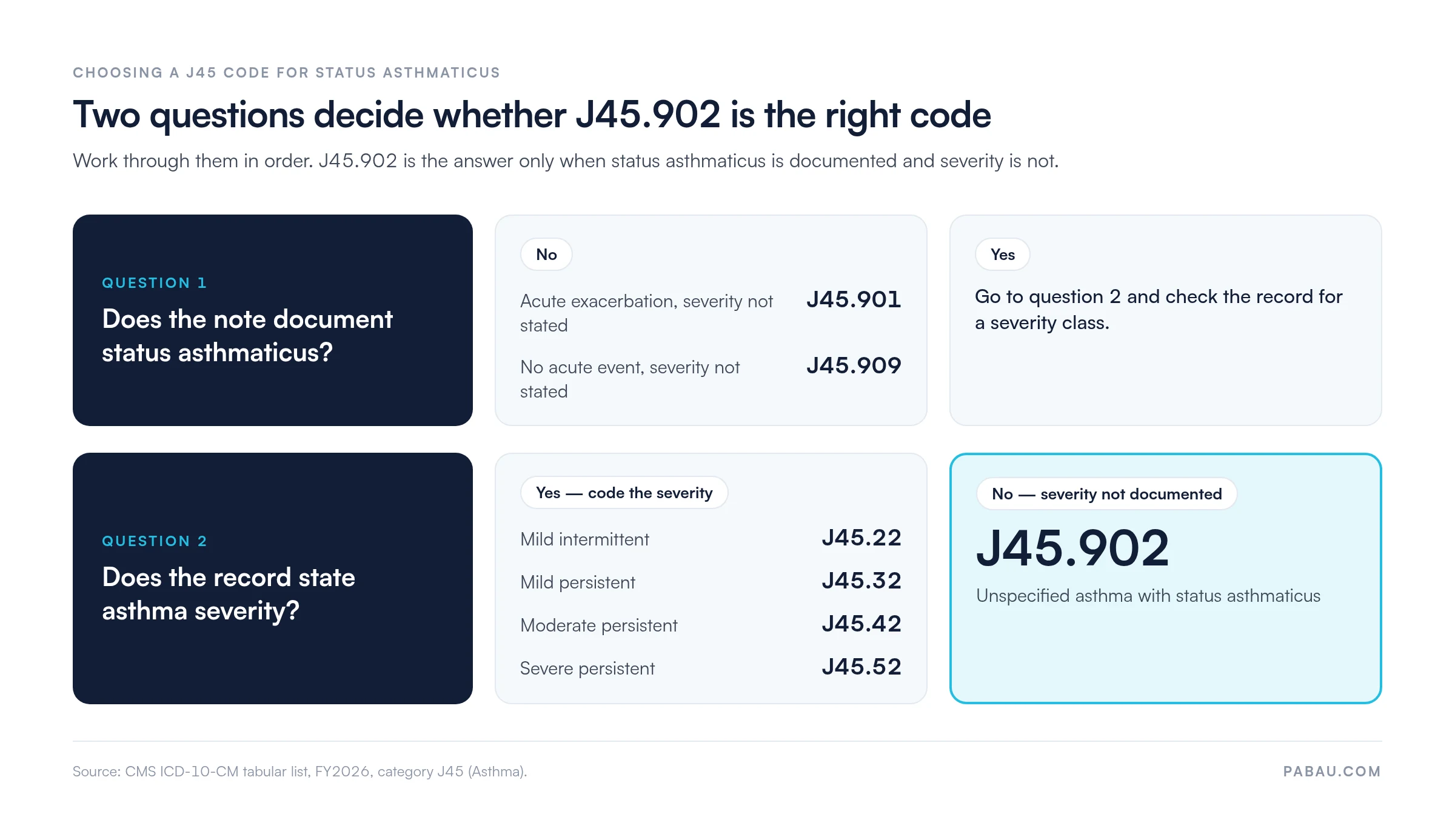
A practical scenario: An ED physician documents “patient presents with status asthmaticus, failed two albuterol nebulizer treatments, admitted for IV magnesium and steroids.” No severity classification appears anywhere. ICD-10 Code J45.902 is correct. Had the same physician added “underlying moderate persistent asthma” to the note, J45.42 would be correct instead.
Coders should not query the physician solely to obtain a severity classification. The ICD-10-CM Official Guidelines allow a query when documentation is ambiguous or conflicting. Querying only to turn a legitimately unspecified code into a more specific one, without clinical basis, is not appropriate practice.
Run a quarterly audit of all J45.9x claims at your practice. Flag any J45.902 claim from a routine outpatient visit. Status asthmaticus in a routine office visit is clinically unlikely and may indicate a coding error. Cross-reference with procedure codes and treatment notes to identify systemic mismatch patterns before payers do.
Unspecified severity codes like ICD-10 Code J45.902 depend entirely on the physician’s note. The coder cannot assign a more specific code without physician input. A missing severity statement often surfaces only when a denial arrives.
Pabau, the practice management platform we build, handles US insurance billing through its claims management for practices. Claims go out as CMS-1500/837P claims through Claim.MD, with an eligibility check before submission. ERA remittances come back to the practice, and secondary claims run through the same route.
Because notes, invoices, and claims live in one system, the billing team can read the note behind a J45.902 claim before it goes out. Prior authorization codes, dates, and sessions are tracked on the patient’s case, with a warning when one is missing. Tracking revenue cycle management workflows from encounter to ERA receipt shows where status asthmaticus claims stall.
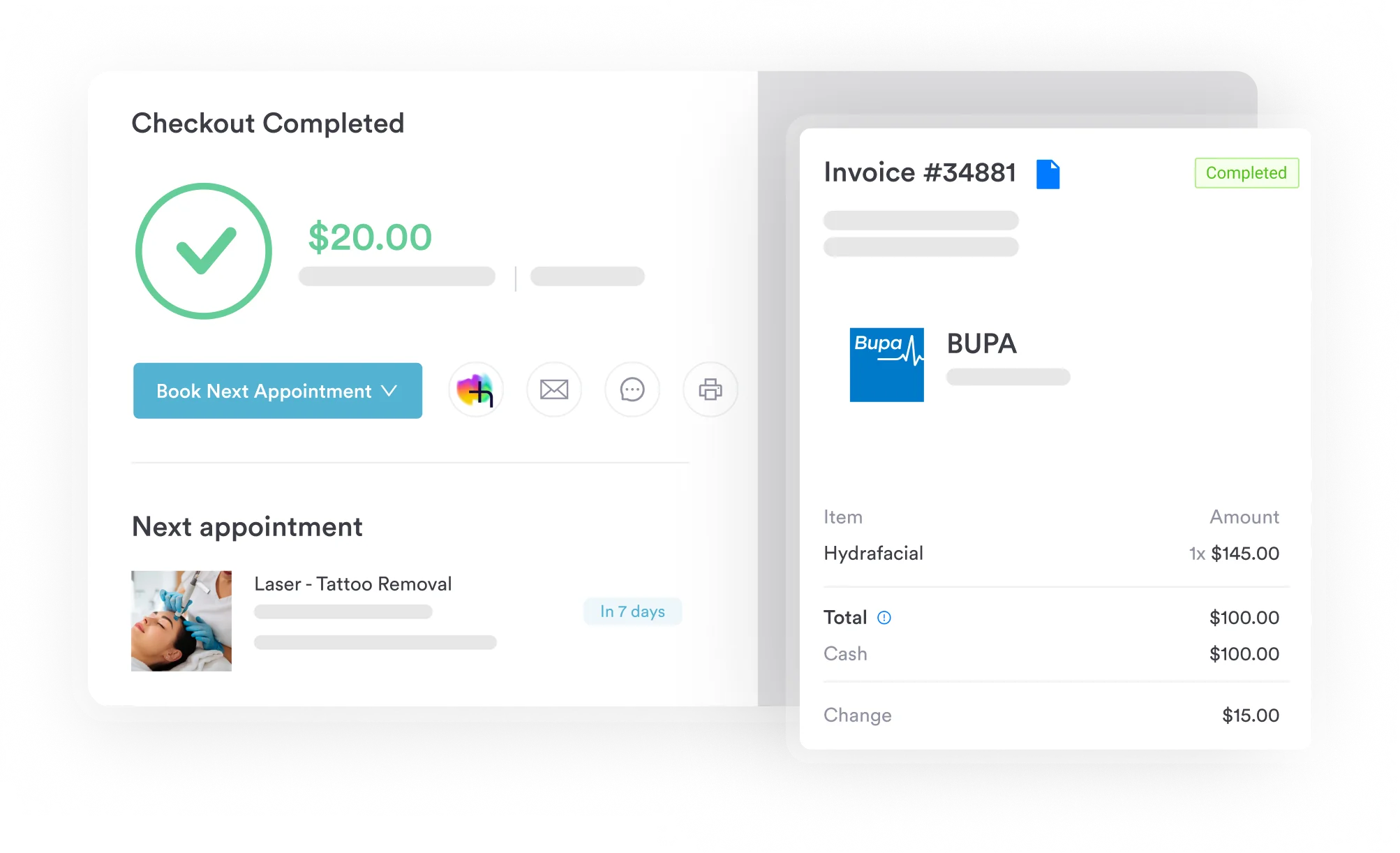
The result is fewer physician queries after the fact, fewer claims that need an appeal, and a cleaner first-pass rate on respiratory diagnosis codes.

Pabau sends US claims through Claim.MD, with an eligibility check before submission and ERA remittances returned to the practice. See how one system keeps J45.902 claims and their notes in step.

Treat J45.902 as the last stop among the status asthmaticus codes. Before assigning it, read the whole encounter for a severity statement, because one phrase such as “moderate persistent” moves the claim to J45.42. Then confirm the note shows treatment failure, which separates status asthmaticus from the exacerbation code J45.901.
Both checks take minutes at the coding stage and cost far less than an appeal. Pabau keeps notes, claims, and remittances in one system, so the billing team can run them before a claim goes out. Book a demo to see how Pabau handles asthma claims from the clinical note to the remittance.

Need a framework for managing claim denials across diagnosis codes? Denial management in healthcare covers root-cause analysis and appeal strategies for ICD-10-driven rejections.
Coding a routine asthma visit with no acute event? ICD-10 code J45.909 covers unspecified asthma without an exacerbation or status asthmaticus.
Unfamiliar with how clearinghouses process respiratory claims? Claim.MD clearinghouse overview explains how claim edits and ERA processing work for complex diagnosis codes.
Looking for a plain-language guide to the billing cycle? What is medical billing walks through the full claim lifecycle from encounter to payment posting.
ICD-10 Code J45.902 is the billable ICD-10-CM diagnosis code for unspecified asthma with status asthmaticus. It is used when a physician documents status asthmaticus but does not classify the asthma as intermittent, mild persistent, moderate persistent, or severe persistent. It is a valid, specific six-character code within the J45 (Asthma) category.
J45.901 is unspecified asthma with acute exacerbation, assigned when a standard worsening episode is documented without severity classification. J45.902 is unspecified asthma with status asthmaticus, assigned when the physician documents a prolonged, treatment-refractory attack that did not respond to initial bronchodilator therapy. Status asthmaticus implies a higher clinical acuity and typically requires escalated intervention.
Use J45.902 only when the physician documents status asthmaticus AND the record contains no severity classification (intermittent, mild persistent, moderate persistent, or severe persistent). If severity is documented anywhere in the encounter, assign the corresponding severity-specific code: J45.22, J45.32, J45.42, or J45.52.
Yes, J45.902 can be assigned as a primary diagnosis when status asthmaticus is the reason for the encounter and severity is unspecified. It often appears as the primary code on ED and inpatient claims where the status asthmaticus episode drove the encounter. In those cases, no prior severity classification is on record.
Most denials trace to one of four problems. The physician may have written a vague phrase like “severe asthma” instead of “status asthmaticus.” Or a severity class elsewhere in the record made a more specific code available. Other claims lack evidence of treatment failure, or the diagnosis does not match the procedure codes billed for the encounter.
The direct parent is J45.90 (Unspecified asthma), within J45.9 (Other and unspecified asthma) and J45 (Asthma). Hierarchy: J00-J99 > J40-J4A > J45 > J45.9 > J45.90 > J45.902.