CPT code 52648: Laser ablation of the prostate billing guide
What CPT code 52648 covers, and what it bundles in CPT code 52648 is the code fo...

Last Updated: Oct 21, 2026

HCPCS Code J3487 (injection, zoledronic acid / Zometa, 1 mg) is a deleted code and cannot be used on current Medicare or commercial insurance claims.
The active successor is J3489, billed per 1 mg of zoledronic acid administered. Units on the claim must match the dose given.
Oncology bills 4 units for a 4 mg Zometa dose, while rheumatology bills 5 units for a 5 mg Reclast infusion.
Medicare covers zoledronic acid for five indications under LCD L33270: hypercalcemia of malignancy, bone metastases, multiple myeloma, osteoporosis, and Paget disease of bone.
Practice management software like Pabau helps infusion practices track drug units, attach ICD-10 codes, and submit clean zoledronic acid claims.
HCPCS Code J3487 is a deleted Level II code that described injection of zoledronic acid (Zometa), 1 mg. J3489 replaced it, and J3489 is the only code Medicare and commercial payers now accept for this drug.
The old code still turns up in charge masters, EHR order sets, and inherited superbills.
Below you will find the deletion history, the crosswalk to J3489, and every Medicare-covered indication. The rest covers the required ICD-10-CM codes, reimbursement, documentation, and the errors that trigger denials.
HCPCS Code J3487 was a Level II Healthcare Common Procedure Coding System code describing injection of zoledronic acid (Zometa), 1 mg.
It sat in the HCPCS Level II system maintained by the Centers for Medicare and Medicaid Services (CMS). That system covers drugs, biologicals, and non-physician services billed to Medicare Part B and most commercial payers.
The code is now deleted. Any claim submitted today with J3487 as the drug code will be rejected by Medicare and most commercial payers. The table below summarizes the core code facts.
J3487 was deleted by CMS as part of a routine HCPCS Level II annual update. CMS consolidates or revises drug codes when a descriptor no longer reflects current billing conventions. It also does so when a new code gives more precise coverage.
Practices working from billing templates built before the deletion date are the usual source of continued J3487 use. The AAPC HCPCS code database lists J3487 as deleted, with J3489 as the crosswalk replacement.
Submitting a deleted HCPCS code does not simply reduce the payment. The claim is rejected outright, so nothing is paid until you correct and resubmit it. For practices running zoledronic acid on a schedule, such as annual osteoporosis infusions, repeated rejections tie up cash for weeks.
Understanding medical billing fundamentals helps billing teams audit their charge masters for deleted codes before claims go out, not after.
J3489 is the active replacement for J3487. Both codes describe injection of zoledronic acid at 1 mg per billing unit. J3489 is the one Medicare and commercial payers accept today. The table below compares them side by side.
One distinction matters for billing teams. J3487’s descriptor named Zometa by brand. Reclast had a separate brand code, HCPCS code J3488, which is also deleted. J3489 uses a generic descriptor, so it covers Zometa for oncology dosing and Reclast for the annual 5 mg osteoporosis infusion. Practices administering either brand now use J3489.
Medicare covers zoledronic acid infusions under LCD L33270, Bisphosphonates (Intravenous [IV]) and Monoclonal Antibodies in the Treatment of Osteoporosis and Their Other Indications.
Coverage is limited to medically necessary indications. Off-label use may need prior authorization and is not automatically covered under this LCD. The five covered indications and their ICD-10-CM codes are listed below.
Verify ICD-10-CM codes against the current year’s CMS update file before you submit. Codes are revised annually, and an outdated code is a common source of denials.
Every zoledronic acid claim needs a linked ICD-10-CM diagnosis code that matches a covered LCD indication. A missing or mislinked diagnosis code is one of the leading causes of denial on infusion drug claims. Several secondary codes commonly appear on the same claim.
The CMS fee schedule lookup lets billers check which ICD-10-CM codes a drug code accepts and confirm coverage before submission.
Medicare Part B reimburses zoledronic acid under J3489 using the Average Sales Price (ASP) methodology. CMS sets payment at ASP plus 6% for physician office settings. Hospital outpatient departments bill under the Outpatient Prospective Payment System (OPPS), which calculates payment differently.
Site of service drives that difference, so how your revenue cycle management process captures it matters. A physician office claim and a hospital outpatient claim for the same drug are processed on different rules.
ASP-based rates change quarterly. CMS publishes an updated ASP drug pricing file each quarter, so the zoledronic acid rate in January will differ from the rate in October. Check the current CMS file before you quote patients or project drug revenue.
Site-of-service billing rule: practices administering the infusion in a physician office use Place of Service code 11 and bill J3489 on a CMS-1500. Hospital outpatient infusion suites bill on a UB-04 with the applicable revenue code. The payment difference between the two settings can be significant for high-dose oncology regimens.
Audit your ASP pricing file at the start of each quarter. Set a calendar reminder for the CMS ASP publication date, typically mid-month after the quarter starts. Update your fee schedule before the first claims of the new quarter go out. This prevents the systematic undercoding or overbilling that triggers audits.
LCD L33270 sets out what the record must contain to support a zoledronic acid claim. Miss any required element and the payer has grounds for denial or recoupment on audit. Structured IV therapy intake forms and pre-infusion checklists catch missing detail before the patient reaches the chair.
Consistent documentation templates cut the time staff spend preparing records for pre-payment reviews and post-payment audits. They also remove the variability that creates compliance risk. Good medical billing compliance begins in the clinical note, well before anyone opens the claim form.
Practices billing zoledronic acid today should run the same workflow on every encounter. Claims management software that validates drug codes against active HCPCS tables catches deleted-code errors before the claim leaves the practice.
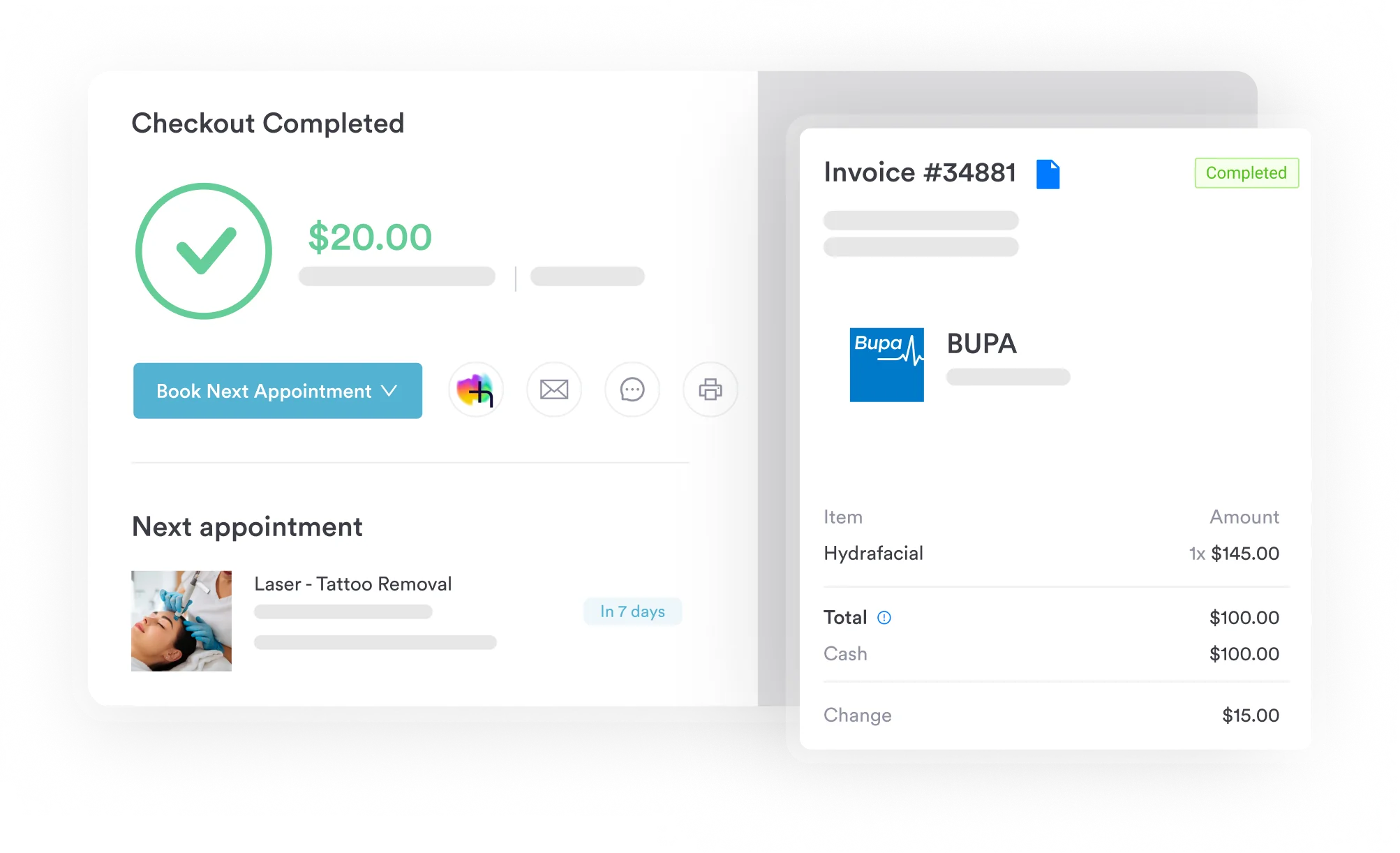
A superbill that pre-populates J3489 that pre-populates J3489 with the right administration CPT code cuts manual entry errors and speeds up recurring infusion appointments.
Zoledronic acid claims fail for a predictable set of reasons, and most are correctable with a focused pre-claim audit. Strong denial management means knowing which error produces which denial code, so the billing team can fix them systematically.
Submitting a clean claim for zoledronic acid means getting all six elements right at once. One missing piece creates a denial that costs more to fix than it would have cost to prevent.
Zoledronic acid is given in specialty settings that bill it very differently. The dose, the claim form, and the prior authorization pattern all shift with the setting, as the comparison below shows.
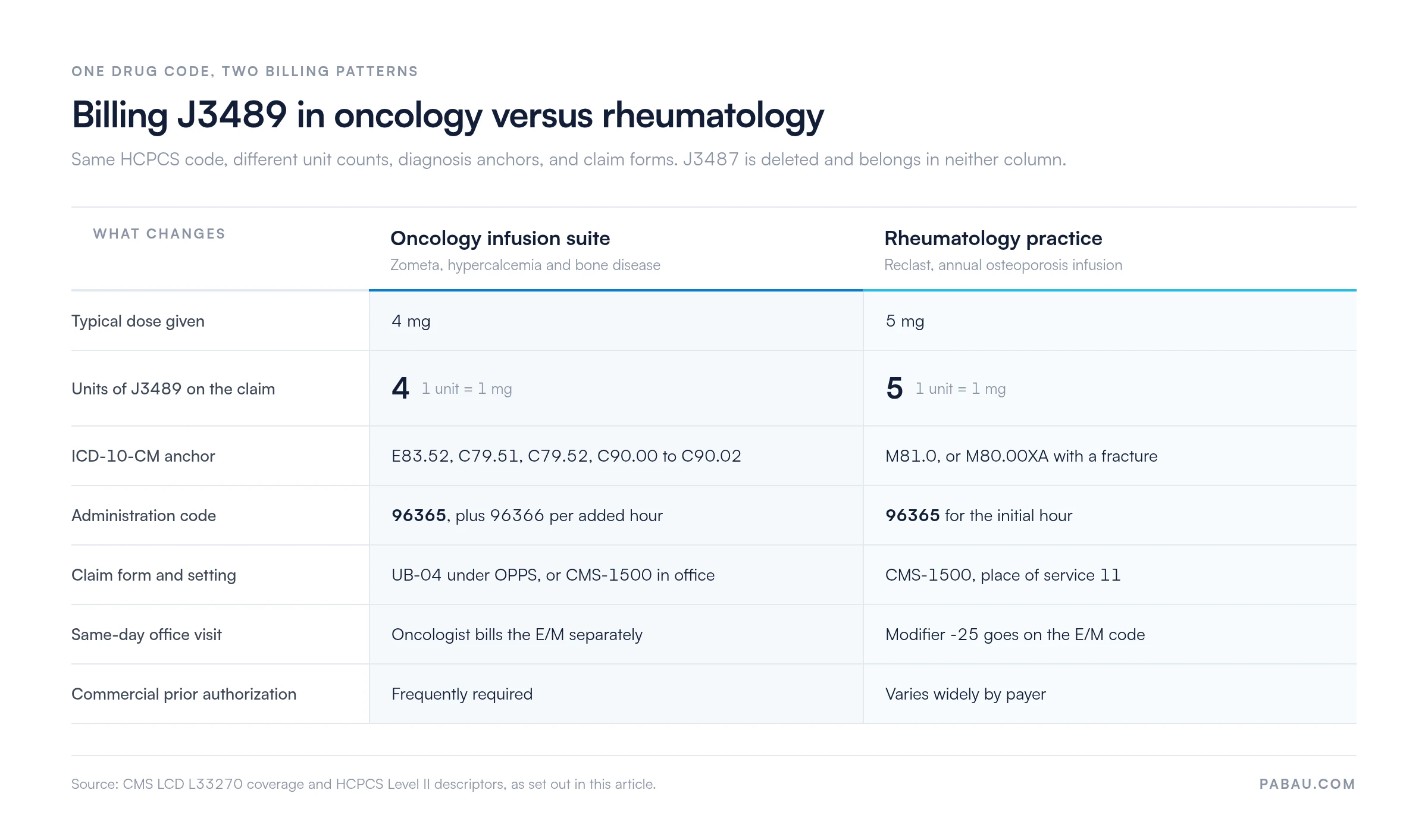
Oncology practices typically administer zoledronic acid in a dedicated infusion suite. The facility and professional components are often split. The facility bills the drug and administration under OPPS on a UB-04, and the oncologist bills separately for evaluation and management.
On multi-drug encounters, J3489 sits alongside the chemotherapy codes and supportive-care drugs such as drugs such as J3250, with the 96365 series covering administration time. Oncology practices need IV therapy EMR software that handles split billing, concurrent infusion tracking, and drug unit documentation in one workflow.
Rheumatology practices more often give the drug as the annual osteoporosis infusion, Reclast at 5 mg. These encounters are usually billed entirely by the physician practice on a CMS-1500. The practice bills J3489 at 5 units plus the administration code.
The office visit E/M is added when a separate evaluation happens that day. Modifier -25 belongs on that E/M code to show a separately identifiable service. The same modifier question comes up when the practice also bills 20611 for an image-guided joint injection.
Prior authorization patterns by specialty: commercial payers frequently require PA for oncology uses such as bone metastases and multiple myeloma. They apply different rules to osteoporosis infusions.
Practices billing annual Reclast infusions find PA rules differ between Blue Cross plans, UnitedHealth, and regional payers. The same is true for other rheumatology drug codes such as J1438, so verify with each payer at the start of the plan year.
IV infusion practice software that ties prior authorization tracking to the scheduling workflow stops an infusion going ahead before PA is confirmed.
Billers working on these claims will meet the codes below. Knowing when each one applies prevents inappropriate substitution and keeps claims from being denied for a code mismatch.
The PGM Billing HCPCS lookup searches current HCPCS Level II codes from CMS source data and confirms whether a drug code is active or deleted.
Most infusion practices find a deleted drug code the same way. The rejection comes back, someone opens the charge master, and the claim goes out again two weeks later. The code was already wrong before the patient sat down.
Practice management software like Pabau works the other way around. The drug code, the units, and the ICD-10-CM diagnosis are captured in the treatment note, then carried onto the claim. Submission runs through our Claim.MD integration, so rejections land back in the record your team already works in.
That matters most for practices running infusions on a schedule. Oncology suites, rheumatology offices, and the functional medicine practices that run their own infusion rooms all document differently. One pre-claim check, built once, covers every setting you bill from.

Pabau’s claims management tools validate HCPCS codes, attach the ICD-10 diagnosis, and track submission status. Your zoledronic acid claims go out right the first time.

J3487 is not a problem you can fix at the claim level. Pull it out of the charge master, the superbills, and the EHR order sets, and the rejections stop at the source.
After the swap, what remains is arithmetic and linkage. Units must equal milligrams given, and the diagnosis must match a covered LCD indication. The chart also has to carry infusion times and medical necessity. Those three checks prevent most of the denials this drug generates.
The trade-off worth remembering is timing. ASP rates move every quarter and PA rules move every plan year, so a workflow that was clean in January can start failing by October. Book a demo to see how Pabau keeps drug codes, units, and diagnoses aligned for oncology and rheumatology billing.

Billing for a neck muscle strain? Neck strain coding guide explains why the S16.1 parent code needs a 7th character before submission.
Billing another drug code CMS retired? HCPCS Code J3365 sets out what to bill in its place.
Treating oncology and rheumatology patients in one suite? HCPCS Code J9312 covers rituximab billing units and modifiers.
Coding osteoporosis without a fracture? ICD-10 Code M81.8 explains when the other-osteoporosis code applies.
Coding a follow-up breast injury? Breast injury coding guide covers S20.109D for superficial breast injuries documented at a follow-up visit.
HCPCS Code J3487 is a deleted Level II code that described injection of zoledronic acid (Zometa), 1 mg. Medicare and commercial payers used it to reimburse intravenous zoledronic acid infusions. It was removed from the active code set and replaced by J3489.
Yes. HCPCS Code J3487 is deleted and cannot be submitted on current Medicare or commercial insurance claims. Claims submitted with J3487 will be rejected. Use J3489 for all current zoledronic acid billing.
J3487 is deleted and J3489 is the active replacement. Both describe injection of zoledronic acid at 1 mg per billing unit. J3487’s descriptor referenced only the Zometa brand. J3489 uses a generic descriptor that covers Zometa and Reclast, so only J3489 belongs on current claims.
The diagnosis code depends on the clinical indication. Hypercalcemia of malignancy uses E83.52, and bone metastases use C79.51 or C79.52 with the primary malignancy code. Multiple myeloma uses C90.00 to C90.02, osteoporosis uses M81.0 or M80.00XA, and Paget disease uses M88.0 or M88.8X1 to M88.8X9. All must match a covered indication under LCD L33270.
Yes. Medicare Part B covers it under LCD L33270 for five indications. Those are hypercalcemia of malignancy, bone metastases from solid tumors, multiple myeloma, osteoporosis, and Paget disease of bone. Reimbursement uses the Average Sales Price plus 6% methodology and changes quarterly. Off-label use is not automatically covered and may need prior authorization.
Six errors account for most denials. The first is using the deleted J3487 instead of J3489. The second is billing 1 unit regardless of the dose given. The third is omitting the required ICD-10-CM diagnosis code. The rest are using J3490 when J3489 applies, missing commercial prior authorization, and submitting without infusion start and stop times.