CPT Code 62284: Injection procedure for myelography
CPT Code 62284: official descriptor and procedure overview The American Medical ...

Last Updated: Oct 19, 2026

CPT code 96365 covers the initial hour of intravenous infusion for therapeutic, prophylactic, or diagnostic purposes, excluding chemotherapy and hydration.
The code must be billed as the first service in a visit — CPT 96366 is appended for each additional hour beyond the initial period.
Documentation must capture infusion start and stop times, substance administered, physician oversight, and medical necessity to survive payer audit.
Pabau’s claims management software and digital forms help IV therapy practices capture timed infusion records and submit cleaner claims with fewer denials.
CPT code 96365, also written as CPT 96365, is the billable code for the initial hour of an intravenous infusion given for a therapeutic, prophylactic, or diagnostic purpose, excluding hydration and chemotherapy. It’s the entry point for the 96360-96379 infusion family, and every add-on code in that family is billed on top of it.
Getting the base code, time documentation, and sequencing right is what separates a claim that pays on first submission from one that sits in a denial queue for weeks.
According to the American Medical Association (AMA), CPT code 96365 describes “intravenous infusion, for therapy, prophylaxis, or diagnosis (specify substance or drug); initial, up to one hour.” The key distinction from hydration codes (CPT 96360 and 96361) is purpose: 96365 requires the infused substance to have a therapeutic, prophylactic, or diagnostic intent beyond simple fluid replenishment.
This guide covers the code descriptor, add-on code hierarchy, time rules, documentation requirements, modifier usage, reimbursement context, and common denial patterns. Practices running IV therapy EMR software that integrates infusion timing directly into the patient record will find many of these requirements easier to meet consistently.
Among the infusion CPT codes an IV therapy practice bills most often, CPT code 96365 sits at the top of the sequencing hierarchy. The 96360-96379 family follows this hierarchy strictly, and CPT code 96365 must always be the “first service” code when a therapeutic infusion is the primary service delivered during a visit.
Billing it as an add-on or secondary code is a common sequencing error that triggers automatic edits at most clearinghouses.
Use this infusion and injection coding cheat sheet to see the full 96360-96379 hierarchy at a glance:
A few sequencing rules catch practices off-guard. If a patient receives both a hydration infusion (96360) and a therapeutic infusion (96365) in the same visit, the hydration code is billed as a secondary add-on, not as the primary service.
The therapeutic code always takes hierarchy precedence. Understanding how to open an IV therapy practice with correct billing workflows built in from day one avoids years of corrective claims work later.
Radiopharmaceutical infusions fall outside the 96360-96379 family. Report 79101 for intravenous radiopharmaceutical therapy, and check payer policy before billing 96365 for one.
IV push codes (96374-96376) describe a clinician-attended injection given over 15 minutes or less. CPT code 96365 applies when infusion is delivered over a longer, controlled period requiring nursing observation throughout.
The distinction matters because payers audit duration: an infusion documented as lasting 12 minutes should have been billed under the IV push CPT code family, not as 96365, and submitting the wrong code creates both a denial and a potential compliance flag.
For practices offering NAD+, high-dose vitamin C, or antibiotic infusions.
Getting the CPT code 96365 guidelines right depends on documentation as much as on coding knowledge. Medi-Cal and CMS guidance both state that claims for CPT code 96365 require documentation of physician direct oversight. Missing or vague documentation is the primary reason payers downcode or deny these claims. A compliant infusion record needs to capture five specific elements.
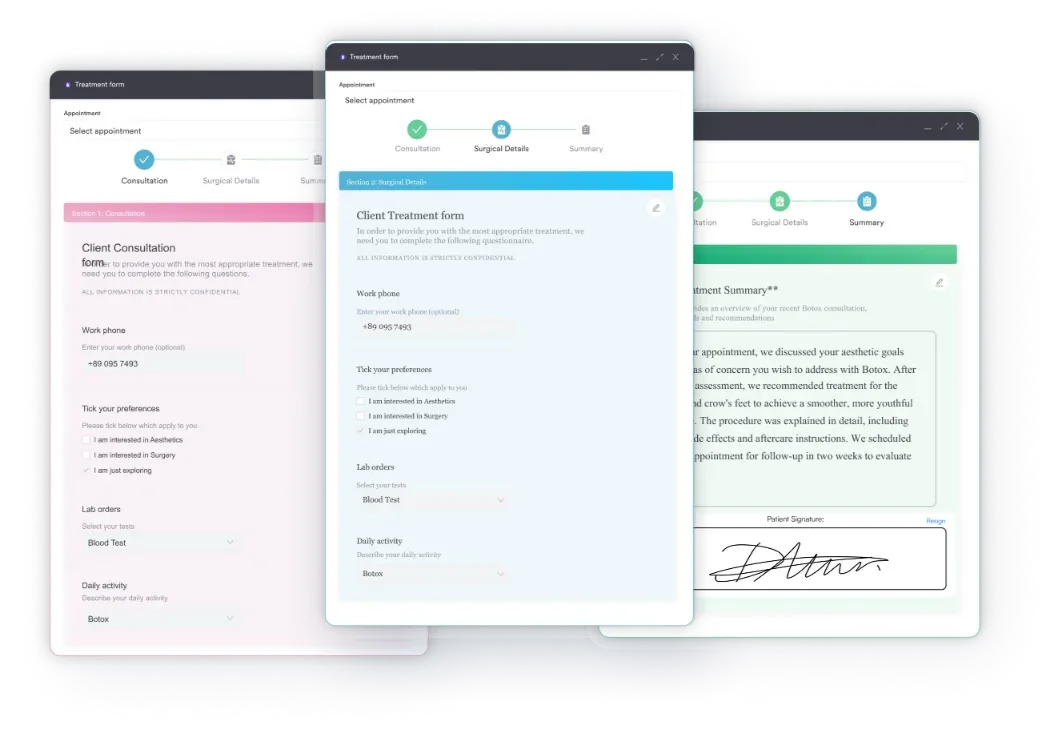
Capturing these elements consistently is easier when intake and treatment forms are built to prompt for them.
Staff working from a well-structured infusion record template will rarely miss a required element, while those working from free-text notes miss them routinely. Reviewing your practice’s current IV therapy intake form documentation against these five requirements is a practical first audit step.
CMS guidance via Palmetto GBA (Medicare Coverage Database Article A53778) states that an infusion must exceed 15 minutes to be reasonable and necessary for safe and effective administration, and to be billed as an infusion rather than an IV push. In practice, that means at least 16 minutes of documented infusion time is needed to bill CPT code 96365.
Practices should not bill 96365 for infusions that concluded at or before the 15-minute mark. The appropriate code in that scenario is the relevant IV push code.
Audit your infusion records quarterly by pulling a random sample of 96365 claims and matching documented start/stop times against billed units. A single session where a nurse documented 12 minutes but the claim shows 96365 creates audit exposure. Build a timed-infusion field into your treatment note template so clock times are captured automatically.
The right software for primary care practices turns immunizations and in-office tests into charted, billable entries automatically.
CPT code 96365 is the parent code. The three add-on codes below it each serve a specific clinical scenario, and billing them incorrectly together creates Correct Coding Initiative (CCI) edit conflicts.
When an infusion of the same substance continues beyond the initial hour billed with 96365, each additional full hour is captured with 96366. A two-hour infusion of a single therapeutic agent bills as 96365 plus one unit of 96366, and a three-hour infusion bills as 96365 plus two units of 96366.
CMS Medicare Coverage Database article A53778 confirms this sequential billing structure for facility and non-facility settings.
When a second drug is infused after the first has finished (sequentially, not simultaneously), 96367 captures the initial hour of that second substance. It can be reported more than once if multiple additional substances are administered sequentially during the same visit.
A practice infusing vitamin C followed sequentially by magnesium, for example, would bill 96365 for the vitamin C and 96367 for the magnesium.
96368 applies when two substances run simultaneously through separate IV lines. It is billed only once per visit regardless of how many concurrent substances are running or how long they run. This code is frequently underbilled: practices that give two simultaneous drips and only bill 96365 leave a reimbursable code on the table.
The AAPC Codify CPT lookup includes CCI edit pairs for the 96360-96379 family, which makes it the fastest way to check whether a specific combination of codes will trigger a bundling edit before submission.

Pabau’s claims management software and timed digital forms help IV therapy practices document infusion start and stop times automatically, sequence add-on codes correctly, and submit cleaner claims from day one.

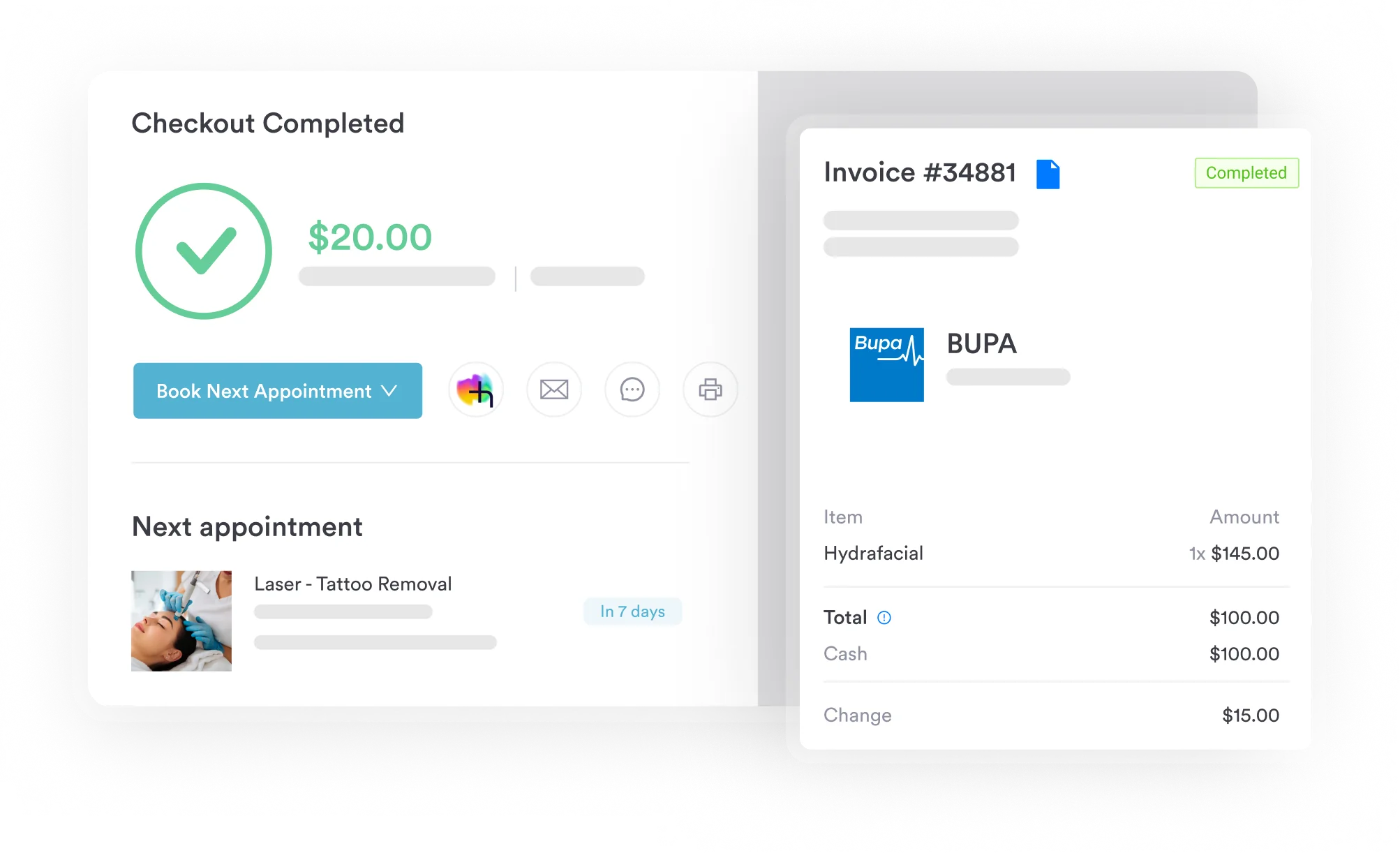
Medicare reimbursement for CPT code 96365 varies by geographic locality, practice setting (facility vs non-facility), and the annual Medicare Physician Fee Schedule update. The CMS Physician Fee Schedule lookup tool allows practices to retrieve the current payment amount for their specific MAC jurisdiction. CPT code 96365 reimbursement varies enough by locality and setting that it’s worth checking the Medicare Physician Fee Schedule directly rather than assuming a flat national rate. Patients paying up front and claiming later need a superbill, which itemizes the service, the code and the charge.
Non-facility rates (office-based infusion suites, independent IV therapy practices) are generally higher than facility rates, because the non-facility practice expense RVU accounts for the cost of supplies and equipment the practice absorbs directly.
Modifiers help payers understand why a service that might otherwise be bundled or questioned is appropriate for separate reimbursement. Four modifiers come up regularly with CPT code 96365.
Billing CPT code 96365 alongside an E&M code on the same date is appropriate when the E&M addresses a separate clinical problem. The classic example is a patient presenting for a planned antibiotic infusion who also has a new complaint (a wound, a rash, a blood pressure concern) that prompts a distinct evaluation.
That evaluation supports the E&M. Without Modifier 25 and distinct documentation, payers will bundle the E&M into the infusion code and deny the separate charge.
Four denial patterns account for the majority of rejected 96365 claims.
Tracking these denial patterns by code and payer across your book of business is one of the clearest signals of where documentation workflows need tightening. Practices using claims management software can filter denial reasons by CPT code and build targeted correction protocols. Practices weighing platforms for this kind of tracking can start with this billing software guide.
Understanding who can administer IV vitamin therapy in your state also directly affects which provider credentials appear on the claim and whether the supervision documentation is complete.
CMS Medicare Coverage Database article A53049 confirms that medications administered as supportive management of chemotherapy or certain monoclonal antibody infusions (antiemetics, steroids, analgesics, antibiotics) should be separately reported using CPT codes 96360, 96361, 96365, or 96379.
This means a practice or infusion suite that administers supportive IV medication on the same day as chemotherapy can bill CPT code 96365 for that supportive infusion, provided the documentation clearly distinguishes it from the chemotherapy service and the appropriate chemotherapy administration codes (which belong to the 96401-96549 family) are used for the chemotherapy itself.
When billing 96365 alongside chemotherapy administration codes, confirm your EHR generates separate claim lines with distinct start/stop times and drug names for each infusion. Commingled documentation that treats all infusions as one event is the primary trigger for line-level bundling denials on multi-drug infusion claims.
Billing accuracy for CPT code 96365 is a documentation problem before it is a coding problem. High denial rates on infusion claims usually trace back to how the infusion was recorded, not how it was coded: clinical staff often aren’t capturing the data the billing team needs to submit a clean claim. That claim typically reaches the payer as an 837 file, the electronic format most clearinghouses require for infusion claims.
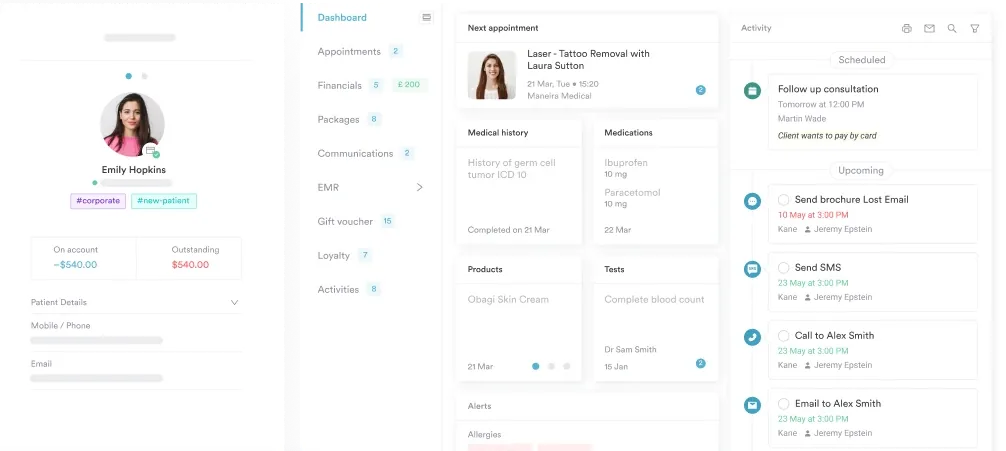
Pabau’s clinical documentation and client records module allows IV therapy practices to build timed infusion templates directly into the patient record, so start time, stop time, substance administered, and supervising clinician are captured at the point of care rather than reconstructed from memory after the visit.
When those records feed directly into the billing workflow, the claim reflects exactly what the clinical note says, and denial rates drop accordingly. Practices focusing on IV therapy marketing strategies to grow patient volume need billing workflows that scale without increasing administrative overhead per claim.
For practices operating a mobile IV therapy business, the documentation challenge is compounded by the absence of a fixed clinical environment. The same principle applies to home infusion therapy billing: mobile infusion records need the same five documentation elements as practice-based ones, plus a clear notation of the service location for claims that require a place-of-service code.
The 96365 procedure code is straightforward in description but unforgiving in execution. Start and stop times, correct sequencing above hydration codes, physician oversight documentation, and a clear medical necessity link are the four elements that determine whether a claim pays or goes to a denial queue.
Getting all four right every time depends more on a solid documentation workflow than on coding knowledge alone.
Pabau’s timed infusion templates and IV therapy practice management tools capture the five required documentation elements at the point of care, so billing staff work from complete records rather than chasing clinicians for missing times. To see how Pabau handles IV infusion documentation and claim submission, book a demo.

Billing larger syringes too? 5 cc syringe billing guide covers HCPCS code A4209 for a sterile syringe of 5 cc or greater and the errors that cause denials.
Also billing chemotherapy-adjacent infusions? CPT code 96413: Chemotherapy IV infusion billing guide covers administration code sequencing and documentation for chemo infusion claims.
Billing needle-free devices too? Needle-free device billing guide covers HCPCS code A4210 for a needle-free injection device billed per unit under the DME benefit.
Working through other high-denial billing codes? HCPCS code J1160: Billing guide for digoxin injection breaks down the dosage-based units and documentation that keep these claims from being denied.
Need a diagnosis code for a related claim? ICD-10 code H43.9 covers documentation requirements for unspecified vitreous body disorder claims.
Billing self-administered injection supplies too? Self-administered injection supplies guide covers HCPCS code A4211 for miscellaneous home self-administered injection supplies billed when no other code applies.
CPT code 96365 is used to report the initial hour of an intravenous infusion administered for therapeutic, prophylactic, or diagnostic purposes, excluding chemotherapy and simple hydration. It covers infusions such as antibiotics, antifungals, IV vitamins, immunoglobulins, and other drugs or biologicals delivered by continuous IV drip requiring nursing supervision throughout.
Bill CPT code 96365 as the first service in the visit, before any add-on infusion or push codes, and document infusion start and stop times, the substance given, and the diagnosis supporting medical necessity. These are the same CPT code 96365 guidelines that determine whether add-on codes 96366, 96367, or 96368 apply on top of it.
CPT 96365 covers the first hour of a therapeutic IV infusion and is billed as the standalone initial code. CPT 96366 is an add-on code that captures each additional full hour of the same infusion beyond that first hour. A two-hour infusion bills as one unit of 96365 plus one unit of 96366, and a three-hour infusion adds a second unit of 96366.
Not always, but Modifier 25 is required when a separately identifiable E&M service is performed on the same date, and Modifier 59 is needed when a CCI edit would otherwise bundle 96365 with another code that reflects a distinct service. Modifier requirements vary by payer, so check your specific commercial and Medicare plan contracts before assuming a modifier is or is not needed.
Bill one unit of 96365 for the first hour, then one unit of 96366 for each additional full hour of the same substance. Document clock start and stop times for the entire infusion period. Partial hours at the end of an extended infusion are generally not separately billable with an additional unit of 96366 unless the documented time exceeds the midpoint threshold for that increment.
Yes, when the E&M addresses a separate and distinct clinical problem from the reason for the infusion. Modifier 25 must be appended to the E&M code, and the documentation must clearly show two distinct services: one supporting the infusion order and one supporting the separate evaluation. Payers commonly audit same-day infusion-plus-E&M claims, so documentation clarity is essential.
CPT code 96365 covers up to one hour of infusion. CMS guidance (Medicare Coverage Database Article A53778) requires an infusion to exceed 15 minutes for safe and effective administration, meaning at least 16 minutes of documented time is needed to bill the code. Infusions shorter than that should generally be reported with an IV push code instead. Start and stop times must appear in the clinical record to substantiate the billed duration.
CPT code 96365 reimbursement varies by locality, site of service, and payer, so there’s no single national rate. Check the current Medicare Physician Fee Schedule for the exact non-facility and facility payment amounts in your MAC jurisdiction, since commercial payer rates are typically negotiated as a percentage of that baseline.