CPT code 28615: Open Lisfranc dislocation billing guide
What CPT code 28615 means, in plain terms CPT code 28615 is the code for open tr...

Last Updated: Oct 20, 2026
J2425 is the HCPCS Level II code for injection, palifermin, 50 micrograms. Palifermin is sold as Kepivance and is billed in 50 mcg units.
Palifermin reduces the incidence and duration of severe oral mucositis in patients with hematologic malignancies. It is given around myelotoxic therapy with autologous stem cell support. Billing turns on weight-based units, the 103.2-unit vial, the JW or JZ modifier and the NDC.
Let Pabau's smart automation suggest the right codes, reduce claim denials, and keep your practice compliant—effortlessly.
Automate repetitive tasks and focus on what matters most—your patients.
Reduce coding errors and ensure compliance with the latest regulations.
Clean claims, fewer denials, and faster reimbursements.
Powerful insights and reporting to help your practice thrive.
HIPAA compliant SOC 2 certified GDPR-compliant Trusted by 4,000+ clinics worldwide

HCPCS code J2425 bills palifermin (Kepivance) at 50 mcg per unit, so a 60 mcg/kg dose for a 70 kg patient is 84 units.
Each 5.16 mg Kepivance vial counts as 103.2 billing units, so most doses leave drug to report on a JW line.
Lead with the hematologic malignancy code from C81–C96, and add K12.31 only when the note documents oral mucositis.
The October 2026 Medicare payment limit is $38.839 per unit, with inflation-adjusted coinsurance of 15.688%.
Many commercial and Medicaid plans require prior authorization tied to autologous stem cell support, the label’s only indication.
HCPCS code J2425 is the CMS HCPCS Level II code for injection, palifermin, 50 micrograms. Palifermin is sold as Kepivance, and CMS added the code on January 1, 2006.
Palifermin is a recombinant human keratinocyte growth factor. According to the FDA-approved Kepivance label, it decreases the incidence and duration of severe oral mucositis in patients with hematologic malignancies. Those patients are receiving myelotoxic therapy with autologous hematopoietic stem cell support.
The label narrows that use further. Palifermin is not established for non-hematologic malignancies, was not effective with allogeneic stem cell support, and is not recommended with melphalan 200 mg/m² conditioning.
J2425 covers the drug supply only. The IV push that delivers it is billed separately, and billing staff convert each weight-based dose into 50 mcg units.
Sources for the table are the CMS October 2026 HCPCS file and ASP payment limit file, plus the December 2025 Kepivance label.
Palifermin is dosed by weight, so the unit count changes with every patient. Multiply the weight in kg by 60 mcg, then divide the result by 50.
One vial covers a dose for a patient up to 86 kg. Above that weight a second vial opens, and the leftover drug jumps from a few units to nearly a full vial.
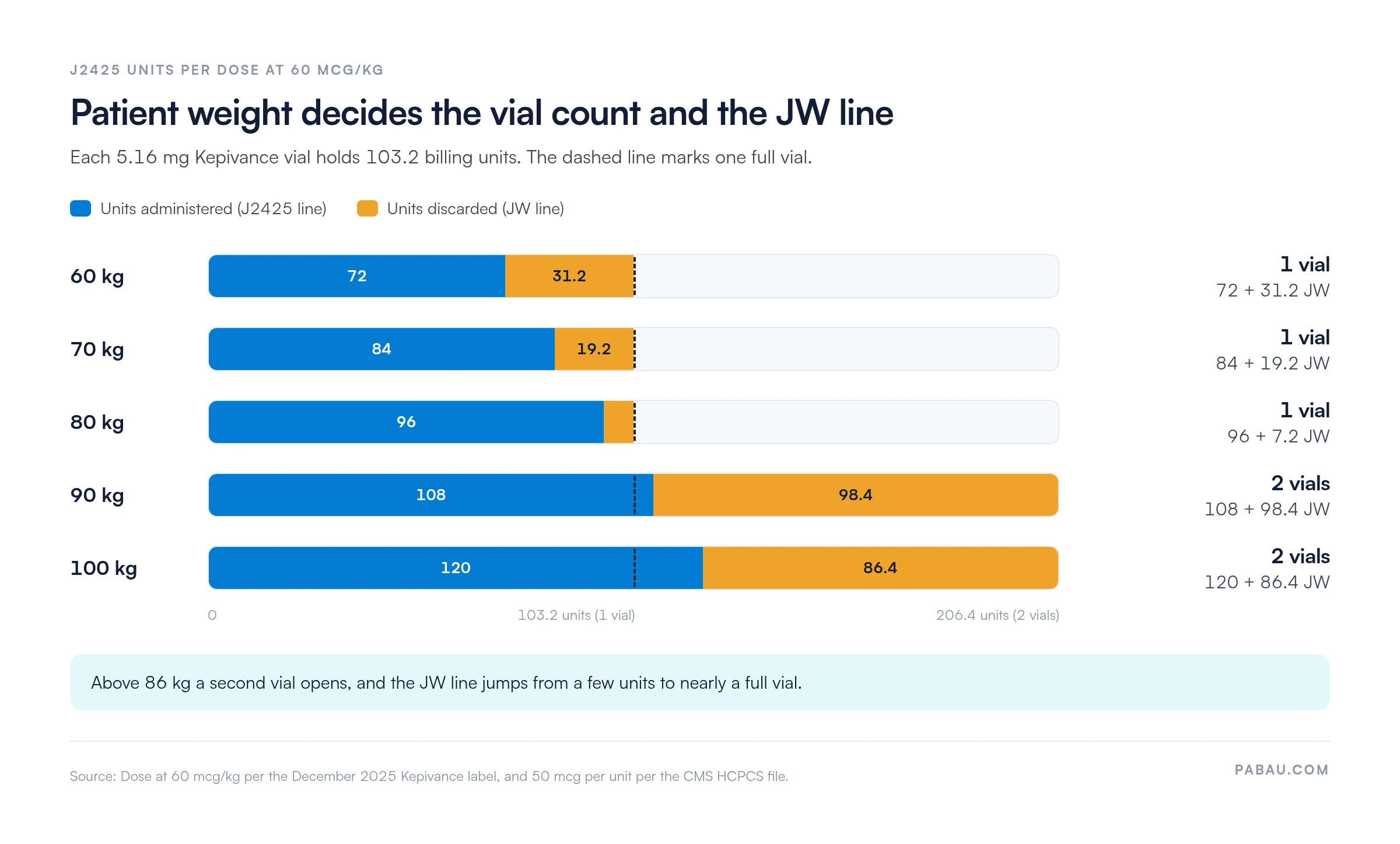
Enter the units in item 24G of the CMS-1500 claim form. Never bill the vial count or the volume in mL. A full six-dose course for a 70 kg patient totals 504 administered units.
When a dose produces a fractional unit, follow your Medicare Administrative Contractor’s rounding instruction. Record the exact dose in mcg so a reviewer can trace the unit count.
Kepivance comes in single-dose vials, so Medicare’s discarded drug policy applies to every J2425 claim. The CMS JW and JZ modifier FAQ sets three rules.
A weight-based dose rarely empties a 103.2-unit vial. Expect JW on most J2425 claims, and give any JZ claim a second look before it goes out.
For the 70 kg patient, bill 84 units on the first line. Bill the leftover 19.2 units on a JW line, rounded per your contractor’s instruction.
Palifermin is given as an intravenous bolus, so the administration line is an IV push code. Bill CPT 96374 for the first IV push of a drug in the encounter.
If palifermin follows another drug’s IV push in the same encounter, CPT 96375 for a sequential new drug usually applies. Palifermin is supportive care, not chemotherapy, so the chemotherapy push code 96409 does not fit.
The label asks staff to rinse a heparinized line with saline before and after the dose. That flush is part of the administration, not a separate drug charge.
J2425 needs a diagnosis that matches the labeled indication. Lead with the hematologic malignancy from the C81–C96 block, and add mucositis codes only when the note documents mucositis.
Multiple myeloma is the pairing most likely to draw a denial. Autologous transplants for myeloma often use melphalan 200 mg/m², and the label does not recommend palifermin with that regimen.
A payer can deny on that basis even with a valid C90.0- code. Document the conditioning regimen and its dose in the order, so the reviewer sees it at once.
Report the 11-digit NDC from the carton you dispensed. The October 2026 CMS NDC-HCPCS crosswalk maps two Kepivance packages to J2425.
The current FDA label also lists NDC 66658-113-01 for a single vial. Older 6.25 mg vials, product code 66658-112, held 125 units and are discontinued, so retire any unit math built on them.
On the CMS-1500, enter the N4 qualifier, the NDC without hyphens, the unit qualifier and the quantity in the shaded area of item 24A. Medicaid requires the NDC on physician-administered drug claims so states can collect manufacturer rebates.
Record the patient’s weight, the dose in mcg, the vial count and the lot number in the same note as the administration time. That one entry supports the unit count, the JW line and the NDC.
In the physician office, Medicare Part B pays J2425 from the quarterly CMS ASP payment limit file, set at 106% of the average sales price. For October 1 to December 31, 2026, the limit is $38.839 per 50 mcg unit.
For the 70 kg patient, one 84-unit dose comes to $3,262.48 before coinsurance. Medicare pays the JW line for discarded drug at the same rate per unit.
The same file sets J2425 coinsurance at 15.688%, flagged as inflation-adjusted, instead of the standard 20%. Use that figure to estimate the patient’s share, and recheck it every quarter.
In a hospital outpatient department, the hospital bills the drug on its own claim under OPPS. Doses given during an inpatient stay are paid through the MS-DRG, so they never go out as separate J2425 lines.
Medicaid and commercial rates come from each state fee schedule or payer contract. Pabau, the practice management platform we build, helps billing staff catch underpaid claims by comparing expected and paid amounts by payer.
Traditional Medicare has no general prior authorization program for Part B drugs like palifermin. Coverage still depends on medical necessity, so the record must support the labeled indication.
Medicare Advantage, Medicaid and commercial plans often require prior authorization for Kepivance. Their criteria usually follow the label, so expect to show these points.
Request one authorization for the full six-dose course. The pre-therapy and post-therapy doses fall on either side of the transplant, often in different care settings.
Each J2425 line needs a record entry for the date of service. Keep these elements in the note.
A complete note speeds up superbill preparation, because coders read units and NDCs straight from it. It also holds up in the medical billing compliance reviews payers run on high-cost drugs.
A structured denial management process catches these patterns before they turn into write-offs. The aim is a clean claim on the first pass.
When a J2425 claim does come back, the remittance denial codes tell you which pre-submission check to tighten.
CPT 96374 and 96375 bill the IV push that delivers palifermin. J3490 and J1050 should never stand in for J2425, because Kepivance has its own code.
Kepivance claims break when the weight, dose, vials and NDC sit in different places. Billing staff then rebuild the unit count from a paper log or from memory.
Pabau keeps the treatment note, the stock record and the claim together. Its inventory and stock management logs each Kepivance vial used against the treatment note.
Claims management then tracks each J2425 claim from submission to payment. With the dose, the vial and the claim in one record, your team can check a unit count before the claim goes out.

Pabau keeps each palifermin dose, the vial used and the claim line in one record, so units and JW lines match the note. Our onboarding team sets it up with you.

J2425 rewards a practice that treats every Kepivance dose as a calculation rather than a vial count. Weight, 50 mcg units and the 103.2-unit vial decide what you bill and what you report as waste.
Confirm autologous support and the conditioning regimen before the first pre-therapy dose. A question settled at dose one costs far less than a denial at dose six.
Book a demo to see how Pabau ties each palifermin dose to a clean J2425 claim.

Managing injectable drug billing across multiple payers? Revenue cycle management fundamentals covers the end-to-end process from charge capture through payment posting.
Need to verify claim submission best practices? Understanding electronic remittance advice explains how to read ERAs and reconcile drug claim payments efficiently.
Requesting Kepivance approval from a commercial plan? Medical prior authorization form gives you a template for the clinical details a payer reviews.
Giving palifermin after another IV push? CPT code 96375 explains how to bill each sequential new drug pushed in the same encounter.
HCPCS code J2425 represents palifermin, sold as Kepivance, billed per 50 micrograms. It reduces severe oral mucositis in patients with hematologic malignancies receiving myelotoxic therapy with autologous stem cell support.
A 5.16 mg Kepivance vial equals 103.2 units of J2425, because one unit is 50 mcg. The discontinued 6.25 mg vial equaled 125 units.
Multiply the patient’s weight in kg by 60 mcg, then divide by 50. A 70 kg patient receives 4,200 mcg per dose, which is 84 units.
Yes. Kepivance comes in single-dose vials, so Medicare requires JW on a separate line for discarded drug, or JZ when none was discarded.
For October 1 to December 31, 2026, the Medicare Part B payment limit for J2425 is $38.839 per 50 mcg unit. CMS updates the figure every quarter in its ASP file.
Use the patient’s hematologic malignancy code from C81–C96 as the primary diagnosis. Add K12.31 with T45.1X5A when chemotherapy-related oral mucositis is documented.