



CCSD code G5100: Bypass of duodenum billing guide
CCSD code G5100 bills a bypass that leaves the duodenum in place CCSD code G5100...

Last Updated: Oct 16, 2026

CPT code 96375 is the add-on code for each additional sequential IV push of a new drug. It cannot be billed on its own.
A primary code has to sit on the same claim, usually 96374, and every unit of 96375 must name a different drug.
Medicare’s 2026 national amount for 96375 is about $15.70 per unit, and the facility and office rates are identical.
Hydration codes never lead a claim that carries 96375, so a push outranks the bag for the initial slot.
Pabau pre-fills the claim from the encounter record, then checks the required fields are complete before submission.
CPT code 96375 is the add-on code for each additional sequential IV push of a new drug during the same encounter. It never travels alone. A primary code, almost always 96374, has to appear on the same claim. Every unit of 96375 must also point at a different drug in the record.
That second rule is where the money leaks. A nurse pushes ondansetron after ketorolac, the note reads “IV” instead of “IV push”, and the line denies. What follows is the pairing logic, the 2026 Medicare amounts, and the record entries that keep 96375 paid.
The code describes each additional sequential intravenous push of a new drug or substance. It sits in the Therapeutic, Prophylactic, and Diagnostic Injections and Infusions section of the American Medical Association’s CPT code set.
The official AMA descriptor reads: “Each additional sequential intravenous push of a new drug/substance (List separately in addition to code for primary procedure).” That parenthetical is an instruction rather than a footnote. It tells you to report 96375 alongside a primary service code, most often 96374.
The plus symbol marks 96375 as an add-on code, and two hard requirements follow from that status. It cannot stand alone on a claim. The drug pushed also has to differ from the one billed under the primary code. A repeat dose of the same medication earns nothing extra.
The code applies the moment a clinician pushes a second distinct drug during an encounter that already carries a billed initial push.
Every further drug gets its own unit. Those encounters show up in four settings more than anywhere else.
When 96375 does not apply: a repeat push of the same drug earns no additional unit. Drugs delivered over 15 minutes or longer are infusions, not pushes, so a different code family applies. And with no qualifying primary code on the same claim, 96375 denies outright.
The facility setting carries one exception to the first of those rules. A repeat push of the same drug, given more than 30 minutes later, reports as 96376.
The split between the two codes is simple on paper and muddled in practice. 96374 is the primary. 96375 is the add-on that follows it, once per new drug.
A short way to hold it: 96374 opens the encounter, and 96375 repeats for every new drug after that. The sequence below tracks one four-drug encounter through the codes, including the push that earns nothing.
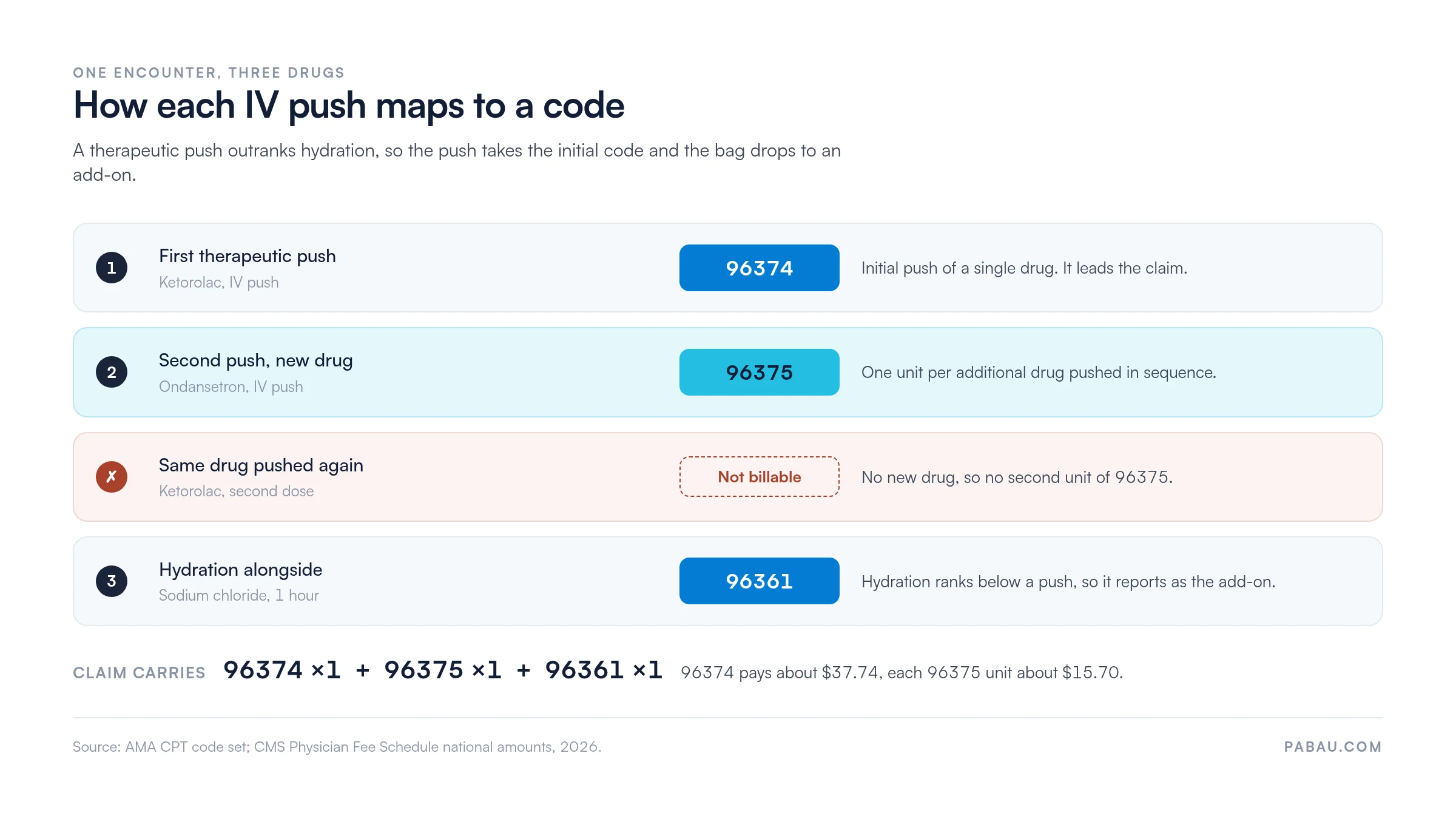
Payer edits enforce these automatically, so none of them are worth arguing with after the fact. All six are checkable while the encounter is still open.
Modifier use is payer-dependent. Medicare and most commercial payers accept 96375 with no modifier as long as the primary code is present.
A handful of contracts ask for one in specific situations, and the table below covers the three you are likeliest to meet.
Requirements shift by MAC locality and by private contract, so check with the payer rather than copying another practice’s habit. Applying modifier 59 without payer guidance can flag an audit on its own.
Before applying any modifier to CPT code 96375, pull the payer’s Local Coverage Determination or coverage article for infusion codes. MAC policies differ by region, and a modifier that clears a denial for one payer can raise an audit flag for another. Write your payer-specific modifier logic into the billing policy manual so it survives staff turnover.
Auditors reviewing 96375 look for a fixed set of elements. Miss one and the line is exposed to denial or recoupment, even where the care itself was appropriate.
Every claim should rest on documentation that includes:
Reading the infusion log once, in order, catches most 96375 denials before anyone hits submit.
Six steps, and they run faster than the sentence describing them:
Step four is the one worth slowing down for. A duplicate drug looks like two separate events in a log sorted by time. Sorting that same log by drug name instead makes the repeat obvious at a glance.
Payment for 96375 is small next to the primary infusion codes, which follows from its add-on status.
The CMS Physician Fee Schedule sets the national amounts and your MAC locality adjusts them. Check the current figure before quoting it to staff or building it into an infusion revenue forecast.
Rate note: the figures above are approximate national amounts from published fee schedule data. CMS updates them annually and MAC localities adjust them. Verify the current amount in the CMS Physician Fee Schedule lookup before billing.
Three RVU components drive the calculation: work RVU for clinician effort, practice expense RVU for overhead, and malpractice RVU. The work RVU for 96375 sits below 96374, because each additional push takes less incremental effort than the first one does.
The practice expense RVU is where this code surprises people. Many services carry a higher office RVU than facility RVU, so the office amount runs ahead.
CMS assigns 96375 the same practice expense RVU in both settings, and 96374 behaves the same way. Both codes therefore pay one amount wherever the push happens. A place-of-service error costs you accuracy rather than dollars.
96375 does not establish coverage on its own. The ICD-10 code on the claim carries medical necessity. It has to justify the initial push as well as every additional one.
Our ICD-10-CM code library goes deeper on the individual diagnoses below.
The list is not exhaustive, and coverage criteria move by payer and by MAC locality. Some payers name specific diagnosis codes for particular drugs.
Read the Local Coverage Determination before assuming a diagnosis code guarantees payment.
Preventive screening codes add a frequency test on top of the diagnosis. Medicare denies G0121 automatically when a prior screening colonoscopy claim sits inside the 10-year window, whatever diagnosis the new claim carries.
Denials cluster around a predictable set of errors, and each one has a pre-submission fix. That is why they belong on a checklist rather than a rework queue.
96375 belongs to a family of infusion and injection codes. The sequence you build depends on which of them led the encounter. Start with 96374, since it is the primary on almost every claim that carries 96375.
The AAPC Codify platform lists the full descriptor and parenthetical for each code in the range.
The table covers the initial chemotherapy hour under 96413. Where that infusion runs longer, each additional hour reports as 96415 on the same claim.
The costliest 96375 mistakes are the ones that reach the payer. Adding a missing drug name before submission takes seconds. Unwinding the denial takes days.
Practice management software like Pabau shortens that distance by keeping the clinical record and the claim in one system.
Pabau’s claims management software builds the claim from the treatment record itself. When a clinician logs an IV push, the system stores the drug name, dose, route and administration time in structured fields. Those fields then pre-fill the claim, so the details a payer audits are never retyped from a nursing note.
Before the claim goes out, Pabau validates that its required fields are complete. A submission then cannot fail on a blank nobody noticed. Practices submitting claims through Claim.MD also get eligibility verification up front. The coding judgment stays with your biller, which is where it belongs.
For infusion work specifically, that means nurses document once, in the system that produces the superbill. There is no handoff between a clinical note and a billing record. The drug names that support 96375 reach the claim exactly as they were charted.
Audit your 96375 claims once a month. Every unit needs a uniquely named drug in the encounter record. It also needs a qualifying primary code on the same claim, plus documented start and stop times. Three checks, run monthly, will surface the denial patterns that otherwise compound quietly across a whole quarter.

Pabau records drug name, dose, route and times on the encounter itself. Those fields pre-fill the claim, and Pabau checks it is complete before submission.

96375 is a simple code with an avoidable denial rate. The pairing rule, the new-drug rule and the documentation standard do not move. What moves from practice to practice is whether anybody checks them while the encounter is still open.
So decide where that check lives. One biller’s memory works until that biller takes a week off. Structured fields in the record work at any volume, and they survive staff turnover.
Book a demo to see how Pabau keeps infusion documentation and claim data in the same place.

Need the code that leads the claim? CPT code 96374 covers the initial IV push, including when it takes the primary slot ahead of hydration.
Billing hydration alongside the pushes? CPT code 96360 explains the initial hour of IV hydration and how the additional hours report.
Coding a chemotherapy encounter? CPT code 96413 sets out the initial infusion rules that supportive drug pushes attach to.
Giving the drug by IM or subcutaneous route instead? CPT code 96372 covers the injection code that sits outside the IV push family.
Want fewer denials across the whole billing workflow? Denial management in healthcare shows how to build a pre-submission and post-denial review process.
Yes. 96375 pays for the administration only. The drug itself goes on its own claim line, with its HCPCS J-code and the units given, wherever the payer covers it.
Medicare publishes a Medically Unlikely Edit value for 96375, and units above it are denied automatically. Check the current quarterly MUE file before you submit a high unit count.
Yes, where the visit is a significant, separately identifiable service and the note shows it. Most payers want modifier 25 on the E/M line rather than on 96375.
Clinical staff can give it in a physician office under the incident-to rules. That means a physician order on file and the required level of supervision available on site.
The add-on falls with it. Correct the primary line first, then resubmit both together. Appealing the 96375 line on its own will not restore the payment.



