



HCPCS code E0198: Water pressure pad billing guide
HCPCS code E0198 is a water pad for a standard mattress HCPCS code E0198 is the ...

Last Updated: Oct 13, 2026

CPT code 96374 describes an intravenous push of a single therapeutic, prophylactic, or diagnostic drug administered in 15 minutes or less, excluding chemotherapy.
Only one initial service code (96374, 96360, 96365, 96409, or 96413) may be billed per patient encounter per Noridian and CMS guidance.
Missing start/stop times in nursing documentation is the most common reason for 96374 claim denials; accurate MAR entries are non-negotiable.
Pabau’s claims management software automates charge capture and flags missing documentation before submission, reducing IV push billing errors.
CPT code 96374 covers the single or initial intravenous push of a therapeutic, prophylactic, or diagnostic substance and sits at the center of injection and infusion billing hierarchies for practices, urgent care centers, and IV therapy providers across the US.
This guide covers every component that coders and practice administrators need to bill CPT code 96374 correctly: the official definition, the 15-minute time rule, hierarchy requirements, modifier usage, documentation standards, reimbursement context, and the denial patterns that cost practices revenue every month.
CPT code 96374 is defined by the American Medical Association (AMA) as: Therapeutic, prophylactic, or diagnostic injection (specify substance or drug); intravenous push, single or initial substance/drug. The administration window is 15 minutes or less. In practical terms, it is the CPT code for an IV push of the initial drug delivered directly into a vein or an existing IV line. For practices running claims management software, this time threshold is the single most important field to capture accurately at the point of care.
| Attribute | CPT code 96374 detail |
|---|---|
| Official descriptor | Therapeutic, prophylactic, or diagnostic injection; intravenous push, single or initial substance/drug |
| Administration time | 15 minutes or less |
| Service type | Initial IV push (non-time-based) |
| Excludes | Chemotherapy and other highly complex drug or biologic administration |
| Add-on code | 96375 for each additional sequential push of a new drug |
| Most common denial trigger | Missing start and stop times in the medication administration record |
An IV push is direct injection of medication into a vein or an existing intravenous line, completed within that 15-minute window. It is not a drip infusion, not a hydration service, and not a chemotherapy administration. The parenthetical notes in the CPT codebook explicitly exclude chemotherapy and other highly complex drug or highly complex biologic agent administration from 96374 coverage.
Each of these use cases qualifies for CPT code 96374 provided the drug is not classified as chemotherapy and the administration completes within 15 minutes. Because several of these agents carry infusion-reaction risk, documenting any IV therapy complications alongside the administration record supports both patient safety and clean billing. Practices that also bill for EMR built for IV therapy workflows will find that code selection and time documentation are tightly linked in compliant charge capture workflows.
CPT code 96374 is one of five “initial” service codes in the injection and infusion family. Per Noridian JE Part B guidance, only one initial service code may be reported per patient encounter. The five initial codes are:
| CPT code | Service Description | Category |
|---|---|---|
| 96360 | Hydration infusion, initial 31 minutes to 1 hour | Hydration |
| 96365 | Therapeutic/diagnostic infusion, initial hour | Infusion |
| 96374 | IV push, single or initial substance | IV Push |
| 96409 | Chemotherapy push, single or initial | Chemotherapy |
| 96413 | Chemotherapy infusion, initial hour | Chemotherapy |
When multiple services occur in the same encounter, CPT hierarchy rules determine which code leads. CPT code 96374 takes hierarchy priority over hydration (96360 and 96361). A practical example: if a patient receives a therapeutic IV push alongside hydration, 96374 is the initial code and 96361 (hydration, each additional hour) follows. The hierarchy is not negotiable and is based on CPT parenthetical notes, not clinical preference.
CPT code 96375 is the add-on code for each additional sequential IV push of a new substance or drug. It is not used for repeat doses of the same drug within the same encounter. To bill 96375, the second drug must be distinct, administered sequentially (not concurrently), and through the same IV site. Billing 96374 twice in a single encounter for two different drugs given sequentially is incorrect. The correct pair is 96374 (initial) plus 96375 (each additional new substance).
Check the parenthetical notes following 96374 and 96375 in the AMA CPT codebook each January. Parenthetical instructions govern exactly when add-on codes may be reported and are updated annually. Relying on last year’s rules is a common source of preventable claim errors.
Poor documentation is the leading cause of 96374 denials and the primary exposure in a payer audit. According to CMS billing article A53778, the medication administration record (MAR) and nursing documentation must reflect the time of initiation, time of completion, and the specific substance administered. Those three data points are non-negotiable for compliant billing.
Practices with robust IV therapy clinic documentation best practices typically build a standardized capture template that prompts staff to record these fields at the point of administration rather than retrospectively. Retrospective time entries are one of the most common audit findings in injection and infusion billing reviews.
Practices that use IV therapy EMR software purpose-built for infusion workflows can automate the population of many of these fields from nursing notes into the superbill, reducing manual entry errors that lead to incomplete records. The CMS Physician Fee Schedule lookup tool can be used to verify payment status and coverage requirements at the MAC level before submission.

Pabau’s claims management tools help IV therapy and infusion practices capture charge data at the point of care, flag incomplete documentation before submission, and reduce CPT 96374 denials. See how it works for your practice.

A GP practice platform keeps these high-volume services charted, coded, and billed from one screen.
Modifier use with CPT code 96374 is governed by National Correct Coding Initiative (NCCI) edits and MAC-level local coverage determinations. Applying the wrong modifier, or omitting a required one, generates automatic claim edits. The most commonly used modifiers with 96374 are:
Modifier 59 is applied when CPT code 96374 is billed in a separate, distinct encounter on the same date of service. A common example: a patient receives a morning IV push, leaves the facility, and returns later the same day for a second separate push. Per coding guidance from the Journal of Urgent Care Medicine, 96374 may be reported twice in this scenario with modifier 59 appended to the second claim line, signaling that the encounters were clinically separate. Verify current NCCI edit tables before applying, as pairing rules are updated quarterly.
When a second IV push of the same substance is administered at a different anatomical site (a second IV access point rather than a second encounter), modifier XS may be added to indicate a separate structure. AHIMA coding guidance references this application specifically for injection and infusion services. This modifier is subject to MAC interpretation, so verify with your local Medicare Administrative Contractor before routine use.
When a billable evaluation and management (E/M) service is provided on the same date as CPT code 96374, modifier 25 is appended to the E/M code (not to 96374) to signal that the E/M was medically necessary, significant, and separate from the injection service. Without modifier 25, the E/M may be bundled into the injection code and denied. The E/M documentation must stand on its own clinical merits.
Practices managing IV therapy intake forms that capture clinical decision data can use that documentation to support the medical necessity of a same-day E/M, strengthening the modifier 25 defense if audited.
Medicare reimbursement for CPT code 96374 is determined by the annual Medicare Physician Fee Schedule, updated each January by CMS. Rates vary by geographic payment locality and practice setting (facility vs. non-facility). Because rates change each year, any figure published in a static resource should be verified directly against the CMS Physician Fee Schedule for the current fee schedule year before quoting to patients or payers.
Commercial payer rates for 96374 vary considerably. Some plans reimburse at Medicare rates; others negotiate higher or lower amounts based on contract terms. Medicaid reimbursement differs by state and is subject to program-specific rules. Wisconsin Medicaid’s ForwardHealth program, for example, publishes specific IV infusion billing requirements including U4 modifier mandates for certain therapeutic substances. Practices billing across multiple payers should maintain a payer matrix that maps 96374 reimbursement by contract.
The professional fee for CPT code 96374 differs between facility (hospital outpatient, ambulatory surgical center) and non-facility (physician office) settings. Non-facility rates are typically higher because the practice absorbs overhead costs. In facility settings, the practice submits a professional claim for the physician work component while the facility submits a separate institutional claim pairing 96374 with revenue codes such as 0261 (infusion pump) or 0262 (IV therapy/pharmacy services). Billing teams in facility settings must coordinate professional and facility claim submission to avoid duplicative billing errors.
Practices considering how billing structure affects revenue when opening an IV therapy clinic should clarify their place of service designation early, as it affects both fee schedule rates and documentation obligations.
Run a quarterly audit of your 96374 claims against the current CMS Physician Fee Schedule. Compare your allowed amounts to the published rates for your locality and practice setting. Discrepancies often reveal contract negotiation opportunities or systematic underpayments that compound over time.
Injection and infusion codes rank among the most frequently audited in CMS’s Office of Inspector General (OIG) work plans. Because they sit at the intersection of clinical documentation and medical billing, practices that bill CPT code 96374 regularly need a structured denial prevention protocol, not a reactive one. These are the most consistent denial patterns:
Practices running an automated charge capture workflow can flag many of these issues before submission rather than managing them post-denial. For practices considering mobile delivery. Revenue cycle management reporting separates claims that were denied from claims nobody submitted.
The drug or product code and the administration code have to travel together on other claims as well. A skin substitute billed under Q4140, for example, is denied when the CPT application code from 15271 to 15278 is missing.
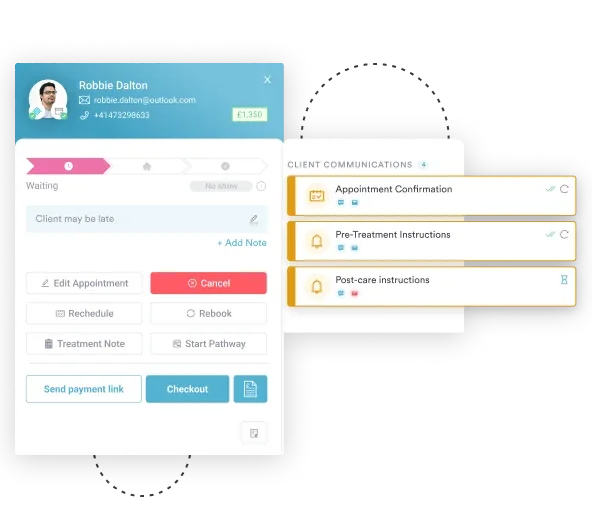
Billing CPT code 96374 accurately depends on what happens at the point of care, not just in the billing department. When nurses and providers document administration in real time within a connected practice management platform, the data needed for a clean claim is already structured and timestamped before the patient leaves. Pabau’s claims management software integrates documentation, charge capture, and claim review so IV therapy practices can reduce the manual handoffs that introduce billing errors.
Practices that also need structured intake workflows for IV services can use digital documentation forms to capture clinical history, consent, and pre-treatment assessments in a format that flows directly into the patient record and supports medical necessity documentation. For broader context on staffing and scope of practice in IV settings.
CPT code 96374 is straightforward in definition but unforgiving in execution. The 15-minute threshold, the single-initial-code rule, and timestamped nursing documentation are the three pillars that determine whether a claim pays or denies. Getting them right consistently requires workflow discipline at the point of care, not just billing review after the fact.
Pabau’s claims management and documentation tools are built to support exactly this kind of workflow: capturing charge data in context, flagging incomplete records before submission, and giving billing teams a clean foundation to work from. To see how Pabau handles IV therapy billing workflows, book a demo with the team.

Billing supplies for a nebulizer treatment? Sterile saline billing for nebulizers covers HCPCS code A4218, billed per unit for a 10 ml metered dose dispenser alongside a nebulizer code.
Billing supplies for an insulin pump? Insulin pump infusion set billing explains why HCPCS code A4231 is not separately payable and is bundled into the weekly A4224 allowance.
Billing a glucose monitor battery replacement? Glucose monitor battery billing covers HCPCS code A4233, the replacement alkaline battery for a patient-owned home blood glucose monitor.
CPT code 96374 is used to bill for the intravenous push administration of a single therapeutic, prophylactic, or diagnostic drug completed in 15 minutes or less, excluding chemotherapy. Common uses include antiemetics, analgesics, antibiotics, vitamins, and diagnostic contrast agents delivered directly into a vein or existing IV line.
CPT 96374 is the initial IV push code for the first drug administered in an encounter. CPT 96375 is the add-on code for each additional sequential IV push of a new and different substance given through the same site in the same encounter. You cannot bill 96374 twice for two different drugs in one encounter; the correct pairing is 96374 plus 96375.
Not always. Modifier 59 is required when 96374 is billed for a second separate encounter on the same date of service. Modifier 25 is appended to a same-day E/M code (not to 96374 itself) when a significant, separate evaluation also occurred. Modifier XS applies when a second push uses a different anatomical IV site. Without one of these qualifying circumstances, no modifier is needed.
Yes. Billing 96374 with 96375 is correct when a patient receives an initial IV push of one drug followed sequentially by an IV push of a different drug in the same encounter. The second drug must be new, distinct, and administered sequentially rather than concurrently. 96375 cannot be billed without 96374 as the lead code.
The medication administration record must include the exact drug name and dose, administration start time, administration stop time (confirming 15 minutes or less), route of administration specified as intravenous push, a signed provider order, and a documented clinical indication linking to the diagnosis code on the claim. All fields must be completed at the point of care, not retrospectively.
CPT 96374 covers an IV push completed in 15 minutes or less. CPT 96365 covers a therapeutic or diagnostic infusion requiring more than 15 minutes, typically administered via a continuous drip over an hour or more. The time and delivery method are the key distinctions. Billing 96365 when the actual administration took under 15 minutes is a common audit finding.



