CPT Code 62284: Injection procedure for myelography
CPT Code 62284: official descriptor and procedure overview The American Medical ...

Last Updated: Oct 19, 2026
J1741 is the HCPCS Level II code for injection, ibuprofen, 100 mg, the intravenous ibuprofen sold as Caldolor. One billing unit equals 100 mg, so you divide the total milligrams given by 100 and round up.
A standard 800 mg dose bills as 8 units, not 1. The costliest J1741 errors come from treating a whole vial or dose as a single unit. Medicaid and many commercial payers also deny claims that lack the National Drug Code (NDC) with the N4 qualifier.
Let Pabau's smart automation suggest the right codes, reduce claim denials, and keep your practice compliant—effortlessly.
Automate repetitive tasks and focus on what matters most—your patients.
Reduce coding errors and ensure compliance with the latest regulations.
Clean claims, fewer denials, and faster reimbursements.
Powerful insights and reporting to help your practice thrive.
HIPAA compliant SOC 2 certified GDPR-compliant Trusted by 4,000+ clinics worldwide

J1741 describes ibuprofen injection per 100 mg, covering the Caldolor brand and FDA-approved generic IV formulations.
Units equal the total milligrams administered divided by 100, rounded up, so a standard 800 mg dose bills as 8 units, not 1.
Medicaid and many commercial payers require the 11-digit NDC with the N4 qualifier, and so do Medicare claims for dual-eligible patients.
Caldolor’s label calls for a diluted infusion over at least 30 minutes in adults, so CPT 96365 is the usual administration code.
Pabau’s claims management software helps IV therapy practices track drug units, attach NDC data, and flag incomplete claims before submission.
HCPCS code J1741 covers ibuprofen injection, billed per 100 mg. Divide the milligrams given by 100 to get the units, so a standard 800 mg dose bills as 8.
The Centers for Medicare and Medicaid Services (CMS) maintains the code within the HCPCS Level II code set. It is a J-code, the HCPCS section for drugs given other than by mouth, which is mostly injectables.
J1741 applies to all FDA-approved intravenous ibuprofen formulations, including the branded product Caldolor (Cumberland Pharmaceuticals). Generic IV ibuprofen products that carry their own NDC numbers and are bioequivalent to Caldolor also fall under this code. They must share the same route and drug entity.
Caldolor is the primary branded IV ibuprofen product billed under J1741. Its current label lists an 800 mg/8 mL single-dose vial at 100 mg/mL, which must be diluted before use. It also lists a ready-to-use 800 mg/200 mL bag at 4 mg/mL, launched in 2020.
A full 800 mg dose bills as 8 units from either package. The older 400 mg/4 mL vial appears to be discontinued, though a 400 mg dose still bills as 4 units. Bill from the milligrams given, not the container count, because one vial or bag is never one unit.
A J1741 claim line has to get three things right: The unit count, the CPT administration code, and the NDC where required. A wrong unit count or CPT code puts the claim at risk with any payer. Medicare also expects a waste modifier on single-dose containers.
The breakdown below shows every field for one standard 800 mg dose.
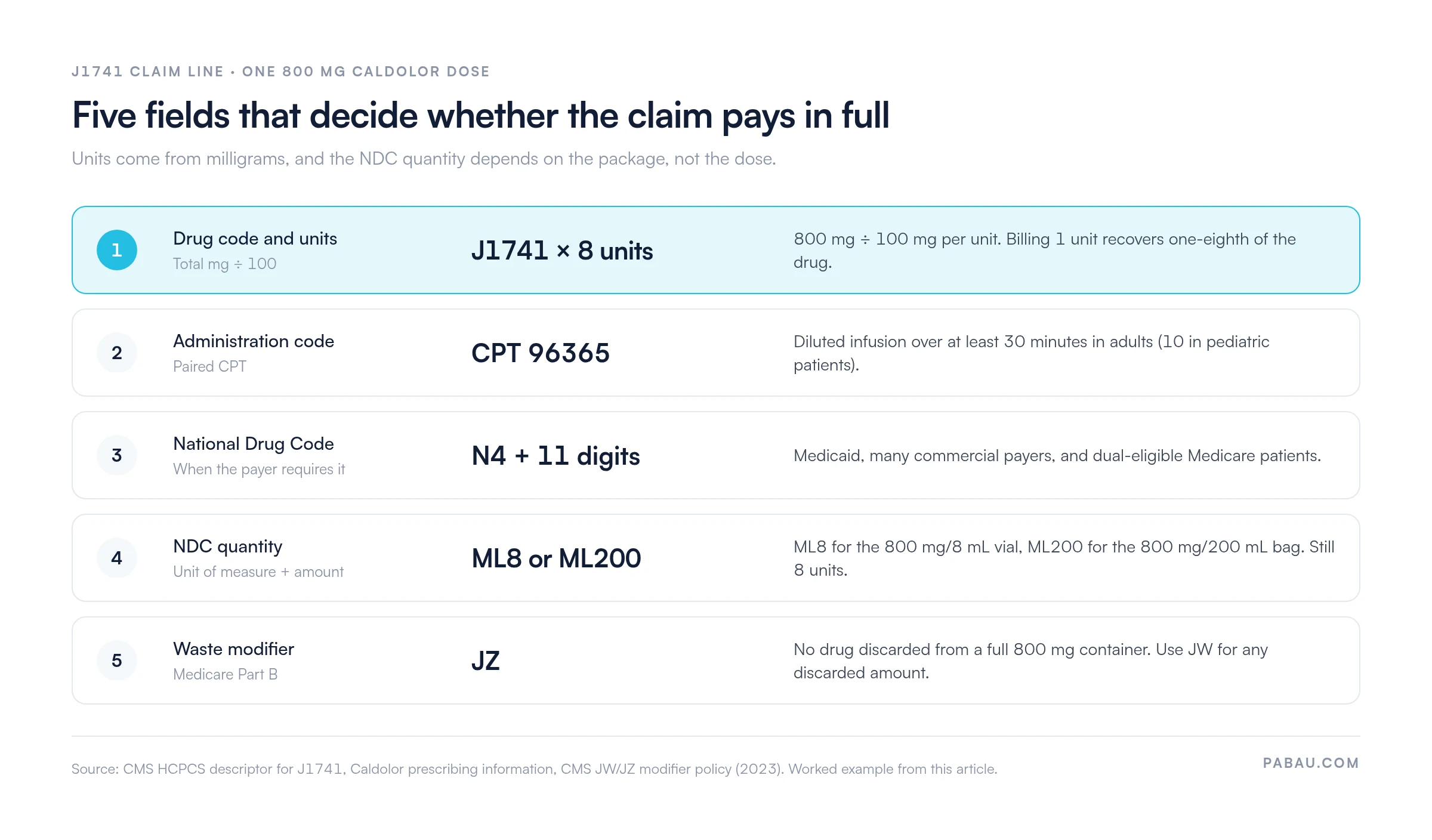
Divide the total dose administered (in mg) by 100 and round up to the next whole number. With the 100 mg/mL vial, the unit count matches the milliliters drawn from the vial. That shortcut fails with the 4 mg/mL bag, where 800 mg is 200 mL but still 8 units.
Rounding rarely matters at a 100 mg unit, since standard doses are multiples of 100 mg. The error to watch is billing 1 unit for a full vial or a full 800 mg dose. That claim recovers only one-eighth of the drug given.
Medicaid requires the drug’s 11-digit NDC, reported with the N4 qualifier, on physician-administered drug claims. Many commercial payers require it too, and so do Medicare claims for dual-eligible patients. Standard Medicare Part B claims generally don’t, so check your MAC and each payer’s rules. The exact format is in the NDC crosswalk section below.
J1741 is the drug code only. A separate CPT code must appear on the same claim to cover the service of administering the drug. See the CPT pairing section below for the correct code.
Caldolor comes in single-dose containers, so Medicare Part B expects a waste modifier on J1741. Add JZ when none of the drug was discarded, as with a full 800 mg dose from an 800 mg vial. If part of a container is discarded, bill the discarded units on a second line with JW.
CMS has required JZ since July 1, 2023, and a claim carrying neither modifier can be returned as unprocessable. Commercial payers set their own waste rules, so check each payer’s policy.
The correct CPT administration code depends on how the drug was given and for how long. Selecting the wrong administration code alongside J1741 is a common denial trigger because payers validate that the drug code and the service code are consistent.
Caldolor’s prescribing information states administration over at least 30 minutes (at least 10 minutes in pediatric patients), so CPT 96365 is the typical pairing. CPT 96374 is rarely supportable for Caldolor, because the label requires a diluted infusion. Use it only when the record documents an IV push of 15 minutes or less. A mismatch between the documented method and the billed CPT code can trigger post-payment audits.
Medicare Part B reimburses physician-administered drugs at Average Sales Price plus 6% (ASP+6%) in the physician office setting. Pabau, the practice management and billing software we build, lets practices track drug-level reimbursement and reconcile payments against expected ASP rates.
ASP rates update quarterly. The specific payment amount for J1741 must be verified against the current CMS quarterly ASP pricing file, available on the CMS Physician Fee Schedule portal. Recent quarterly files put the Medicare Part B payment limit at about $3.25 per 100 mg unit, or roughly $26 for an 800 mg dose. Any figure stated in a reference article, including this one, reflects only a historical snapshot.
Place of service affects payment materially. A claim billed with a physician-office place of service (POS 11) is paid at ASP+6% from the quarterly ASP file. The same drug billed in a hospital outpatient department (POS 22) falls under OPPS rules, where the payment may differ. There, the drug may be bundled into an ambulatory payment classification (APC) rather than paid separately.
Verify J1741 reimbursement rates each quarter before setting patient cost-share estimates. ASP updates take effect January 1, April 1, July 1, and October 1. Giving a patient a coinsurance estimate based on a three-quarter-old rate creates a billing reconciliation problem downstream.
J3490 is the unclassified drug HCPCS code used for injectable drugs that lack their own specific J-code. Because J1741 exists specifically for ibuprofen injection, using J3490 for ibuprofen is incorrect and creates unnecessary claim risk.
CMS policy and standard payer rules require the use of the most specific HCPCS code available. Billing J3490 when J1741 exists constitutes use of a non-specific code, which most payers treat as a billing error, not a clinical judgment. Claims billed with J3490 for ibuprofen are likely to be denied on specificity grounds or require a lengthy manual review process before payment.
Prior authorization requirements for J1741 vary substantially by payer and plan year. There is no universal rule, and medical billing compliance for infusion drugs requires checking each payer’s current drug policy before treatment.
When PA is required, the supporting documentation typically must include the diagnosis and the clinical rationale for IV rather than oral administration. Add any prior treatment failures and the ordering provider’s credentials. Pull the current Local Coverage Determination (LCD) from the relevant Medicare Administrative Contractor (MAC) for your region to confirm coverage criteria.
A clean J1741 claim rests on the medical record showing every element a payer needs to confirm medical necessity and correct billing. A superbill that captures drug name, dose, route, and NDC at the point of care prevents the retroactive documentation scramble that follows a denial.
Effective denial management for J1741 starts with knowing which errors generate the most volume. Most J1741 denials fall into seven categories, each with a clear corrective action.
Audit J1741 claims monthly rather than waiting for remittance. Pull all J1741 submissions from the last 30 days and check the NDC field and unit count on each. Then confirm the paired CPT code matches the administration method documented. An error caught before submission never becomes a denial, so it costs no appeal and no resubmission.
When a payer asks for the NDC on a J1741 claim, it follows the N4 qualifier convention used for physician-administered drugs. Report the 11-digit number in the 5-4-2 layout (labeler-product-package), padding with a leading zero where needed. Enter it without hyphens or spaces on both 837P and CMS-1500 claims.
The table below shows the reporting format. NDC numbers change with new generic entries and manufacturing updates. Before billing, verify the NDC for the product in your dispensary against the current CMS NDC crosswalk file. That file maps each 11-digit NDC to its HCPCS J-code, confirming J1741 is correct for the product on hand. The AAPC HCPCS code lookup and the PGM Billing HCPCS tool can assist with code-level research. The CMS crosswalk file remains the authoritative source for NDC-to-J-code mapping.
The unit of measure qualifier must accompany the NDC. For ibuprofen injection, the unit of measure is typically ML (milliliters), reflecting the volume dispensed. From the 100 mg/mL vial, an 800 mg dose reports as ML8 alongside 8 HCPCS units. From the 800 mg/200 mL bag, the same dose reports as ML200, still with 8 HCPCS units.
The two quantities only match for the vial, and they are always separate fields. Confirm the unit-of-measure qualifier with the MAC or the payer’s companion guide if that field gets rejected.
Many infusion practices still work out J1741 units by hand from the administration record, then key the NDC into the claim separately. That leaves two chances for an 800 mg dose to go out as 1 unit, or without its N4 qualifier.
Pabau keeps the drug, dose, route and NDC together in the patient’s treatment record, so billing staff work from one source. It also handles billing for infusion practices from that record. Drug units are tracked, NDC data is attached, and incomplete claims are flagged before submission.
The result is fewer corrected claims and fewer underpaid ibuprofen infusions, because the unit count and NDC are checked while the record is still open.

Pabau’s claims management software helps IV therapy and infusion practices track drug administration data and attach NDC codes to claims. It also catches unit calculation errors before submission. See how it works for your practice.

J1741 is billed per 100 mg, and that single fact decides whether an IV ibuprofen claim pays in full. Build the unit count from milligrams given, not vials opened, and an 800 mg dose bills as 8 units every time.
The trade-off is worth naming. Billing from the vial count feels faster, but an underbilled claim usually pays the smaller amount without a denial, so the loss goes unnoticed. Book a demo to see how Pabau helps infusion practices catch unit and NDC errors before a J1741 claim goes out.

Billing another IV NSAID? HCPCS code J1885 for ketorolac covers unit math, NDC reporting and denials for the other common injectable NSAID.
Want to understand how drug claims move through a clearinghouse? What is revenue cycle management explains the end-to-end process from encounter to payment posting.
Need a practical guide to keeping claims clean from the start? Clean claim requirements in medical billing outlines what every field must contain for a first-pass acceptance.
New to the billing side of a practice? What is medical billing walks through how a claim moves from the visit to payment.
HCPCS code J1741 covers intravenous ibuprofen injection billed per 100 mg of drug administered. It applies to the branded formulation Caldolor and to FDA-approved generic IV ibuprofen products sharing the same route and drug entity. The code is used for physician-administered ibuprofen in outpatient settings including physician offices, hospital outpatient departments, and ambulatory infusion centers.
Divide the total dose administered in milligrams by 100 and round up to the next whole number. For example, a 400 mg dose is 4 units, an 800 mg dose is 8 units, and a 1,200 mg dose is 12 units. Never bill a full vial or dose as 1 unit.
Report the 11-digit NDC of the exact product you administered, with the N4 qualifier. Medicaid requires it, as do many commercial payers and Medicare claims for dual-eligible patients. Standard Medicare Part B claims generally don’t, so check your MAC and payer. Verify the NDC for your vial or bag against the CMS NDC-to-HCPCS crosswalk file, updated quarterly.
Yes, Medicare Part B covers J1741 when the drug is physician-administered and medically necessary. Payment is calculated at ASP+6% in the physician office setting. Coverage is subject to the applicable diagnosis supporting medical necessity. Medicare Advantage plans may impose prior authorization requirements that differ from traditional Medicare.
J1741 is the specific HCPCS code for ibuprofen injection and must always be used when billing IV ibuprofen. J3490 is an unclassified drug code reserved for drugs that have no specific J-code assigned. Using J3490 for ibuprofen is a billing error under CMS and most commercial payer rules, and will typically result in a denial on specificity grounds.
Prior authorization requirements depend on the payer and plan. Traditional Medicare Part B generally does not require PA for J1741, but Medicare Advantage and most commercial payers may. Check the specific payer’s drug policy and Local Coverage Determination before administering the drug when PA status is unknown.
The most common denial reasons are a missing or misformatted NDC, a wrong unit count, no prior authorization, or a mismatched CPT administration code. Unit errors usually come from billing a full vial or dose as 1 unit instead of 1 unit per 100 mg. Medical necessity not documented in the clinical note is also a frequent basis for commercial payer denials.