

HCPCS Code E0272: Foam rubber mattress billing guide
HCPCS Code E0272: official descriptor and code overview HCPCS Code E0272 is the ...

Last Updated: Nov 6, 2026
J0256 is the HCPCS Level II code for injection, alpha 1 proteinase inhibitor (human), not otherwise specified, 10 mg. It covers Prolastin-C, Prolastin-C Liquid, Aralast NP and Zemaira, billed at one unit per 10 mg administered.
Glassia has its own code, J0257. Most J0256 denials trace back to three upstream errors: a wrong unit count, a missing or malformatted NDC, and an expired prior authorization.
Let Pabau's smart automation suggest the right codes, reduce claim denials, and keep your practice compliant—effortlessly.
Automate repetitive tasks and focus on what matters most—your patients.
Reduce coding errors and ensure compliance with the latest regulations.
Clean claims, fewer denials, and faster reimbursements.
Powerful insights and reporting to help your practice thrive.
HIPAA compliant SOC 2 certified GDPR-compliant Trusted by 4,000+ clinics worldwide

J0256 bills alpha-1 proteinase inhibitor (human), not otherwise specified, at one unit per 10 mg. It covers Prolastin-C, Prolastin-C Liquid, Aralast NP and Zemaira, while Glassia has its own code, J0257.
Units come from the weight-based dose. Multiply 60 mg/kg by the patient’s weight in kg, then divide by 10, because a unit error is a common cause of J0256 underpayment.
NDC is required on most payer claims for J0256, including Medicaid. Report it in 11-digit 5-4-2 format with qualifier N4.
Pabau, the practice management software we build, helps billing staff track J0256 claim status and documentation before submission.
HCPCS code J0256 is the Level II code for injection, alpha-1 proteinase inhibitor (human), not otherwise specified, 10 mg. CMS maintains it within the HCPCS Level II coding system, which covers drugs given by infusion or injection in outpatient and physician settings. The “not otherwise specified” wording is deliberate. J0256 is the catch-all code for A1PI products that have no product-specific HCPCS code of their own.
The unit of service is 10 mg. A patient receiving a 4,200 mg infusion would be billed at 420 units. The division is simple. The harder step sits upstream, because the administered dose depends on the patient’s weight.
J0256 covers the FDA-approved alpha-1 proteinase inhibitor (human) products that have no product-specific HCPCS code. The products billed under J0256 are Prolastin-C and Prolastin-C Liquid (Grifols), Aralast NP (Takeda), and Zemaira (CSL Behring). The NDC on the claim identifies which product was administered, so accurate NDC selection matters for audit compliance.
Glassia (Kamada/Takeda) is the exception. It has its own code, J0257, so a Glassia infusion never bills under J0256. The other products would move off J0256 only if CMS assigns one of them a product-specific code, so check each quarterly HCPCS update.
J0256 is billed per 10 mg of alpha-1 proteinase inhibitor administered. Dosing is weight-based, so the billable unit count comes from the administered dose and never from a fixed vial size. Coder forums often cite unit errors as a common cause of J0256 underpayment and overpayment audit flags.
The standard clinical dose for AATD augmentation therapy is 60 mg/kg per week, administered intravenously. Use this formula to convert a dose to billable units, then compare the result with the two common decimal errors shown below the table.
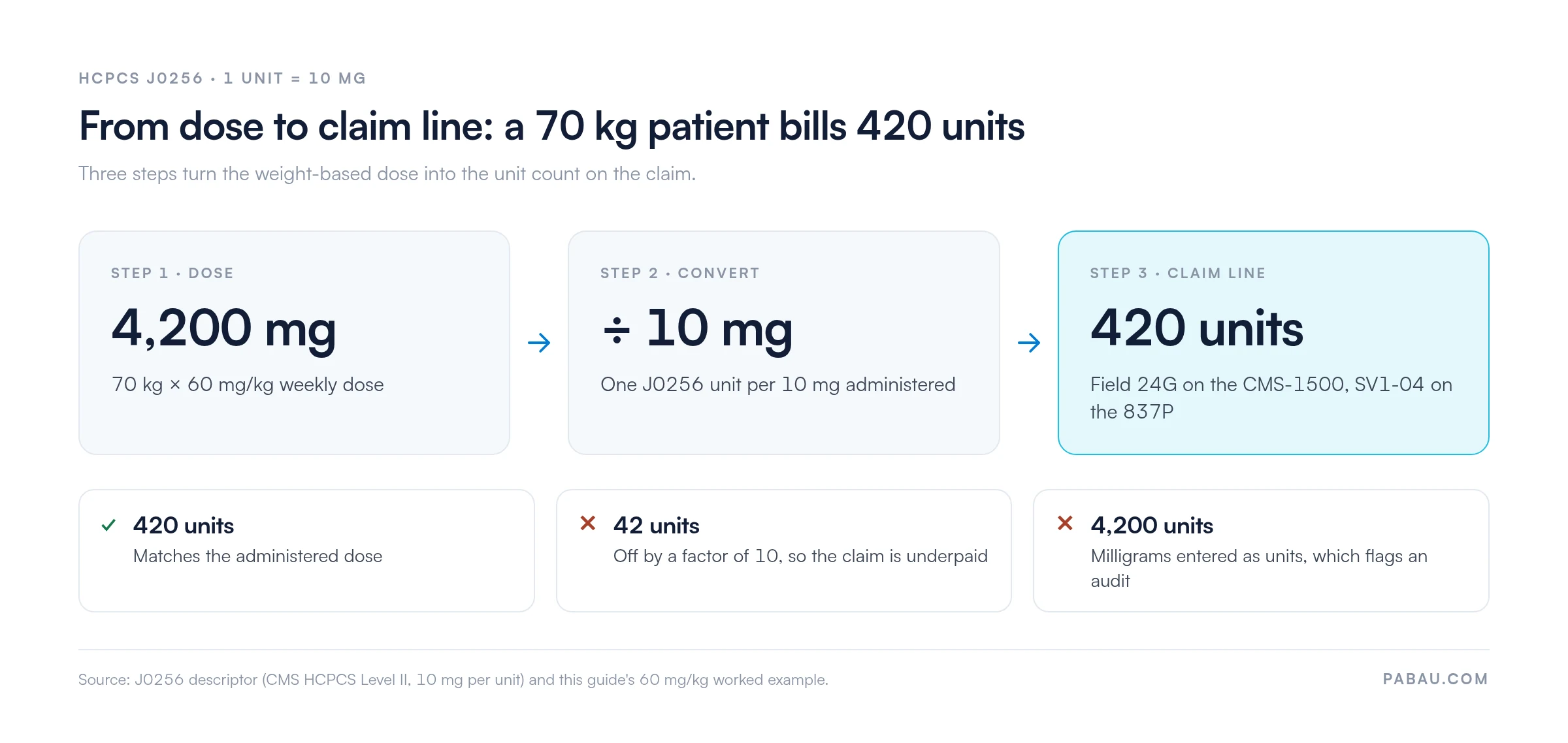
Round down to the nearest whole unit only if the administered dose does not reach the next 10 mg threshold. Never bill vial waste as administered dose. Some payers allow billing for the full vial when the remaining product cannot be reused. That requires the single-use policy and the waste to be documented in the medical record.
Cross-reference the unit count on the claim against the pharmacy dispensing record and the administration log before submission. A 70 kg patient receiving 4,200 mg produces exactly 420 billable units. If your claim shows 42 or 4,200, the unit field is off by a factor of 10. The payer will then either underpay or flag the claim for audit.
An NDC is mandatory on J0256 claims for Medicaid (under the Deficit Reduction Act drug rebate rules) and for most commercial payers. Medicare typically does not require it on professional J-code claims. At payers that do require it, a missing or malformatted NDC is a frequent cause of automatic J0256 denial.
Without the NDC, the payer cannot confirm which A1PI product was administered. Clean claim submission needs the NDC present, correctly formatted, and matched to the product named on the prior authorization.
The NDC must be reported in 11-digit 5-4-2 format (XXXXX-XXXX-XX). On the CMS-1500 paper form, it goes in the shaded area of box 24A, with qualifier N4 before the 11 digits. On the 837P electronic transaction, it appears in loop 2410, segment LIN, with qualifier N4 in element LIN02 and the NDC in element LIN03.
Payers require a covered ICD-10-CM diagnosis code on the J0256 claim to establish medical necessity. E88.01 (alpha-1 antitrypsin deficiency) is the primary diagnosis code and is accepted by Medicare, Medicaid, and virtually all commercial payers that cover A1PI therapy. Claims submitted without E88.01 or with an unsupported secondary diagnosis are automatically denied for non-covered indication.
Confirm the diagnosis code requirements against the applicable Local Coverage Determination (LCD) for A1PI therapy before submission. LCD criteria list the accepted ICD-10-CM codes, the minimum documented serum A1AT level, and the required pulmonary function test findings.
Prior authorization is required by nearly all commercial payers for J0256 and must be obtained before the first infusion, not after. Medicare Part B does not require PA for J0256. It enforces coverage criteria through the applicable LCDs instead, which work as its medical necessity review. Running insurance eligibility verification before the first infusion is scheduled prevents denials that cannot be corrected later.
Commercial payer PA packages for J0256 typically require these four items:
Anthem has published a medical policy for A1PI augmentation therapy. Check the current policy’s effective date when you submit PA documentation, because the criteria are updated periodically.
Medicare Part B covers J0256 as a physician-administered drug under the buy-and-bill model. The practice buys the drug, administers it, and bills Medicare for both the drug and the administration. Reimbursement follows the Average Sales Price (ASP) methodology at ASP plus 6%, which CMS publishes quarterly.
For current rates, check the CMS Physician Fee Schedule lookup tool or the quarterly ASP drug pricing file. Dollar figures change every quarter, so this guide quotes none.
Coverage under Medicare is subject to the applicable Local Coverage Determination for alpha-1 antitrypsin products. The LCD sets the clinical eligibility criteria. They include a minimum documented serum A1AT level, baseline FEV1 as a percentage of predicted, and smoking history requirements. Patients with emphysema too severe to benefit are excluded.
Claims that miss the LCD criteria are denied as not medically necessary, even when no PA was required. Pabau’s claims management software helps billing staff track claim status and documentation before submission.
Home infusion of A1PI drugs may require a different billing pathway. When a specialty pharmacy supplies the drug for home infusion, the J0256 drug claim may shift away from the prescribing practice. The pharmacy or home infusion provider may bill it instead. Confirm the site-of-service billing pathway with your compliance counsel before billing J0256 for home-administered doses.
J0256 covers the drug only. When a nurse or physician gives the infusion in an office or outpatient setting, the practice also bills an administration code. That is usually 96365 for the first hour. A missing or wrongly bundled administration line gets that part of the encounter denied.
The superbill documentation for a J0256 infusion records the start and stop times, the dose in mg, the lot number, and the NDC. It also names the administering provider. The infusion times support the administration code. The dose supports the unit count on the drug line.
J0256 is the “not otherwise specified” code for the A1PI drug class. Glassia is already billed under its own code, J0257, and reporting it as J0256 is incorrect coding that may trigger recoupment. Prolastin-C, Prolastin-C Liquid, Aralast NP and Zemaira stay on J0256 unless CMS assigns one of them a product-specific code.
Verify the HCPCS code status of each A1PI product at the start of every year. Use the AAPC HCPCS code lookup or the CMS annual HCPCS update files.
The most common substitution error is a swap between J0256 and J0257. J0257 covers Glassia only, and Glassia is given intravenously like the products billed under J0256. No subcutaneous A1PI product is approved in the US, so the product on the vial label decides the code.
J0256 claims carry more denial risk than most drug claims. They combine weight-based dosing, NDC reporting, near-universal commercial PA, and LCD-governed medical necessity. Good denial management workflows for infusion practices check each of these points before the claim is sent. Reading the claim denial codes on each remittance advice shows which point keeps failing.
Use the two lists below as a pre-submission check for every J0256 encounter. The first covers the chart, and the second covers the claim itself. Applying medical billing compliance checks at this stage prevents the rework cycle that follows a denial.
In the medical record (chart requirements):
On the claim (billing requirements):
Build a J0256 pre-submission checklist into your billing workflow as a mandatory step before the claim is queued for submission. The six most common denial reasons for this code all have upstream documentation fixes. Each one can be checked during the visit or while the claim is built. Catching a missing NDC or an expired PA before submission avoids the rework cycle that follows a denial.
On a typical infusion day, the dose, the vial’s NDC and the infusion times go into the chart. Someone else then keys them into the claim. Each handoff is a chance for 420 units to become 42, or for the NDC to drop off the drug line.
Pabau runs clinical notes, forms and insurance billing in one system. The dose and infusion times recorded at the chair sit in the same patient record the claim is built from. Billing staff can then track each claim’s status and documentation before it is submitted.
The result is fewer corrected claims, and less time spent chasing a payer over a J0256 line that should have paid the first time.

Pabau’s claims management software helps infusion practices track claim status and documentation before submission, so J0256 claims reach the payer complete.

J0256 claims are decided at the infusion chair. When the dose, the NDC and the infusion times are recorded as the drug goes in, nobody has to rebuild the claim from memory later.
If you add one check first, make it the unit cross-check against the administered dose. A slipped decimal costs the most and is the easiest error to catch. Then confirm the product on the vial, because a Glassia vial moves the claim to J0257.
Book a demo to see how Pabau helps infusion practices track J0256 claim status and documentation before submission.

Need a framework for managing infusion drug denials? Denial management in healthcare covers the end-to-end workflow for identifying, appealing, and preventing recurring claim denials.
Want to understand how drug claims move through the clearinghouse? 837 file guide explains the electronic claim transaction format, including how NDC loop 2410 is structured for drug codes.
Looking for a complete overview of medical billing requirements? What is revenue cycle management covers the full claim lifecycle from patient registration through payment posting.
New to drug and administration billing? What is medical billing walks through how codes, claims and payments fit together for a practice.
HCPCS code J0256 covers injection, alpha-1 proteinase inhibitor (human), not otherwise specified, billed per 10 mg administered. It is used for FDA-approved A1PI replacement products, including Prolastin-C, Prolastin-C Liquid, Aralast NP, and Zemaira. Glassia has its own code, J0257.
Divide the total administered dose in milligrams by 10. For a 70 kg patient receiving 60 mg/kg, the administered dose is 4,200 mg, yielding 420 billable units. Always derive units from the administered dose documented in the chart, never from the vial size or the prescribed quantity.
Yes, for virtually all commercial payers. Medicare Part B does not require prior authorization but enforces coverage criteria through Local Coverage Determinations. Medicaid PA requirements vary by state. Obtain commercial PA before the first infusion, as most payers will not retroactively authorize a claim.
The NDC must be the 11-digit code from the vial administered, reported in 5-4-2 format with qualifier N4. Take it from the vial label at the time of administration, never from a formulary reference. NDCs differ by vial size and package, even within one brand.
Yes, Medicare Part B covers J0256 as a physician-administered drug under the buy-and-bill model, reimbursed at ASP plus 6%. Coverage is subject to the applicable Local Coverage Determination, which specifies minimum serum A1AT levels, PFT criteria, and other clinical eligibility requirements. Check the CMS quarterly ASP drug pricing file for current reimbursement rates.
J0257 is the code for Glassia, alpha-1 proteinase inhibitor (human), 10 mg. J0256 covers the other A1PI products, including Prolastin-C, Prolastin-C Liquid, Aralast NP, and Zemaira. All of them are given intravenously, so the product on the vial label decides the code.




