HCPCS Code E0272: Foam rubber mattress billing guide
HCPCS Code E0272: official descriptor and code overview HCPCS Code E0272 is the ...

Last Updated: Nov 6, 2026
H2010 is the HCPCS Level II code for comprehensive medication services, per 15 minutes. It sits in the H code range for behavioral health services and is funded primarily through state Medicaid plans. That means rates, modifier requirements and prior authorization rules differ from state to state, and Medicare does not pay for the code (status I).
Each 15-minute increment is a separate billable unit, and the documentation must log start and end times to support every unit claimed. Claims that ignore state-specific rules are a common source of H2010 denials.
Let Pabau's smart automation suggest the right codes, reduce claim denials, and keep your practice compliant—effortlessly.
Automate repetitive tasks and focus on what matters most—your patients.
Reduce coding errors and ensure compliance with the latest regulations.
Clean claims, fewer denials, and faster reimbursements.
Powerful insights and reporting to help your practice thrive.
HIPAA compliant SOC 2 certified GDPR-compliant Trusted by 4,000+ clinics worldwide

HCPCS code H2010 covers comprehensive medication services billed per 15-minute unit, used by state Medicaid programs and not payable by Medicare (status I).
One billing unit needs at least 8 minutes of direct service time, so a 50-minute session supports 3 units.
Modifiers such as SC, HQ, HN, HO and HP, plus state-defined U1-UD codes, are common, and requirements vary by state Medicaid plan.
Progress notes must document start and end times, the provider credential, the Medicaid ID, the services rendered and the medical necessity.
Pabau’s claims management software helps teams check unit counts and modifiers before each H2010 claim is submitted.
HCPCS code H2010 is a Level II code maintained by the CMS HCPCS National Panel, with the official descriptor: Comprehensive medication services, per 15 minutes. Within HCPCS Level II, the H codes (H0001-H9999) cover behavioral health and substance abuse treatment services, and state Medicaid agencies use them. Medicare does not pay for H2010 (status I), so its rates and rules come from each state’s Medicaid plan.
Comprehensive medication management (CMM) under H2010 is a structured clinical service. An eligible provider reviews every medication the patient takes for appropriateness, effectiveness, safety, and adherence. The provider works through the regimen with the patient, so the review goes further than copying the medication list from the chart.
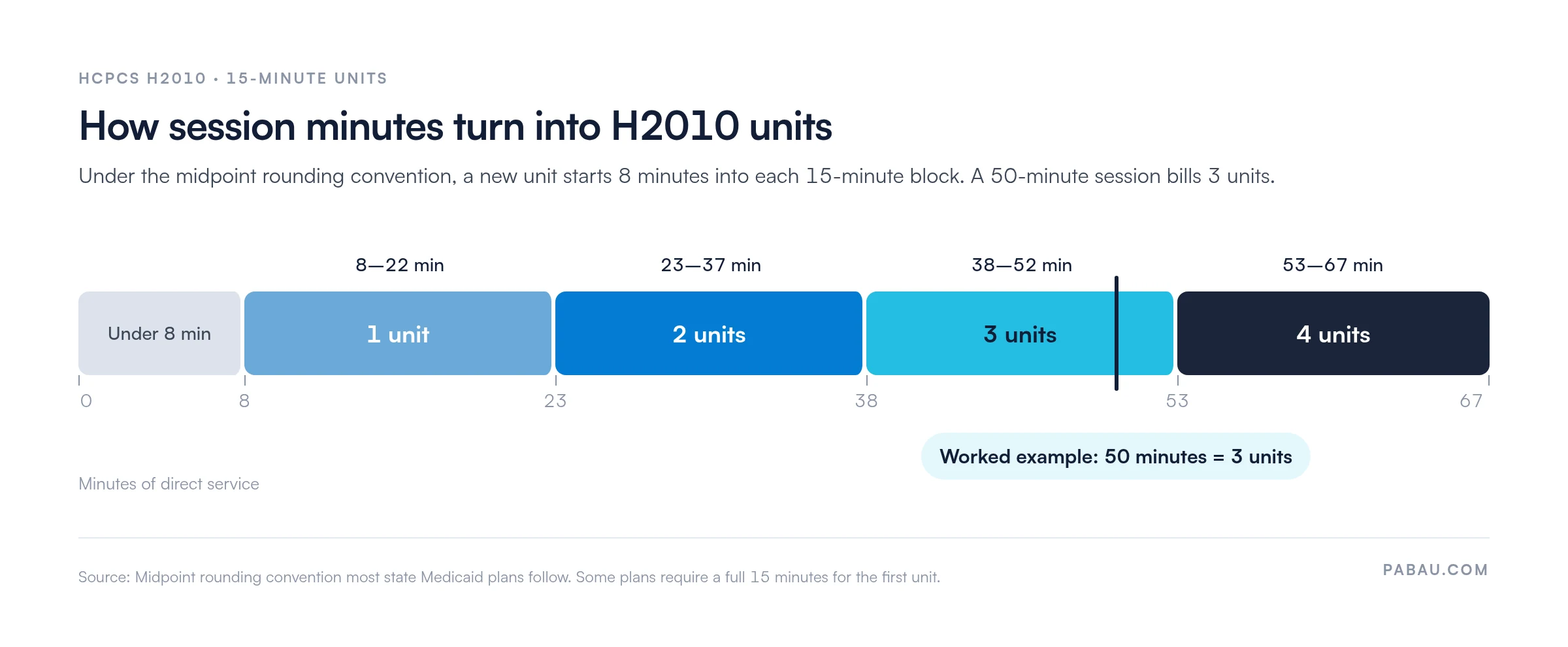
H2010 uses time-based billing, with each unit representing 15 minutes of direct service. Most state Medicaid plans follow the AMA’s midpoint rounding convention. A provider must deliver at least 8 minutes to claim one unit, and each additional unit starts 8 minutes into the next 15-minute block.
Verify your state Medicaid plan’s specific rounding rule before applying this convention universally. Some state plans require a full 15 minutes for the first unit and use the 8-minute rule only for additional units.
Worked example: A pharmacist delivers 50 minutes of CMM to a patient managing five concurrent psychiatric medications. At 38 minutes, the third unit threshold is crossed. The session runs to 50 minutes, which does not reach 53 minutes, so the correct billing is 3 units of H2010.
The note must document a start time and end time (or a running service time log) that the auditor can verify against the unit count. The timeline below shows where each unit begins and where that 50-minute session lands.
Modifier requirements for H2010 vary by state Medicaid plan. The table below reflects commonly accepted modifiers across Medicaid behavioral health programs. Confirm each one against your state’s billing manual before you append it to a claim.
Provider eligibility for H2010 is determined by each state’s Medicaid plan. There is no single federal rule specifying which provider types may bill this code. State billing manuals commonly authorize the provider types below. Each one needs Medicaid enrollment in the billing state and must work within its scope of practice under that state’s law.
Covered settings generally include outpatient behavioral health clinics, CMHCs, and some residential treatment programs. Telehealth delivery of CMM services became more broadly covered following federal flexibility expansions. Check your state Medicaid telehealth policy for the current rules.
Before billing H2010, confirm your Medicaid provider enrollment is active and the service type code on your enrollment matches behavioral health or outpatient clinic. A mismatch between your enrollment taxonomy and the claim’s place of service is a common denial reason.
Missing or vague documentation can lead to denials in post-payment audits. Every progress note must contain the elements below to support the claim. Following standards for medical billing compliance limits audit exposure when state Medicaid runs retrospective reviews.
Vague notes such as “medication management performed” do not support an audit. The note must describe what specifically was reviewed and what clinical action resulted from the review.
H2010 is often confused with adjacent H-series codes such as H2011 and H2019, and with CPT medication therapy management (MTM) codes. The core distinction is the payer. State Medicaid programs pay for CMM under H2010. Part D plans reimburse CPT 99605-99607 only through MTM contracts, at the plan’s rate, and some state Medicaid programs also use them.
Billing the wrong code family to the wrong payer typically ends in a denial.
The MTM vs. CMM rule in practice: A “dual eligible” patient is enrolled in both Medicare and Medicaid. They may receive MTM billed under CPT to their Part D plan on one date. CMM billed under H2010 to Medicaid can follow on a different date, for a separate clinical encounter. Billing both on the same date of service for the same provider typically triggers a bundling edit.
There is no federal fee schedule for HCPCS H-series codes. Each state Medicaid agency sets its own per-unit rate for H2010, and those rates are updated on the state’s fee schedule publication cycle, typically annually. Understanding medical billing workflows for state-funded programs is essential before setting productivity targets for CMM services.
Rates are set by each state Medicaid fee schedule, and they vary with provider type, setting, and state plan. Retrieve the current rate from your state’s official fee schedule before you quote reimbursement amounts to clinical staff.
Most H2010 denials fall into a small number of repeating patterns. Effective denial management in healthcare starts with knowing which pattern you are in before appealing. The CARC and RARC denial codes on the remittance advice tell you which one applies. The table below maps the most frequent denial reasons to their root causes and corrective actions.
Yes, in many states, but bundling edits determine which code combinations are permitted on the same date of service. H2010 may be billed alongside psychotherapy codes and psychiatric evaluation codes when the services are clinically distinct and separately documented. H2010 is not appropriate on the same date as a service that already includes medication review within its descriptor.
A claim check before submission can flag same-day code combinations before the payer does. Each state Medicaid plan maintains its own code-pair edit tables. Review your plan’s outpatient behavioral health billing manual to confirm which combinations are allowed. Some states require a modifier to justify billing H2010 alongside an evaluation and management code on the same day.
Run a same-day billing audit on your H2010 claims quarterly. Pull every claim where H2010 was billed alongside another behavioral health code on the same date. Confirm each pairing is documented as a distinct service with separate start and end times. This catches bundling exposure before an audit does.
A clean H2010 claim reaches the Medicaid payer with five elements in place, and each one must match the progress note exactly:
Use the PGM Billing HCPCS lookup tool and the CMS HCPCS overview to verify H2010’s current status and descriptor before each billing cycle. Codes do not change frequently, but annual HCPCS updates can modify descriptors, add modifiers, or retire adjacent codes in the H2000 series. If you submit through a clearinghouse, read its rejection report before you resubmit, because a front-end rejection never reaches the Medicaid payer.
Many H2010 denials trace back to the claim itself, such as a unit count that does not match the note or a missing credential modifier. A team that builds claims by hand usually finds these errors only when the remittance comes back.
Pabau, the practice management platform we build, includes claims software for practices that raises each claim from the visit’s invoice. Claim validation checks for missing or invalid details before submission, which helps teams check unit counts and modifiers. A rejected claim is flagged “Needs action,” with a link to the field that needs fixing.
Prior authorization cases attach to the booking and follow the appointment through to the claim, with approved sessions tracked. US claims go out as CMS-1500 forms through Claim.MD, and ERA files settle payments against the invoices they cover.

Pabau’s claims management software checks each claim for missing or invalid details before it goes out. Your team can confirm unit counts and modifiers against the note, then track each claim from pending to paid.

H2010 pays for time, so the progress note carries the claim. Before you bill it, confirm three points in your state Medicaid manual: The rounding rule, the required modifiers, and whether prior authorization applies.
Building those state rules into a claim check takes an afternoon of setup. After that, the same unit or modifier error stops coming back every billing cycle. Book a demo to see how Pabau’s claims management software helps your team check unit counts and modifiers before each H2010 claim goes out.

Need to understand how denial codes work? Denial codes in medical billing explains CARC and RARC denial reason codes and how to act on them.
Billing medication training rather than a full review? HCPCS code H0034 covers medication training and support in 15-minute units.
Looking for a broader overview of medical billing workflows? What is revenue cycle management covers the end-to-end process from eligibility check to payment posting.
Handing patients a record of their visit? Superbill guide walks through what a superbill must contain and when practices use one.
HCPCS code H2010 covers comprehensive medication services billed in 15-minute increments. That includes medication review across all current drugs, reconciliation, patient education on adherence and side effects, and care coordination with prescribers. It does not cover dispensing, prescribing, or general psychotherapy.
H2010 is used by state Medicaid programs and not payable by Medicare (status I). Pharmacist-led medication management for Medicare patients runs through Part D plans instead. Part D plans reimburse CPT 99605-99607 only through MTM contracts, at the plan’s rate.
One billable unit of H2010 requires at least 8 minutes of direct service time, under the AMA midpoint rounding convention most Medicaid plans use. A 50-minute session supports 3 units. The progress note must record a start time and end time to support the unit count.
Required modifiers vary by state Medicaid plan. Commonly used modifiers include SC (medically necessary), HQ (group setting), HN (bachelor’s level), HO (master’s level), and HP (doctoral level). State-specific U1-UD modifiers apply in some plans. Check your state’s behavioral health billing manual before billing.
H2010 covers comprehensive medication services focused on reviewing and optimizing a patient’s medication regimen. H2019 covers therapeutic behavioral services focused on behavior modification, not medications. The two codes address distinct clinical objectives and should not be used interchangeably.
Count units from the documented service time and append the modifiers your state Medicaid billing manual requires. Confirm the rendering provider is actively enrolled in Medicaid, then submit on a CMS-1500 claim form with the correct place-of-service code. Every unit must be supported by a progress note with start and end times.