

CPT Code 30801: Superficial turbinate ablation billing guide
CPT Code 30801: Official descriptor and procedure overview The American Medical ...

Last Updated: Nov 27, 2026
T1502 is the HCPCS Level II code for administration of oral, intramuscular and/or subcutaneous medication by a health care agency or professional, per visit. It is one of the national T codes CMS maintains for state Medicaid agencies.
T1502 is billed once per visit, however many doses the nurse gives. It applies to Medicaid state-plan payers only, and Medicare fee-for-service does not pay it.
Let Pabau's smart automation suggest the right codes, reduce claim denials, and keep your practice compliant—effortlessly.
Automate repetitive tasks and focus on what matters most—your patients.
Reduce coding errors and ensure compliance with the latest regulations.
Clean claims, fewer denials, and faster reimbursements.
Powerful insights and reporting to help your practice thrive.
HIPAA compliant SOC 2 certified GDPR-compliant Trusted by 4,000+ clinics worldwide

HCPCS Code T1502 covers oral, intramuscular, and subcutaneous medication administration by a health care agency or professional, billed once per visit.
T1502 is a Medicaid state-plan code, and Medicare fee-for-service does not pay it.
Most state Medicaid programs require an RN or LPN to give and document the medication. That rule comes from the state, not the CMS descriptor.
Routes other than oral, IM, or SQ never go on T1502, and IV or infusion visits take the code the state manual assigns.
Modifier rules are payer-specific, so check whether the payer wants TD, TE, or a state-defined U modifier on the claim.
HCPCS Code T1502 covers a visit in which a health care agency or professional gives oral, intramuscular (IM), or subcutaneous (SQ) medication. Its official descriptor in CMS’s quarterly HCPCS file reads: Administration of oral, intramuscular and/or subcutaneous medication by health care agency/professional, per visit. The same file gives it Medicare coverage code I, which means not payable by Medicare.
T1502 belongs to the national T codes that the Centers for Medicare & Medicaid Services (CMS) maintains for state Medicaid agencies, the range T1000-T5999. Within that range it opens the Miscellaneous Services and Supplies group, T1502-T1999. T codes cover services outside the CPT code set, and they sit in the CMS HCPCS Level II code set.
The descriptor names no nursing license. The RN or LPN requirement most payers apply comes from state Medicaid rules. Confirm in the provider manual who may perform the visit.
The code is billed per visit, not per dose or per medication. A nurse visit in which the patient gets both an oral medication and a subcutaneous injection is still one unit of T1502.
T1502 covers three routes of medication administration during an agency or professional visit, usually in the patient’s home.
Most state Medicaid programs require a registered nurse (RN) or licensed practical nurse (LPN) to perform the visit. Whether an LPN may bill T1502 independently depends on the state provider manual. Some states require RN co-signature or supervision documentation for LPN services, so verify provider eligibility before billing under LPN credentials alone.
T1502 has a narrow scope. Billing it for a service outside its descriptor is the fastest route to a denial or an audit flag.
T1502 and its neighbor T1503 split home medication visits by route, and both are billed per visit. Neither code describes IV administration, which is where the diagram below sends the third branch.
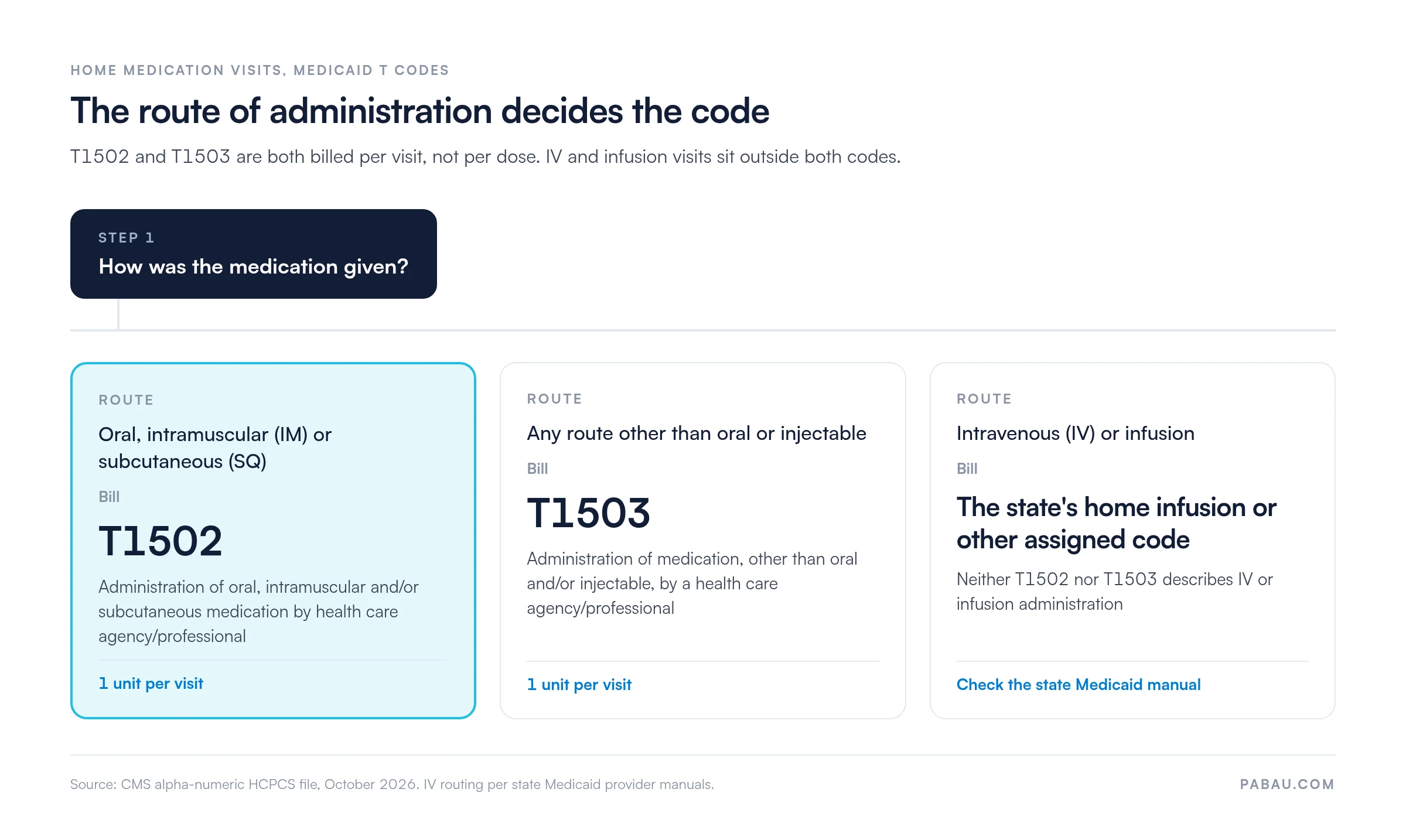
The decision rule is short. If the route is oral, IM, or SQ, bill T1502. If it is neither oral nor injectable, bill T1503. An IV or infusion visit fits neither code, so take the code your state manual assigns to home infusion.
Modifier selection for T1502 is payer-specific, and no single modifier applies to every Medicaid plan. The table below covers modifiers state programs commonly ask for on nursing T codes. Always confirm the requirements in the state Medicaid provider manual or the managed care organization (MCO) contract.
A missing or wrong modifier is a common reason T1502 claims deny on first submission. Record the nurse’s license level and any state modifier when the visit is documented, rather than during claims scrubbing. That way the biller is not chasing the information later.
Review your state Medicaid provider manual and any MCO contract addenda for T1502 modifier requirements every quarter. State agencies update billing instructions, and managed Medicaid plans often add their own modifier rules on top of the state-plan rules. A modifier that was optional last year may be mandatory this year.
Thin documentation is a common reason T1502 claims fail review. Every claim needs a complete visit record behind it, and state Medicaid auditors routinely request these records during recoupment reviews.
T1502 is usually billed with Place of Service (POS) code 12 (Home). Some states also accept POS 14 (Group Home) or POS 33 (Custodial Care Facility) for Medicaid-covered residential settings. Many state programs do not accept POS 11 (Office) for T1502.
A POS the payer does not accept for T1502 triggers a denial at the claim edit stage. Confirm the accepted POS codes in the state provider manual before billing.
T1502 is not covered under traditional Medicare Part A or Part B fee-for-service. The code is a Medicaid state-plan code. Some Medicare Advantage plans may cover medication administration visits as a supplemental benefit, but coverage is plan-specific and must be verified with the plan.
Never submit T1502 on a Medicare fee-for-service claim. Medical billing workflows that separate Medicare and Medicaid claim queues stop this error before submission.
Prior authorization rules for T1502 vary by state Medicaid program and MCO. Some fee-for-service Medicaid plans do not require it for routine medication administration visits. Managed Medicaid MCOs often do, especially for frequent visits or high-cost biologics. Verify the rules with the payer before you start a home medication administration plan.
Medicaid rates for T1502 are set by each state and differ widely, so there is no single national rate. Managed Medicaid MCO rates follow the contract rather than the state fee schedule.
To find the 2026 rate, go to the state Medicaid agency’s published fee schedule. The Connecticut Department of Social Services, for example, publishes its home health T-code rates in its provider rate schedule. Sound revenue cycle management means tracking the contracted rate for every payer, not a generic estimate.
Most T1502 denials fall into a small set of recurring categories, each traceable to a documentation or workflow step. Match each remark code against the denial code reference to find the step that failed.
Fix that step and the same denial stops coming back. Good denial management workflows treat each denial code as a signal about the process behind the claim.
A correctly built T1502 claim follows the same eight steps every time. Pabau’s claims management software helps practices submit and track those claims once the steps are done.
After submission, track the claim through your clearinghouse or the payer’s provider portal. If a denial comes back, check its CARC and RARC codes against the denial table above. Correct the element that failed, and resubmit with an appeal letter where required. The AAPC HCPCS code lookup and the PGM Billing HCPCS tool give more code-level context.
Track denial patterns for T1502 and its neighboring T codes over time. A recurring pattern points to a workflow step that a one-off appeal never fixes.
Read your state Medicaid provider bulletins every year, not just the provider manual. States often publish T1502 billing changes in a bulletin first. A bulletin missed in the fall can cause a wave of denials in January, when the new policy year begins.
A T1502 claim leans on records that often live in different places: the physician order, the MAR, the visit note, and the claim itself. When a Medicaid auditor asks for them, someone has to pull them together by hand.
Pabau, a practice management platform, keeps the visit note and physician order on the patient record behind the claim. In the US, its claims management submits CMS-1500 and 837P claims through Claim.MD, runs eligibility checks, and brings ERA remittances back to that record.
Your billers still choose the code and the modifiers. What changes is the time spent hunting for paperwork when an audit, a denial, or an appeal asks for it.

Pabau’s claims management submits and tracks your Medicaid claims, with the visit note and physician order on the same patient record. Your team can answer an audit request without digging through paper files.

HCPCS Code T1502 is simple to pick and easy to lose money on. The route settles the code in seconds. Whether the claim pays depends on state rules you have to look up. They decide who may give the medication, which modifiers apply, and whether prior authorization is needed.
The teams that collect on T1502 without rework check those rules at the visit, not at the billing desk. Put the modifier and license checks into the nurse’s visit note template, and recheck the state manual once a year.
Pabau keeps the visit note and physician order linked to the claim record, so the paperwork is there when a payer asks. Book a demo to see how it fits your Medicaid billing workflow.

Billing a medication visit by another route? HCPCS code T1503 covers medication given other than orally or by injection.
Need a denial management framework for Medicaid claims? Denial management in healthcare covers how to categorize, track, and resolve claim denials across payer types.
Looking for clean claim standards before submission? What is a clean claim outlines the elements every claim needs to pass payer edits on the first pass.
Want to understand broader medical billing workflows? What is medical billing explains the billing cycle from patient encounter to payment posting.
HCPCS code T1502 covers the administration of oral, intramuscular and/or subcutaneous medication by a health care agency or professional, billed per visit. Most state Medicaid programs limit it to RNs and LPNs, a rule that comes from the state rather than the descriptor. The code covers the nursing service only, and the drug is billed separately.
T1502 is covered by Medicaid and state-plan programs only. Traditional Medicare Part A and Part B fee-for-service do not pay T-series HCPCS codes. Some Medicare Advantage plans may cover home medication administration as a supplemental benefit, but coverage is plan-specific and must be verified before submission.
No modifier applies to every T1502 claim, because modifier rules are payer-specific. Many state Medicaid programs ask for TD (RN) or TE (LPN/LVN) to show who gave the medication. Some also use U1 through U9, which each state defines for itself. Check the state provider manual or MCO contract before billing.
You need a current signed physician order and a contemporaneous medication administration record (MAR). The skilled nursing visit note should show the date, time, route, dose, nurse credentials, and the clinical reason a nurse was needed. It should also reference an active plan of care that orders medication administration. A missing element is an audit and denial risk.




