CCSD code H4430: Examination of rectum under anaesthetic
CCSD code H4430 pays for the examination alone CCSD code H4430 is the UK private...

Last Updated: Oct 20, 2026
H0042 is the HCPCS Level II code for foster care, child, non-therapeutic, per month.
Pick the wrong family and the month is unpayable by the time the denial arrives. Two more rules decide the rest. Only state Medicaid pays H0042, and your records have to span the whole billed month.
Below is how the code works, where claims stall, and what to check before you submit.
Let Pabau's smart automation suggest the right codes, reduce claim denials, and keep your practice compliant—effortlessly.
Automate repetitive tasks and focus on what matters most—your patients.
Reduce coding errors and ensure compliance with the latest regulations.
Clean claims, fewer denials, and faster reimbursements.
Powerful insights and reporting to help your practice thrive.
HIPAA compliant SOC 2 certified GDPR-compliant Trusted by 4,000+ clinics worldwide

HCPCS code H0042 covers non-therapeutic foster care for a child, billed once per calendar month.
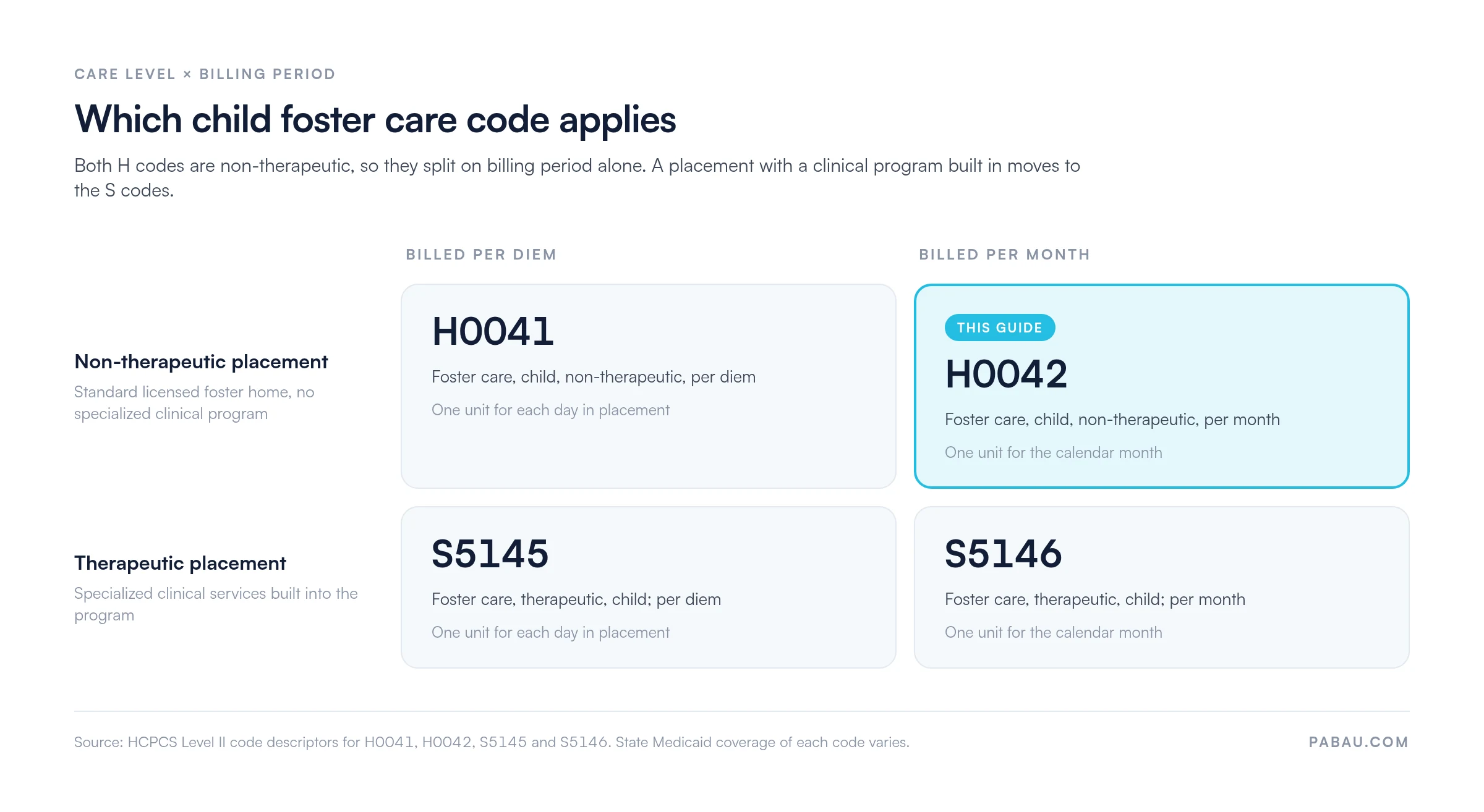
H0041 is the same non-therapeutic service billed per diem, so the two codes split on billing period alone.
Therapeutic child foster care sits in the S codes instead, S5145 per diem and S5146 per month.
H0042 is a Medicaid-only code. Medicare does not cover it, and a claim filed to Medicare denies automatically.
Documentation must show authorization, placement, and monthly service activity for the whole billed month. Requirements vary by state.
Practice management software like Pabau tracks the monthly billing cycle and stores the records an H0042 audit asks for.
HCPCS code H0042 describes non-therapeutic foster care for a child, billed per month.
The official CMS descriptor is: Foster care, child, non-therapeutic, per month. The code sits in HCPCS Level II, the set CMS maintains for behavioral health and social services. CPT does not describe them.
Non-therapeutic means the placement itself carries no specialized clinical program. The child lives in a standard licensed foster home. Counseling the child receives is billed separately, by the clinician who provides it.
One unit equals one calendar month of placement. H0042 is active for 2026, but confirm that before you bill. HCPCS additions, deletions, and revisions take effect each January 1.
Check the AAPC HCPCS entry or your state Medicaid bulletin.
This is the most common misunderstanding in the foster care code family. H0041 is not the therapeutic version of H0042.
Both codes describe non-therapeutic child foster care, and only the billing period separates them.
So the deciding factor is the billing cycle your state Medicaid program runs. Clinical content does not enter into it. Some states pay daily and expect H0041. Others pay monthly and expect H0042, and your state fee schedule names the unit it recognizes.
Partial months are where teams start improvising. Do not switch between the two codes to work around one. Instead, ask your state Medicaid program how it wants a part-month placement reported. Some states prorate the monthly rate, while others expect per diem lines for the days covered.
Worked example. A child enters placement on March 12 and stays through March 31. Those 20 days do not make a calendar month, so H0042 alone does not describe them.
In a per diem state, you bill H0041 lines for the 20 days. A monthly state will point you to its proration rule instead. Either way, the answer comes from the manual, and the placement start date belongs in the record.
Genuinely therapeutic foster care sits in a different HCPCS family. Two S codes carry it:
Therapeutic placement means specialized clinical services are built into the program itself. An occasional counseling session does not make a placement therapeutic.
If the S codes describe your program, check those first. State Medicaid programs also differ on which of the four codes they accept, so confirm coverage for each one.
Set out on two axes, the four codes stop overlapping.
Eligibility to submit H0042 is set by each state Medicaid program, rather than by one federal rule. The provider types that commonly hold it are:
Individual clinicians and solo practitioners rarely bill H0042. This is an agency-level code for the placement itself, rather than for a clinical session with the child. A therapist treating that child bills their own session codes, usually from a separate therapy practice system.
State variation matters. Some states restrict H0042 to contracted agencies. Others open it to a wider range of enrolled providers. Verify your status in the state Medicaid provider manual before the first claim goes out.
H0042 is a Medicaid-only code. Medicare does not cover it, and a claim sent to a Medicare administrative contractor denies automatically. There is no Medicare crosswalk here, and no secondary payer path.
Every state Medicaid program sets its own monthly rate. Rates are then revised annually. Treat any figure from outside your own fee schedule as unreliable. Pull the current one from the behavioral health fee schedule your state Medicaid agency publishes.
Four billing mechanics decide whether that rate is paid at all:
Before the start of each fiscal year, download your state Medicaid behavioral health fee schedule and flag the H0042 rate. Rate changes take effect January 1 in most states. Billing at last year’s rate is a quiet revenue loss that nobody spots until the remittance arrives.
Most state Medicaid programs require prior authorization before an H0042 placement is payable. The authorization carries dates, and those dates have to span the calendar month on the claim. A placement authorized for part of the month is payable only for that part.
Three authorization failures cause most denials in this category:
Confirm the requirements before the placement starts. Retroactive authorization is possible in some states and impossible in others. Finding out which one applies after a month of unpaid care is an expensive way to learn it.
Thin documentation is the main reason H0042 claims are recouped at audit. This is a monthly code. Your records have to show the placement was active and authorized all month.
Five record types carry an H0042 claim through a post-payment review:
Treat that list as the floor, then add whatever your state’s behavioral health billing manual asks for. Keeping the records in the same system as the claim also supports HIPAA compliance. Access stays logged, rather than spread across shared drives and paper files.
H0042 carries no nationally required modifier. Individual state Medicaid programs do mandate them for adjudication, so use only what appears in your state billing manual. An unsupported modifier causes rejection just as reliably as a missing required one.
Check the manual for the current program year, not last year’s copy. State modifier requirements change with funding streams and waiver renewals. When the manual is ambiguous, call state Medicaid provider relations before you submit.
An H0042 claim passes four checkpoints between month end and payment. Knowing which one stopped it tells you which record to fix.
Rejections at the first three checkpoints are usually fixable with a corrected claim inside the filing window. A documentation failure found after payment becomes a recoupment, which costs far more to unwind.
The denial patterns for this code repeat from state to state. Good denial management starts with knowing which six to watch:
A pre-submission checklist removes most of these before the claim leaves the building. Working from a clean claim checklist confirms every required element is present while the claim is still yours to fix.
The H series (H0000-H9999) covers behavioral health, substance use, and social services. Foster care sits inside it, with the therapeutic equivalents over in the S codes.
Below are the codes most often confused with H0042 or billed near it.
Agencies billing H0042 also use H0041 where a state pays foster care daily. Case management and assessment work draws on other H0000-H0099 codes.
When several codes land on one child’s record in the same month, check your state’s bundling rules. Some programs edit specific combinations out for the same beneficiary and date.
Run a monthly code combination audit across your active H0042 caseload. Pull every claim submitted for each child last month. Check that no codes were billed in combinations your state restricts. Catching a bundling error before the remittance arrives saves the whole appeals cycle.
The monthly unit, the Medicaid-only payer rule, and state documentation standards all interact. Risk builds up at several points in one billing cycle, so working the same sequence every month keeps it contained.
Timely filing deadlines run from 90 days to 12 months after the date of service, depending on the state. Missing the window makes the claim unbillable, however accurate it is. So build submission into the monthly close, and nothing waits for a quieter week.
The per-month cycle creates a specific administrative load. For every enrolled child, every month, someone confirms active placement, current authorization, and complete documentation.
Most agencies do that across spreadsheets, shared drives, and paper files, which is where a lapsed authorization goes unnoticed.
Practice management software like Pabau keeps those records against the client, so the monthly check reads from one place. Our claims management software builds the claim from what is already on file, then flags missing fields before submission.
In the US, claims route through our Claim.MD integration, so submissions and remittances land beside the documentation behind them.
What that changes for an H0042 biller:
Tracking H0042 beside the rest of the H series in one system also makes monthly close-out quicker. Reporting reads from the same records the claims came from.

Pabau helps behavioral health and child welfare agencies track monthly billing cycles and store the required documentation. Claims then go out from the same client record.

H0042 has a narrow job. It covers non-therapeutic foster care for a child, billed monthly to state Medicaid. The difficulty sits around the code, not inside it. You pick H0042 over per diem H0041, then hold the authorization across the whole month. The records behind it have to survive a post-payment audit.
Get those three right and the code becomes unremarkable to bill. What stays hard is the volume. Every child needs one placement record, one authorization, and one month of logs, over and over.
Pabau carries that repetition in one client record, so the monthly check reads from a single place. Book a demo to see the monthly cycle and its documentation together.

Documenting opioid dependence instead? ICD-10 code F11.20 covers opioid dependence, uncomplicated, a diagnosis that gets denied more than most behavioral health claims.
Coding stimulant dependence instead? ICD-10 code F15.20 covers other stimulant dependence, uncomplicated, a diagnosis frequently confused with stimulant abuse.
Documenting nicotine dependence instead? ICD-10 code F17.210 covers nicotine dependence from cigarettes with no withdrawal symptoms present.
Billing another monthly H code? H0044 covers supported housing per month and shares the same calendar-month unit rule.
The professional claim. Most state Medicaid programs take H0042 on a CMS-1500, or its electronic equivalent, the 837P. Your state companion guide confirms the format and the payer ID.
The child in placement. The child is the Medicaid member, and the agency is the billing provider. Foster parents are rarely the billing provider, so their details do not belong in that field.
Either one, depending on the state. Some states keep child welfare services in fee-for-service Medicaid. Others delegate them to a managed care plan, which sets its own authorization and filing rules.
Usually yes. Most state Medicaid programs expect an ICD-10 diagnosis on the professional claim. Some name the code they want for placement services, so check the companion guide before you submit.
Usually yes. Authorizations are commonly tied to the placement, the provider, or both. Request the new one before the move where you can, because backdating is not allowed everywhere.