CPT code 93503: Swan-Ganz catheter billing and modifiers
CPT code 93503: Official descriptor and procedure overview In the AMA CPT code s...

Last Updated: Oct 23, 2026
H0015 is the HCPCS Level II code for alcohol and/or drug intensive outpatient services. It covers a substance use disorder (SUD) program running at least 3 hours a day, 3 days a week, under an individualized treatment plan. One per-diem unit bundles assessment, counseling, crisis intervention, and activity therapies or education.
State Medicaid programs are the main payers for H0015, and Medicare doesn't pay for it. Billing teams often confuse it with H0014 or H0018, and some commercial payers expect S9480 instead.
Let Pabau's smart automation suggest the right codes, reduce claim denials, and keep your practice compliant—effortlessly.
Automate repetitive tasks and focus on what matters most—your patients.
Reduce coding errors and ensure compliance with the latest regulations.
Clean claims, fewer denials, and faster reimbursements.
Powerful insights and reporting to help your practice thrive.
HIPAA compliant SOC 2 certified GDPR-compliant Trusted by 4,000+ clinics worldwide

HCPCS Code H0015 covers alcohol and drug intensive outpatient (IOP) services, billed per diem at one unit per qualifying treatment day.
The program must deliver at least 3 hours of services per day and run at least 3 days per week to meet the H0015 threshold.
H0015 is a bundled per-diem code, so assessment, counseling, crisis intervention, and activity therapy can’t be billed separately on the same day.
State Medicaid programs are the main payer and Medicare doesn’t pay for H0015, while some commercial plans want S9480 for SUD IOP claims.
Claims management software such as Pabau tracks per-diem submissions and denial reasons, so billing teams can catch unit and code errors early.
HCPCS Code H0015 is defined by the Centers for Medicare & Medicaid Services (CMS) in one descriptor with three parts. Here it is verbatim:
In billing terms, H0015 is a per-diem code. One unit covers one treatment day that meets the 3-hour minimum, and the daily rate includes every service in the descriptor. State Medicaid programs and Medicaid managed care plans are the main payers, since Medicare doesn’t pay for H0015.
H0015 is a comprehensive per-diem bundle. Every service listed in the official descriptor is included and reimbursed within the single daily rate. Billing any of the following separately on the same day creates a duplicate-billing defect under CMS’s HCPCS Level II guidelines.
Services bundled into H0015 (cannot be billed separately on the same day):
What H0015 does not include:
National Correct Coding Initiative (NCCI) edits are updated quarterly by CMS. Before billing any code alongside H0015 on the same claim date, verify the current NCCI edit tables, as bundling conflicts change between update cycles.
A claim for HCPCS Code H0015 is only valid when the program itself meets the structural thresholds written into the descriptor. Payers review the program as well as each service, so documentation must prove program compliance on every date of service.
Program eligibility requirements:
The American Society of Addiction Medicine (ASAM) criteria designate IOP as Level 2.1 care. Many Medicaid managed care organizations and commercial plans use ASAM criteria to establish medical necessity for H0015 reimbursement. A clinician-completed ASAM Level 2.1 determination, or an equivalent level-of-care assessment, strengthens the claim record significantly.
SAMHSA’s TIP 47, Substance Abuse: Clinical Issues in Intensive Outpatient Treatment, sets out clinical best practices for intensive outpatient SUD programs. Payers frequently reference SAMHSA’s Treatment Improvement Protocols (TIPs) when reviewing medical necessity during audits.
Documentation required on every H0015 claim date:
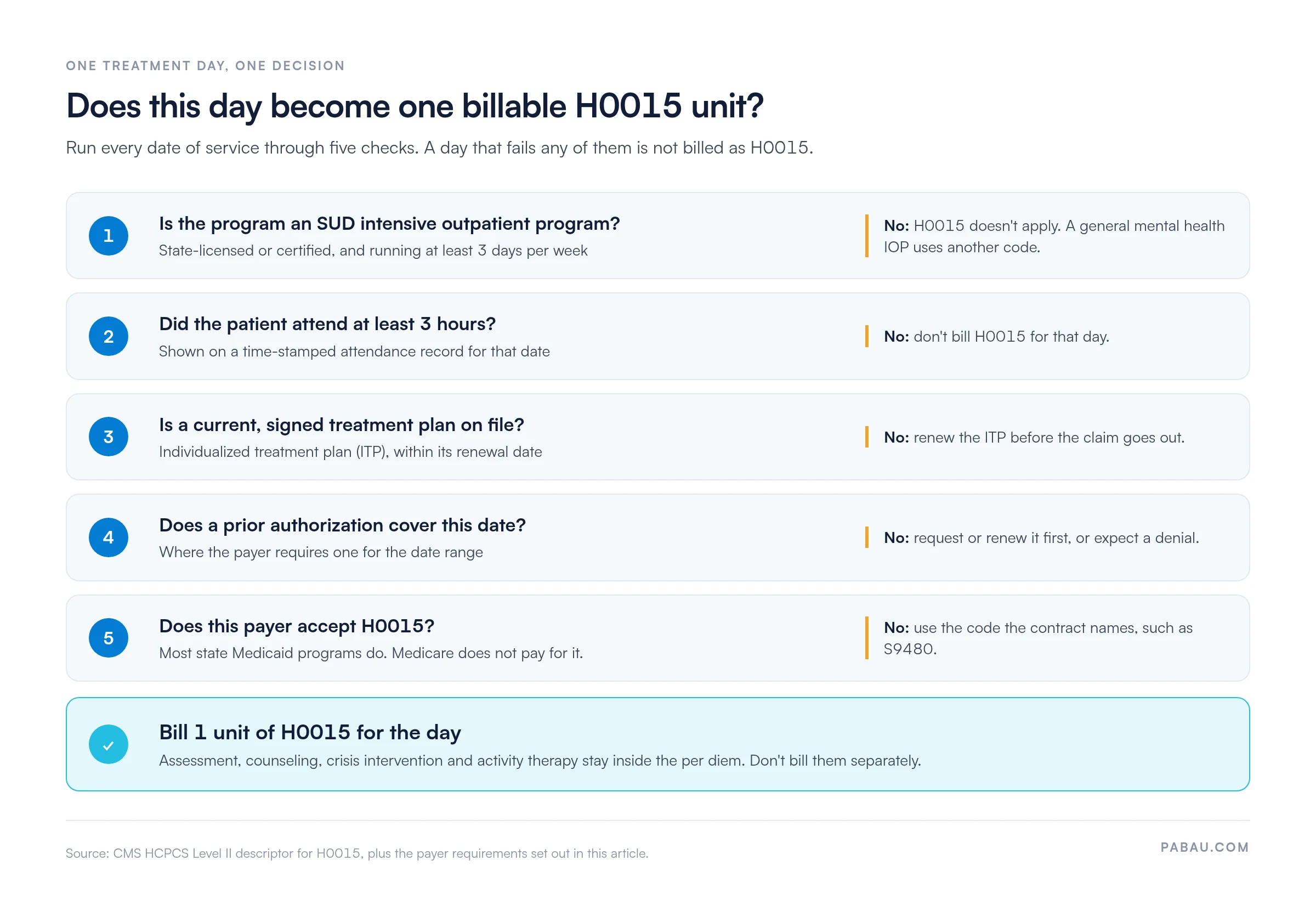
Put together, the program rules and the daily records come down to five checks. The flow below shows how one treatment day either becomes a billable H0015 unit or doesn’t.
H0015 billing mechanics differ by provider type. Facility-based programs submit on a UB-04. Professional and group practice providers submit on a CMS-1500. Confirm which claim form your payer contract and provider enrollment require before selecting the form.
Check your state Medicaid provider manual before billing H0015. Some state Medicaid programs require a modifier, such as HH for co-occurring mental health and SUD. Others require a place-of-service code that differs from commercial plans. Document the payer-specific rule in your billing team’s code reference.
Revenue code 0912 is the standard pairing for H0015 on UB-04 institutional claims for chemical dependency intensive outpatient programs. Some state Medicaid programs use revenue code 0906 (behavioral health IOP) instead. Verify against your specific state’s Medicaid provider manual before finalizing UB-04 submissions.
Pabau’s claims management software helps behavioral health billing teams track per-diem submissions, flag mismatched units, and manage payer-specific billing rules across multiple claim dates.
Three codes compete for IOP billing in substance use disorder treatment: H0015, H0014, and S9480. Each applies in different clinical and payer contexts. Selecting the wrong one is among the most common denial triggers on SUD claims.
H0015 and H0014 cannot be billed on the same day at the same facility. They represent different levels of SUD care (IOP treatment versus ambulatory detoxification). Whether same-day billing is permissible when services occur at two distinct facilities on the same date is payer-specific. Confirm the individual payer’s policy before attempting this configuration.
S9480 covers intensive outpatient psychiatric programs rather than SUD-focused programs, though some commercial plans use it for both. If your payer contract specifies S9480 for IOP SUD claims, use that code.
If the contract does not address the distinction and the program is SUD-specific, H0015 is generally the correct Medicaid code. Refer to the AAPC HCPCS code lookup to confirm current descriptor language before selecting between these codes for a specific payer.
H0015 sits within a family of H-series HCPCS codes that cover the full continuum of SUD and behavioral health services. Billing teams working in SUD programs frequently encounter H0018 and H0035 alongside H0015 as patients move between levels of care.
H0018 applies when the patient resides at the treatment facility overnight (short-term residential). If a patient moves from residential care (H0018) to IOP (H0015), claims for each level should reflect the correct dates and not overlap.
H0035 covers psychiatric partial hospitalization rather than SUD IOP. Using it for a substance-use intensive outpatient program is a coding error that payers will deny or audit.
Prior authorization requirements for H0015 vary by state Medicaid program and managed care organization. There is no universal rule. Most state fee-for-service Medicaid programs and virtually all Medicaid managed care plans require authorization before IOP services begin.
Typical authorization criteria payers assess:
Reimbursement rates for H0015 differ significantly by state. Ohio, Kansas, and Florida each publish state-specific Medicaid fee schedules with distinct per-diem rates. Always reference the current state fee schedule on each state’s Medicaid portal rather than a third-party estimate, as rates are updated periodically.
Traditional fee-for-service Medicare doesn’t pay for H0015. CMS lists the code with coverage status I, not payable by Medicare, which is why it’s primarily a Medicaid code.
H0015 denials cluster around a predictable set of documentation and billing errors. Most are correctable before submission with the right workflow controls.
Effective denial management requires tracking denial reasons by code across claim dates to spot patterns early. A single billing rule error (wrong revenue code, for example) will generate dozens of denials before it is caught manually.
Staying current with medical billing compliance matters most for SUD programs. Medicaid audits there focus heavily on documentation for per-diem codes like H0015.
Many SUD programs track H0015 requirements in several places at once. Attendance lives on sign-in sheets, ITP renewal dates sit in a spreadsheet, and each payer’s code preference lives in a biller’s head. A claim can go out before anyone notices the day ran short or the authorization lapsed.
In Pabau, those records sit on the patient’s file. Signed treatment plans and intake forms are stored as digital forms against the patient record. Claims are submitted and tracked from the same system, with denial reasons reported by code.
The result is fewer avoidable H0015 denials, and less time spent reworking claims your team already sent once.

Pabau helps SUD programs and behavioral health practices submit per-diem claims, track authorization expiry dates, and catch missing documentation before claims go out.

Treat the attendance record as the claim. If a day falls short of 3 hours, or the ITP has lapsed, that day isn’t an H0015 unit, however much care was delivered.
Settle the code question at contracting, before the first claim. Confirm with each payer whether it takes H0015 or S9480, and record the answer where your billers will see it. The per-diem structure keeps coding simple, but one missing document costs a full day’s rate.
Book a demo to see how Pabau helps SUD programs keep attendance, treatment plans, and claims in one place.

Billing the intake assessment before IOP starts? HCPCS Code H0001 covers the alcohol and drug assessment that often comes before an IOP admission.
Want to understand how claims clearinghouses work for behavioral health? Medical claims clearinghouse overview explains how electronic claims routing works between providers and payers.
Looking for guidance on clean claim requirements? Clean claim best practices covers the elements every claim needs to reach adjudication without edits.
Working a denied H0015 claim? Denial codes in medical billing explains what each denial reason means and how to resubmit.
HCPCS Code H0015 is a HCPCS Level II per-diem billing code for alcohol and drug intensive outpatient program (IOP) services. The program must operate at least 3 hours per day and at least 3 days per week. The code bundles assessment, individual and group counseling, crisis intervention, and activity therapies into a single daily rate, most commonly reimbursed by state Medicaid programs.
Yes, H0015 is a per-diem code: 1 billing unit equals 1 qualifying treatment day. Submitting more than 1 unit per date of service is a common denial trigger. The per-diem structure means all services listed in the descriptor (counseling, crisis intervention, activity therapy) are bundled into that single daily rate.
The program must deliver at least 3 hours of services on each treatment day billed under H0015. The program must also operate at least 3 days per week. If attendance records show fewer than 3 hours on a given date, H0015 cannot be billed for that day. A claim submitted anyway will be denied.
H0015 covers SUD-specific IOP programs and is the code most state Medicaid programs use. S9480 describes an intensive outpatient psychiatric program and is preferred by some commercial and managed care plans that do not accept H-series codes. If your payer contract specifies S9480, use that code. If you’re billing Medicaid for a substance use disorder IOP, H0015 is generally the correct code.
Revenue code 0912 (chemical dependency intensive outpatient) is the standard pairing with H0015 on a UB-04 facility claim. Some state Medicaid programs use 0906 instead. Always verify against the specific state Medicaid provider manual before finalizing UB-04 submissions, as the wrong revenue code is a common and avoidable denial reason.
Each H0015 claim date needs a time-stamped attendance record showing at least 3 hours of services. It also needs progress notes for each treatment component and a current signed individualized treatment plan (ITP). Add the prior authorization number if the payer requires one. The intake assessment must be on file but does not need to be repeated daily.