CPT code 93503: Swan-Ganz catheter billing and modifiers
CPT code 93503: Official descriptor and procedure overview In the AMA CPT code s...

Last Updated: Oct 23, 2026
G0151 is the HCPCS Level II code for services performed by a qualified physical therapist in the home health or hospice setting, each 15 minutes. Visits by a physical therapist assistant are reported under G0157, not G0151.
The home health agency reports G0151 under consolidated billing, without a GN, GO or GP therapy modifier. Payment depends on three records: documented homebound status, a physician-signed plan of care, and a skilled justification in each visit note.
Let Pabau's smart automation suggest the right codes, reduce claim denials, and keep your practice compliant—effortlessly.
Automate repetitive tasks and focus on what matters most—your patients.
Reduce coding errors and ensure compliance with the latest regulations.
Clean claims, fewer denials, and faster reimbursements.
Powerful insights and reporting to help your practice thrive.
HIPAA compliant SOC 2 certified GDPR-compliant Trusted by 4,000+ clinics worldwide

HCPCS Code G0151 covers services by a qualified physical therapist in home health or hospice, reported in 15-minute units. PTA visits bill under G0157, not G0151.
Claims require a physician-signed plan of care (CMS-485), documented homebound status, and a skilled justification in every visit note.
G0151 falls under consolidated billing: the home health agency bills Medicare, not the individual therapist.
Pabau’s claims management software tracks visit documentation and flags incomplete fields before a claim is submitted.
HCPCS Code G0151 is a G-code in the Level II HCPCS code set, maintained by the Centers for Medicare and Medicaid Services (CMS). It captures skilled physical therapy delivered by a qualified physical therapist in the home health or hospice setting.
The official CMS descriptor reads: “Services performed by a qualified physical therapist in the home health or hospice setting, each 15 minutes.”
Two details in that descriptor drive correct billing. The code is for the physical therapist only, so a visit by a physical therapist assistant (PTA) is reported under G0157 instead. And the time is reported in 15-minute units on the home health or hospice claim line, not as one flat code per day.
The code belongs to a family of home health and hospice G-codes, each mapped to one clinical discipline and one provider type. CMS Transmittal 859 (R859OTN), Change Request 7182, split the therapy assistants out of the therapist codes from January 1, 2011.
Since then, PTA visits bill under G0157. Occupational therapy splits the same way, with G0152 for the occupational therapist and G0158 for the occupational therapy assistant (OTA).
G0151 covers skilled physical therapy that a qualified physical therapist delivers in the patient’s home during a Medicare home health period of care. It also covers hospice. The CMS descriptor names the physical therapist and no one else. When a PTA delivers the visit, the agency reports it under HCPCS Code G0157, as set out in CMS Transmittal 859.
G0151 does not cover outpatient physical therapy. An outpatient PT visit uses standard CPT codes (97110, 97530, etc.) with modifier GP attached. Using G0151 for outpatient services is a billing error that triggers automatic denial.
Hospice billing for G0151 follows consolidated billing rules that differ from home health. The hospice benefit bundles most services into the per-diem rate, so confirm with your MAC before billing G0151 separately in a hospice context.
Older billing guides and some code lookups still describe G0151 as covering “PT or PTA” services. That reading predates January 1, 2011. CMS Transmittal 859 (R859OTN) created separate assistant codes, so the code on the claim line now has to match the person who delivered the visit. The diagram below shows the two questions that settle which code applies.
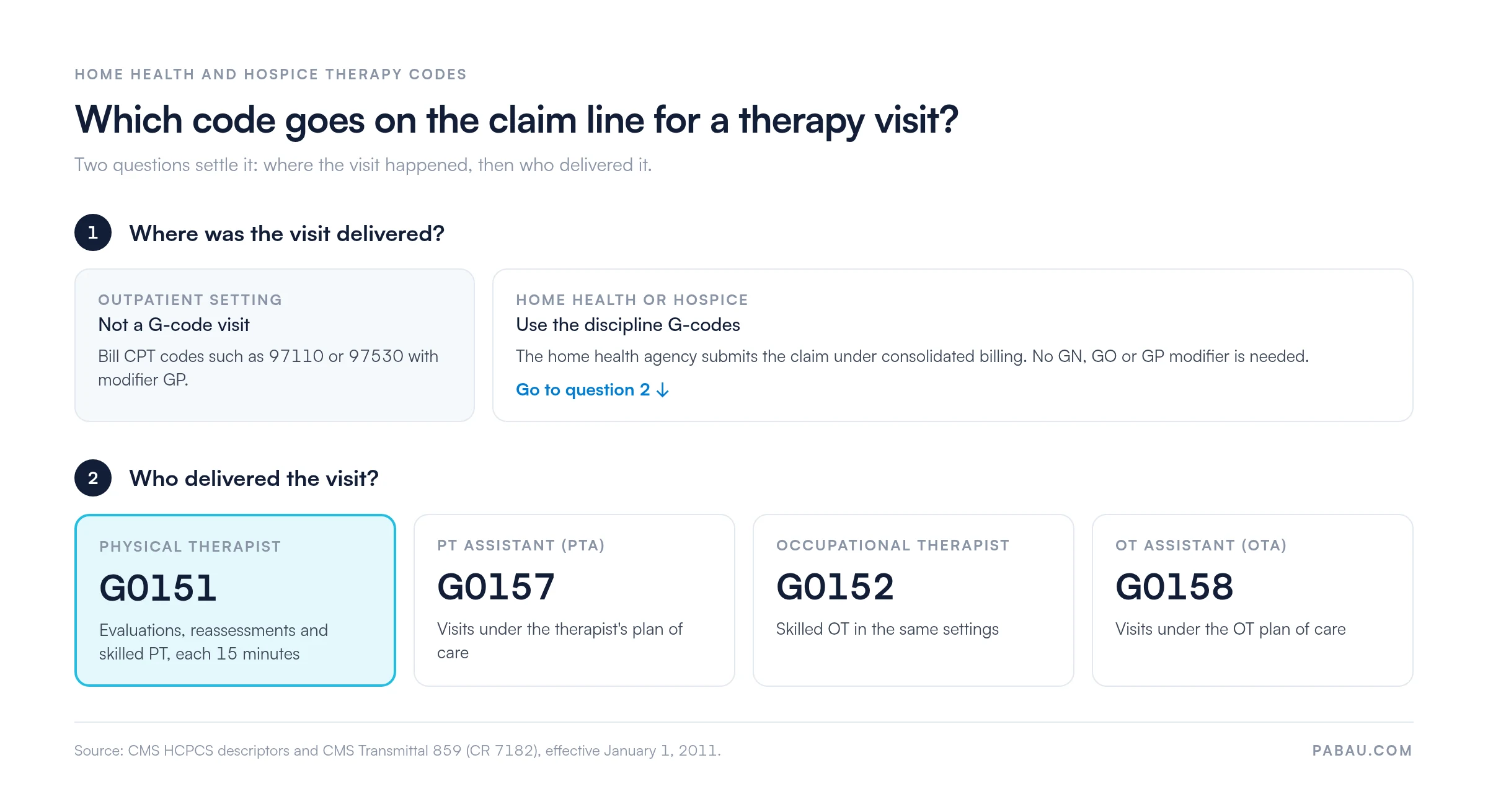
Reporting an assistant’s visit under G0151 misstates who delivered the care. It also skews the therapy data CMS collects on the claim, so it is a common target in home health record reviews. Map each scheduled visit to the clinician’s credential at the point of scheduling, not at claim build.
Medicare will only reimburse G0151 when five conditions are met before and during the episode. Missing any one of them is grounds for denial or recoupment on audit. Home health agencies using claims management software that validates these fields at claim-build time catch most errors before submission.
G0151 home health claims do not need modifier GP. The GN, GO and GP therapy modifiers apply to outpatient Part B therapy billed with CPT codes, not to home health G-codes under consolidated billing.
Every G0151 visit note must stand on its own as evidence that the service was skilled, medically necessary, and consistent with the plan of care. Auditors reviewing home health records look for these specific elements. A note missing even one of them can turn a paid claim into a recoupment demand.
Maintaining strong medical billing compliance practices at the documentation level is the most effective defense against post-payment audits.
Medical necessity for G0151 is established through the ICD-10-CM diagnosis codes on the claim. The table below lists common diagnosis codes that support home health PT services. The list is illustrative, not exhaustive. The codes must reflect the patient’s clinical condition and appear in the OASIS and the physician-signed plan of care.
Traditional Medicare follows the rules above. Medicare Advantage plans and state Medicaid programs may add requirements that go beyond standard Medicare, and assuming parity is a common source of unexpected denials.
Before starting a new home health PT episode, check whether the patient’s payer is traditional Medicare, a Medicare Advantage plan, or state Medicaid. Request a copy of the payer’s current home health provider policy and confirm prior authorization requirements before the first visit. One phone call to the payer at intake prevents the most common denial pattern seen with G0151 claims.
The same denial patterns appear repeatedly on G0151 audits. Understanding them by root cause, not just code, makes corrections stick. Reviewing denial management best practices before claim submission helps home health billing teams build defenses into the process rather than reacting after the fact.
Run a quarterly internal audit on a sample of G0151 visit notes. Score each note against four criteria: homebound status documented, skilled justification present, functional measurement included, and alignment with the active CMS-485 orders. Notes that fail two or more criteria represent your highest audit risk and should be addressed before CMS or a RAC contractor identifies them first.
Medicare provides a five-level appeals process for denied home health claims. Most successful G0151 appeals are won at the redetermination or reconsideration level by supplying documentation that was missing or inadequate in the original claim.
For G0151 denials tied to homebound status or skilled justification, the strongest appeal is a clinical narrative from the treating PT. It should explain, in plain language, why the patient’s condition required therapist-level skill at each documented visit. Auditors are not always clinicians. A clear functional explanation carries more weight with them than technical jargon.
G0151 is reimbursed within the Home Health Prospective Payment System (HH PPS) episode payment, not as a fee-for-service line item in the traditional sense.
The HHA receives a bundled per-episode payment that covers all home health services, including G0151 visits. The payment is adjusted by geographic area using the Home Health Wage Index published annually by CMS.
Some practices need to estimate per-visit costs or compare payment against contract rates. For them, the CMS Physician Fee Schedule lookup tool provides current national and locality-specific payment data. Use the PGM Billing HCPCS lookup for a free search of current CMS data by code and geographic area.
G0151 payment is embedded in the PDGM episode rate. Revenue cycle teams tracking per-discipline contribution should work with their finance department to see how PT visit volume affects the blended episode payment.
Home health agencies billing G0151 juggle OASIS submissions, CMS-485 tracking, visit note completeness and consolidated claim submission. Pabau’s claims management software checks those documentation fields before a claim reaches the clearinghouse. Each visit carries the clinician who delivered it, so a PTA visit is not sent out under the therapist code.
Some physical therapy practices work within or alongside home health agencies. For them, Pabau’s physical therapy EMR adds structured visit note templates, plan of care tracking and automated recalls. The templates can prompt the therapist for homebound status, functional measures and a skilled justification at every visit.
Billing teams that understand medical billing workflows from documentation through submission fix these problems before a claim leaves the building. With the checks built into the visit record, a G0151 claim goes out ready to defend on audit.

Pabau’s claims management tools help home health billing teams validate documentation and submit cleaner claims. See how it works with a quick demo.

Documentation quality decides whether a G0151 claim gets paid. Before you submit, confirm three items in the visit note: homebound status, a signed plan of care, and a skilled justification written in clinical detail.
Then check the code against the clinician. A PTA visit belongs on G0157, and a home health G0151 line carries no GP modifier. Building both checks into scheduling moves the work to the start of the process, where a fix takes minutes rather than an appeal.
To see how Pabau keeps visit documentation complete for home health and physical therapy teams, book a demo.

Billing Medicare for other services? Medicare billing guide explains how Medicare claims are built, submitted and paid.
Want to understand superbill requirements for therapy claims? Superbill documentation guide explains what a compliant superbill must include and how it connects to claim submission.
Want more claims paid on first submission? What a clean claim is covers the fields and checks that keep a claim from bouncing back.
HCPCS Code G0151 covers services performed by a qualified physical therapist in the home health or hospice setting, reported in 15-minute units. Visits delivered by a physical therapist assistant are reported under G0157 instead. G0151 does not apply to outpatient PT visits, which use CPT codes with modifier GP.
G0151 covers services by a qualified physical therapist in home health or hospice. G0152 covers services by a qualified occupational therapist in the same settings. Neither code covers assistants: PTA visits bill under G0157 and OTA visits under G0158. The codes are discipline-specific and cannot be substituted for each other.
G0151 is for home health or hospice visits delivered by a qualified physical therapist. G0157 is for visits delivered by a qualified physical therapist assistant. CMS Transmittal 859 (R859OTN) split the two from January 1, 2011. The code on the claim line must match the clinician who delivered the visit.
Every G0151 visit note needs a skilled justification statement, objective functional measures, and current homebound documentation. It must also align with the active CMS-485 orders and list supporting ICD-10 codes. A note that only describes exercises performed without explaining why PT skills were required fails skilled-care review.
G0151 is reimbursed within the bundled Home Health PPS episode payment under the PDGM model rather than as a standalone fee-schedule line item. The per-episode payment is adjusted geographically by the CMS Home Health Wage Index. Use the CMS Physician Fee Schedule lookup tool at cms.gov to find current locality-specific rates.
The most common reasons are homebound status not documented per visit and a missing or unsigned physician plan of care. Visit notes that read as maintenance, a PTA visit billed under G0151, and frequency beyond the CMS-485 orders also lead to denials. Consolidated billing violations, where an independent PT bills Part B during an active home health episode, also trigger denial.
No. G0151 applies only when a qualified physical therapist delivers the visit, and a PTA visit is reported under G0157. The patient must also meet homebound criteria, have an active signed plan of care, and need skilled therapy. Non-skilled maintenance visits and visits beyond the ordered frequency are not billable under G0151.
No GN, GO or GP therapy modifier is required on a G0151 home health claim. Those modifiers belong to outpatient Part B therapy billed with CPT codes. Check your Medicare Administrative Contractor for any payer-specific line-item rules.
Common supporting codes include M62.81 (muscle weakness), Z96.641/Z96.651 (hip or knee replacement status), and I69.351 (hemiplegia and hemiparesis after stroke, right dominant side). Others are G35 (multiple sclerosis), R26.81 (unsteadiness on feet), and S72.001D (femoral neck fracture, subsequent encounter). The codes must reflect the patient’s clinical condition and appear consistently across the OASIS, plan of care, and visit notes.