

HCPCS code E0198: Water pressure pad billing guide
HCPCS code E0198 is a water pad for a standard mattress HCPCS code E0198 is the ...

Last Updated: Oct 13, 2026
G0439 is the HCPCS Level II code for annual wellness visit, includes a personalized prevention plan of service (pps), subsequent visit.
It's also one of the most routinely denied preventive codes in family and internal medicine, usually the result of a missed PPPS update, a visit billed too early, or confusion between G0438 and G0439. Practices running GP software or wellness clinic software bill this code the most, since Medicare Annual Wellness Visits sit squarely in primary care.
Let Pabau's smart automation suggest the right codes, reduce claim denials, and keep your practice compliant—effortlessly.
Automate repetitive tasks and focus on what matters most—your patients.
Reduce coding errors and ensure compliance with the latest regulations.
Clean claims, fewer denials, and faster reimbursements.
Powerful insights and reporting to help your practice thrive.
HIPAA compliant SOC 2 certified GDPR-compliant Trusted by 4,000+ clinics worldwide

HCPCS code G0439 is the Medicare Part B code for a subsequent Annual Wellness Visit, billed after the initial visit (G0438) is already on file for the patient.
G0439 requires at least 12 full months from the date of service of G0438 before it can be billed; eligibility begins on the first day of the same calendar month the following year.
Medicare Part B covers G0439 at 100% with no patient cost-sharing when billed as a standalone preventive visit and fully documented per CMS requirements.
Practice management software like Pabau flags missing AWV documentation fields and tracks visit frequency to help reduce G0439 claim denials.
HCPCS code G0439 is defined by the CMS HCPCS overview as: Annual wellness visit, includes a personalized prevention plan of service (PPPS), subsequent visit. It is a Level II HCPCS code maintained by the Centers for Medicare & Medicaid Services (CMS) and billed under Medicare Part B for beneficiaries who have already completed an initial Annual Wellness Visit.
The Annual Wellness Visit is a preventive benefit introduced under the Affordable Care Act. It is not a physical examination. Its purpose is to review and update the patient’s Personalized Prevention Plan of Services (PPPS) — a documented, individualized plan addressing health risks, screening recommendations, and preventive care goals.
G0439 is the code that covers every subsequent visit in that series, billed once per calendar year after the first year.
The two codes are not interchangeable. Getting this wrong is the single most common denial reason for AWV claims.
The 12-month rule for G0439 has a specific CMS definition. The new visit must occur on or after the first day of the month that is 12 months after the month the G0438 service was provided.
Billing G0439 even one day before that date results in a denial. The visit cannot be billed on the anniversary date itself if the month has not yet reset.
Practices frequently bill G0439 for what was actually a routine physical examination. That is a coding error with real financial consequences. Here is how the two visits differ:
The AWV is a distinct service from a physical exam, not a scaled-down version of one. Practices that conflate the two often find their AWV claims converted to E&M visits during audit, creating patient billing disputes and compliance exposure.
Tracking preventive services is simpler in software for GP clinics that logs each visit against its billing code.
These three codes represent the complete Medicare preventive visit lifecycle. Understanding where each fits prevents miscoding across the AWV-family procedure codes used in primary care practices.
G0402 is a one-time benefit and is not the same as G0438, even though both involve a Medicare preventive visit. Practices serving new Medicare enrollees must bill G0402 for that first visit, then transition to G0438 at the appropriate interval.
Skipping G0402 and billing G0438 too early is a compliance risk across the AWV code family.
CMS requires specific elements to be documented for every G0439 claim. Missing even one component is sufficient grounds for denial on audit. The note must reflect all of the following, per current CMS AWV guidance:
Using digital intake forms that capture all required AWV fields before the provider enters the room removes a significant documentation risk. When fields are pre-populated from structured intake data, billing staff can verify completeness at the point of claim submission rather than chasing the chart after the fact.
Practices relying on generic SOAP templates routinely miss the PPPS update requirement, which is the most audited element of G0439 claims. For more on building compliant documentation workflows.
Medicare Part B reimburses G0439 under the Physician Fee Schedule (PFS). When billed as a standalone preventive visit with full documentation, there is no patient deductible and no coinsurance — Medicare covers 100% of the approved amount.
The national average non-facility reimbursement for G0439 is approximately $137.61 per visit under the 2026 PFS, though geographic adjustment factors (GAF) cause rates to vary by Medicare Administrative Contractor (MAC) region. High-cost areas such as New York City and San Francisco typically reimburse 15-25% above the national average, while rural or lower-cost geographies may fall below it.
To verify the exact reimbursement rate for your practice location, use the CMS Physician Fee Schedule lookup tool, selecting the current year and your MAC region. Rates are updated annually on January 1.
Billing based on prior-year rates without checking the current fee schedule is a common revenue shortfall in practices that don’t refresh their billing benchmarks at the start of each fiscal year.
Check your MAC region’s G0439 rate each January before your first AWV claim of the year. CMS adjusts the Physician Fee Schedule annually, and billing based on a prior year’s rate creates small but cumulative revenue shortfalls – especially across a high-volume Medicare panel.
Practices can bill an Evaluation and Management (E&M) service on the same day as G0439 – but only when a separately identifiable medical problem is addressed. The rules are specific and the documentation requirements are strict.
Modifier 25 signals to the payer that a significant, separately identifiable E&M service was performed on the same day as a preventive service. Without it, the E&M claim will be bundled and denied.
The E&M note must stand entirely on its own — it cannot reference the AWV documentation as its clinical basis. If the two services are documented in a single note, billing staff cannot separate them, and the E&M portion is typically lost.
Medicare requires a diagnosis code on every G0439 claim. The appropriate ICD-10 Z-codes for a preventive wellness visit are:
Z00.00 and Z00.01 are the standard first-listed diagnosis codes paired with G0439 claims, per current ICD-10-CM guidance and MAC LCD policies. When Z00.01 is used, the abnormal findings must be clearly documented in the visit note — the code selection must match the clinical content.
Additional secondary ICD-10 codes reflecting chronic conditions (hypertension, diabetes, COPD) may be listed after the primary Z-code, but the Z-code must be listed first for the preventive nature of the visit to be recognized. A cognitive assessment finding that needs further evaluation is typically coded separately under ICD-10 F09 rather than folded into the AWV’s Z-code.
Verify your MAC’s specific covered diagnosis requirements against its current Local Coverage Determination (LCD), as requirements can vary by region. For HCPCS code lookup and crosswalk support, AAPC’s HCPCS code reference provides a searchable index of covered diagnoses by code.
Most G0439 denials trace back to a small set of recurring errors. These are the patterns billing staff encounter most often:
Using automated billing workflows to flag claims with missing elements before submission, rather than relying on manual chart review, reduces the window for these errors significantly.
A pre-submission check that cross-references the visit date against the patient’s G0438 service date, verifies the primary diagnosis code, and confirms PPPS field completion catches the top six denial causes before they reach the payer.
For a broader look at HCPCS Level II codes, the HCPCS code search tool from PGM Billing lets teams verify code descriptions and payer assignment quickly.
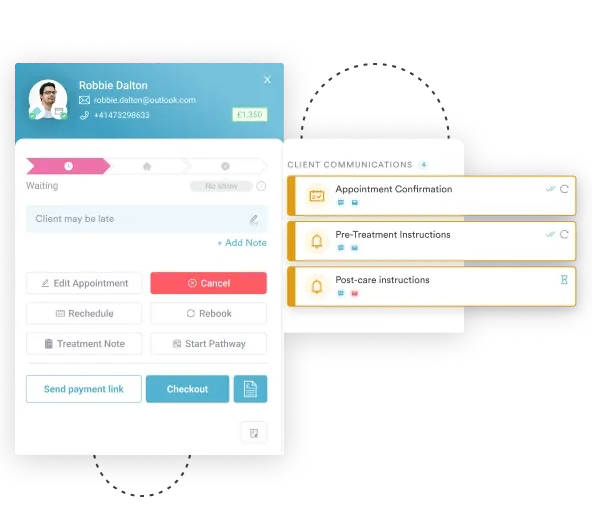

Pabau’s claims management tools help primary care and wellness practices track AWV visit frequency, flag incomplete documentation fields, and automate pre-submission checks – so G0439 claims go out clean.

Accurate G0439 billing requires coordination across scheduling, clinical documentation, and claims submission. Each step creates an opportunity for errors when managed manually. Practice management platforms that integrate all three reduce denial rates by closing the disconnects between them. Scheduling gaps and documentation errors both slow cash collection when they reach the claims stage.
Specifically, the areas where software has the greatest impact on G0439 accuracy are:
For practices managing a Medicare panel, the volume of annual wellness visits makes each of these touchpoints a high-frequency risk. A claims management software solution that handles AWV eligibility checks and documentation completeness as part of the standard workflow removes the manual dependency.
Structured intake, compliant documentation, and clean claim submission work as one workflow when they live in the same system . Practices moving from disconnected EHR and billing tools to an integrated practice management platform typically report fewer denial cycles and faster reimbursement turnaround on preventive codes.
Scheduling logic that ties visit type to billing code selection prevents the most common upstream error in AWV claims.
Build a G0439-specific claim scrubbing rule in your billing system: if the submitted date of service is less than 12 months from the last G0438 or G0439 on file, hold the claim for manual review. This single automated check eliminates the most common denial reason for subsequent AWV claims.
G0439 is a fully reimbursable Medicare benefit that many primary care practices fail to capture consistently. The code itself is straightforward. The denial rate is driven by incomplete documentation, timing errors, and missing modifiers, all preventable with the right systems in place.
Pabau tracks AWV visit intervals, enforces structured AWV documentation templates, and runs pre-submission edits that catch G0439 errors before they reach the payer. For practices ready to reduce preventive billing denials, book a demo to see how the workflow operates end to end.

Billing home visits alongside preventive care? CPT 99350 carries the same documentation burden, and the same audit exposure when notes don’t stand on their own.
Also billing a hearing test? Audiometry billing guide covers billing audiometry for hearing aid evaluation, noting Medicare will not pay it.
Also billing a breast reconstruction procedure? DIEP flap billing guide covers billing unilateral breast reconstruction with a DIEP or SIEA flap for Medicaid and commercial payers.
HCPCS code G0439 is the Medicare Part B billing code for a subsequent Annual Wellness Visit (AWV), defined by CMS as “annual wellness visit, includes a personalized prevention plan of service (PPPS), subsequent visit.” It is billed after a patient has already received an initial AWV (G0438) and at least 12 months have elapsed since that first visit.
G0438 is the initial Annual Wellness Visit code, used once per lifetime for a Medicare beneficiary who has never had an AWV. G0439 is the subsequent AWV code, used for every annual visit after that first one. G0439 cannot be billed if G0438 has not yet been used for that patient.
G0439 can be billed on or after the first day of the month that is 12 months after the month G0438 was provided. For example, if G0438 was billed on March 15, 2024, G0439 is eligible on April 1, 2025 – not March 15, 2025. Billing before this date results in denial.
Yes, with conditions. An E&M code can be billed on the same day as G0439 when a separately identifiable medical problem is addressed and clearly documented in a distinct note. Modifier 25 must be appended to the E&M code. Without Modifier 25, the E&M claim will be bundled and denied.
Z00.00 (encounter for general adult medical examination without abnormal findings) or Z00.01 (with abnormal findings) are the standard first-listed diagnosis codes for G0439 claims. Chronic condition codes (hypertension, diabetes) may be listed as secondary diagnoses but must not be listed first, as this can trigger a medical-visit reclassification and cost-sharing application.
The national average non-facility Medicare reimbursement for G0439 is approximately $137.61 per visit under the 2026 Physician Fee Schedule, with geographic adjustment factors causing variation by MAC region. No patient deductible or coinsurance applies when the visit is billed correctly as a standalone preventive service. Verify your region’s current rate using the CMS Physician Fee Schedule lookup tool.
G0439 itself does not require a modifier for standalone billing. Modifier 25 is required on the accompanying E&M code (not on G0439) when both are billed on the same date of service. No other modifiers are routinely required for G0439 in standard Medicare fee-for-service billing.



