Normal ECG values chart: Adult and pediatric reference ranges
A normal ECG values chart lists the expected range for every measurement on an e...

3
Last Updated: Oct 12, 2026

A medical practice business plan is your operating roadmap for funding, compliance, and growth, not just a document for the bank.
Build it from nine core sections, from the executive summary and market analysis to financial projections and an implementation timeline.
Validate demand and location before you sign a lease. Around 70% of patients rank access as their top factor when choosing a provider.
Pin down your payer mix and start credentialing early, since it can take 90–150 days before you can bill, then keep 6–12 months of runway beyond break-even.
Treat the plan as a living document: track your KPIs after launch and revisit it each quarter.
A medical practice business plan is the document that turns your clinical expertise into a business a lender will fund and a team can run. It sets out who you’ll treat, how you’ll deliver and price care, how you’ll staff and equip the practice, and the numbers that show it all works before you spend a dollar.
Write it well and it does three jobs at once. It wins funding. It forces the operational decisions you’d otherwise make on the fly. And it becomes the scorecard you run the practice against once the doors open.
This guide walks the whole build in ten steps, with a section-by-section template you can copy. First, what one actually is.
On paper it’s a document. In practice, a medical practice business plan is a set of decisions made on purpose, the ones that are cheap to change now and expensive to change once you’ve signed a lease.
Writing a business plan for a medical practice is what forces those decisions into the open, with numbers attached.
It also has three readers, and each one goes straight to a different part:
Get those three right and the plan keeps earning its keep long after launch day.
A business plan in healthcare has to account for things a generic template ignores. Your revenue depends on your payer mix and how quickly insurers reimburse you, not just the price you set.
Credentialing with payers can take 90–150 days before you can bill a single claim. And compliance (HIPAA, OSHA, and state licensing) shapes your costs from day one.
That’s why business plans in healthcare read differently from a retail or software plan. The sections are the same, but the weight sits on regulation, reimbursement, and clinical staffing.
Every strong plan is built from the same core sections. Use the outline below as a working medical practice business plan template, the nine parts lenders expect to see and what to put in each.
Whether you’re drafting a plan for a solo private practice, a multi-provider medical clinic, an urgent care center, or a multi-location group, the sections stay the same. Only your numbers change.
US Bureau of Labor Statistics data shows that 20–30% of new businesses fail within their first year, and medical practices aren’t exempt.
A clinic business plan is your best defense against stalling in those early months. It puts the risks on the table while you can still do something about them.
Poor planning, undercapitalization, and insufficient market research are the most common reasons practices stall. A solid business plan helps reduce those risks by forcing you to confront cash requirements, regulatory obligations, and operational realities before you open your doors.
And those aren’t the only reasons you need one. You also need it for:
A well-crafted business plan surfaces potential problems before they escalate. Analyzing your market, competition, and finances upfront is how you catch weaknesses while they’re still cheap to fix.
Your plan also keeps you on the right side of the law. It prompts you to think through key legal and regulatory requirements, like HIPAA, OSHA, and state licensing, from day one. This builds a culture of compliance that protects the practice and reduces regulatory exposure.
Clearly defining your standard operating procedures and staffing models keeps your team aligned and your operations smooth. That consistency reduces confusion, improves efficiency, and keeps care standards high.
Think of your business plan as a framework that grows with you. If your practice succeeds and you decide to expand into multiple locations, you’ll already have a strong foundation.
Source: Pabau
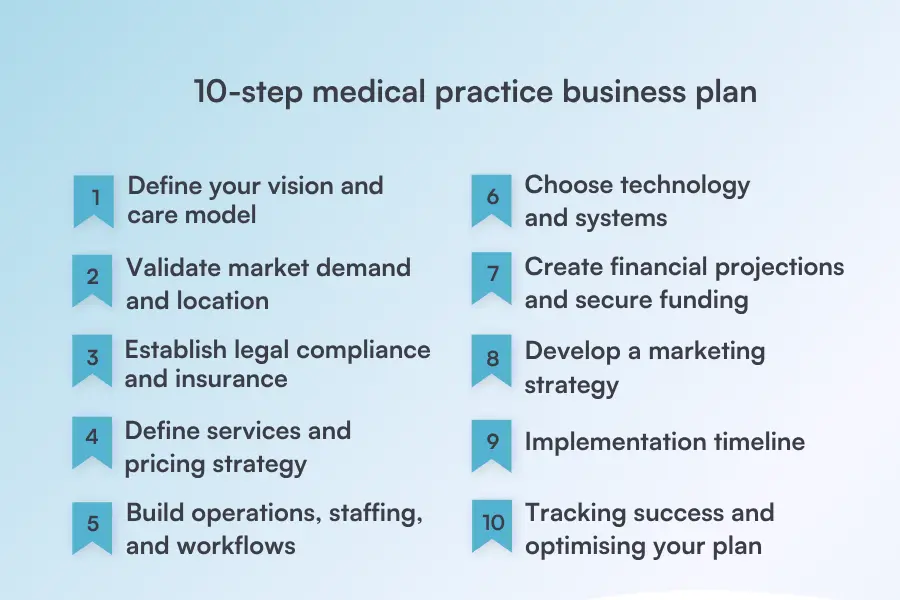
So whether you’re launching a solo micro-practice or running a multi-location clinic, the same ten steps take you from idea to open doors. Here’s how each one works.
Defining the why and how of your practice is the foundation of your entire business plan. Everything else is built on it, so it’s worth doing first, not last.
Here’s how to do it:
A clear, well-defined vision keeps your practice focused, aligned, and true to its purpose, no matter how much it grows.
The goal here is to confirm there are enough patients in your target area who need your services and can pay for them, before you commit to a location.
If you’re writing a business plan for private practice, this is the section lenders scrutinize hardest. They want proof of demand, not optimism.
Here’s how to approach it:

Illustration: Pabau / Source: Accenture
Location plays a big role in whether patients choose your practice. In fact, a research report from Accenture found that around 70% of patients rank access as their top factor when choosing a healthcare provider.
Access covers convenient location and hours, fast appointment availability, and digital options, so an easy-to-reach site by car or public transport is one essential part of that picture, not the whole story.
Setting up a medical practice is as much about strong administration as it is about clinical expertise. Getting these foundations right early means regulatory issues don’t derail clinical operations later.
By establishing these foundations early, you’re protecting the safety of your patients, your team, and the future of your practice.
This step of your business plan is critical and should never be taken lightly. If you’re unsure how to navigate it, hiring a professional can help ensure your practice is built on a solid, secure foundation.
Once you’ve clarified your vision and validated your market, the next step is to define exactly what services your practice will provide and how they will generate sustainable revenue.
So, start by building your service list around three things:
This will help you decide whether your focus will be on chronic disease management, specialist consultations, wellness and preventive care, or something more niche.
Next, decide how you’ll price and bill your services. Will you operate on:
Accurate coding is essential to getting paid correctly and staying compliant. In the US, procedures are billed with CPT codes and diagnoses with ICD-10-CM codes. Getting this right early prevents billing problems down the line.
A smart pricing strategy accounts for demand, seasonality, staff expertise, and local competition.
Finally, take time to plan your appointment structure. Set clear appointment types and durations. For example, follow-ups will be 20 minutes, and 40 minutes for new patient consultations. This might seem like a small detail, but it has a big impact on patient flow, clinician workload, and your financial performance.
When you define your services and pricing clearly from the start, you’re setting up your practice to deliver care efficiently without compromising quality, staff well-being, or profitability.
This step maps the day-to-day reality of your medical practice operations, so everyone knows their role and every process is consistent.
So here’s how to get started:
When operations are well-organized, you free up clinical time and cut the admin load on your team.
By the time you reach this section, technology is the operating layer the rest of the plan runs on, not an afterthought.
Patients now expect to book online at 9 p.m., not phone during office hours. A clunky system loses them before the first visit, and it quietly taxes your team every day it’s in use. So when you choose a platform for your medical practice, write down what it actually has to do:
Juggling a separate tool for each of these is where new practices lose hours, so an all-in-one practice management system like Pabau usually beats stitching point solutions together: one record, one schedule, one bill, so nothing slips between systems. Whatever you pick, budget for setup and training in the plan, not just the monthly license.

Source: Pabau
Write your chosen stack into the plan. It signals to a lender that you’ve thought past opening day, and it keeps your team’s day running from booking to follow-up.
Before you open your doors, you need a clear forecast of how much it will cost to get started, how long your funds will last, and when your practice will start turning a profit.
The financial section is the heart of any business plan for medical practice, and it’s what a lender turns to first after the executive summary. This means you should:
Finally, when all of this is calculated, you need to explore your funding options. You can consider a bank loan, equipment financing, investor backing, or your own capital. Finally, model your cash flow so the practice stays solvent as it ramps up.
The marketing section of your plan should show exactly how you’ll reach patients with proven marketing strategies for practices, not just promise that you’ll “do marketing”. With a solid plan, you can bring your practice closer to your future patients:
Here’s, for example, how one primary care practice promoted its services for men’s health week:
A post shared by Albert Road General Practice (@albertroadgp)
By showing up consistently, educating patients, and building genuine relationships, you’ll attract patients who will help you get your business off the ground and start on the right foot.
A launch runs on a clear timeline that tells you what to do, and what to expect, at each stage. Map it in three phases:
With the phases mapped, you always know the next move, and so does anyone reading the plan.
Launching your practice is just the beginning. To ensure long-term success, you need to track how well it’s performing and make adjustments along the way. Start by defining key performance indicators (KPIs) across three areas:
Reviewing these KPIs regularly lets you catch underperformance early and adjust before it affects revenue or the patient experience.
Practice management software with built-in reporting gives you an accurate, up-to-date picture of performance across revenue, appointments, and patient retention.
Your business plan is step one of a longer launch list. Opening the doors also means forming the entity, licensing, credentialing with payers, fitting out the space, hiring, and setting up your systems. Start licensing and payer enrollment first. They take the longest, and until a payer clears you, you cannot bill it for a visit.
Opening in Ontario instead? Billing there waits on a CPSO certificate of registration, an OHIP billing number and CMPA coverage. Our guide to opening a medical clinic in Ontario sequences each one against a target opening day.
A two-page checklist in seven sections: licensing and credentialing, entity and funding, lease and safety, systems and HIPAA, staffing, marketing, and the first 90 days. Every section names the lead time to start it, so the long-lead tasks get moving first.
Download templateThe ten steps above apply to any practice, but how much weight each one carries shifts with the type of practice you’re opening. A private practice, a multi-provider clinic, and a walk-in urgent care earn revenue in very different ways, so their financials, staffing, and marketing read differently even when the structure is identical.
Two common variations follow the same logic: a business plan for a concierge medical practice leans on membership-retention math, and a business plan for an expanding medical practice adding its next location leans on multi-site overhead. The three models below show what changes by setting.
A business plan for private practice usually rests on one physician’s productivity and a narrow payer mix. Two numbers decide whether it works: your patient panel size and your collections per visit.
Model a realistic ramp, since most solo practices book well below capacity while credentialing clears and referrals build. Spell out whether you’ll bill insurance, run cash-pay, or blend both, because that choice drives your pricing and how much working capital you need before break-even.
A business plan for a medical clinic with more than one provider shifts the focus from a single schedule to room and staff utilization. Your financials model revenue per provider and per treatment room, not just per visit.
Build it around shared overhead: front desk, medical assistants, and one GP clinic software stack serving the whole team. Done well, adding the next provider becomes a marginal cost rather than a second startup.
An urgent care business plan lives or dies on walk-in volume and visibility, so location and hours are the heaviest lines in the plan. Model visits per day against a fixed cost base that runs whether ten patients or eighty come through the door.
Plan for extended evenings and weekends from day one. Because most visits are unscheduled, lead your marketing with local search and signage rather than referrals, and keep your operations plan built for fast triage and same-day documentation, with clear protocols for common walk-in presentations like the scaphoid fracture test for wrist injuries.
Most plans don’t fail on the writing. They fail on a handful of predictable blind spots, the ones a lender spots in the first read, or the ones that surface in month four when the money’s tight. Here are the traps that trip up a medical practice business plan, and what to do instead:
Before you send the plan to a lender or commit to a lease, run it past this quick gut-check:
A medical practice business plan isn’t paperwork you file and forget. It’s the difference between opening with a clear line of sight and hoping it works out. Work through the ten steps, pressure-test the numbers, and you’ll walk into launch knowing exactly where the practice stands.
When it’s time to execute the plan, the right software keeps the moving parts in one place (records, scheduling, billing, and patient communication), so your time goes to patients, not admin. If you’d like to see how Pabau handles that day to day, book a live demo with our team.

Not sure what it costs to open your doors? Our cost and loan template lays out the startup and working-capital numbers lenders expect to see.
Ready to choose your systems? Practice management software explains what an all-in-one platform replaces, so your technology section isn’t guesswork.
Planning how you’ll fill the calendar? Marketing for clinics covers the channels that actually bring new patients through the door.
Yes. The nine-section outline above works as one. Copy it and fill in your own numbers. You can also adapt a general healthcare business plan sample, but make sure it reflects US payer mix, credentialing, and compliance rather than a generic startup format.
A strong one usually runs 20–30 pages and moves from an executive summary to market analysis, services, operations, and financial projections. The lender and academic samples online follow that same skeleton, and the outline in this guide mirrors it for a single practice.
The structure is the same, but a hospital business plan carries far more weight on capital expenditure, departmental staffing, and regulatory approvals. A single practice plan stays lighter, with one care model, a smaller team, and a faster path to break-even.
Start with the plan. A medical practice business plan forces the decisions that make or break a launch: your care model, market and location, credentialing and compliance, technology stack, and a funded runway to break-even. Work through the ten steps above in order, then pressure-test the numbers before you sign a lease or take on debt.