HCPCS code G0143: Thin-layer Pap screening with rescreening
HCPCS code G0143 means two manual reads of one liquid-based slide HCPCS code G01...

Last Updated: Oct 19, 2026
G0160 is the HCPCS Level II code for an occupational therapy maintenance program in home health. A qualified occupational therapist establishes or delivers the program, and each unit is 15 minutes.
A home health agency reports G0160 on its home health claim under revenue code 043x. Payment comes through the 30-day home health payment, not a per-code fee. When an occupational therapist assistant delivers the program, the visit is reported under G2169 instead.
Let Pabau's smart automation suggest the right codes, reduce claim denials, and keep your practice compliant—effortlessly.
Automate repetitive tasks and focus on what matters most—your patients.
Reduce coding errors and ensure compliance with the latest regulations.
Clean claims, fewer denials, and faster reimbursements.
Powerful insights and reporting to help your practice thrive.
HIPAA compliant SOC 2 certified GDPR-compliant Trusted by 4,000+ clinics worldwide

HCPCS code G0160 reports a qualified occupational therapist establishing or delivering an occupational therapy maintenance program in the home health setting.
Report one unit per 15 minutes of total visit time, on revenue code 043x of the home health agency’s claim.
An occupational therapist assistant delivering the program bills G2169, and restorative OT visits bill G0152.
Payment comes through the 30-day home health payment under PDGM, not the Medicare Physician Fee Schedule.
GN, GO and GP therapy modifiers are not required on home health claims.
HCPCS code G0160 reports skilled occupational therapy time spent on a maintenance program in a patient’s home. A qualified occupational therapist either designs the program or delivers it, because the patient’s condition calls for a therapist’s skills. Each unit equals 15 minutes.
The official CMS descriptor has three parts:
G0160 is a temporary G-series code among the HCPCS Level II codes that CMS maintains. CMS added it on January 1, 2011, and it remains active in the October 2026 file.
A maintenance program aims to keep a patient’s current function or slow its decline. Therapy that restores lost function is billed under G0152 instead, the code for restorative home health occupational therapy.
Source: the CMS HCPCS quarterly update file (October 2026 release) and the Medicare Claims Processing Manual, Chapter 10. Confirm the code’s status against each new quarterly release before you rely on it.
Only a qualified occupational therapist’s time belongs on G0160. Federal rules say the maintenance program must be established by a qualified therapist, not an assistant.
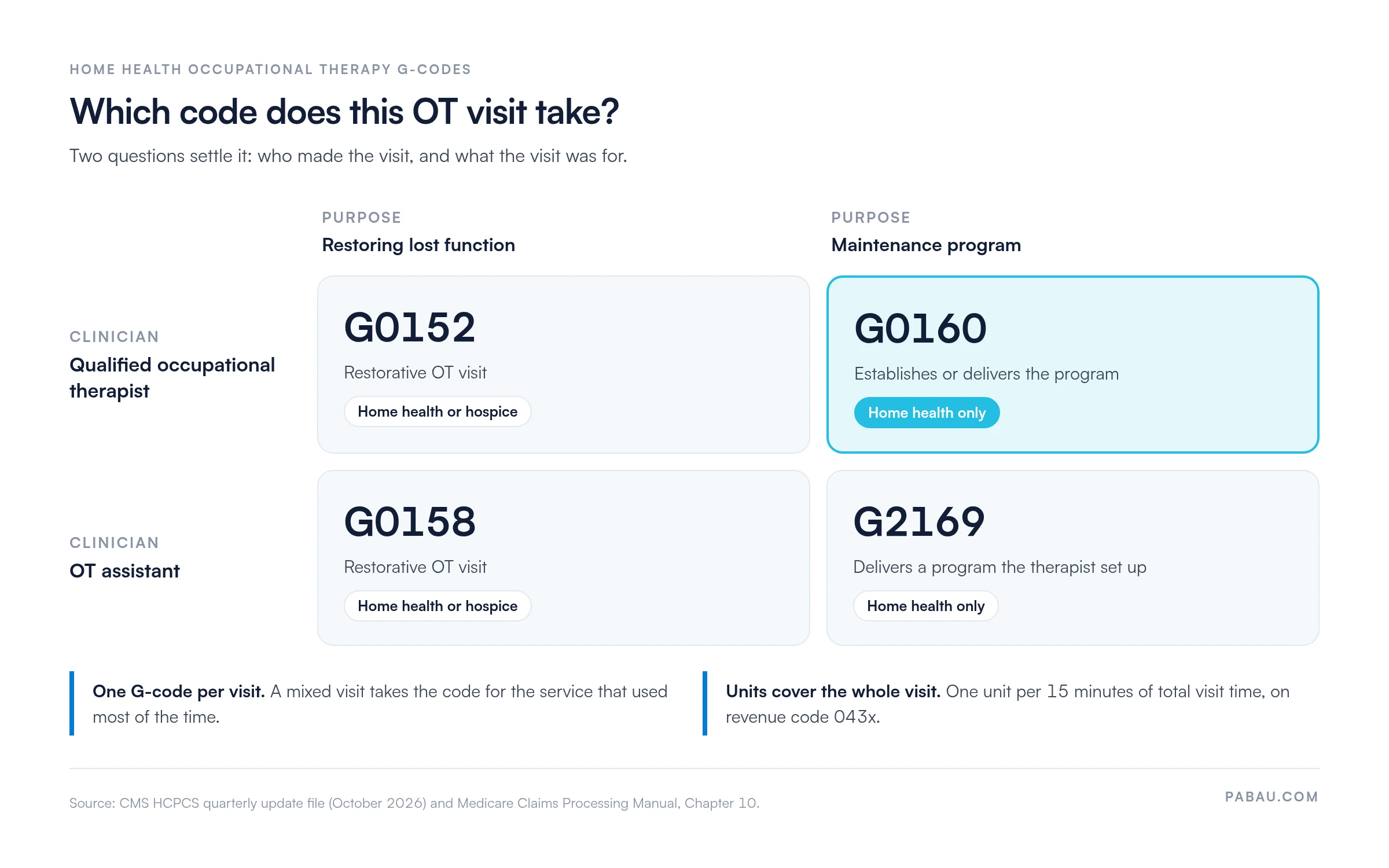
Since January 1, 2020, an occupational therapist assistant may deliver a maintenance program that the therapist has set up. That visit is reported under G2169, not G0160. Medicare systems accepted G2169 from October 5, 2020, for dates of service from January 1, 2020. G0158 reports assistant visits for restorative occupational therapy.
Side by side, the four home health occupational therapy codes split on two questions: who made the visit, and what it was for.
The note itself must name the person who made the visit and their credential. A wrong match between clinician and code is a frequent reason for review.
Use G0160 when the visit’s purpose is maintenance, and G0152 when it is restoring function. The plan of care should state which goal applies to each part of the episode.
A single visit can mix both. A therapist might treat toward a restorative goal and then set up a home program. CMS allows only one G-code per visit, so the agency reports the code for the service that took most of the time.
The units still reflect the whole visit. A 50-minute visit spent mostly on program design is reported as G0160 with three units, even if some minutes were restorative.
G0160 is one of three maintenance codes, one per therapy discipline. G0159 is the physical therapy version, and G0161 covers speech-language pathology. Each discipline also has a restorative code and an assistant code.
Skilled nursing visits sit in a separate family under revenue code 055x. For example, G0299 covers RN visits and G0162 covers RN management of the plan of care. Those codes never substitute for an occupational therapy line.
Medicare covers G0160 under the home health benefit when the patient meets the usual home health conditions. The patient must be homebound and under a plan of care. That plan is set up and periodically reviewed by a physician or allowed practitioner.
Occupational therapy has one extra limit. It cannot open a Medicare home health episode by itself. The patient first needs skilled nursing, physical therapy or speech-language pathology. Once eligibility is established, continuing occupational therapy keeps it in place.
Coverage does not depend on the patient improving. Under 42 CFR 409.44, maintenance therapy is covered when the program needs a qualified therapist’s skills to be safe and effective. The 2013 Jimmo v. Sebelius settlement confirmed that Medicare has no improvement standard.
G0160 appears only as a line on the agency’s home health claim. Each occupational therapy visit goes on its own line under revenue code 043x.
Time spent completing an Outcome and Assessment Information Set (OASIS) assessment during a billable visit may count toward the units. So may time spent updating the record in the home during that visit.
G0160 does not need a therapy modifier on a home health claim. The Medicare Claims Processing Manual, Chapter 10 states that GN, GO and GP modifiers are not required on home health prospective payment system (PPS) claims.
CMS documents no other modifier for G0160 on these claims. Telehealth is reported differently from physician billing. When an agency uses audio-video or audio-only contact, it adds a separate line with G0320 or G0321, one unit each.
Commercial and Medicaid plans may set their own rules. Check the payer’s billing manual before adding any modifier to a G0160 line.
Medicare does not pay G0160 per unit. The agency receives a case-mix adjusted payment for each 30-day period of care under the Patient-Driven Groupings Model (PDGM). That payment is keyed to the Health Insurance Prospective Payment System (HIPPS) code on the claim’s 0023 revenue line.
The G0160 lines still affect the payment in three ways.
The Medicare Physician Fee Schedule does not apply, and neither do geographic practice cost index (GPCI) adjustments. In the HCPCS file, G0160 carries pricing indicator 00, so the code has no separate Part B price. Home health rates are adjusted by the home health wage index instead.
Each G0160 visit note should show why the maintenance program needed a qualified therapist. Good medical billing compliance starts with a note that answers that question without a phone call.
Reviewers judge a maintenance note on one question: did the program need a therapist’s skills? A plateau in function is acceptable, as long as the note explains that skilled need.
The G0160 descriptor names the home health setting only. Hospice occupational therapy is reported with G0152, whose descriptor covers home health or hospice.
The same split applies to G0159 and G0161. No modifier makes a maintenance code payable on a hospice claim, so the line has to be recoded to the discipline’s restorative code.
Most G0160 problems trace back to the clinician, the setting or the note. Effective denial management starts by checking these before the claim goes out.
A clean claim on the home health side means matching visit lines to notes. Reviewers compare both.
Most G0160 denials start in the visit note, long before a claim is built. Therapists who keep notes on paper or in a separate tool make it hard to check the clinician, the time and the skilled need.
Pabau, the practice management and EHR platform we build, keeps forms, treatment notes and the appointment in one patient record. Templates can prompt the therapist for start and end times, the maintenance goal and the skilled reason. Reminders help the team book the 30-day reassessment on time.
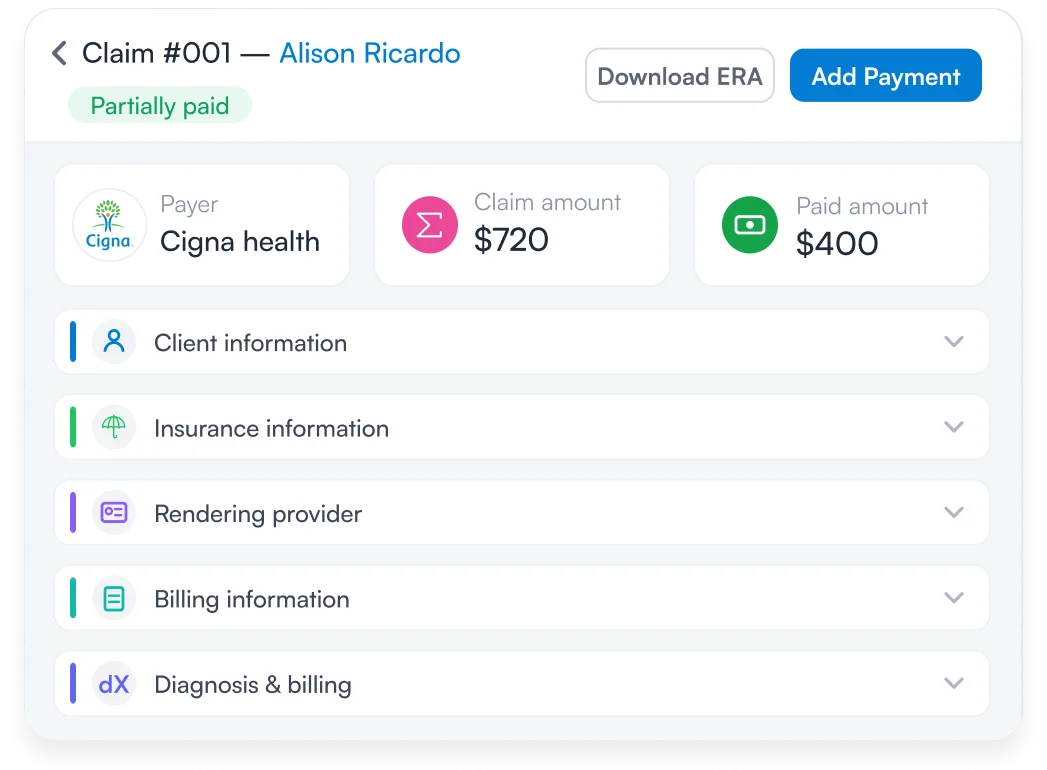
For practices that bill insurers through Pabau, claims management submits claims built from the details already entered and tracks their status. Your billing team works from the same record the therapist wrote, so a mismatch shows up before submission.

Pabau keeps therapy notes, plans of care and claim records in one place. Your team can check each visit before billing.

Medicare pays G0160 for skilled maintenance whether or not the patient improves. If the note shows that the program needed a qualified occupational therapist, a plateau does not end coverage.
Before you submit, match the code to the clinician and the purpose. Use G2169 when an assistant delivers the program, and G0152 for restorative work or any hospice visit. Then confirm that the units match the documented time and that the 30-day reassessment happened.
To see how Pabau keeps therapy notes and claim records together for your team, book a demo.

Billing a restorative OT visit instead? HCPCS code G0152 covers restorative occupational therapy in home health and hospice, with its own unit and documentation rules.
Coordinating nursing visits in the same episode? HCPCS code G0162 explains how to bill RN management and evaluation of the plan of care.
Need a framework for reducing claim denials across your billing team? Denial management in healthcare covers root-cause analysis methods and appeal workflows for common payer rejections.
Want to understand how HCPCS fits into broader billing compliance? Medical billing compliance outlines the regulatory framework that governs G-code and CPT billing in US practices.
Looking to benchmark your revenue cycle against industry standards? Revenue cycle management explains the end-to-end process from patient encounter to final payment posting.
HCPCS code G0160 reports a qualified occupational therapist establishing or delivering an occupational therapy maintenance program in the home health setting. Each unit equals 15 minutes of visit time.
No. G0160 is for a qualified occupational therapist only. An assistant who delivers a maintenance program set up by the therapist is reported under G2169.
G0160 reports maintenance therapy, which keeps function or slows decline. G0152 reports restorative occupational therapy and also covers hospice. A visit gets one code, chosen by the service that took most of the time.
G0160 is paid within the 30-day home health payment under PDGM, not per unit from the Physician Fee Schedule. Its units matter for low-utilization and outlier calculations.
No. CMS states that GN, GO and GP modifiers are not required on home health PPS claims. Check commercial and Medicaid payer manuals for their own rules.
No. Medicare covers maintenance therapy when the program needs a qualified therapist’s skills to be safe and effective. The note must explain that skilled need.