CCSD Code B2710: Radical mastectomy including block dissection
CCSD Code B2710: Definition and clinical scope CCSD Code B2710 is the UK private...

Last Updated: Nov 13, 2026
G0158 is the HCPCS code for services performed by a qualified occupational therapist assistant in the home health or hospice setting, each 15 minutes. Home health agencies report it on the institutional claim to record OTA visits.
Choosing between G0158 and G0152 depends on who delivered the service. Bill G0158 when the OTA performs the hands-on session, and G0152 when the occupational therapist does. Billing the wrong one can cause denials or audit findings.
Let Pabau's smart automation suggest the right codes, reduce claim denials, and keep your practice compliant—effortlessly.
Automate repetitive tasks and focus on what matters most—your patients.
Reduce coding errors and ensure compliance with the latest regulations.
Clean claims, fewer denials, and faster reimbursements.
Powerful insights and reporting to help your practice thrive.
HIPAA compliant SOC 2 certified GDPR-compliant Trusted by 4,000+ clinics worldwide

HCPCS Code G0158 reports occupational therapist assistant (OTA) visits in the home health or hospice setting, billed in 15-minute units.
Bill G0152 instead when the occupational therapist personally delivers the hands-on care.
Home health agencies report G0158 on type of bill 032X with revenue code 043X, a claim that carries no place-of-service code.
Under PDGM, Medicare pays G0158 visits within the 30-day period payment, while low-utilization (LUPA) periods are paid per visit.
Visit notes need the OTA’s name and credential, time in and out, and the skilled service delivered.
HCPCS Code G0158 is a Level II G-series code that CMS maintains for reporting occupational therapist assistant (OTA) visits in home health and hospice. The official descriptor reads “Services performed by a qualified occupational therapist assistant in the home health or hospice setting, each 15 minutes.” CGS Medicare’s home health billing codes list G0158 under revenue code 043X for occupational therapy.
G0152 covers the same service when the occupational therapist delivers it. The code you report depends on which clinician performed the hands-on care.
G0158 covers skilled occupational therapy that an OTA delivers to the patient at home, under the supervision of an occupational therapist. The services must need the training and judgment of a qualified OTA. They must also be documented as medically necessary.
Covered activities include upper-extremity therapeutic exercise, activities of daily living (ADL) training, and adaptive equipment instruction. Cognitive and perceptual skill training and energy conservation techniques count too.
Recording the treating clinician’s credential on every visit note is the simplest guard against a G0158 coding error. Without it, a biller has to guess whether the OTA or the OT made the visit.
G0158 uses time-based billing in 15-minute increments. Each unit billed equals 15 minutes of direct patient contact. Under the 8-minute rule, a segment of 8 minutes or more rounds up to one billable unit. Fewer than 8 minutes does not reach a billable unit. These rules come from CMS Claims Processing Manual guidance on timed therapy codes.
Claim format: Home health agencies report G0158 on the institutional claim (UB-04 or 837I), type of bill 032X, with revenue code 043X. Each line carries the visit date and the number of 15-minute units. Institutional claims have no place-of-service field, so POS 12 does not apply. POS codes belong only on professional claims (CMS-1500 or 837P).
Modifiers: Therapy modifiers (GN, GO, GP) are generally not required on home health PPS claims, type of bill 032X. The GO modifier belongs on outpatient occupational therapy claims, such as an HHA’s type of bill 034X. Check your MAC’s guidance if your agency bills both claim types.
Two facts decide each claim line: who delivered the care, and which claim carries the visit.
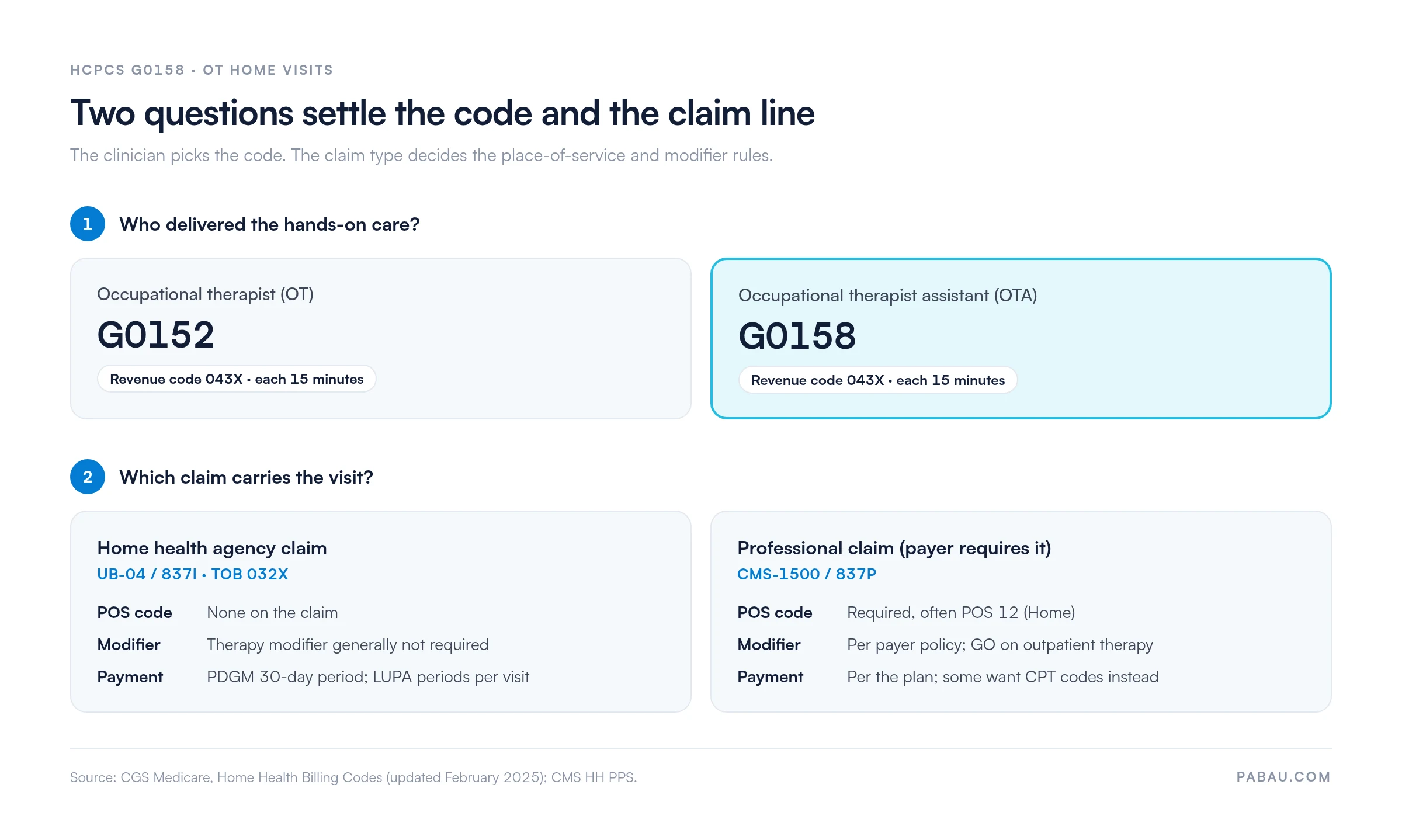
G0158 and G0152 describe the same occupational therapy service in the same setting. One variable separates them: who performed the hands-on service. G0152 applies when the occupational therapist personally delivers the treatment.
G0158 applies when the OTA delivers it under OT supervision. Billing the wrong code misstates the credential behind the visit, which can lead to denials or audit findings.
G0158 belongs to a series of home health and hospice G codes. Each code maps to the discipline and credential of the clinician who made the visit. The physical therapy pair works the same way, with G0157 for assistant visits and G0151 for the physical therapist.
Maintenance programs have their own codes, such as G0160 for an OT maintenance program. AAPC’s HCPCS code range lookup shows the current descriptor for each code in the series.
Medicare does not pay G0158 per unit. For a certified home health agency, the visit is bundled into the Patient-Driven Groupings Model (PDGM) payment for each 30-day period.
CMS sets that payment from the patient’s clinical grouping, functional impairment level, comorbidities, and admission source. The number of G0158 units on the claim does not change it. G0158 appears on the UB-04 to document the visit within the period.
Low-utilization payment adjustment (LUPA) periods are the exception. When a 30-day period has fewer visits than its LUPA threshold, Medicare pays a national per-visit rate for each discipline instead.
Check the CMS home health PPS rate update for the current year before you model G0158 revenue. It sets the 30-day period rates and the LUPA per-visit rates, and both change each calendar year.
CMS and Medicare Administrative Contractors (MACs) require a complete, contemporaneous record that supports both medical necessity and homebound status. A missing element from the list below gives an auditor grounds to deny or recoup payment.
A visit note template that requires time in, time out, and a skilled-service narrative gives coders a complete record. It also saves chasing corrections after the visit.
An ICD-10-CM diagnosis code alone does not establish homebound status or medical necessity for G0158. Every home health claim still needs a clinically appropriate diagnosis. It should reflect the condition driving the OTA’s skilled intervention, not the patient’s most prominent comorbidity. The table below lists common diagnoses for OTA home health services.
Your MAC’s Local Coverage Determination (LCD) for home health occupational therapy specifies which diagnoses it accepts as supporting medical necessity for OTA services. Always check the applicable LCD before billing, since accepted diagnoses vary by MAC jurisdiction.
Common G0158 denials trace back to documentation deficiencies, provider-type errors, or claim-format mistakes. Read the denial reason code on each remittance first, then check it against the patterns below. Sound denial management in healthcare catches these early, and our denial codes and fixes guide maps each CARC to its correction.
Run a quarterly audit of G0158 claims against your OTA visit logs. Compare the treating provider on each visit note with the HCPCS code billed. A G0158 claim whose note shows the OT as the treating provider is a coding error to correct. Catching it internally beats finding it in a MAC pre-payment review.
Medicare sets the framework for G0158, but many HHAs also serve commercial and state Medicaid patients. Those payers do not automatically follow Medicare G code conventions.
Commercial insurers vary widely in their acceptance of HCPCS G codes. Some recognize G0158 for home health OTA services with a network-specific authorization. Others reject G codes and want the service billed with CPT codes, often from the therapeutic exercise and ADL training families.
The plan’s coverage policy decides the code set, not Medicare’s conventions. Pull the payer’s current fee schedule and billing manual before submitting.
The CMS HCPCS overview clarifies which G codes are Medicare-specific and which other payers may use. When in doubt, contact the payer directly before submitting a G code on a non-Medicare claim.
Coding G0158 correctly starts with a visit note that names the clinician, the time in and out, and the skilled service. When those details sit in paper notes or a separate app, a biller has to chase them before the claim goes out.
Pabau, the practice management platform we build, keeps treatment notes on the patient record with a time stamp attached. Prior authorizations sit on the patient’s case with the auth code, dates and approved sessions, and Pabau warns when one is missing.
Some therapy practices send professional claims to commercial and Medicaid plans. For those, Pabau’s end-to-end claims management submits CMS-1500 claims and tracks each one through to the remittance. Your billers spend less time hunting for visit details and more time on the claims that need attention.

Pabau keeps time-stamped visit notes, prior authorizations and claim status on one patient record. Your billers get complete visit details before a claim goes out.

Code selection for G0158 rests on one fact in the visit note: who delivered the hands-on care. Get that right, then report the visit on type of bill 032X with revenue code 043X and accurate 15-minute units.
Medicare pays through the PDGM period rather than per unit, so the exposure sits in documentation and medical review. Audit OTA notes against billed codes each quarter, and confirm commercial and Medicaid rules before sending a G code to those plans.
Book a demo to see how Pabau keeps time-stamped visit notes and prior authorizations on one patient record.

Need a denial management framework? Denial management in healthcare covers the end-to-end process for tracking, appealing, and preventing claim rejections across code types.
Billing a visit the OT delivered? G0152 covers the same home health OT service when the occupational therapist performs it.
Looking for a complete billing workflow guide? Medical billing fundamentals explains the full revenue cycle from claim creation to remittance posting.
HCPCS Code G0158 is a CMS-maintained Level II G-series code for occupational therapist assistant (OTA) services in the home health or hospice setting. It is billed per 15 minutes of direct patient contact. It applies when the OTA, not the supervising occupational therapist, performs the hands-on service.
G0158 is billed when the occupational therapist assistant (OTA) performs the home health visit. G0152 is billed when the occupational therapist personally performs it. Both use 15-minute units and revenue code 043X, so the treating clinician’s credential decides the code.
No universal per-visit unit cap applies to G0158. Billable units follow direct patient contact time in 15-minute increments, with the 8-minute rule for partial units. Some MACs and commercial payers set visit-level or period-level limits, so check the payer’s policy before billing several units.
None on a home health agency claim. HHAs report G0158 on the institutional claim (UB-04 or 837I) with type of bill 032X and revenue code 043X, which has no place-of-service field. A POS code applies only when a payer wants the service on a professional claim (CMS-1500).
Common ICD-10-CM diagnoses paired with G0158 include stroke sequelae (I69.x) and Parkinson’s disease (G20.A1 through G20.C). Rheumatoid arthritis (M05-M06), post-surgical orthopedic conditions (M96.x), and dementia (F03.x) are also common. Your MAC’s Local Coverage Determination sets which diagnoses it accepts, and it takes precedence.
Same-day billing of G0158 and G0152 is not automatically prohibited. The OTA and the OT must each provide distinct, separately documented services on that date. Some MACs flag same-day G0152 and G0158 lines for review, so check your MAC’s policy before submitting both.