CPT code 21011: Excision of soft tissue tumor of the face
CPT code 21011: Official descriptor and procedure overview CPT code 21011, as pu...

Last Updated: Oct 8, 2026
G0159 is the HCPCS Level II code for services performed by a qualified physical therapist, in the home health setting, in the establishment or delivery of a safe and effective physical therapy maintenance program, each 15 minutes.
Both of those limits are misstated in widely used code lookups, and both produce avoidable denials. It also covers who may deliver the service, how units are reported, and what auditors expect in the record.
Let Pabau's smart automation suggest the right codes, reduce claim denials, and keep your practice compliant—effortlessly.
Automate repetitive tasks and focus on what matters most—your patients.
Reduce coding errors and ensure compliance with the latest regulations.
Clean claims, fewer denials, and faster reimbursements.
Powerful insights and reporting to help your practice thrive.
HIPAA compliant SOC 2 certified GDPR-compliant Trusted by 4,000+ clinics worldwide

HCPCS Code G0159 covers a qualified physical therapist establishing or delivering a physical therapy maintenance program at home. Each unit is 15 minutes.
G0159 applies in the home health setting only. Hospice physical therapy visits are reported with G0151 or G0157 instead.
When a physical therapist assistant delivers the maintenance program, the correct code is G2168. Only a qualified PT can establish the program.
Documentation must show a physician-certified plan of care, timed service minutes, homebound status, and why the maintenance program needs a therapist’s skill.
Practice management software like Pabau tracks 15-minute units, flags recertification dates, and helps you submit cleaner home health claims.
HCPCS Code G0159 is the Medicare G-code for a physical therapy maintenance program delivered at home. A qualified physical therapist sets up or delivers that program, and each unit covers 15 minutes.
The official CMS descriptor is specific about the setting and the service:
Services performed by a qualified physical therapist, in the home health setting, in the establishment or delivery of a safe and effective physical therapy maintenance program, each 15 minutes.
Two words in that descriptor do the heavy lifting. Home health rules out hospice, outpatient, and inpatient use. Maintenance program rules out routine restorative visits, which belong to G0151. Every other billing question about this code follows from those two limits.
Home health agencies submit claims under the Home Health Prospective Payment System (HH PPS), not the outpatient fee schedule.
Under that system, HCPCS Level II G-codes report therapy services instead of CPT procedure codes. G0159 is a Level II G-code maintained by the Centers for Medicare and Medicaid Services (CMS).
The table below consolidates the core reference data billers need before submitting a claim under HCPCS Code G0159.
Use G0159 when the skilled work is the maintenance program itself, and G0151 for a routine skilled visit. The choice turns on the purpose of the visit, not the patient’s diagnosis. Both codes describe a qualified PT working in the home.
A maintenance program is built to hold on to current function or slow decline. Medicare covers it when skilled therapy is needed to carry it out safely and effectively.
Improvement is not the test, and a claim cannot be denied purely because the patient will not get better. CMS confirmed that position in the Jimmo v. Sebelius settlement and revised its manuals to match.
Some visits blend both purposes. Report the code that matches the skilled service that justified the visit, and let the note show clearly which one it was.
Only a qualified physical therapist can bill HCPCS Code G0159. That means a licensed PT with the credentials and scope of practice to deliver skilled therapy independently. Provider eligibility is the most consequential coding decision in this code family.
A physical therapist assistant cannot bill G0159. When a PTA delivers the maintenance program, the correct code is G2168. Its descriptor covers delivery only, so establishing the program stays with the qualified PT.
PTAs have only been able to furnish home health maintenance therapy since CMS finalized that change for calendar year 2020. G2168 and its occupational therapy counterpart G2169 were created for exactly that purpose.
Required supervision levels for a PTA vary by state licensure rules. Confirm them with your Medicare Administrative Contractor (MAC) and your state practice act before you submit claims.
HCPCS Code G0159 sits inside a family of home health therapy G-codes that also covers occupational therapy and speech-language pathology. Each code maps to one discipline, one clinician type, and one kind of service.
Picking the wrong member of the family is a common denial trigger in physical therapy billing. Every code below is reported in 15-minute units.
Where the G0151 confusion comes from: the descriptor for G0151 reads “in the home health or hospice setting.” Several third-party code references then copy that wording onto G0159. It does not belong there. G0159’s own descriptor names the home health setting and nothing else.
Check the current CMS HCPCS Alpha-Numeric file before you trust any lookup tool, including the one built into your billing system.
Medicare Part A covers home health physical therapy under strict eligibility criteria. A patient must meet every condition below before a claim under HCPCS Code G0159 can be submitted. Incomplete eligibility documentation is a primary source of denial.
According to the Medicare Benefit Policy Manual (Chapter 7) and CMS’s home health PPS guidance, eligibility requires all of the following:
The skilled care test is where maintenance claims usually stand or fall. Complexity, safety risk, and the patient’s clinical instability are what make a therapist necessary. Write those factors into the note rather than leaving a reviewer to infer them.
Prior authorization requirements vary by MAC jurisdiction and plan type. Some Medicare Advantage plans and select MAC regions require prior authorization for home health therapy. Confirm current requirements with your MAC, such as WPS Government Health Administrators or CGS Administrators, before initiating services.
Billing HCPCS Code G0159 correctly depends on accurate time tracking. The code is time-based, and each unit represents 15 minutes of skilled maintenance program work. A 45-minute visit, for example, reports as 3 units of G0159. Documentation of treatment minutes is non-negotiable for clean claims.
Home health agencies submit claims on the UB-04 (Form CMS-1450) rather than the CMS-1500. Pairing the correct revenue code with G0159 is required. Using claims management software that validates revenue code pairings before submission reduces this type of error significantly.

Track service minutes as the visit happens rather than reconstructing them from memory at claim submission. A 15-minute discrepancy between documented and billed time is one of the most common G0159 audit triggers. Build a timed-minutes field into every home health visit note template.
G0159 has no national payment amount of its own. Home health therapy is not paid line by line from the physician fee schedule. Medicare pays the agency a bundled amount for each 30-day period of care, and the G-codes report what was delivered inside that period.
That distinction matters because rate lookup tools built for outpatient CPT codes will return nothing useful for G0159. The numbers that move your revenue live in the annual home health rate files instead.
Reporting G0159 units accurately still protects revenue, even though the code is not separately paid. Visit counts drive LUPA thresholds, and the recorded time supports the case-mix and cost report data CMS uses to set future rates.
Insufficient documentation is a leading cause of G0159 denial, alongside the wrong provider type. Medicare auditors and MAC reviewers routinely request clinical records to validate medical necessity and skilled care. Using digital forms and structured visit templates keeps the required elements from going missing.

Every G0159 claim should be supported by the following documentation:
Maintain HIPAA-compliant documentation practices for all home health records. Records must be retained per your state’s requirements and Medicare documentation standards, typically a minimum of five years from the date of service.
G0159 has no hospice setting, so it never belongs on a hospice claim. Its CMS descriptor names the home health setting only. CMS’s hospice billing instructions in Publication 100-04, Chapter 11 list G0151 and G0157 for physical therapy visits under revenue code 042x. G0159 does not appear there at all.
The mix-up is easy to trace. G0151 is the code whose descriptor says “in the home health or hospice setting.” That phrase then gets copied onto G0159 across a lot of secondary sources. Anyone who reads it there and bills accordingly is submitting a setting mismatch.
For a patient who has elected the Medicare hospice benefit, here is what applies instead:
Maintenance-style therapy can absolutely be appropriate for a hospice patient. The code that reports it is still G0151 or G0157, because the maintenance program G-codes exist only inside the home health benefit.
Home health PT billing generates a predictable set of denial patterns. Knowing the most frequent G0159 errors before they happen is the cheapest way to prevent them. Most fall to a solid documentation workflow and a pre-submission claim check.
Home health PT practices running many concurrent cases face a tracking problem that scales with patient volume. Managing 15-minute units, recertification dates, and homebound entries by hand across dozens of active patients creates steady error exposure. Anyone opening a PT practice or scaling home health capacity runs into that early. An out-of-network claim rests on the paperwork the practice hands over, so what a superbill includes matters. The CARC denial code list is short enough to learn, and most rework traces to a handful of entries.
Its claims tools support therapy billing workflows, including several that reduce G0159 denial exposure directly:
The result is fewer resubmissions and less chasing paperwork after the fact. Pabau’s automated billing workflows cut down manual follow-up on recertification cycles and incomplete notes. Your billers spend their time on the claims that need judgment, not on ones that should never have failed.
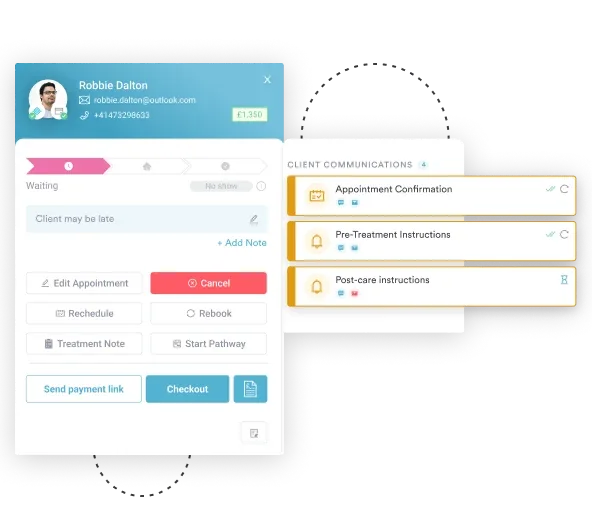
Audit your last 30 maintenance program claims before scaling home health volume. Check each one for the correct provider credential, timed minutes per visit, and documented homebound status. Then check for a plan of care inside the active 60-day period and a written reason the program needs a therapist. A 30-claim audit usually surfaces two or three systematic problems that, once fixed, reduce denials across the whole caseload.

Pabau’s claims management tools help physical therapy practices track 15-minute billing units, document homebound status, and submit clean home health claims. See how it works for your practice.

G0159 is a narrow code doing a specific job. It reports a qualified physical therapist establishing or delivering a maintenance program in the home, in 15-minute units, and nowhere else. Get the setting and the service type right and most of the denial risk disappears before a claim is ever built.
What remains is documentation discipline. That means timed minutes, a current plan of care, and a written reason the program needs a therapist. Build those three checks into the visit itself and the record is finished before anyone opens the claim. To see how Pabau handles home health billing workflows, book a demo with the team.

Trimming a Medicare patient’s nails? nail trimming billing guide covers why Medicare excludes routine foot care and what documentation this code needs.
Billing activity therapy for a mental health patient? activity therapy billing guide explains how to document activity therapy as part of a structured treatment plan, not recreation.
Billing an occlusive device after a cardiac cath? occlusive device billing guide explains why payment for this device folds into the main procedure instead of billing separately.
Billing another discipline on the same home health claim? G0155 covers clinical social work visits in the home health and hospice settings.
Reporting aide visits alongside skilled therapy? S9122 covers hourly home health aide services and the payers that accept it.
HCPCS Code G0159 is the Medicare code for a physical therapy maintenance program in the home health setting. A qualified physical therapist establishes or delivers the program, and each billed unit covers 15 minutes. It is a HCPCS Level II G-code maintained by CMS, and home health is the only setting it covers.
G0151 reports a routine skilled physical therapy visit by a qualified PT, and its descriptor covers both the home health and hospice settings. G0159 reports the establishment or delivery of a physical therapy maintenance program, and it applies in home health only. Choose between them by the purpose of the visit.
A maintenance program is a set of activities designed to hold on to a patient’s current function or slow their decline. Medicare covers skilled therapy to establish or deliver one when the patient’s condition makes a therapist necessary. Improvement is not required for coverage.
G0159 has no separate national payment amount. Medicare pays home health agencies a case-mix adjusted amount for each 30-day period of care, and G0159 reports the service inside that period. Per-visit rates apply only when the period is a low utilization payment adjustment, and CMS publishes those rates annually.
No. The CMS descriptor for G0159 names the home health setting only. CMS hospice billing instructions in Publication 100-04, Chapter 11 do not list it. Hospice physical therapy visits are reported with G0151 for a qualified PT or G0157 for a physical therapist assistant, under revenue code 042x.
Only a qualified physical therapist can bill G0159. When a physical therapist assistant delivers the maintenance program, the correct code is G2168. Establishing the program remains the qualified therapist’s responsibility, since the G2168 descriptor covers delivery alone.
Prior authorization requirements for G0159 vary by MAC jurisdiction and payer. Traditional Medicare fee-for-service does not universally require prior authorization for home health PT, but some Medicare Advantage plans and select MAC regions do. Confirm current requirements with your MAC before initiating home health PT services.