CPT Code 62284: Injection procedure for myelography
CPT Code 62284: official descriptor and procedure overview The American Medical ...

Last Updated: Oct 19, 2026
C1818 is the HCPCS code for integrated keratoprosthesis, a synthetic corneal implant used after failed donor transplants or when a graft is unlikely to work. It covers the device only, and the surgery is billed separately with CPT 65770.
C1818 is a C-series code, valid only on hospital outpatient claims under the Outpatient Prospective Payment System (OPPS). Most denials trace to a non-hospital billing setting, a missing device invoice or Unique Device Identifier (UDI), or a diagnosis that doesn't support medical necessity.
Let Pabau's smart automation suggest the right codes, reduce claim denials, and keep your practice compliant—effortlessly.
Automate repetitive tasks and focus on what matters most—your patients.
Reduce coding errors and ensure compliance with the latest regulations.
Clean claims, fewer denials, and faster reimbursements.
Powerful insights and reporting to help your practice thrive.
HIPAA compliant SOC 2 certified GDPR-compliant Trusted by 4,000+ clinics worldwide

HCPCS Code C1818 covers the integrated keratoprosthesis device only, not the surgery to implant it.
C-codes are restricted to hospital outpatient departments under OPPS. A C1818 claim billed from a physician office is denied.
Most commercial payers and many Medicare Advantage plans require prior authorization before a high-cost implant like C1818.
Pair C1818 with CPT 65770 for the surgical work and a corneal failure ICD-10-CM diagnosis on the same facility claim.
Pabau, the practice management platform we build, checks claims for missing required fields such as authorization codes before submission, then tracks each claim’s status.
HCPCS Code C1818 is a CMS-maintained Level II device code with the official descriptor Integrated keratoprosthesis. It belongs to the C-series of HCPCS Level II codes.
The Centers for Medicare and Medicaid Services (CMS) reserves C-codes for hospital outpatient billing under the Outpatient Prospective Payment System (OPPS).
Clinically, an integrated keratoprosthesis replaces the full-thickness cornea when one or more donor corneal transplants (penetrating keratoplasty) have failed. It is also used when corneal disease is so severe that a conventional graft is unlikely to succeed.
The most widely used device in the US is the Boston KPro, in Type I and Type II. C1818 itself is a generic device code, so it applies to any FDA-cleared integrated keratoprosthesis billed in a hospital outpatient setting.
C1818 covers the integrated keratoprosthesis device as a single billable unit. “Integrated” is the operative word: the device must function as a self-contained prosthesis, not a collection of separately supplied components.
Covered by C1818:
NOT covered by C1818:
A common bundling error is including the device cost in the facility’s operative supply charge and also billing C1818. CMS OPPS packaging rules prohibit double-billing the device. The device cost belongs in C1818, not in a supply line item.
C1818 covers the device, and a companion CPT code covers the surgical work. Both codes appear on the same outpatient facility claim. Neither one replaces the other, so they are always billed together.
CPT 65770 is the primary companion code. CPT codes 65730, 65750, and 65755 may apply when the operative report documents a full penetrating keratoplasty as part of the keratoprosthesis implant. Verify the CPT against the operative report before billing.
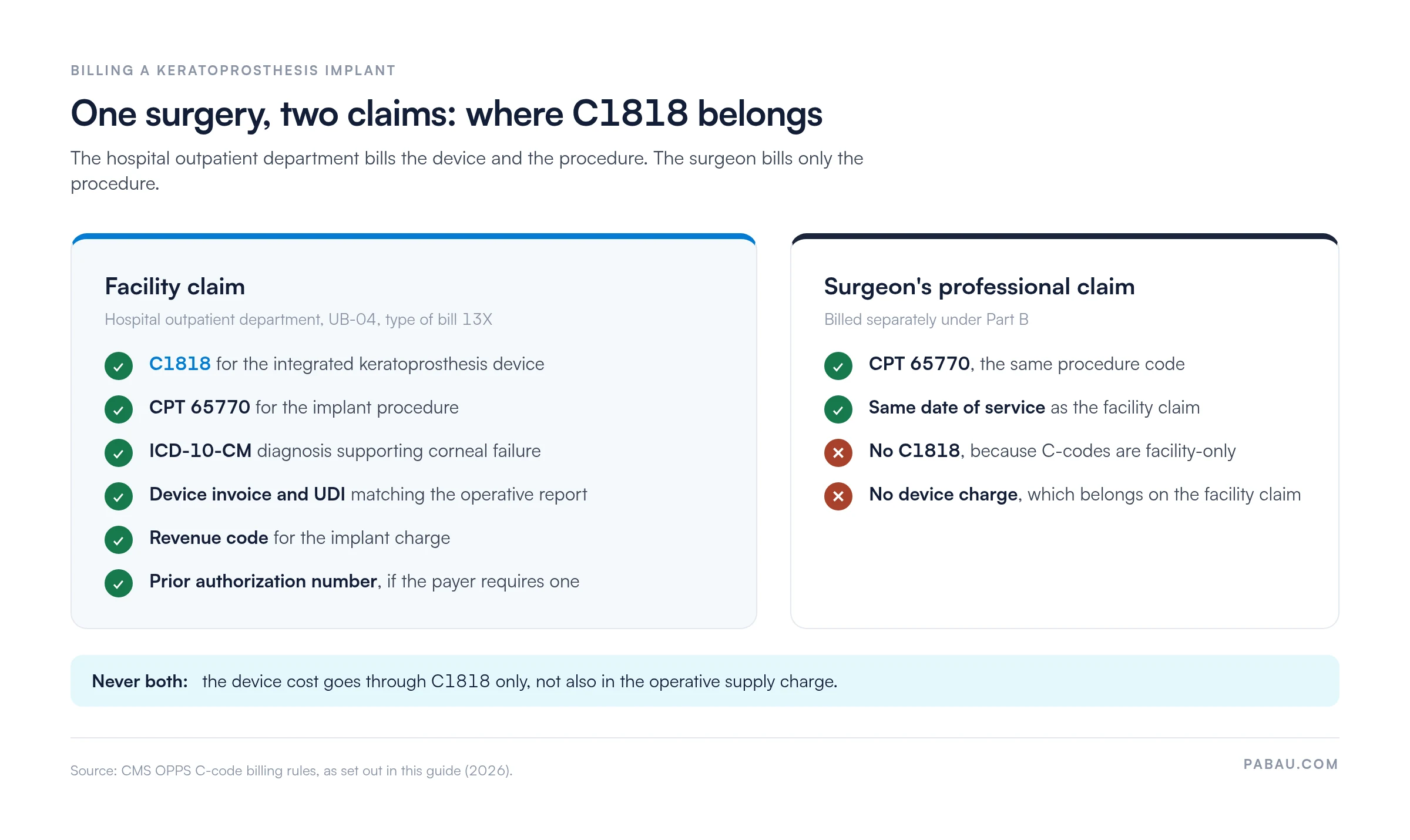
The facility bills the CPT and C1818 together. The surgeon bills the same CPT on a separate professional claim with the same date of service, as the split below shows.
Several HCPCS and CPT codes cover nearby corneal procedures and devices. Picking the wrong one is a common cause of C1818 denials and upcoding flags.
V2785 is the code most often confused with C1818, because both follow a failing cornea. V2785 applies to donor corneal tissue processed for standard keratoplasty, while C1818 applies to a manufactured prosthetic device.
If the patient received a donor corneal graft, V2785 may be appropriate. If they received a synthetic integrated prosthesis, C1818 is the correct device code.
HCPCS Code C1818 is valid only in hospital outpatient departments (HOPDs) billing under the Medicare Outpatient Prospective Payment System (OPPS). CMS defines C-series codes as OPPS-only, so the restriction applies whichever payer processes the claim.
Valid billing settings:
Invalid billing settings (automatic denial):
If an ophthalmologist performs the keratoprosthesis implant in their office-based surgical suite and bills C1818, the claim will be denied. The device must be implanted in a covered HOPD setting to use this code. According to the CMS HCPCS overview, C-series codes are maintained specifically for the OPPS hospital outpatient context.
Under OPPS, CMS assigns each device code to an Ambulatory Payment Classification (APC) group, then sets a payment rate for that APC. High-cost devices like integrated keratoprostheses may carry a device-offset or pass-through payment status that separates device reimbursement from the procedural APC payment.
In CMS Addendum B, payment status indicator “H” marks a device with pass-through status. Pass-through means CMS pays for the device separately, based on the hospital’s charges reduced to cost, instead of packaging it into the APC rate.
Pass-through designations are time-limited, typically lasting two to three years before the device cost is folded into the APC. Confirm whether C1818 carries pass-through status in the current Addendum B, because status can change with each annual OPPS final rule.
For the current 2026 payment rate, check the CMS fee schedule lookup tool or the Addendum B published with the 2026 OPPS final rule. Rates vary by geographic wage index, so cross-reference any third-party figure against the official CMS files.
Commercial payer rates for C1818 are negotiated separately. Most commercial contracts reference Medicare OPPS rates with a multiplier. Verify the contracted rate in your facility’s payer agreement before assuming the Medicare rate applies.
Traditional Medicare fee-for-service doesn’t universally require prior authorization for C1818. Most commercial payers and Medicare Advantage plans do require it for high-cost implantable devices. Skipping prior auth when a plan requires it leads to a CO-197 denial.
Following good medical billing compliance practices means verifying auth requirements before the procedure, not after. Call the payer’s provider line or use their online portal.
For Medicare Advantage plans specifically, check whether the plan has added C1818 to its prior authorization list, which can change annually at plan renewal.
Documentation typically required for prior authorization:
Build a prior authorization checklist into your pre-procedure workflow. A missing attestation letter or an incomplete device invoice usually triggers a request for more documentation, which pushes back the procedure date.
A clean C1818 claim requires complete documentation at two levels: the medical record supporting medical necessity, and the claim-level data supporting the device charge. Missing either level triggers a payer request for additional documentation or an outright denial.
Medical record documentation (medical necessity):
Claim-level documentation (device identification):
For corneal transplant failure, code from T86.841 and report T86.8419 when the chart doesn’t specify the eye. Other diagnoses commonly paired with C1818 include H16 keratitis codes, H18 codes for other corneal disorders, and H17.9 for corneal scar and opacity. Verify each code against the operative findings documented in the chart.
A working knowledge of medical billing workflows helps billing teams build checklists that catch a missing invoice or diagnosis before submission.
Attach the device invoice as an attachment on the electronic claim whenever your clearinghouse supports it. For paper claims or payers that do not accept attachments, include the UDI and device description in the claim notes field. Many payers need device-level data to process C1818 without an additional documentation request.
C1818 denials cluster around a predictable set of billing errors. Each denial reason below maps to a prevention step you can build into the pre-submission workflow.
Our guide to denial codes for billers explains each CARC in more depth. Effective denial management in healthcare starts with catching these errors before the claim leaves the facility.
A pre-submission checklist that confirms the billing setting, auth status, diagnosis specificity, and device documentation prevents most of these denials.
For appeals, follow the rules for submitting a clean claim on the corrected resubmission. A cover letter citing the specific OPPS rule carries more weight than a generic appeal narrative.
Many outpatient billing teams run the C1818 checks by hand. Someone ticks off the auth number, the device invoice, and the diagnosis against a checklist. Later, they call the payer to find out where the claim stands.
Pabau moves those checks into the claim itself. Its claims software for billers runs validation every time you send a claim, flagging a missing membership number or authorization code before submission. In the US, claims go to the payer through the Claim.MD clearinghouse, with no manual uploads.
After submission, every claim shows its live status in one view: pending, submitted, processing, paid, or error. When a C1818 claim is paid, your team records the payment against the right invoice from the same dashboard. A stalled device claim gets picked up the day its status changes, not weeks later.
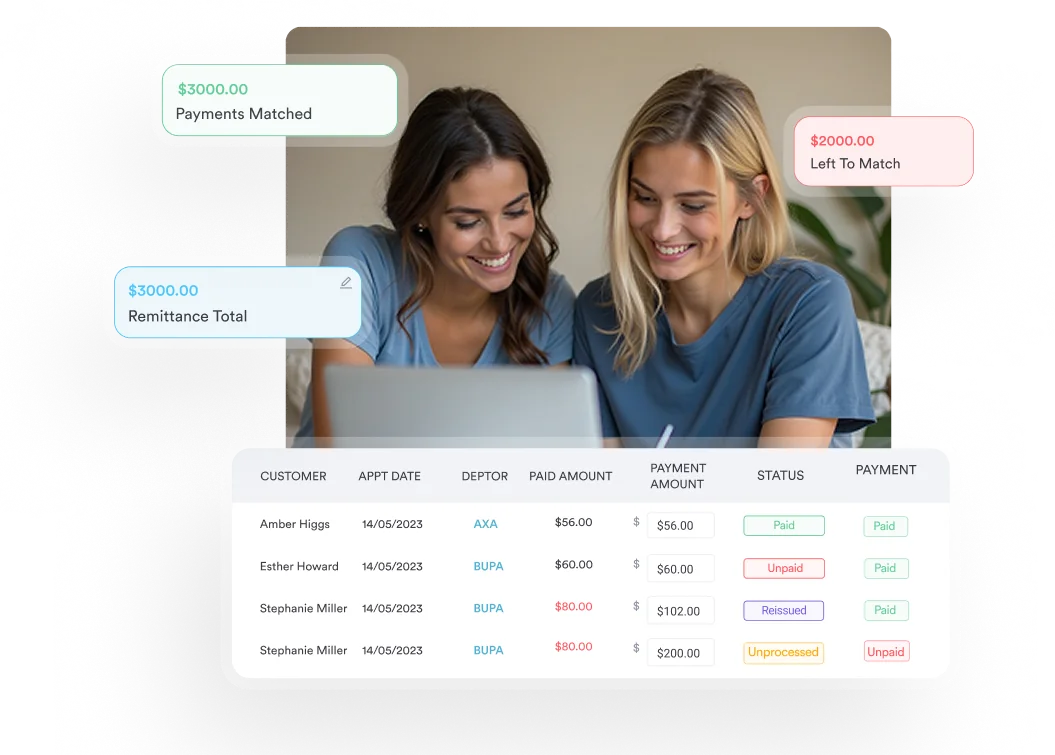

Pabau checks every claim for missing required fields, such as authorization codes, before it goes out. It then tracks each claim’s status, so high-cost device claims like C1818 don’t stall unnoticed.

C1818 is a low-volume, high-cost device code, so a single denial is expensive and slow to recover. Treat three controls as a gate before any keratoprosthesis case goes on the schedule. You need a confirmed HOPD billing setting, a completed prior authorization, and a device invoice with its UDI.
Teams that run that gate on every case spend their time submitting claims instead of reworking them. The cost is a few minutes of checking before the procedure date. Book a demo to see how Pabau flags missing claim fields before your device claims reach the payer.

Billing a payer that requires approval before the implant? The prior authorization process walks through each step from request to approval, so a C1818 case isn’t denied for a missing number.
Coding another device under OPPS? HCPCS code C1731 covers catheter billing, OPPS reimbursement, and the denials that hit device C-codes.
Pairing C1818 with a corneal disorder diagnosis? ICD-10 code H18.10 explains bullous keratopathy, one of the H18 corneal disorders that can sit behind a keratoprosthesis claim.
Want CPT, ICD-10, and HCPCS rules in one place? Our medical coding cheat sheet gives your team a quick reference for each code set used on an implant claim.
HCPCS Code C1818 covers the integrated keratoprosthesis device itself, a synthetic corneal prosthesis implanted when conventional corneal transplantation has failed. It does not cover the surgical procedure (billed via a companion CPT code such as 65770), separately billed supplies, or the physician’s professional fee.
Yes, Medicare covers C1818 for medically necessary integrated keratoprosthesis implantation in a hospital outpatient department setting under OPPS. Coverage requires documented medical necessity, typically evidenced by failed conventional corneal transplantation. Medicare Advantage plans may impose additional prior authorization requirements beyond traditional Medicare fee-for-service.
Traditional Medicare fee-for-service does not universally require prior authorization for C1818. Most commercial payers and Medicare Advantage plans do require it for high-cost implantable devices. Verify the specific payer’s requirements before the procedure. Missing a required prior authorization is one of the most common reasons C1818 claims are denied with CARC CO-197.
CPT 65770 (keratoprosthesis) is the primary companion surgical procedure code. CPT codes 65730, 65750, or 65755 (penetrating keratoplasty in phakic, aphakic, or pseudophakic eyes) may apply, depending on the surgeon’s operative report. Both the device code (C1818) and the companion CPT appear on the same outpatient facility claim.
The most common denial reasons are a non-HOPD billing setting (CO-58) and a missing prior authorization (CO-197). Others are a diagnosis that doesn’t support medical necessity (CO-50) and a missing device invoice or UDI (CO-16). Bundling the device cost into a supply line item while also billing C1818 triggers a CO-97 bundling denial.
The 2026 Medicare rate for C1818 depends on its APC assignment and on whether the 2026 OPPS Addendum B lists it with pass-through status. Verify the current rate in the CMS fee schedule lookup or in Addendum B of the 2026 OPPS final rule. Pass-through status changes annually and should not be assumed from prior-year data.