Anemia nursing care plan
An anemia nursing care plan is a structured document that guides a nurse from as...

2
Last Updated: Oct 9, 2026

A medical coding cheat sheet keeps CPT, ICD-10-CM, HCPCS, modifier, and billing definitions on one page you can scan in seconds.
CPT codes are five-digit procedure codes from the American Medical Association, updated every January 1 across surgery, radiology, laboratory, and E/M categories.
Office visit codes run 99202 to 99205 for new patients and 99211 to 99215 for established patients.
Code selection rests on medical decision-making or total time on the date of the visit, whichever the note supports.
Practice management software like Pabau keeps documentation, coding, and claim checks in one system, so fewer errors reach the payer.
The PDF lays out CPT category ranges, ICD-10-CM code structure, the HCPCS letter series, and E/M time thresholds. It also covers modifiers, place of service codes, common denial codes, and the billing terms your team uses daily.
Download templateA medical coding cheat sheet is a one-page reference for the code sets you touch every day. This one covers CPT procedures, ICD-10-CM diagnoses, HCPCS supplies, modifiers, and evaluation and management levels. Our comparison of med spa management software is worth a look if your coding work touches cosmetic procedures.
Coding accuracy decides how much of your work gets paid and how well it holds up on review. Documentation rules sit right next to it. That is why HIPAA compliance and coding training usually land on the same desk.
Whether you’re studying for a CPC exam or comparing EMR software, treat the sections below as a lookup rather than a read-through.
A medical coding cheat sheet collects the codes, terminology, and billing rules you reach for most into one page. Full code manuals are built for completeness, and a cheat sheet is built for speed.
That means scannable definitions, grouped code ranges, and short examples you can match against the chart in front of you. Five areas do most of the work: procedure codes, diagnosis codes, supply codes, modifiers, and the evaluation and management framework.
Current Procedural Terminology (CPT) codes are the procedure codes used for billing in the United States. The American Medical Association updates the set every January 1, adding codes, deleting others, and revising descriptions to match current practice.
Pick the wrong code and the claim either rejects or pays less than the work was worth. A septoplasty billed as 30520 sits in the surgery range rather than the E/M one. Tar and UVB photochemotherapy, coded 96910, falls in the Medicine range because it is a non-surgical therapy.
Add-on codes deserve their own check, because the unit count does the work. A carotid study coded 36224 is reported once per vessel selectively catheterized.
ICD-10-CM codes record the patient’s diagnosis, condition, or the reason for the encounter. The main update lands every October 1, with a smaller set of additions in April in some years.
Every code is alphanumeric. The first character is a letter, followed by two digits, a decimal point, and up to four more characters. F41.1 covers generalized anxiety disorder, and M25.50 covers pain in an unspecified joint. ICD-10 code M62.830 follows the identical alphanumeric structure for a documented back muscle spasm.
Add detail and the code narrows. M25.561 reports pain in the right knee, while M25.569 reports knee pain with no side documented. Behavioral health teams hit the same pattern with F-codes. ICD-10 code F33.9 for recurrent major depressive disorder needs the same level of detail to satisfy a payer.
Picking the right code means documenting the diagnosis with specificity. A generic code such as R10.9 for abdominal pain signals a thin note and invites review. The more specific R10.13 for epigastric pain supports medical necessity and defends the claim. ICD-10 code R33.9 for urinary retention faces that same scrutiny when the cause goes unrecorded.
Transplant codes show how far that detail runs.
Knowing how practice management software works helps you decide which forms to digitize first.
Evaluation and management (E/M) coding carries the most revenue in most practices, and the most audit attention. The office visit rules changed on January 1, 2021.
Code selection moved to medical decision-making (MDM) or total time, replacing the old history and exam scoring. The same approach reached the other E/M categories in 2023.
The 2025 CPT update left that framework alone. It added telehealth codes 98000 to 98015, and Medicare’s G2211 add-on still applies to visits that anchor a patient’s ongoing care.
Office visit codes split into new patients, 99202 to 99205, and established patients, 99211 to 99215. Choose the level with either MDM complexity or total time.
When time drives the choice, count total time on the date of the visit, including chart review and documentation. When MDM drives it, the note has to meet two of three elements. Those elements are problems addressed, data reviewed, and risk of management.
Office visits carry most of the revenue in primary care. That leaves the coder reading evidence rather than reconstructing the visit.
HCPCS Level II codes cover supplies, drugs, orthotics, and services that CPT does not describe. Each one is a single letter followed by four digits. CMS maintains the set and publishes updates quarterly.
The letter tells you the category. J-codes are drugs, E-codes are durable medical equipment, and A-codes are supplies. A commode chair bills as E0165. T-codes cover services state Medicaid agencies pay for, such as T1029 for a comprehensive environmental lead investigation.
Our DME equipment list expands on the E-code line. It pairs common E and K codes with Medicare coverage status and prior authorization requirements.
Modifiers are two-character codes appended to a CPT or HCPCS code to explain circumstances that change payment. Modifier 25 flags a separate E/M service on the same day as a procedure. Modifier 59 flags a distinct procedural service, and modifier 50 flags a bilateral procedure. A clean claim needs the code, the modifiers and the diagnosis to agree, which is the check claim submission software runs.
Two more come up constantly. Modifier 76 reports a repeat procedure by the same physician, and modifier 91 reports a repeat clinical lab test. A missing modifier is one of the fastest routes to a denial. Laterality is the other, since 25624 needs LT or RT on the claim line.
Place of service (POS) codes say where the care happened. Office is 11, patient home is 12, telehealth is 02 or 10, hospital inpatient is 21, and an ambulatory surgery center is 24. The POS code drives facility versus non-facility payment rates. A delivery billed as 59409 is paid at the facility rate, because the hospital bills the room.
Shared language saves time when a claim goes wrong. These are the terms every coder and biller needs on hand:
Coding accuracy shows up directly in the revenue cycle and in audit risk. The most frequent errors are all preventable:
A denied claim comes back with a group code and a reason code on the remittance advice. The group code tells your team who owns the balance:
Working denials weekly beats working them in a quarterly panic.
The sheet earns its keep when it sits where the work happens. Keep a printed copy at the front desk for place of service lookups, and hand the PDF to every new biller during onboarding.
Specificity starts before the visit does. Structured intake forms put history and symptom detail on the chart in the patient’s own words, which gives the coder something to work from.
Pair the sheet with training on your payers’ rules and your own documentation standards. Then check the denial code section whenever a rejection lands, before anyone re-keys the claim.
Most coding errors start in the chart rather than the code book. The note is thin, the diagnosis is vague, and the coder picks a level the documentation cannot defend. Six weeks later the claim comes back.
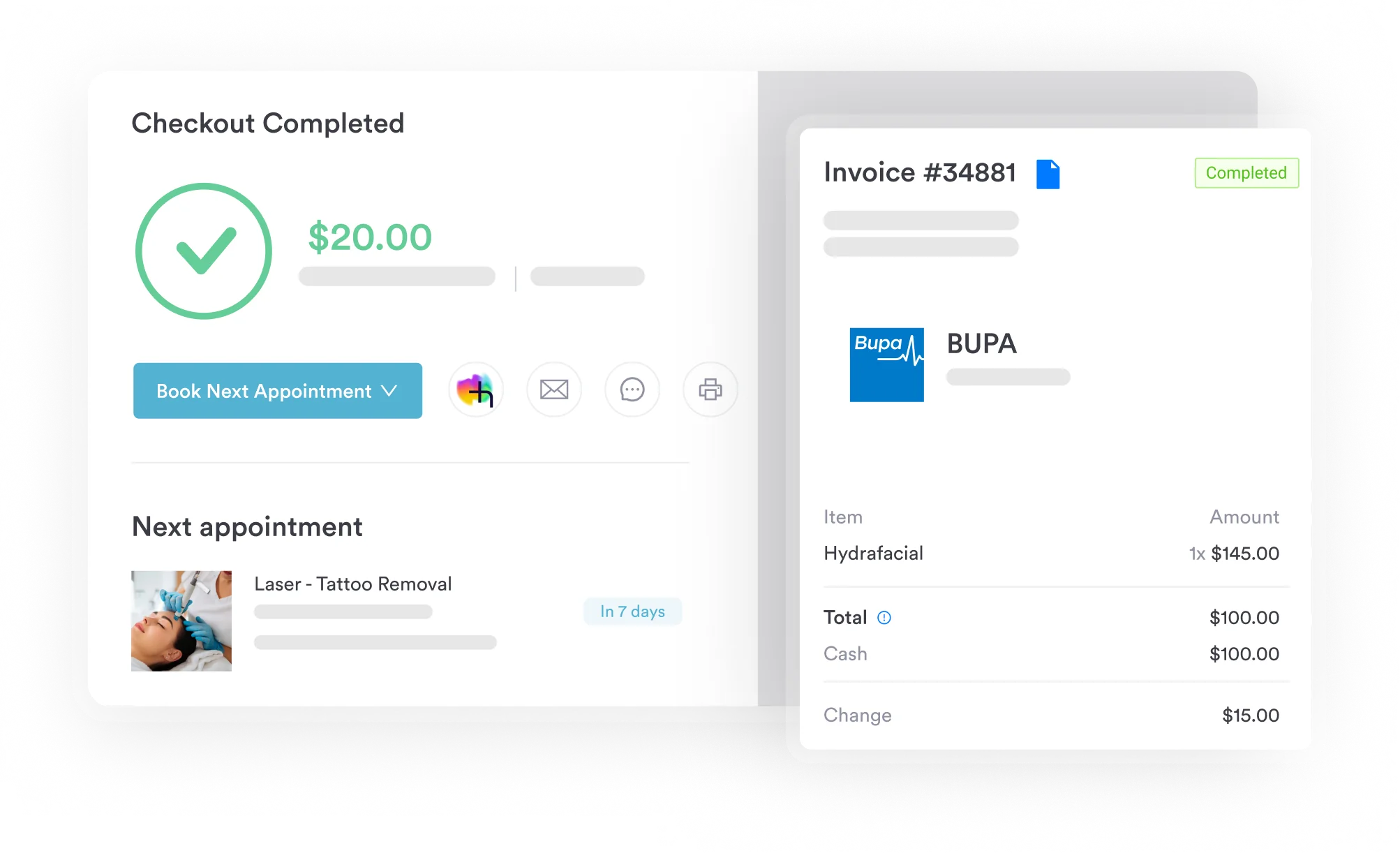
Practice management software like Pabau holds the documentation and the billing in one system. Treatment notes.
Invoicing and claims sit in the same record, so a coded visit turns into a claim without anyone re-typing it. Denial codes land back in the same place, which makes a repeat mistake obvious across the whole team.

Pabau keeps treatment notes, patient records, and claims in one system. Coders work from complete documentation, so fewer claims come back with a denial code attached.

Coding accuracy is mostly a documentation habit. The code sets shift once or twice a year, and the codes you actually use fit on a single page.
Print the sheet and keep it where claims get built. Then watch the two things behind most denials, which are the modifier nobody added and the level the note cannot support.
Book a demo to see how Pabau ties treatment notes, coding, and claims together, so your team spends less time reworking rejections.

Coding a full-thickness graft? 15260 shows why most denials trace back to the note rather than the code.
Billing behavioral services in 15-minute units? H2019 walks through unit math and state Medicaid rules.
No CPT code fits the procedure? 20999 explains what the special report has to contain before a payer will price it.
Billing a device used in retina repair? C1784 covers the hospital outpatient rules for device codes.
Documenting an SSRI adverse effect? T43.225A covers initial encounter coding and the seventh character.
A medical coding cheat sheet is a quick-reference guide covering CPT, ICD-10-CM, HCPCS Level II, modifiers, E/M criteria, and billing terms. Coders use it for fast lookup instead of opening a full manual.
The American Medical Association updates the official CPT code set once per year, effective January 1. Updates include new codes, deleted codes, and revised descriptions to reflect current clinical practice.
CPT codes describe the service or procedure delivered (e.g., 99214 = office visit, established patient, moderate complexity). ICD-10 codes describe the patient’s diagnosis, condition, or reason for the encounter (e.g., F41.1 = Generalized Anxiety Disorder). Both are required on every claim.
Select the level using either medical decision-making complexity or total time on the date of the visit. New patient visits run 99202 to 99205, and established visits run 99212 to 99215. Time starts at 15 minutes for 99202 and tops out at 54 minutes for 99215.
A place of service (POS) code identifies where the service happened. Office is 11, telehealth is 02 or 10, hospital is 21, and an ambulatory surgery center is 24. The POS code sets facility versus non-facility payment rates and routes the claim.
Top errors include upcoding E/M levels, missing or incorrect modifiers, and retired ICD-10 codes. Thin diagnosis documentation, the wrong place of service code, and unbundling round out the list. Claim validation in your software catches many of them before submission.
Official CPT codes are published by the American Medical Association. ICD-10-CM codes are maintained by the Centers for Medicare & Medicaid Services. AAPC and AHIMA also publish authoritative coding guidelines and training materials.
Validate claims in your practice management software before submission, and train billing staff on your payers’ rules. Keep documentation standards that support the level you bill. Then track denial codes so patterns get fixed at the source.