ICD-10 Code R34: Anuria and oliguria
ICD-10 Code R34 is the billable ICD-10-CM diagnosis code for anuria and oliguria...

Last Updated: Oct 6, 2026
T86.841 is the ICD-10-CM code for corneal transplant failure, the permanent loss of function in a donor cornea after keratoplasty. It is not billable on its own. Claims need a seventh character for the eye: T86.8411 right, T86.8412 left, T86.8413 bilateral, or T86.8419 unspecified.
T86.841 sits under T86.84, Complications of corneal transplant, beside separate codes for rejection (T86.840-), infection (T86.842-), other complications (T86.848-), and unspecified complications (T86.849-). Code assignment turns on what the surgeon documents, and the eye must match the procedure modifier on the claim.
Let Pabau's smart automation suggest the right codes, reduce claim denials, and keep your practice compliant—effortlessly.
Automate repetitive tasks and focus on what matters most—your patients.
Reduce coding errors and ensure compliance with the latest regulations.
Clean claims, fewer denials, and faster reimbursements.
Powerful insights and reporting to help your practice thrive.
HIPAA compliant SOC 2 certified GDPR-compliant Trusted by 4,000+ clinics worldwide

T86.841 is the ICD-10-CM code for corneal transplant failure, but it is a header that cannot be billed on its own.
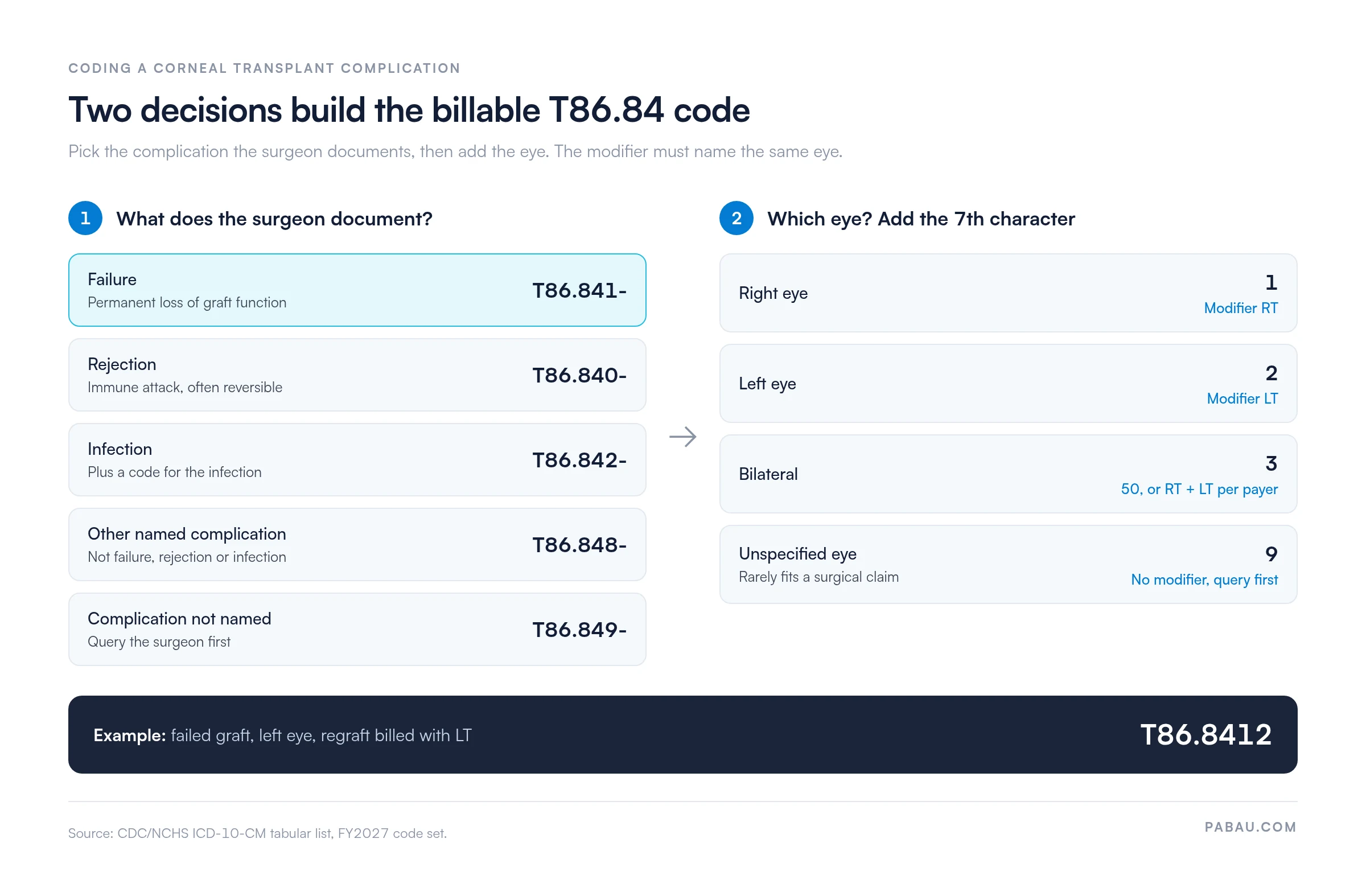
Claims need the seventh character for the affected eye: T86.8411 right, T86.8412 left, T86.8413 bilateral, or T86.8419 unspecified.
Failure (T86.841-) is permanent loss of graft function, while rejection (T86.840-) is an immune response that may still be reversed.
The ICD-10-CM laterality and the CPT eye modifier on the keratoplasty line must point to the same eye.
The chart must state graft failure in the surgeon’s own words, because coders cannot infer it from a cell count.
ICD-10 code T86.841 classifies corneal transplant failure, the permanent loss of function in a donor cornea after keratoplasty.
It is not a billable code by itself. In the FY2027 code set, effective October 1, 2026, the claim needs a seventh character that names the eye.
The CDC/NCHS ICD-10-CM browser tool lists T86.841 under T86.84, Complications of corneal transplant, in Chapter 19 (S00-T88). The same four billable children have been in place since laterality was added to the corneal transplant codes. The FY2027 update left the code and its four children unchanged.
The code applies across keratoplasty techniques. The diagnosis does not change with the procedure type, but the CPT code you pair it with does.
Surgeons usually document graft failure when the cornea stays edematous and cloudy despite treatment, or when the patient needs a regraft. The operative report and slit-lamp findings are the primary documentation sources.
Every claim for corneal transplant failure carries one of the four codes below. Submitting the bare T86.841 returns the claim as an invalid diagnosis, because a header code is not a reportable endpoint.
The laterality on the diagnosis and the modifier on the procedure line should describe the same eye. A T86.8411 diagnosis linked to a keratoplasty billed with LT is a mismatch that claim edits catch.
T86.8419 is valid, but it rarely fits a surgical claim. An operative report always names the eye, so an unspecified-eye code usually means the coder missed it.
T86.841 sits in a parent-to-child chain in the ICD-10-CM tabular list. Its siblings under T86.84 each need a seventh character for the eye as well.
The T86.85- codes that sit just below this subcategory belong to intestine transplants, not corneal grafts. T86.850 is intestine transplant rejection, so a corneal claim coded there describes the wrong organ entirely.
T86.841 inherits notes from its category and from the T80-T88 block. Ignoring them is a common audit finding on transplant complication claims.
Official guidelines require two codes to describe a transplant complication. The first is the T86 code, and the second identifies the complication itself. For a failed corneal graft, the second code usually describes the corneal condition the surgeon documents.
Guidelines also limit when a T86 code applies at all. A transplant complication code is assigned only when the complication affects the function of the transplanted tissue.
T86.84 carries an Excludes2 note for mechanical complications of a corneal graft, coded under T85.3-. Breakdown or displacement of the graft tissue goes there, and Excludes2 means both codes may be reported when both conditions are present.
Category Z94 excludes complications of transplanted tissue, so Z94.7 (corneal transplant status) is not reported alongside T86.841-. The complication code already tells the payer a transplant exists.
Failure (T86.841-) means the graft has permanently lost function, while rejection (T86.840-) is an immune attack that aggressive treatment can often reverse. The surgeon has to name which one is present, because the codes are not interchangeable.
Unresolved rejection is a common path to failure. When the chart records a rejection episode that progressed to permanent decompensation, both codes can be reported for that eye. Each must be stated by the treating surgeon, with the same seventh character.
Pick the most specific code the documentation supports, then add the eye. The four siblings split the corneal transplant complications as follows.
An unspecified code on a regraft claim invites a records request. The operative note almost always says why the graft is being replaced, so the specific code is usually available. The map below runs both decisions in order, the complication first and the eye second.
T86.841- is the diagnosis that supports medical necessity for a repeat keratoplasty. Clean pairing is one of the medical billing fundamentals that keeps a regraft from stalling. Verify current-year descriptors in the AMA CPT codebook before each claim cycle.
Lens status decides the penetrating code, so check the operative note for phakic, aphakic, or pseudophakic before you pick one. The donor cornea is often billed separately with HCPCS V2785, supported by the eye bank invoice.
Check the global period before you bill a regraft. Keratoplasty codes carry a 90-day global, so a regraft inside that window needs modifier 78 for an unplanned return to the operating room. Without it, the claim reads as an unbillable postoperative visit.
Payers reviewing a regraft pull the operative report, the preoperative note, and any specular microscopy or imaging. A clean claim submission for corneal transplant failure needs these elements in the record before billing.
Coders cannot assign a diagnosis from a lab value or an image alone. The surgeon’s documented interpretation that the findings mean graft failure is the coding trigger, not the cell count itself.
Medicare Part B covers a medically necessary repeat keratoplasty for a failed graft. The diagnosis has to be one of the four billable T86.841 codes, and the CMS ICD-10 code files list T86.841 itself as a non-billable header.
Local Coverage Determinations vary by Medicare Administrative Contractor (MAC), and commercial plans set their own prior authorization rules for corneal surgery. Check the contractor or plan policy before you schedule the regraft. The CMS Medicare Coverage Database is the source for MAC policies.
Strong medical billing compliance habits reduce coverage-related denials on these high-value procedures. The fixes are usually upstream, at scheduling and at chart sign-off.
Corneal graft failure denials cluster around a handful of recurring issues. Each has a prevention step you can build into the pre-billing workflow instead of fixing it on appeal.
A structured denial management process helps practices prevent these patterns instead of relying on one coder’s memory. Mapping the denial codes that come back on these claims shows which root cause you are dealing with.
Many regraft denials trace back to steps taken before the claim is built. The eligibility check gets skipped, the authorization number sits in an email, and the coder works from a scanned operative note.
Pabau, our practice management and billing platform, keeps those steps in one place. Its claims management software connects to the Claim.MD clearinghouse for US practices.
You can run real-time eligibility checks before the surgery date and submit the claim electronically. Electronic remittance advice (ERA) is then posted without leaving the patient record.
Pabau also runs validation checks each time you send a claim, so missing membership numbers or authorization codes surface before submission. Every claim then shows a live status, so a rejected regraft is visible the day it comes back.

Pabau’s claims dashboard and Claim.MD connection help ophthalmology practices check eligibility before surgery, submit regraft claims electronically, and see every denial as it lands.

T86.841 tells you where corneal graft failure lives in the code set, but a claim needs one of its four children. It lands cleanly only when it carries the right seventh character, a matching eye modifier, and a chart where the surgeon names the failure.
If your team builds one check into the pre-billing workflow, make it the laterality match between the diagnosis and the keratoplasty line. That check catches the header-code error, the wrong-eye error, and most coder guesswork in one pass.
Book a demo to see how Pabau helps ophthalmology practices submit regraft claims with fewer denials.

Need a structured approach to claim denials? Denial management in healthcare covers the end-to-end process for identifying, appealing, and preventing billing denials across specialty practices.
Want to understand CARC and RARC codes on remittances? Denial codes in medical billing explains how to read adjustment reason codes and build targeted appeal workflows.
Looking to strengthen your clearinghouse setup? Claim.MD clearinghouse overview explains how Pabau’s US clearinghouse integration handles 837P submissions and ERA processing for ophthalmology claims.
Planning a regraft that needs payer approval? The prior authorization process walks through each step of getting approval before the procedure date.
Want fewer coverage surprises before surgery? Insurance eligibility verification shows what to confirm with the payer before the patient arrives.
ICD-10 code T86.841 means corneal transplant failure, the permanent loss of function in a donor cornea after keratoplasty. It sits under T86.84, Complications of corneal transplant, and needs a seventh character before it can be billed.
No, T86.841 is not billable on its own. Bill T86.8411 for the right eye, T86.8412 for the left eye, T86.8413 for both eyes, or T86.8419 when the eye is unspecified.
No, T86.850 is intestine transplant rejection. Corneal transplant failure is T86.841, billed with a seventh character for the eye, such as T86.8411 for the right eye.
Rejection (T86.840-) is an immune response that treatment can often reverse, while failure (T86.841-) is permanent loss of graft function. The surgeon must document which is present. Both can be reported for the same eye when both are documented.
Regraft claims pair T86.841- with 65710, 65730, 65750, 65755, or 65756, depending on the technique and lens status. Add-on code +65757 may be reported with 65756 for backbench preparation of the endothelial graft.
No, category Z94 has an Excludes1 note for complications of transplanted tissue. Report the T86.841 code with the eye instead, because it already tells the payer the transplant exists.
The most common are a missing seventh character, a laterality mismatch with the RT or LT modifier, and a chart that never states failure. Missing modifier 78 inside the global period and missing prior authorization follow close behind.