CCSD Code D0630: Repair of pinna billing guide
What CCSD code D0630 covers CCSD code D0630 is the code for “repair of pin...

Last Updated: Oct 8, 2026
C1731 is the HCPCS Level II code for catheter, electrophysiology, diagnostic, other than 3d mapping (20 or more electrodes).
C1731 reports this catheter on hospital outpatient claims under the Medicare Hospital Outpatient Prospective Payment System (OPPS). Coders confuse it most often with C1730 (19 or fewer electrodes) and C1732 (diagnostic/ablation, 3D or vector mapping), which describe different electrophysiology catheters. Choosing the wrong descriptor before submission is a fast route to a denial or bundling edit.
Let Pabau's smart automation suggest the right codes, reduce claim denials, and keep your practice compliant—effortlessly.
Automate repetitive tasks and focus on what matters most—your patients.
Reduce coding errors and ensure compliance with the latest regulations.
Clean claims, fewer denials, and faster reimbursements.
Powerful insights and reporting to help your practice thrive.
HIPAA compliant SOC 2 certified GDPR-compliant Trusted by 4,000+ clinics worldwide

HCPCS code C1731 reports a diagnostic electrophysiology catheter with 20 or more electrodes that is not a 3D mapping catheter.
It is billed on UB-04 institutional claims for hospital outpatient procedures under Medicare OPPS, never on the CMS-1500.
C1731 carries no separate APC payment, because its cost is packaged into the APC of the procedure it accompanies.
Prior authorization varies by payer. Medicare Advantage plans such as Wellcare and commercial plans such as Ambetter publish PA matrices covering C-code device procedures.
The top denial reasons are missing medical necessity documentation, a wrong revenue code on the UB-04, and no prior authorization before the procedure.
HCPCS code C1731 is the Level II code for a diagnostic electrophysiology (EP) catheter with 20 or more electrodes that does not perform 3D mapping. The Centers for Medicare and Medicaid Services (CMS) maintains its official descriptor. It reads “Catheter, electrophysiology, diagnostic, other than 3d mapping (20 or more electrodes),” and the code has been active since January 1, 2004.
C1731 belongs to the C-series of HCPCS Level II codes. CMS uses that range for devices, drugs, and supplies billed under the Hospital Outpatient Prospective Payment System (OPPS). Many C-codes began as transitional pass-through codes for high-cost devices, which sets them apart from J-codes (drugs) and A-codes (supplies). That status is time-limited, and C1731’s cost is now packaged into the payment for the procedure.
The code applies only to the hospital outpatient setting. Physician office claims and inpatient facility claims use different billing pathways, and C-codes are not valid on those claim types. C1731 goes on the UB-04 institutional claim form, or its electronic equivalent, the 837I transaction. It is paired with the revenue code for the supply or device line.
Confirm the descriptor in the current HCPCS Level II code file before each annual billing cycle. CMS updates the HCPCS code set effective January 1 each year, and descriptor language can change. Citing an outdated descriptor is a compliance risk, particularly under post-payment audit.
C1731 covers one device: “Catheter, electrophysiology, diagnostic, other than 3d mapping (20 or more electrodes).” It is used in EP studies performed in cath labs and EP labs. What the code does NOT cover is equally important: Related but distinct EP catheters fall under neighboring codes. C1730 covers diagnostic catheters with 19 or fewer electrodes, and C1732 covers diagnostic/ablation catheters with 3D or vector mapping.
Billing C1731 for a device that meets a different descriptor produces a claim that fails payer edits. The table below sets the neighboring codes side by side.
National Correct Coding Initiative (NCCI) edits may block separate billing of C1731 alongside certain CPT codes. That happens when the device is considered integral to the procedure. Run claims through the current NCCI edits table before submission. CMS revises NCCI tables quarterly, so assuming last year’s bundling rules still apply is a common audit risk.
C1731 is triggered by EP studies performed in the hospital outpatient setting, usually in an electrophysiology lab. The operative or procedure report is the primary documentation source a coder needs to assign this code accurately.
Three documentation elements determine whether C1731 is defensible on audit.
When the report says “catheter” without further detail, query the clinical team before assigning any C-code.
On the UB-04, C1731 sits on the medical supply or device line and is paired with the correct revenue code. The 27x revenue code range covers medical and surgical supplies and implants. The exact pairing depends on the payer’s billing requirements, and revenue code mismatches are a leading cause of technical denials. Electronic institutional claims go out in the 837I format.
Under the Medicare OPPS, hospital outpatient services are grouped into Ambulatory Payment Classifications (APCs) and paid at a fixed APC rate. C1731 carries no separate APC payment; its cost is packaged into the APC of the associated procedure. Confirm its status indicator in Addendum B, which CMS publishes with the OPPS Final Rule each year.
Two OPPS policy concepts still shape what the hospital is paid for the procedure that carries C1731. First, device-intensive status: When a procedure’s device cost exceeds a CMS threshold (historically around 30%), the procedure is designated device-intensive. A portion of its payment is then conditioned on the device being used.
Second, pass-through payment: Newly approved high-cost devices can receive temporary pass-through status. CMS then pays an additional amount above the APC to offset the device cost. Pass-through status is time-limited, typically two to three years, and expires automatically. C1731 has been active since 2004, so any pass-through period has long expired; it is packaged under OPPS.
For OPPS dollar figures, use CMS OPPS Addendum B to find the procedure’s current-year rate. Professional-side rates sit in the CMS Physician Fee Schedule lookup. Rates change each January 1, so a figure in a prior-year article or chargemaster spreadsheet is unreliable once the new OPPS Final Rule takes effect.
Pull OPPS Addendum B from the CMS website every January and check C1731’s status indicator against your chargemaster. If the packaging status or the procedure’s APC changed, update your cost reporting model. Do it before the first claim of the new year goes out.
C1730, C1731 and C1732 all describe EP catheters for the same care setting, and two descriptor details separate them. Electrode count splits the diagnostic catheters that don’t map in 3D. C1730 covers 19 or fewer electrodes, and C1731 covers 20 or more. Mapping sets C1732 apart, because it describes a diagnostic/ablation catheter with 3D or vector mapping.
Submitting C1731 for a device that meets another descriptor triggers an edit-based denial, because the code no longer matches the procedure report. The comparison below lays the three descriptors side by side.
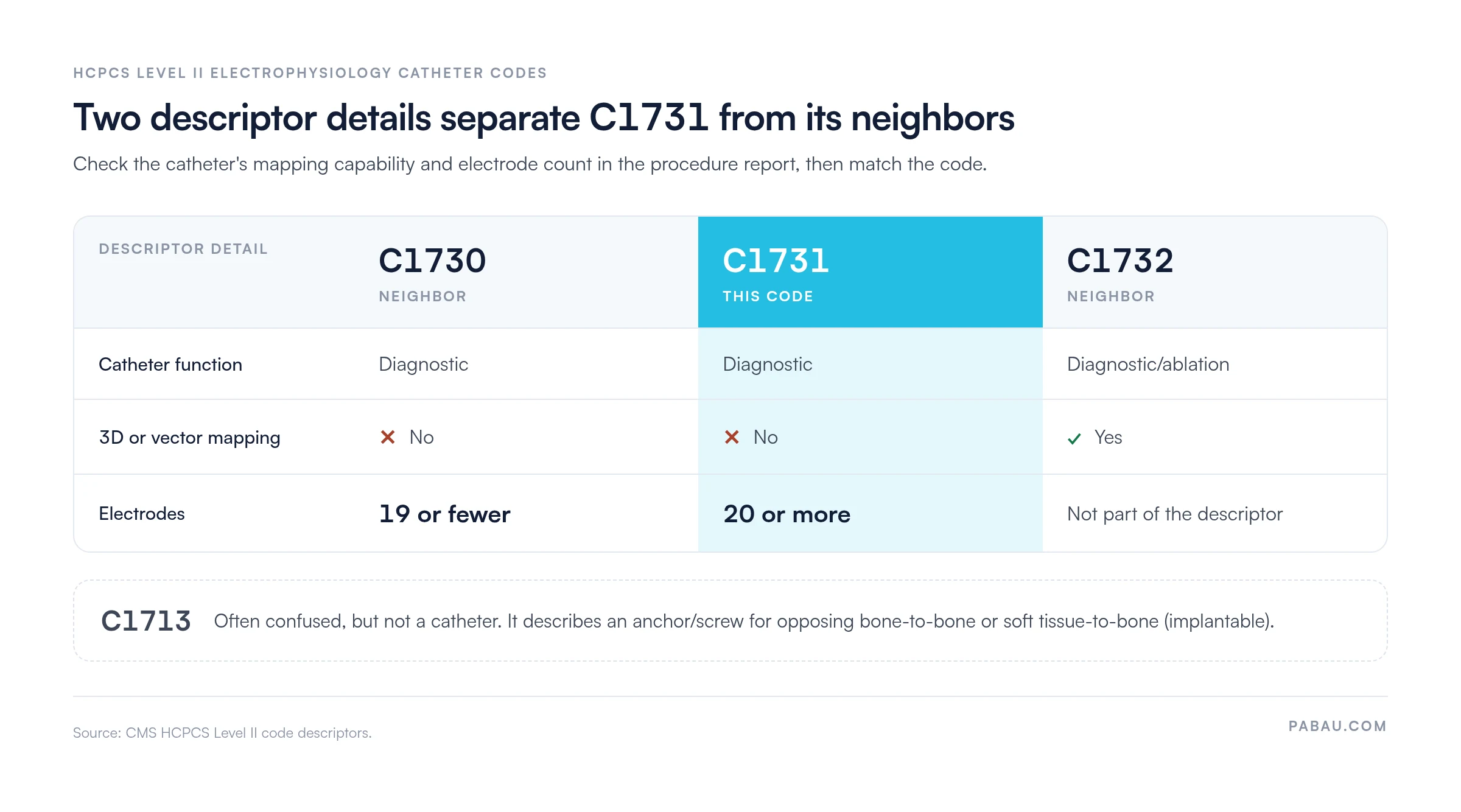
C1713 is the odd one out. It describes an implantable anchor/screw for bone-to-bone or soft tissue-to-bone fixation, so it is not a catheter at all. It sits in the same C-series range, which is why coders occasionally grab it by mistake.
The safest approach is to read the full CMS descriptor for each code at the start of the billing cycle. Don’t rely on the shortened label in a chargemaster. Manufacturers such as Biosense Webster publish coding checklists that map their EP product numbers to HCPCS codes.
Those checklists are a useful cross-reference when the procedure report names a specific product. They are manufacturer resources, though, so reconcile them against the official CMS descriptor rather than treating them as a substitute.
Traditional Medicare (fee-for-service) does not routinely require prior authorization (PA) for most OPPS catheter procedures at the federal level. CMS has, however, expanded PA requirements for certain categories of outpatient services in recent years. Check whether the procedure code combination on the claim falls under a CMS PA program before assuming no PA is needed.
Medicare Advantage and commercial plans are a different matter. Plans such as Wellcare Medicare (H908) and Ambetter publish PA matrices covering interventional cardiovascular and EP procedures billed with C-series device codes. Buckeye Health Plan and similar managed Medicaid plans also keep PA requirements for high-cost device procedures. Requirements vary by plan year and contract, so a rule from one benefit year may change in the next.
Denials on C1731 claims cluster around a small number of root causes, and most are preventable with a pre-submission checklist. The denial management workflow for device codes differs from professional claims: The institutional billing team needs procedure-report documentation and chargemaster accuracy. Code-level edits alone won’t catch these problems.
When a C1731 denial arrives with a Claim Adjustment Reason Code (CARC), the CARC identifies which root cause applies. Two CARCs show up most on device-code denials from NCCI bundling edits. CARC 4 means the procedure code is inconsistent with the modifier used. CARC 97 means the benefit is included in the payment for another service.
Reviewing the remittance advice at the CARC level, rather than the denial status alone, gets you to the corrective action faster. Our guide to common denial codes explains the rest of the CARC list and how to resolve each one.
C-series device codes follow an annual OPPS update cycle that differs from the physician fee schedule. The following practices reduce compliance risk and protect reimbursement on C1731 claims.
Maintaining medical billing compliance for device codes also means logging every denied C1731 claim and how it was resolved. The same denial reason across several claims points to a systemic problem. The fix then sits in chargemaster configuration, PA workflow, or coder training, and a one-off appeal won’t solve it.
A clean claim for a device code on the UB-04 carries more fields than a standard professional claim. Each of these has to be present and correct.
Missing any one of these fields produces a technical rejection, and the timely filing clock keeps running while you correct it.
Build a pre-submission checklist for C-code device claims: Revenue code, descriptor match, LCD-listed diagnosis, NCCI edit cleared, and PA number documented. Running through five fields before each claim goes out is faster than working a denial after the fact.
Most C1731 denials in the table above trace back to a detail that was missing when the claim went out. Billing teams usually find those details by hand, one claim at a time, after the payer has already rejected the line.
Pabau, the practice management platform we build, runs validation checks every time someone goes to send a claim. If a required detail such as an authorization code is missing, the Send button stays disabled until it’s fixed. In the US, Pabau connects to the Claim.MD clearinghouse for electronic submission, real-time eligibility checks, and claim status tracking.
Every claim then sits in one Claims dashboard with a live status, from pending to paid or error. With error-catching claims management software, your team spots a stalled device claim long before the timely filing window closes. You spend less time working denials and more time on the claims that need a coder’s judgment.

Pabau checks every claim for missing details such as authorization codes before it goes out, so fewer device claims come back denied. Track each claim’s status from one dashboard.

HCPCS code C1731 billing depends on three things: Descriptor-level precision, current OPPS packaging data, and a pre-submission check of PA numbers and revenue codes. Of the three, the descriptor match is the one a payer edit won’t fix for you after submission.
So start with the procedure report. If it states the electrode count and confirms the catheter doesn’t map in 3D, the code choice defends itself on audit. If it doesn’t, query the EP lab before the claim goes out. That check costs a few minutes per claim, and the January OPPS update and quarterly NCCI revisions mean it has to run every cycle.
Book a demo to see how Pabau flags missing authorization details before your device claims reach the payer.

Need a framework for reducing claim rejections? What is medical billing? walks through the end-to-end revenue cycle and where device codes fit in the claim lifecycle.
Dealing with repeat denials on institutional claims? Denial codes in medical billing covers the most common Claim Adjustment Reason Codes and how to resolve each one.
Planning authorization for an EP procedure? The prior authorization process sets out a step-by-step workflow from payer check to approval number.
Sending device claims electronically? What is an 837 file? explains the transaction format behind the 837I institutional claim.
Racing a deadline after a rejected claim? Timely filing limits by payer lists the windows for initial claims, corrected claims and appeals.
HCPCS code C1731 covers a diagnostic electrophysiology catheter with 20 or more electrodes that is not a 3D mapping catheter. It is billed on UB-04 institutional claims for hospital outpatient procedures under Medicare OPPS. CMS updates the code set each January 1, so verify the descriptor annually.
C1731 is a diagnostic EP catheter with 20 or more electrodes that does not perform 3D mapping. C1732 is a diagnostic/ablation EP catheter with 3D or vector mapping. Billing C1731 when the device meets the C1732 descriptor produces a claim that fails payer edits. Check the device’s manufacturer and model against the official CMS descriptor before you choose.
Traditional Medicare fee-for-service does not universally require prior authorization for C1731 procedures. Medicare Advantage plans (such as Wellcare), commercial plans (such as Ambetter), and managed Medicaid plans (such as Buckeye) may. Check the plan’s current PA matrix by procedure code combination before each procedure, because requirements change with each plan year.
The top denial reasons are missing medical necessity documentation and a revenue code that doesn’t match the device line on the UB-04. Prior authorization not obtained before the procedure is another. NCCI bundling edits also deny the device line when it is considered integral to the associated CPT code.
C1731 is billed on the UB-04 institutional claim form (or its electronic equivalent, the 837I transaction). It is not valid on the CMS-1500 professional claim form. The code appears on the device or supply line, paired with a revenue code in the 27x supply/implant range.
No. C1731 has been active since 2004, so any pass-through period has long expired; it is packaged under OPPS. Pass-through status for C-codes is time-limited, typically two to three years. To confirm a device code’s current status, check Addendum B (status indicator H).