CPT Code 62284: Injection procedure for myelography
CPT Code 62284: official descriptor and procedure overview The American Medical ...

Last Updated: Oct 19, 2026
V2785 is the HCPCS Level II code for processing, preserving and transporting corneal tissue.
HCPCS code V2785 has a single official descriptor: Processing, preserving and transporting corneal tissue. It belongs to HCPCS Level II, the Healthcare Common Procedure Coding System maintained by the Centers for Medicare and Medicaid Services (CMS). The V-series covers vision items and ophthalmic supplies, and V2785 sits within that range for corneal graft acquisition costs.
The code is billable and active for the current fiscal year. It captures the cost incurred when a surgeon orders donor cornea from a licensed eye bank, not the surgical procedure itself. The surgical work is reported separately using the appropriate CPT keratoplasty code.
Let Pabau's smart automation suggest the right codes, reduce claim denials, and keep your practice compliant—effortlessly.
Automate repetitive tasks and focus on what matters most—your patients.
Reduce coding errors and ensure compliance with the latest regulations.
Clean claims, fewer denials, and faster reimbursements.
Powerful insights and reporting to help your practice thrive.
HIPAA compliant SOC 2 certified GDPR-compliant Trusted by 4,000+ clinics worldwide

HCPCS code V2785 covers processing, preserving and transporting corneal tissue for use in keratoplasty procedures.
V2785 is carrier priced, so Medicare pays from the eye bank’s invoice rather than a published fee schedule amount.
V2785 is billed on a CMS-1500 alongside a keratoplasty CPT code chosen by graft depth and lens status.
Pabau’s claims management software links claim documentation to the patient record, so billing teams submit accurate V2785 claims.
Medicare covers HCPCS code V2785 when the corneal tissue is medically necessary for a covered keratoplasty procedure. Coverage is administered by Medicare Administrative Contractors (MACs), among them Novitas Solutions, Palmetto GBA and Noridian Healthcare Solutions. Each MAC publishes its own local coverage determination (LCD) and billing article. Confirm the applicable jurisdiction policy before submission.
Checking the patient’s Part B eligibility before the procedure date also surfaces any prior authorization requirement in your jurisdiction. Coverage alone does not guarantee payment. Medical necessity documentation has to accompany every claim.
HCPCS code V2785 has no published Medicare fee schedule amount, in 2026 or in any earlier year. CMS assigns the code pricing indicator 46, which means it is carrier priced. Your Medicare Administrative Contractor sets payment claim by claim, from the cost the eye bank invoiced for that cornea.
That invoice is the entire basis of payment. There is no jurisdiction ceiling to measure it against, and no annual rate file to look V2785 up in. Palmetto GBA and Noridian both tell practices to bill the acquisition cost the eye bank charged, to the cent.
The Medicare Claims Processing Manual sets out the same principle for hospital outpatient billing. Chapter 4, section 200.1 pays corneal tissue on a cost basis instead of packaging it into the OPPS rate. Hospitals report that cost using V2785.
Jurisdiction still matters, but for policy rather than price. Jurisdiction E sends a California practice to Noridian, and Jurisdiction H sends a Texas practice to Novitas. Palmetto GBA’s Jurisdiction J covers Alabama, Georgia and Tennessee, and its Jurisdiction M covers the Carolinas, Virginia and West Virginia.
Read the billing article for your own jurisdiction before the first claim goes out. It tells you what the contractor expects to see with the invoice.
Because payment tracks the invoice, it pays to know what the eye bank is charging for. A cornea invoice bundles several steps, and each of them belongs inside the single figure you bill.
No line in that breakdown is billed separately, and none of it is rounded. One cornea produces one invoice and one V2785 claim line.
A charge far above what the contractor usually sees for a cornea is not trimmed back to a ceiling. It draws scrutiny instead. The MAC can request the invoice and open medical review of the claim, which is why the attached invoice has to match Box 24F exactly.
Ophthalmic practices doing keratoplasty regularly should reconcile eye bank invoices against billed claims every month. A cornea with no matching V2785 line is tissue the practice bought and never billed. That is the money worth chasing here, because no ceiling shortfall exists to recover.
Ask the eye bank for an itemized invoice naming the tissue, the recipient and the surgery date. Enter that figure in Box 24F to the cent. A rounded or estimated charge is the discrepancy an auditor finds first.
Billing V2785 correctly requires the right claim form, the right place of service code, and the paired CPT code for the surgical procedure. Meeting clean claim standards on the first submission is what keeps the reimbursement on schedule. Follow these steps for each corneal transplant claim.
Checking these six points before submission prevents the most common rejection reasons. The missing invoice is the one that stops payment outright, because a carrier-priced code cannot be priced without it.
Keratoplasty CPT codes describe work on one eye, so payers expect the RT or LT modifier to identify the operative eye. Carry the same laterality through to the ICD-10-CM code you report.
Each donor cornea also arrives with its own eye bank invoice. A second graft is therefore a separate claim line supported by its own invoice. Confirm unit and modifier expectations with your MAC before submitting a bilateral case.
V2785 covers the tissue acquisition cost, and the surgical procedure is billed with a separate CPT keratoplasty code. Which code applies depends on the depth of the graft. For full-thickness transplants it then depends on the patient’s lens status at the time of surgery. Age does not enter the decision.
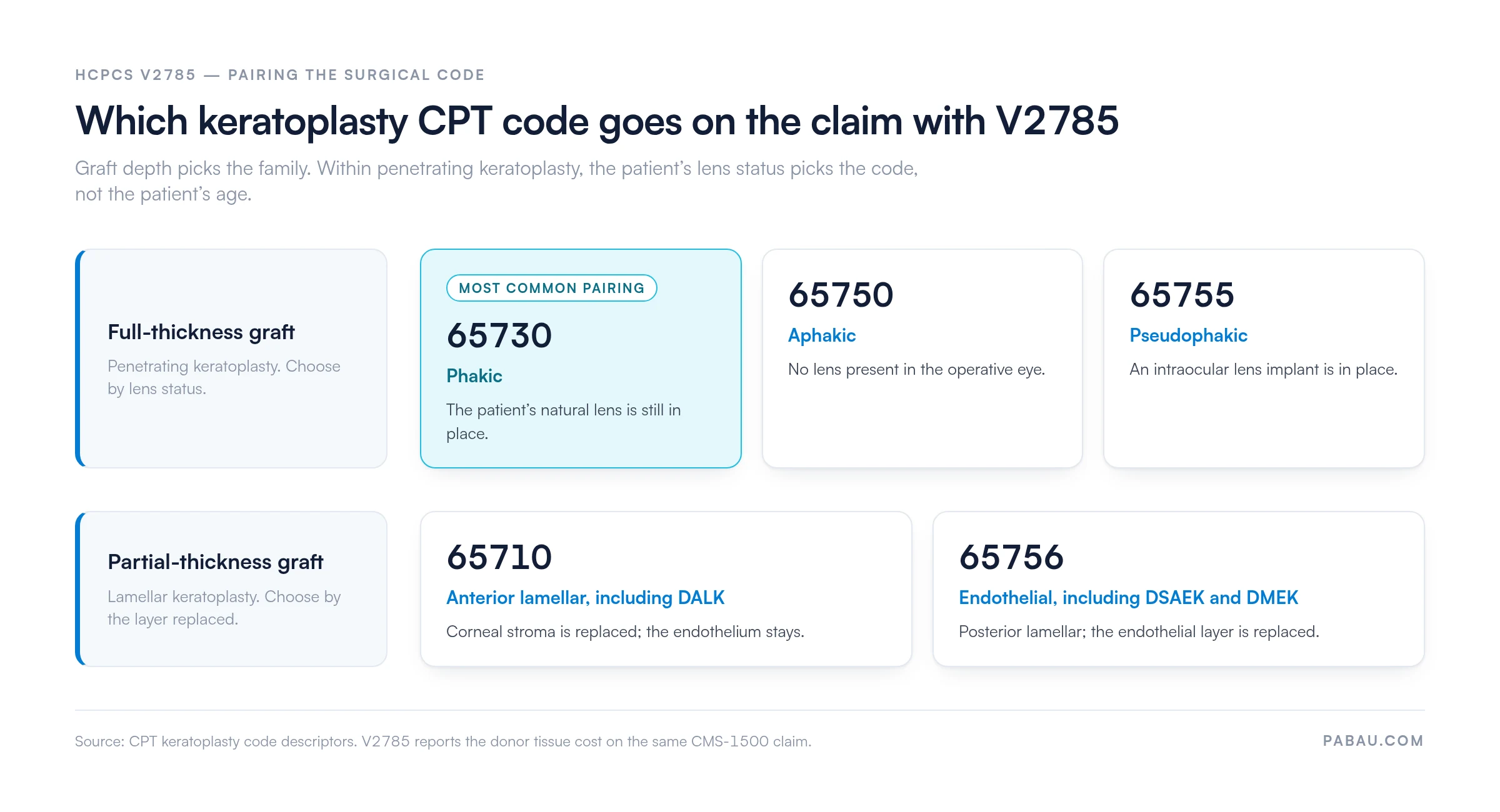
Always verify current Correct Coding Initiative (CCI) edits before billing V2785 alongside these CPT codes. Bundling conflicts vary by payer policy and by MAC jurisdiction, and an unchecked edit turns into a denial on the combined claim.
The diagnosis code on a V2785 claim must establish medical necessity for corneal transplantation. The codes most commonly accepted by MACs fall within the H17 and H18 ranges, covering corneal opacities and corneal dystrophies.
Check each one against your MAC’s LCD and the current CMS ICD-10-CM code files. Our library of ICD-10-CM codes breaks the H17 and H18 ranges down code by code.
The keratoconus codes carry a sixth character for laterality, so H18.611, H18.612 and H18.613 report a stable right, left or bilateral cone. Use the laterality the operative note supports and reserve the 9 ending for cases where it genuinely is not documented. A category code such as H18.60 has no sixth character and will reject as non-billable.
Verify covered diagnoses against the applicable MAC LCD before submission. Diagnosis codes not listed in a MAC’s LCD for corneal transplant may trigger a medical necessity denial regardless of clinical appropriateness.
Documentation is where most V2785 denials originate. Every corneal transplant claim needs a complete documentation trail, and each element below serves a specific audit and reimbursement purpose. Assemble it while the case is fresh, because a MAC can request records months after the claim is paid.
Denials on V2785 cluster into seven patterns. Each one has a check that catches it before the claim leaves the practice.
Build a five-item V2785 pre-submission checklist. It should confirm that the eye bank invoice is attached, the form is a CMS-1500, and the place of service code matches the setting. It should also confirm the ICD-10-CM codes against the MAC LCD and match Box 24F to the invoice. Run it on every corneal transplant claim.
Ophthalmic billing teams handling corneal transplants work with two adjacent V-series codes and the full set of keratoplasty CPT codes. Claims management software that surfaces related codes inside the billing workflow cuts the manual cross-reference time. The AAPC HCPCS code lookup is a useful second check on any V-series descriptor.
In most ophthalmic practices the evidence for a V2785 claim lives in three places. The eye bank invoice arrives by email, the operative report sits in the surgical record, and the diagnosis codes sit in the billing system. Assembling them at submission costs a coder several minutes per claim, and reassembling them for an appeal costs far more.
Practice management software like Pabau keeps that evidence attached to the patient record instead. The operative note, the uploaded invoice and the coded diagnosis stay in one file. Pabau’s claims management tools then track each submitted claim through to adjudication. When a MAC asks for supporting documentation, the coder opens a single record rather than three systems.
For a practice running steady corneal transplant volume, that changes the economics of the appeal. A denial gets answered from documentation that was already linked to the claim. Reimbursement lands on the first or second pass rather than the third.

Pabau’s claims management software keeps clinical documentation, diagnosis codes and claim status in one place. Your billing team submits accurate V2785 claims the first time.

Corneal transplant billing usually fails at the submission step rather than in the operating room. A missing invoice, a wrong place of service code, or a keratoconus code without its laterality digit is enough. Payment stops on tissue the practice has already bought.
The fix is unglamorous and it works. Write the pre-submission checklist down once and run it on every V2785 claim. The denials that survive it will be policy disagreements worth appealing rather than clerical errors. Book a demo to see how Pabau keeps V2785 documentation and claim status in one place for ophthalmic practices.

Need a structured approach to billing workflow compliance? Medical billing compliance guide covers the key compliance requirements for US practices billing Medicare and commercial payers.
Want to understand how denials are classified and resolved? Denial management in healthcare explains adjustment reason codes, root cause analysis, and appeal workflows.
Building the charge document behind the claim? What a superbill needs to contain walks through the fields payers expect on every itemized charge sheet.
Checking Part B coverage before the procedure date? Insurance eligibility verification sets out what to confirm at intake and how often to re-check it.
Looking for the best billing software options for US practices? Best medical billing software for US practices compares leading platforms for claims submission and revenue cycle management.
HCPCS code V2785 covers the processing, preserving and transporting of corneal tissue for use in keratoplasty (corneal transplant) procedures. It reimburses the cost the eye bank charges to obtain, process and deliver the donor cornea. That cost is separate from the surgical CPT code billed for the transplant.
There is no 2026 fee schedule amount for V2785. CMS assigns the code pricing indicator 46, carrier priced, so no national or jurisdiction rate is published. Your MAC prices each claim from the eye bank invoice for that cornea. Bill the exact acquisition cost and keep the invoice on file.
Covered diagnoses include keratoconus, central corneal opacities (H17.10), hereditary corneal dystrophies (H18.509), and bullous keratopathy (H18.10). Keratoconus needs a billable six-character code such as H18.609, H18.619 or H18.629, or the laterality-specific variant the operative note supports. H18.60, H18.61 and H18.62 are category codes and will reject. Always cross-reference the applicable MAC local coverage determination before billing.
Medicare pays the acquisition cost the eye bank invoiced for that cornea. V2785 is carrier priced, so no fee schedule maximum exists to compare the invoice against. Bill the exact invoice total in Box 24F of the CMS-1500. Many MAC policies also require the original eye bank invoice as a claim attachment, and an unusually high charge can prompt medical review.
Yes. V2785 can be billed when the keratoplasty procedure is performed in an ambulatory surgery center (ASC) using place of service code 24. Use place of service 22 for outpatient hospital settings. Confirm the applicable MAC’s billing article for place of service requirements, as policies can differ by jurisdiction.
Lamellar grafts use 65710 (anterior lamellar, including DALK) or 65756 (endothelial, including DSAEK and DMEK). Penetrating keratoplasty uses 65730 (phakic), 65750 (aphakic) or 65755 (pseudophakic). Those three are distinguished by the patient’s lens status, not by age. Verify CCI edits for each pairing before submission.
Required documentation typically includes the original eye bank invoice and the surgeon’s operative report confirming keratoplasty. You also need the patient’s clinical record establishing medical necessity and signed informed consent. Proof of EBAA accreditation is required by some MACs. Review the applicable LCD for jurisdiction-specific requirements, including whether the invoice must be attached.