CCSD code H4430: Examination of rectum under anaesthetic
CCSD code H4430 pays for the examination alone CCSD code H4430 is the UK private...

Last Updated: Oct 20, 2026

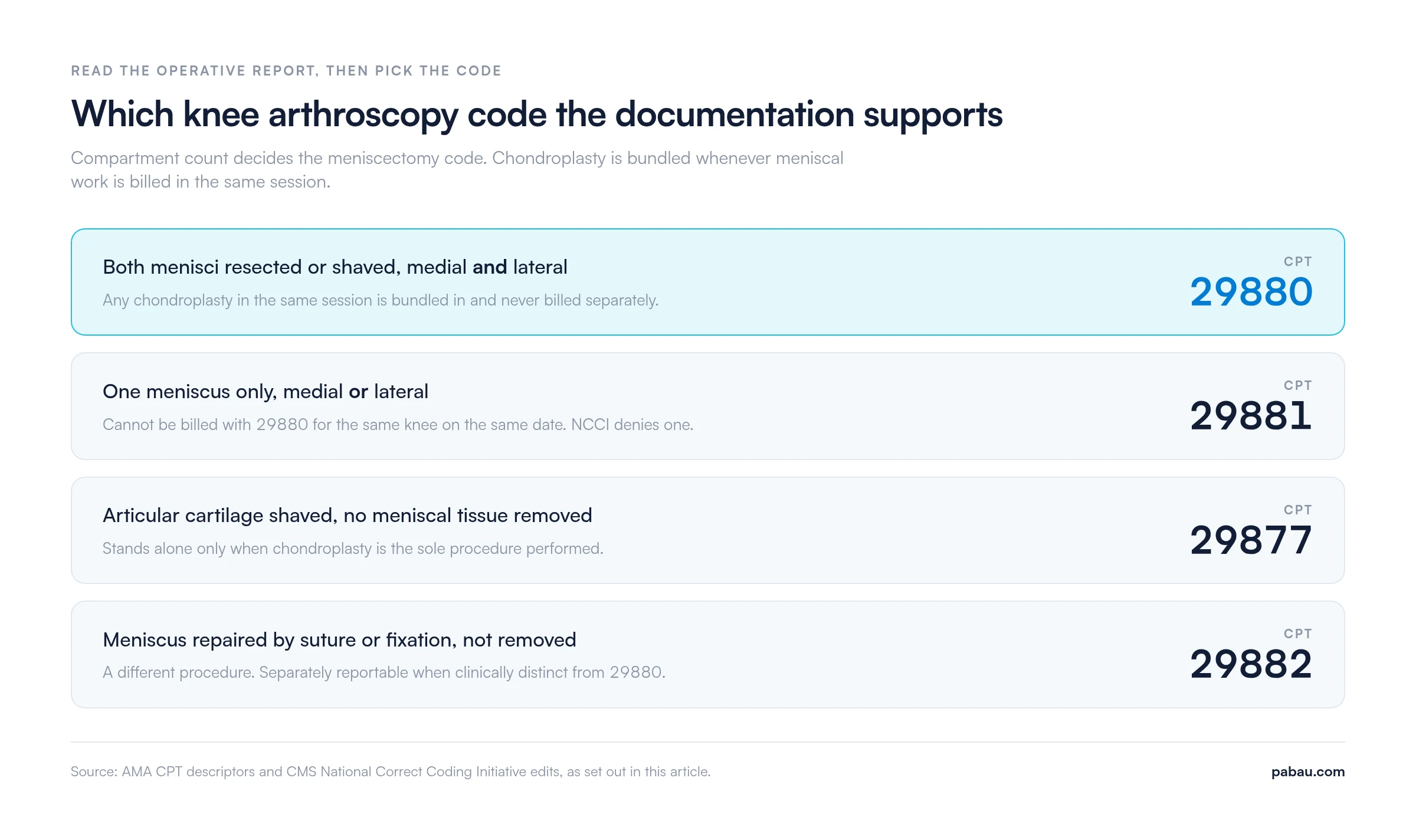
CPT Code 29880 describes knee arthroscopy with meniscectomy of both the medial and lateral compartments, including any meniscal shaving.
CPT 29881 covers a single-compartment meniscectomy. Billing 29881 and 29880 for the same knee on the same date triggers an NCCI bundling denial.
Chondroplasty performed in the same session is bundled into 29880 and is never reported with 29877 alongside it.
Medicare reimbursement varies by facility type and geographic location, so verify current rates at cms.gov before submitting claims.
Practice management software like Pabau attaches CPT codes at the point of care and validates modifiers before the claim leaves the practice.
CPT Code 29880 is the surgical code for knee arthroscopy with meniscectomy of both the medial and lateral compartments, including any meniscal shaving.
Chondroplasty performed in the same session is bundled into it. A meniscectomy in only one compartment belongs on CPT 29881 instead.
The sections below cover the AMA descriptor, the 29880 versus 29881 split, and the modifier rules. They also cover ICD-10 pairings, Medicare reimbursement context, and the documentation payers ask to see.
CPT Code 29880 is maintained by the American Medical Association (AMA) under the Endoscopy/Arthroscopy section of the CPT code set. Its official descriptor reads as follows.
Arthroscopy, knee, surgical; with meniscectomy (medial AND lateral, including any meniscal shaving), including debridement/shaving of articular cartilage (chondroplasty), same or separate compartment(s), when performed.
Three elements define whether 29880 applies. First, both the medial and lateral menisci are removed or shaved, not just one. Second, the procedure is arthroscopic rather than open. Third, any chondroplasty performed in the same session is bundled into this code and cannot be separately reported.
The surgeon inserts an arthroscope into the knee joint and resects torn or damaged meniscal tissue from both the medial and lateral compartments. When the surgeon also shaves articular cartilage in any compartment during the same session, that chondroplasty is included in 29880 with no separate code.
The meniscal shaving component covers partial or subtotal removal. Full meniscectomy of both compartments is also captured under 29880. What matters for coding is that the surgeon operated on both compartments, regardless of how much tissue came out of each.
The single-digit difference between 29880 and 29881 carries a clinically significant distinction. CPT 29881 covers meniscectomy in only one compartment, medial or lateral, while 29880 requires both. Submitting 29880 when the operative report documents work in a single compartment is upcoding. Using 29881 when the surgeon addressed both compartments leaves revenue on the table.
The National Correct Coding Initiative (NCCI) explicitly bundles these two codes. If both are submitted for the same knee on the same date of service, one is denied automatically. The code selection has to match the operative report precisely, and the NCCI policy manual is the definitive source on how the bundle behaves.
Compartment count is not the only decision here. When the surgeon sutured both menisci rather than removing tissue, the session is coded 29883, not 29880.
Coders handling knee arthroscopy claims regularly meet three adjacent codes that are easy to confuse with CPT Code 29880. Knowing what each one covers prevents miscoding and the payer edits that follow it.
The most common miscoding error in this family is submitting 29877 alongside 29880. When 29880 is billed, any chondroplasty in the same session is already bundled. Separately reporting 29877 on the same date for the same knee triggers an NCCI edit denial.
Diagnostic arthroscopy raises the same question. CPT 29870 is a separate procedure code, so it bundles into any surgical knee scope on the same date. Modifier 59 does not unbundle it from 29880.
Lysis of adhesions resolves the same way. A release performed in the same session and coded 29884 bundles into 29880, the more comprehensive procedure. Modifier 59 does not break that edit either.
Confirm with your MAC’s local coverage determination (LCD) for any additional bundling rules in your region. The panel below maps each documented finding to the code it supports.
Check your payer’s NCCI edit table quarterly. CMS updates NCCI edits four times a year, and bundling rules for knee arthroscopy codes can shift with each release. A modifier that cleared a claim last quarter may not clear it today without additional documentation support.
Medicare payments for CPT Code 29880 come from the Medicare Physician Fee Schedule (MPFS). The schedule applies relative value units (RVUs), adjusted for geographic practice cost index (GPCI) factors. Rates change each January with the MPFS update, so the figures below reflect the general 2025 to 2026 range. Always verify current rates at cms.gov before submitting claims.
Commercial payers commonly require prior authorization for CPT 29880, though the requirements vary by plan. Verify them with each payer before the procedure is scheduled. Medicare generally does not require prior authorization for knee arthroscopy, but MAC LCDs may impose coverage conditions tied to diagnosis coding and documentation.
Modifier use on CPT Code 29880 claims is an OIG audit focus area. Incorrect modifier application is a leading cause of denial and post-payment audit risk for knee arthroscopy. The table below covers the modifiers most often applied to 29880 and the conditions for each.
Never append modifier 59 or an X-modifier without documented clinical justification in the operative report. Per CMS coding guidance, modifier use that is inconsistent with clinical documentation is a primary trigger for Medicare audit activity.
Loose body removal is one pairing where an X-modifier can be correct. CPT 29874 may be separately reportable with 29880 when the note documents a distinct loose body. Check the current NCCI table first.
Medical necessity for CPT Code 29880 has to be supported by an ICD-10-CM diagnosis that reflects the condition requiring meniscectomy in both compartments. The diagnosis must appear in the medical record and match what the surgeon reported in the operative note.
Our ICD-10-CM code reference carries the full code set. The codes below are the ones paired with 29880 most often on orthopedic claims.
ICD-10 code selection must reflect the confirmed pathology rather than the suspected diagnosis. Verify each pairing against your MAC’s local coverage determination for knee arthroscopy. Payer LCDs sometimes restrict coverage to specific ICD-10 codes, or require documentation that conservative treatment failed before arthroscopic intervention is approved.
A complete operative report is the foundation of a clean CPT Code 29880 claim. Payers audit these records closely, because knee arthroscopy has long been a high-volume, high-value code exposed to both upcoding and unbundling errors.
The operative note must identify which compartments were treated. “Both compartments” is not enough on its own. The report should name the medial and lateral menisci separately and describe what was done in each. Chondroplasty belongs in the note too, even though it generates no separate code under 29880.
Most MAC LCDs require evidence that conservative management was attempted before arthroscopic meniscectomy is approved. The record should carry a documented history of physical therapy, NSAIDs, or other non-surgical treatment. It also needs to state why that treatment failed or was contraindicated.
Some MACs have issued specific LCDs for knee arthroscopy that limit the covered indications. Several also require the accompanying imaging report, usually the MRI findings, to be referenced in the operative record. Confirm with your MAC before assuming coverage.
A clean claim for CPT Code 29880 gets every field right. That means the place of service, the rendering provider NPI, the modifier, and the diagnosis code the operative findings support. Any mismatch between the claim and the operative report is grounds for denial or recoupment.
Knee arthroscopy billing generates a predictable set of coding errors. Most of them start with a misread operative report rather than deliberate miscoding. The five below account for the majority of CPT Code 29880 denials and audit findings.
Effective denial management workflows catch these errors before they turn into recoupment demands. Practices that review denial patterns by code family spot systemic coding issues faster than those working through denials one at a time.
A wrong-code error can also come from a number in the chart rather than a misread report. HCPCS code K0801 covers a documented weight of 301 to 450 pounds, with K0800 below that and K0802 above 450. Billing the wrong band, or no weight at all, is a routine denial.
Run a monthly audit of all CPT 29880 claims against operative reports. Compare the compartments documented in the operative note with the code billed. If your denial rate on 29880 exceeds 5%, the most likely cause is a 29880/29881 selection error in your coding workflow.
Orthopedic practices billing CPT Code 29880 at volume hit a predictable bottleneck. Every claim needs the operative report cross-referenced and the compartment documentation confirmed. Then the coder picks the right code from the 29877 to 29882 family and attaches a supported ICD-10 diagnosis.
Each of those steps is manual in a reference-only workflow. Practice management software like Pabau attaches the code, the modifier and the diagnosis to the operative note as it is written. That is what cleaner claims management software buys a surgical practice. Fewer claims come back for rework.
Pabau integrates with the Claim.MD clearinghouse. Orthopedic practices submit 29880 claims electronically and validate them against payer edits in real time, then receive electronic remittance advice in the same platform. The integration supports CMS-1500 and 837P formats, eligibility verification, and secondary claim submission.
For a surgical practice, that removes the switching between clinical documentation, code lookup, and claim submission that drives most manual coding errors.

Pabau attaches CPT codes at the point of care, validates modifiers before submission, and routes claims through your clearinghouse automatically. See how it works for surgical practices.

CPT Code 29880 is straightforward when the operative report names both compartments and what was done in each. Denials and audit exposure come from code selection that does not match the documented procedure. They also come from modifiers applied without justification, and from chondroplasty billed separately when it is already bundled.
The practical move is to audit the coding step, not the surgery. If a coder reads the operative note before choosing from the 29877 to 29882 family, most of these denials never leave the building.
Book a demo to see how Pabau keeps the code, the modifier and the diagnosis attached to the note that supports them.

Need a complete overview of medical billing workflows? What is medical billing covers the end-to-end revenue cycle process for clinical practices.
Want to understand how claim denials are categorized? Denial management in healthcare explains CARC codes, denial workflows, and prevention strategies.
Looking for guidance on clean claim submission standards? Clean claim submission outlines the field-level requirements that prevent payer rejections before they happen.
CPT Code 29880 is knee arthroscopy with surgical meniscectomy of both the medial and lateral compartments, including any meniscal shaving. When articular cartilage shaving (chondroplasty) is performed in the same session, that work is bundled into 29880 and cannot be reported separately.
CPT 29880 covers meniscectomy in both compartments, medial and lateral. CPT 29881 covers a meniscectomy in one compartment only. NCCI edits prevent billing both codes for the same knee on the same date, and submitting both denies the lesser-valued code.
Medicare reimbursement for CPT 29880 typically runs from roughly $800 to $1,000 nationally for facility-based procedures, adjusted for geographic GPCI factors. Rates change annually with the Medicare Physician Fee Schedule update. Verify current figures in the CMS MPFS lookup tool at cms.gov before submitting claims.
RT and LT carry laterality, and modifier 50 applies when both knees are operated on in the same session. Modifier 51 covers multiple procedures. Modifier 59, or the preferred X-modifiers such as XS and XU, applies when a distinct service overrides an NCCI edit. Every modifier must be supported by the operative report.
No. NCCI bundling edits prevent CPT 29880 and CPT 29881 from being billed for the same knee on the same date. Bill 29880 alone if the surgeon addressed both compartments, and 29881 alone if only one was treated. Submitting both denies the lower-valued code automatically.
The operative report must document surgical work in both the medial and lateral compartments. It must also record the nature and extent of the meniscal pathology, any chondroplasty performed, and the pre- and post-operative diagnoses. Many MAC LCDs also require evidence of failed conservative treatment, such as physical therapy or NSAIDs.
Common pairings include M23.206, M23.207 and M23.209 for meniscus derangement due to an old tear, plus M23.200 and M23.201 for lateral meniscus specificity by side. M23.30 covers other meniscal derangements. S83.200A covers an acute bucket-handle tear of the right knee, and M17.11 covers primary osteoarthritis of the right knee. Always code to the highest specificity and check your MAC’s LCD.