CCSD Code K2542: Revision replacement of mitral valve
What CCSD code K2542 covers CCSD code K2542 is the UK private healthcare code fo...

Last Updated: Oct 22, 2026

CPT Code 99442 no longer exists. The AMA deleted 99441, 99442, and 99443 effective January 1, 2025. A claim carrying 99442 for a 2025 or later date of service is rejected as an invalid code.
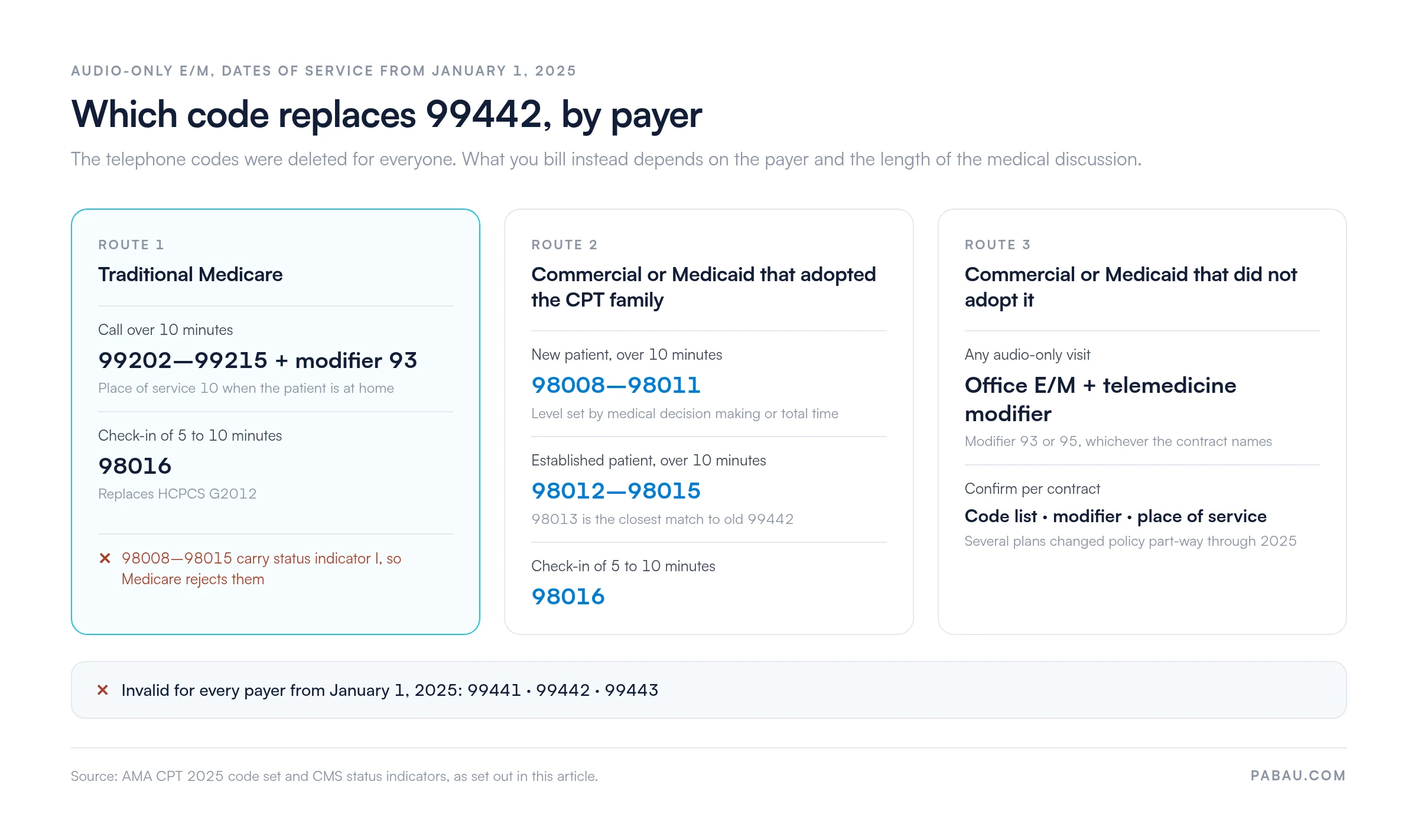
The replacement is the 98000-98016 telemedicine family. Audio-only visits map to 98008-98011 for new patients and 98012-98015 for established patients, with 98016 covering a brief 5-10 minute check-in.
Medicare does not accept 98000-98015. CMS gave those codes status indicator I, which means invalid for Medicare. Bill Medicare audio-only visits with the standard office E/M codes plus modifier 93, and use place of service 10 when the patient is at home.
Commercial and Medicaid payers vary. Some have adopted 98012-98015 outright, others still want an office E/M code with a telemedicine modifier, so confirm the policy per contract.
Practice management software like Pabau holds the current code set in its charge templates and captures call duration at the point of care. Claims route through the Claim.MD clearinghouse before a deleted code reaches a payer.
CPT Code 99442 is a deleted code. The AMA removed the telephone evaluation and management family, 99441 through 99443, from the CPT code set effective January 1, 2025.
Practices that still have those codes in a charge template are producing claims that payers reject outright. The rejection reads as an invalid procedure code, not a coverage problem. This guide covers what 99442 used to describe and which codes replaced it. It also explains why Medicare refuses most of the replacements, and what to bill instead so your medical billing workflows stay clean.
No. CPT 99442 was deleted on January 1, 2025, along with 99441 and 99443. A deleted code is not a non-covered code. It no longer exists in the code set at all, so no payer can adjudicate it, and no contract can reinstate it.
The distinction matters for how you fix the problem. A non-covered code produces a denial you might appeal. A deleted code produces a front-end rejection from the clearinghouse or the payer’s edit engine. There is nothing to appeal. The claim has to be rebuilt with a code that exists.
Claims for dates of service on or before December 31, 2024 are the one exception. If you are still working an old accounts receivable balance, 99442 remains the correct code for that date of service. The payer’s timely filing limit still applies.
Until the end of 2024, CPT 99442 covered a telephone evaluation and management service of 11 to 20 minutes. A physician or other qualified healthcare professional (QHP) had to provide it to an established patient, parent, or guardian. The table below records the code as it stood. That helps when you are reconciling older claims or reading a payer policy nobody has refreshed.
Source: American Medical Association CPT code set, CY2025 changes, cross-checked against the AAPC Codify CPT lookup.
The CPT Editorial Panel built a new telemedicine E/M section, 98000 through 98016, for CY2025. Codes 98000 through 98007 cover audio-video visits. Codes 98008 through 98015 cover audio-only visits and are the direct successors to the deleted telephone codes. Code 98016 covers a brief check-in and takes over from HCPCS G2012.
Two changes go beyond the numbers. Audio-only visits are now available for new patients, which the telephone codes never allowed. Level selection now follows medical decision making or total time, the same way an office visit does. A single duration band no longer decides it.
Codes 98008 through 98015 all require more than 10 minutes of medical discussion. A shorter call falls to 98016, or to no separately reportable service at all. The 7-day and 24-hour rules that governed 99442 carried over to 98016. A check-in tied to a recent visit or an imminent appointment is still bundled.
The closest single substitute for 99442 is 98013. Both sit at the mid-point of their family and both assume an established patient with a call of roughly 11 to 20 minutes. Treat that mapping as a starting point for rebuilding charge templates, not a billing rule. The new code also needs the medical decision making to line up.
A provider phoning a colleague for advice never fell under 99442, which required a QHP treating an established patient, parent, or guardian. So that exchange stays out of the 98008 through 98016 remap. The consulting specialist reports CPT 99451 instead, and the code requires a written report to the requesting physician.
Medicare does not accept the new audio-only codes. CMS assigned 98000 through 98015 a status indicator of I, which means invalid for Medicare purposes. CMS treats the family as duplicative of the office visit codes it already pays for, so it kept practices on the existing E/M set.
For a Medicare audio-only encounter, report the standard office or other outpatient E/M code, 99202 through 99215, at the level the visit supports. Append modifier 93 to show the service was audio-only. Use place of service 10 when the patient is at home, since Medicare’s audio-only payment does not extend to a patient sitting in a facility.
Practices submitting these claims electronically route them through a clearinghouse. Practice management software like Pabau integrates with Claim.MD, which connects to thousands of US payers. That route handles CMS-1500 and 837P submissions, real-time eligibility checks, and remittance advice processing. Watch the same reporting each month, so a payer’s mid-year policy change surfaces there rather than in a stack of rejections.
Commercial payers split three ways on the new audio-only codes. Some adopted 98012 through 98015 on schedule and pay them as ordinary E/M services. Some rejected the family the way Medicare did and want an office E/M code with a telemedicine modifier. Others accept the codes but price them below the equivalent in-person visit.
State Medicaid programs vary just as widely, and several updated their fee schedules part-way through 2025 rather than on January 1. Before you bill an audio-only visit to any non-Medicare payer, check three points. Does the plan recognize 98008 through 98016? Which modifier and place of service does it expect? And what does it pay relative to the in-person visit? Keeping that grid current is straightforward compliance work that pays for itself in avoided rework.
Physicians and other qualified healthcare professionals who report E/M services independently may bill audio-only visits. That covers physicians (MD/DO), nurse practitioners, and physician assistants, within state scope of practice and each payer’s credentialing rules.
Incident-to billing does not apply, because the patient is not physically in the office. Nurse practitioners and physician assistants bill under their own NPI for these encounters. State supervision requirements still differ, so confirm your own state’s rules before a clinician bills independently.
Documentation is the second-most-common denial trigger for audio-only claims, after code selection. The record has to support the level billed and show that the encounter genuinely happened by phone. Treat it as clean-claim discipline. Every required element is present before the claim leaves the practice.
CMS retired the Certificate of Medical Necessity and the DME Information Form for dates of service from January 1, 2023. A supplier billing HCPCS code B4197 now supports medical necessity from records kept on file and produced on request.
Search your charge master, EHR favorites list, and superbill templates for the strings 99441, 99442, and 99443. Deleted codes usually survive in a saved favorite long after the coding team has moved on. The clinician who picks one is not at fault. Replace each entry with the matching 98008-98016 code, and add a separate Medicare-facing entry for the office E/M code plus modifier 93.
Modifier choice now carries more weight than it did under 99442. The same office E/M code can describe an in-person visit, a video visit, or a phone call. The modifier is what tells the payer which one happened.
Place of service belongs in the same check. Medicare expects POS 10 for a patient at home and POS 02 for a patient at another site, and the two pay differently. Confirm both the modifier and the POS with each payer before submission.
Teams rebuilding their templates usually want a one-to-one crosswalk. There is no official crosswalk, because the old codes were purely time-based and the new ones are not. The table below is a practical mapping for established-patient calls, with the Medicare alternative alongside.
Treat the middle column as a default, not a rule. Level selection under 98008 through 98015 follows medical decision making or total time. A 15-minute call about a complex problem can support a higher code than the old time band suggests. On the Medicare side, an 11 to 20 minute established-patient call usually lands on 99213. The chart below sets out all three routes side by side.
Most audio-only rejections in 2025 and 2026 trace back to a code set that was never updated. Strong denial management processes start with knowing which error types appear most often, then building upstream checks that catch them before submission.
The CARC and RARC reason codes attached to telemedicine rejections are covered in our guide to common denial codes. Review your ERA remittance data against it after each claim cycle.
Other specialties face the same stale-template rejections. The AMA retired the lower extremity revascularization family on January 1, 2026. A claim carrying 37221 for a 2026 date of service is rejected.
Run a rejection report filtered to invalid procedure codes for the past 12 months. If 99441, 99442, or 99443 shows up on a 2025 or later date of service, count how many distinct clinicians submitted it. One clinician is a training issue. Several means the deleted codes are still live in a shared template, and fixing the template retires the problem in one change.
The diagnosis code has to support the medical necessity of the encounter, and that requirement did not change when the procedure codes did. Practices that pair codes without a documented clinical rationale face extra scrutiny during audits. Below are the diagnoses seen most often on audio-only claims across primary care and common specialties.
A code deletion is a workflow problem before it is a billing problem. The clinician picks a favorite, the charge posts, and nobody sees the rejection for a week. Pabau closes that loop upstream, at the point where the charge is created.
Pabau’s claims management software holds the current procedure codes in shared charge templates. Retire a code once and it stops being selectable for everyone, rather than practice by practice. Documentation templates for audio-only encounters prompt clinicians to record exact call start and end times, patient location, and modality. Those three fields decide the level and the place of service.
Claims then route through the integrated Claim.MD clearinghouse. That scrub catches missing modifiers and mismatched identifiers before the payer sees them. An omitted modifier 93 would otherwise cost you a full claim cycle.
Practices running phone and video visits can log the encounter in Pabau and produce a superbill for downstream billing. The outcome you are buying is fewer first-pass rejections and less rework, so your billers spend their time on appeals worth making.

Pabau keeps your procedure codes current and captures call duration and patient location at the point of care. Claims route through the Claim.MD clearinghouse, so a deleted code like 99442 never reaches a payer.

CPT Code 99442 is gone, and the fix is mechanical rather than clinical. Remove 99441 through 99443 from every template, then map established-patient calls to 98012 through 98015. Send Medicare audio-only visits as an office E/M code with modifier 93 and place of service 10. Check each commercial and Medicaid contract separately, because adoption of the new family is still uneven.
A deletion this clean rarely starts a coding argument. It starts with a template nobody refreshed, and it ends in a rejection queue three weeks later. Pabau keeps the code set, the documentation prompts, and the clearinghouse connection in one workflow. The next annual CPT update then lands in your templates instead. To see how that works on your own charge sheet, book a demo with the Pabau team.

Need to understand how clean claims reduce rework? Clean claim submission guide covers the data elements that prevent first-pass rejections across CPT codes.
Want to track denials systematically? Denial management in healthcare walks through appeal workflows and CARC code interpretation.
Looking for a broader overview of the billing process? What is medical billing explains the full claim lifecycle from encounter to payment.
Unsure what a clearinghouse actually checks? Medical claims clearinghouse explains the scrubbing that catches an invalid code before the payer does.
Keeping your payer policy grid current? Medical billing compliance covers the checks that stop an annual code change reaching a claim.
No. The AMA deleted CPT codes 99441, 99442, and 99443 from the CPT code set effective January 1, 2025. A claim carrying 99442 for a date of service in 2025 or later will be rejected as an invalid procedure code. The code remains correct only for dates of service through December 31, 2024.
The CPT Editorial Panel introduced the 98000-98016 telemedicine family for CY2025. Audio-only visits now use 98008-98011 for new patients and 98012-98015 for established patients, with the level set by medical decision making or total time. Code 98016 covers a brief 5-10 minute check-in and replaces HCPCS G2012.
Medicare does not accept 98000-98015, which CMS gave a status indicator of I, meaning invalid. Report the standard office E/M code, 99202 through 99215, at the level the visit supports, and append modifier 93 to show the encounter was audio-only. Use place of service 10 when the patient is at home. Code 98016 is the one new code Medicare does pay.
Some do and some do not. A number of commercial and Medicaid plans adopted 98012-98015 for established-patient audio-only visits. Others followed Medicare and want an office E/M code with a telemedicine modifier instead. Confirm the code list, the modifier, and the place of service in each contract before you bill.
Record the exact start and end time of the medical discussion. Note that the encounter was audio-only, where the patient was during the call, and whether the patient is new or established. Add the medical decision making that supports the level billed, plus verbal consent where your state or payer requires it. Finish with the rendering provider’s name and NPI, and a brief assessment and plan.
Common pairings include Z71.89 (other specified counseling), I10 (essential hypertension), and E11.9 (type 2 diabetes mellitus without complications). J06.9 (acute upper respiratory infection) and F32.9 (major depressive disorder) also appear often. Use M54.50, M54.51, or M54.59 rather than M54.5, which was retired on October 1, 2021. The diagnosis must reflect the clinical reason for the call.
Yes. Nurse practitioners and physician assistants credentialed to report E/M services independently may bill audio-only E/M visits, subject to state scope of practice rules. Incident-to billing does not apply when the patient is not in the office, so each clinician bills under their own NPI.