

CCSD code G5100: Bypass of duodenum billing guide
CCSD code G5100 bills a bypass that leaves the duodenum in place CCSD code G5100...

Last Updated: Oct 16, 2026
S0353 is the HCPCS Level II code for treatment planning and care coordination management for cancer, initial treatment.
Two errors drive most denials on this code. The first is submitting a non-Medicare code to Medicare. The second is treating S0353 as a per-meeting charge and billing it again for every planning session.
Let Pabau's smart automation suggest the right codes, reduce claim denials, and keep your practice compliant—effortlessly.
Automate repetitive tasks and focus on what matters most—your patients.
Reduce coding errors and ensure compliance with the latest regulations.
Clean claims, fewer denials, and faster reimbursements.
Powerful insights and reporting to help your practice thrive.
HIPAA compliant SOC 2 certified GDPR-compliant Trusted by 4,000+ clinics worldwide

HCPCS code S0353 covers treatment planning and care coordination management for cancer, initial treatment. It is billed once per patient, at the onset of treatment.
S0353 is not repeatable and is not billed per meeting. There is no second S0353 for the same course of care.
S0354 is the companion code for an established patient with a documented change of regimen. Payers reimburse it no more than monthly.
S0353 is a temporary national HCPCS Level II code that Medicare Part B does not cover. Medicaid and commercial payer coverage varies.
Practice management software like Pabau supports HCPCS code entry, payer-specific rule sets, and denial tracking for oncology billing teams.
HCPCS code S0353 describes treatment planning and care coordination management for cancer, initial treatment. It falls under the S-series of HCPCS Level II codes. These are temporary national codes maintained by CMS but used primarily by Medicaid programs and commercial payers, not Medicare.
The billing unit matters more than any other detail on this code. S0353 is reported once per patient, at the onset of treatment, when the initial cancer treatment plan is developed. It is not a per-meeting or per-session charge, and it does not repeat across the course of care.
Provider eligibility for S0353 is not universal. Payer policies differ, and submitting claims without confirming eligibility first is a common source of denials. As a baseline, these provider types are the ones most often associated with the code.
Credentialing and program enrollment requirements vary by payer. Amerigroup and Carelon Medical Benefits Management have historically required providers to join specific oncology quality programs to access enhanced reimbursement tied to codes like S0353. Verify enrollment status with each payer before billing.
S-series HCPCS codes were designed for non-Medicare use. That distinction is the single most important coverage fact about S0353.
The Anthem Virginia example is a useful reminder that payer policies change. A code that was billable in 2021 may no longer be reimbursable. Confirm current payer policy every plan year, not only at initial contracting.
There is no Medicare fee schedule rate for S0353, because Medicare does not recognize S-series codes. Reimbursement amounts are set by individual payer contracts and Medicaid state plans. The CMS Physician Fee Schedule lookup will not return a rate for this code.
Because S0353 pays once per patient, a contracted rate goes further than it looks on paper. There is no volume to model across a treatment course. Any repeat revenue for the same patient comes from S0354, and only when a regimen change is documented. Tracking the remittance advice from each payer is the most reliable way to confirm allowed amounts per contract.
Ongoing monthly care coordination for a patient with advanced cancer falls outside both S0353 and S0354. Some payer contracts cover that work under HCPCS code S0311, which is billed once per calendar month.
Free tools such as the AAPC HCPCS code lookup and PGM Billing’s HCPCS lookup tool confirm descriptor language and active status. Neither one displays payer-specific contracted rates for S-codes.
Request an updated fee schedule addendum from each payer that covers S0353 at the start of every plan year. Ask for the S0354 rate and its frequency rule in the same request. Commercial rates shift between contract cycles, and catching a reduction early gives you time to renegotiate.
Modifier usage for S0353 depends entirely on payer policy. Not every payer accepts the same modifier set for S-series codes, so confirm requirements before appending anything to a claim.
Always confirm modifier requirements in the payer’s provider portal or billing policy documents. Appending an incorrect modifier to S0353 is a common trigger for automated claim edits.
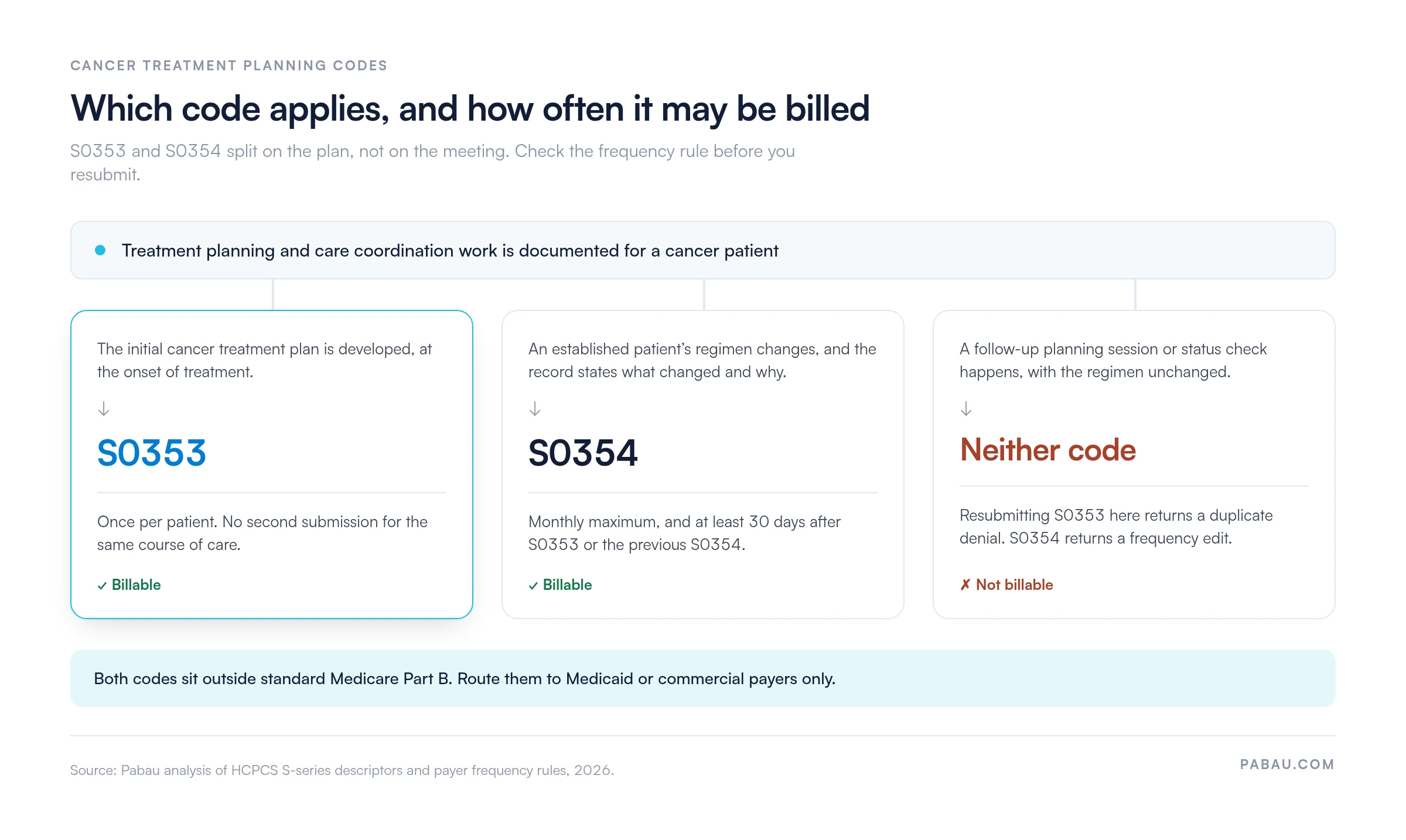
The plan, not the calendar, decides which of these two codes applies. S0353 reports the plan built at the onset of treatment. S0354 reports the replanning work triggered when an established patient’s regimen changes. Billing teams that read the pair as initial meeting and follow-up meeting submit S0354 far too often.
The frequency rules follow from that. S0353 has no repeat. S0354 is reimbursable no more than monthly, and it cannot be used within 30 days of the prior submission. Payers also expect at least 30 days to have passed since S0353 was reimbursed.
A routine follow-up visit does not qualify for S0354. Neither does a status check that leaves the regimen intact. The trigger is a change of regimen, and the record has to show what changed and why. The chart below shows where each of those three scenarios lands.
S0353 does not stand alone. Knowing the adjacent codes prevents billing the wrong one and helps build an accurate oncology billing workflow. The full HCPCS codes hub covers the rest of the S-series and the wider Level II set.
S0220 and S0221 are the codes practices often reach for when they want to bill a meeting. They are time-based conference codes with the patient present. S0353 is not one of them, which is why the per-meeting reading of S0353 fails at adjudication.
S0353 is submitted alongside the diagnosis that establishes the cancer being planned for. Payer medical necessity policies decide which combinations they accept, so confirm the requirement for each contract. These are the categories most often paired with the code.
Sequence the malignancy code first unless the payer’s policy says otherwise. A Z51 code on its own will not support medical necessity for S0353.
Documentation is where S0353 claims fall apart at audit. The code pays for a treatment plan, so the record has to show that a plan was actually produced. Reviewers look for the same core elements every time.
A structured treatment plan template inside the clinical record can pre-populate these fields, which lowers the risk of omission. Storing that documentation with the billing encounter creates a straightforward audit trail. For S0354, the record must additionally state what the regimen change was and what prompted it.
A structured workflow reduces denials. Follow these steps each time you bill S0353, starting with coverage verification before the plan is built.
Five errors account for the majority of S0353 denials. Catching them before submission costs far less than working them through denial management afterward.
Build a hard stop into your charge review for S0353. If the patient already has a paid S0353 on file, the charge should route for review rather than drop to a claim. That single rule removes the most expensive error on this code.
Tracking payer-specific rules for S-series codes by hand is where billing errors compound. An oncology practice billing S0353 across several payers faces different coverage rules, modifier sets, and diagnosis pairing requirements for each one. Frequency rules add another layer, since S0353 pays once and S0354 pays monthly at most.
Practice management software like Pabau reduces that load by centralizing HCPCS code entry with payer rule sets built in. Our claims management software can flag a wrong payer, a missing modifier, or a mismatched diagnosis before the claim goes out. It can also surface a prior paid S0353 on the same patient, so a duplicate never reaches the payer.
Pabau’s billing tools cover the whole revenue cycle, from claim scrubbing through to remittance reconciliation. Charges route through the scrubber first, so an S0353 claim with a wrong payer or a thin diagnosis is caught in-house. Denials that do come back are tracked by reason code, so a repeat pattern surfaces in weeks rather than at year end.

Pabau’s claims management software supports HCPCS code entry, payer-specific rule sets, and denial tracking. Your billing team spends less time chasing claims and more time on patient care.

S0353 pays for the initial cancer treatment plan, once per patient, at the onset of treatment. Read it as a per-meeting code and the claims deny as duplicates. Read it correctly and the follow-on revenue question narrows to S0354, and only where a regimen change is documented.
The code’s non-Medicare status is its other defining constraint, and misrouted claims still account for a large share of denials. Practices that verify coverage, check the patient’s S0353 history, and document the plan in full will see far fewer denial cycles. Pabau’s claims management software supports that workflow with payer rule sets, claim scrubbing, and denial tracking. To see how it works in practice, book a demo.

Need a reference for medical billing fundamentals? What is medical billing covers the end-to-end billing cycle for practices new to HCPCS workflows.
Want to reduce claim rejections before they happen? Clean claim best practices explains what payers check at adjudication and how to pass those edits first time.
Tracking denied S0353 claims? Denial management in healthcare outlines a systematic process for working, appealing, and preventing repeat denials.
HCPCS code S0353 is used to bill treatment planning and care coordination management for cancer, initial treatment. It is reported once per patient, at the onset of treatment, when the initial cancer treatment plan is developed. It is a temporary national HCPCS Level II code used by Medicaid programs and commercial payers, not by Medicare.
No. S0353 covers the initial cancer treatment plan and is billed once per patient, at the onset of treatment. It is not a per-meeting code and it does not repeat across a course of care. Where an established patient’s regimen changes later, S0354 is the code to consider instead.
No. S0353 is not covered under standard Medicare Part B. S-series HCPCS codes are temporary national codes maintained by CMS but excluded from Medicare coverage. Claims submitted to Medicare for this code are denied automatically.
Medicaid programs (varying by state), Amerigroup, Carelon Medical Benefits Management, and certain Blue Cross Blue Shield plans have historically accepted S0353. Coverage depends on the individual payer contract and, in some cases, oncology quality program enrollment. Anthem Virginia discontinued enhanced reimbursement tied to this code on December 31, 2022. Always verify current payer policy before submitting.
S0353 covers treatment planning and care coordination management for cancer, initial treatment, and is billed once per patient at the onset of treatment. S0354 covers the same management for an established patient with a change of regimen. S0354 is reimbursable no more than monthly, and not within 30 days of the prior use or of the reimbursed S0353. A routine follow-up meeting without a regimen change does not qualify for S0354.
Prior authorization requirements for S0353 vary by payer. Some commercial payers and Medicaid managed care organizations require it, particularly where coverage is tied to oncology quality program participation. Check the payer’s provider portal or call provider services before the treatment plan is built.
Yes. S0353 is a temporary national HCPCS Level II code in the S-series. CMS maintains the S-series for use by non-Medicare payers. Temporary codes can be added, revised, or deleted in annual HCPCS updates. Verify the code’s active status in the current CMS HCPCS file each year.



