CPT Code 62284: Injection procedure for myelography
CPT Code 62284: official descriptor and procedure overview The American Medical ...

Last Updated: Oct 19, 2026
A4618 is the HCPCS Level II code for breathing circuits.
Billing A4618 alongside a ventilator is the most common error with this code, and it never pays. It also covers the ventilator documentation, modifiers and medical billing workflow that do get paid in 2026.
Let Pabau's smart automation suggest the right codes, reduce claim denials, and keep your practice compliant—effortlessly.
Automate repetitive tasks and focus on what matters most—your patients.
Reduce coding errors and ensure compliance with the latest regulations.
Clean claims, fewer denials, and faster reimbursements.
Powerful insights and reporting to help your practice thrive.
HIPAA compliant SOC 2 certified GDPR-compliant Trusted by 4,000+ clinics worldwide

HCPCS code A4618 reports breathing circuits. Medicare pays nothing extra for a circuit used with a home ventilator.
Home ventilators E0465 and E0466 sit in the frequent and substantial servicing category, so the monthly rental covers every accessory and supply.
E0450, E0460, E0461, E0463 and E0464 were deleted on January 1, 2016. E0462 is a rocking bed, not a ventilator.
No LCD governs home ventilators. Coverage sits in NCD 240.9 and NCD 280.1, and every claim line needs an SC, GA, GY or GZ modifier.
Practice management software like Pabau keeps the order, the delivery proof and each rental month in one record. Billers can check a month before it is submitted.
HCPCS code A4618 describes “breathing circuits,” a durable medical equipment supply used with ventilators. According to the Centers for Medicare and Medicaid Services (CMS), A4618 belongs to the HCPCS Level II A4000-A4999 series for miscellaneous medical supplies. It is a supply code rather than a procedure code, so it reports the circuit itself and not the act of respiratory therapy.
A breathing circuit is the set of hoses and connectors that carries each ventilator breath to the patient. Noridian defines it that way in its billing instructions for the code, and adds an important limit. Breathing circuits are not used with oxygen equipment or nebulizers, so A4618 should never be billed for accessories on those devices.
Home ventilators fall in Medicare’s frequent and substantial servicing (FSS) payment category, and that monthly rental is all-inclusive. The DME MAC’s ventilator billing bulletin is explicit. There is “no separate payment by Medicare for any options, accessories or supplies used with a ventilator.”
Maintenance, servicing, repairs and replacement equipment sit in the same monthly amount, and claims for any of it are denied as unbundling. Noridian is explicit about this code too. Its breathing circuits article says A4618 “is not separately reimbursable” when it is billed with a ventilator.
The circuit is still expected, still replaced on schedule, and still the supplier’s responsibility. It is simply already paid for.
A4618 does have its own fee schedule line, which is why most billing systems let the charge through without complaint. That line belongs to non-ventilator use, and it does not apply on a ventilator patient’s account.
The two payment routes sit far apart, as the figures below show. For a home ventilator patient there is no circuit charge to bill. Noridian’s oxygen and nebulizer exclusion narrows the code’s scope further.
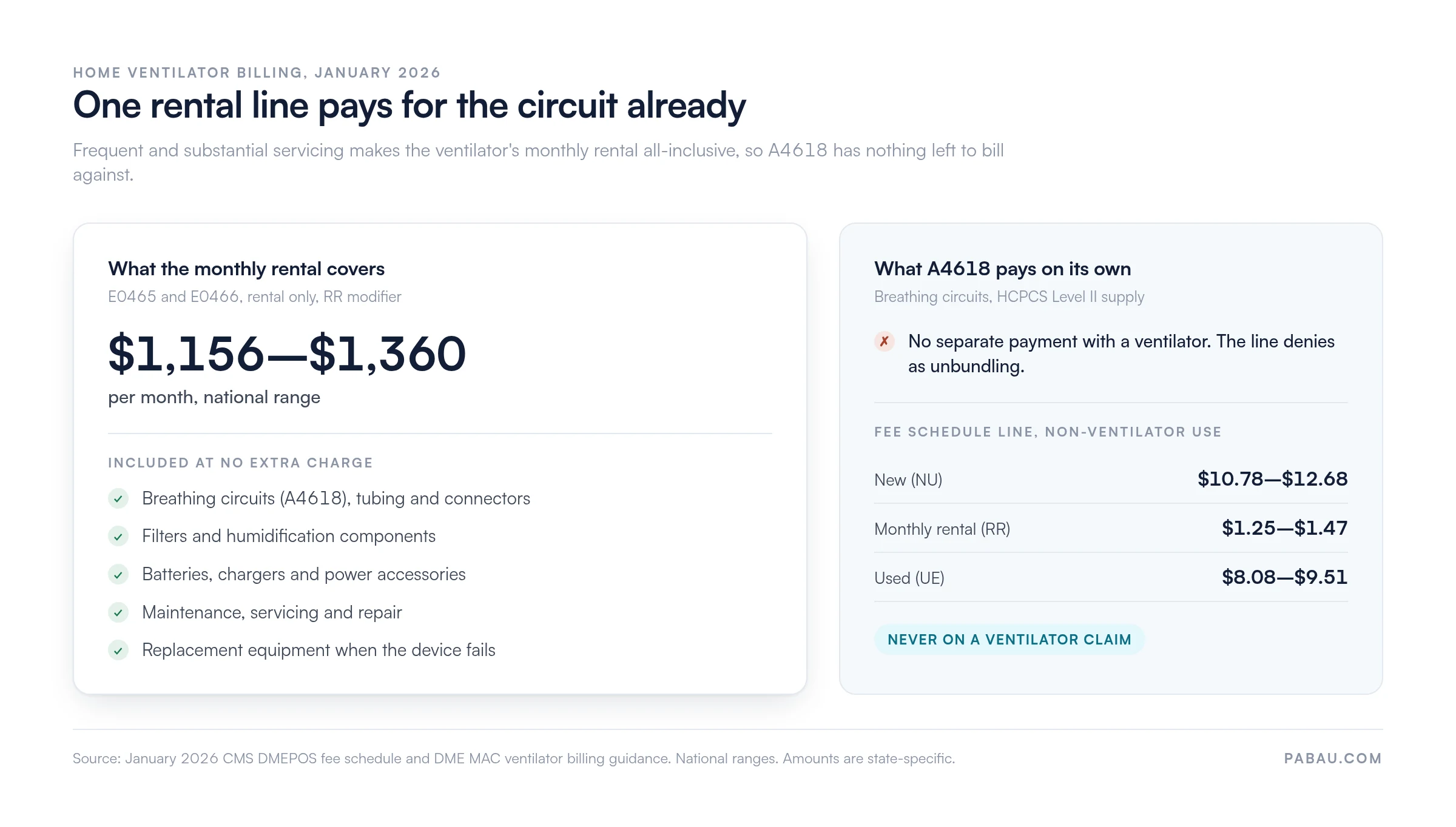
Treat any A4618 line on a ventilator patient as a workflow defect rather than a billing opportunity. The denial costs staff time to work, shows up in your unbundling statistics, and returns nothing even when it is appealed. Build the block into claim scrubbing so the line is stopped before submission rather than written off afterward.
No Local Coverage Determination governs home ventilators. In the absence of an LCD, the reasonable and necessary requirements sit in NCD 240.9 and NCD 280.1.
NCD 240.9 covers noninvasive positive pressure ventilation in the home for chronic respiratory failure consequent to COPD. NCD 280.1 is the durable medical equipment reference list. The coverage question is therefore about the ventilator, never about the circuit on its own.
Codes E0465, E0466, E0467 and E0468 are covered for neuromuscular diseases, thoracic restrictive diseases, and chronic respiratory failure consequent to COPD. Your DME MAC administers those rules for your jurisdiction. Noridian Healthcare Solutions handles Jurisdictions A and D. CGS Administrators handles Jurisdictions B and C.
One exclusion catches suppliers repeatedly. FSS payment is not available when a device classified as E0465, E0466, E0467 or E0468 is used to deliver CPAP or bi-level PAP therapy. That holds regardless of the underlying medical condition. PAP therapy belongs to the respiratory assist device codes under LCD L33800, where accessories are billed and paid separately.
There is no separate 2026 allowable to collect for A4618 on a ventilator patient. The payment arrives as the ventilator’s monthly rental instead.
Under the January 2026 DMEPOS fee schedule, E0465 and E0466 pay about $1,156 to $1,360 per month nationally. Payment is rental-only, with the RR modifier. That single amount covers the device, the circuits and every other supply.
A4618 also carries its own inexpensive or routinely purchased line, which is worth knowing so you can recognize it and ignore it. National figures for January 2026 run about $10.78 to $12.68 new (NU), $1.25 to $1.47 monthly rental (RR), and $8.08 to $9.51 used (UE).
Fee schedule amounts are state-specific, so confirm your own line in the CMS DMEPOS fee schedule file before you quote a number.
Documentation is where most ventilator denials originate, and it attaches to the device rather than the circuit. The written order comes from the treating practitioner, which for most home ventilator patients means a primary care or pulmonology practice. It must reach the supplier before delivery, not after a denial arrives.
Sound medical billing compliance practice keeps that order in the patient file and produces it on request during a MAC audit.
One requirement changes this year. Codes E0466, E0467 and E0468 join the CMS Face-to-Face and Written Order Prior to Delivery List on October 28, 2026.
From that date the treating practitioner must have documented an in-person or telehealth encounter within the six months before the written order. Check the current list before every delivery, because CMS revises it as payment thresholds move.
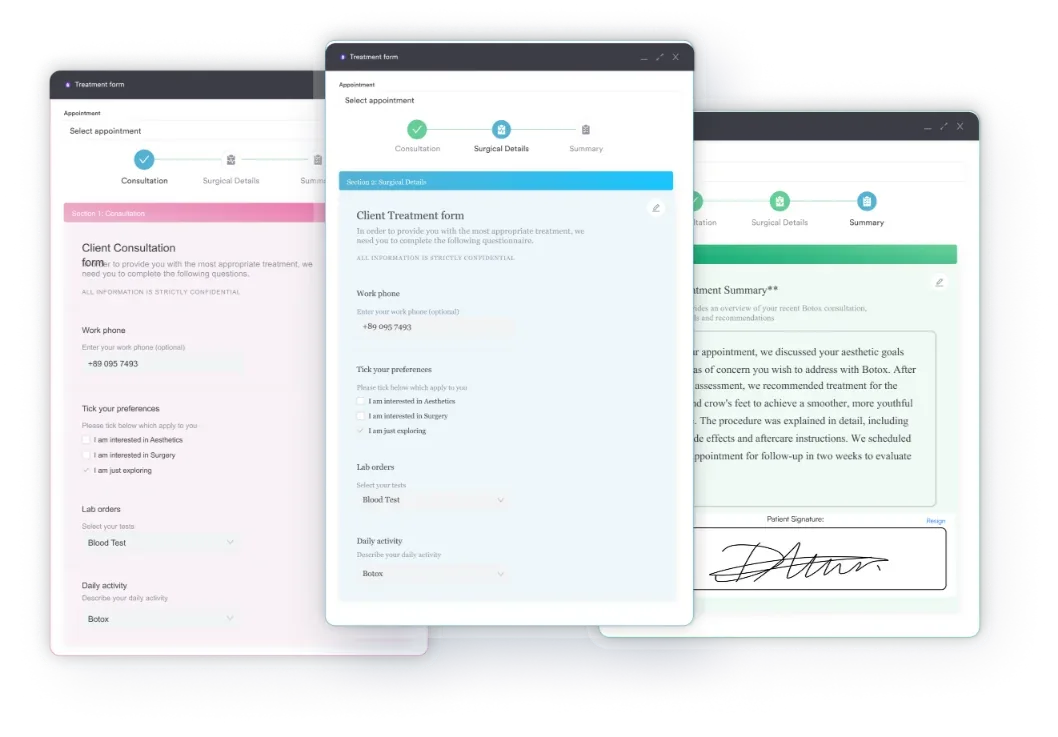
Practices that use digital intake forms to capture clinical and payer detail at intake submit more complete claims. Every field a ventilator claim needs can sit in the intake workflow, so nothing is reconstructed under audit pressure later.
The diagnosis codes below support the ventilator claim, which is the line that pays. Each one must be documented in the clinical record and must sit inside the conditions described in NCD 240.9 or NCD 280.1. Confirm the pairing against your DME MAC’s current guidance before billing, since coding advice for FSS items is revised often.
ALS and muscular dystrophy patients are usually co-managed across several disciplines. The qualifying diagnosis may sit in a physical therapy or neurology record rather than the supplier’s file. Ask for that note before you bill the month.
Do not search for an LCD covered-diagnosis list for A4618, because no LCD applies to home ventilators. Check the diagnosis against NCD 240.9 and NCD 280.1 instead, then confirm the record supports it. A biller who codes to a nonexistent policy list will keep producing plausible codes that adjudication rejects.
A4618 does not stand alone, but it does not appear on a paid claim line either. The codes below are the ones that carry the payment, and the interface decides which of them you bill. CMS guidance on multi-function ventilator upgrades also warns against upgrading a patient to a multi-function device without a documented clinical reason.
Five ventilator codes were deleted effective January 1, 2016, and none of them appear in the January 2026 fee schedule file. They still surface in old payer manuals, cached coding articles and stale system tables. Anything you bill from that list will reject.
E0462 is a separate trap. It is not a ventilator at all. The code describes a rocking bed with or without side rails, and it is a capped rental item at roughly $415 per month. It has no place in a ventilator code table.
Ventilator claim lines carry one of four modifiers, and KX is not among them. The DME MAC bulletin is direct on this point. Lines billed without an SC, GA, GY or GZ modifier are rejected as missing information. SC attests that the NCD payment criteria are met, and the other three describe coverage and liability when they are not.
Why KX does not belong here. KX attests that the requirements in an LCD have been met, and home ventilators have no LCD. The modifier belongs to PAP and respiratory assist device billing under LCD L33800. Carrying it over to a ventilator claim signals a policy the adjudication system cannot find.
Quantity limits and frequency. There is no monthly circuit allowance to bill against, because A4618 is not payable with a ventilator. The ventilator itself bills as one rental unit per month for as long as need and use are documented.
Quantity questions for A4618 only arise outside ventilator use, where the fee schedule line applies. Good denial management practice captures that rule once, so the same line is not written off every month.
Medicaid is the one place where a separate circuit payment is genuinely possible. Each state program sets its own DME fee schedule, prior authorization rules and covered code list, and some do pay ventilator supplies as separate lines. Never assume the Medicare bundling rule or the Medicare rate transfers to your state program.
Verify payer policy before the circuits ship. Retroactive coverage denials on DME supplies are rarely overturned without prior authorization or written confirmation from the payer.
The recurring A4618 errors are policy errors rather than clerical ones. Most of them come from treating the circuit as a payable accessory or from working off code tables that expired in 2016. Reading the denial codes behind DME supply rejections helps billing teams retire these patterns instead of reworking them monthly.
Respiratory and DME teams often manage ventilator billing across three disconnected places. The order lives in a scanned document and the delivery sits in a spreadsheet. Rental months are tracked in a billing system that knows about neither. Unbundled supply lines slip out between them every month, and nobody notices until the remittance arrives.
Practice management software like Pabau holds the whole chain in one patient record instead. The written order, the signed proof of delivery, the continued-use notes and the rental history sit together. Whoever creates the claim can see whether the month is billable before submitting it.
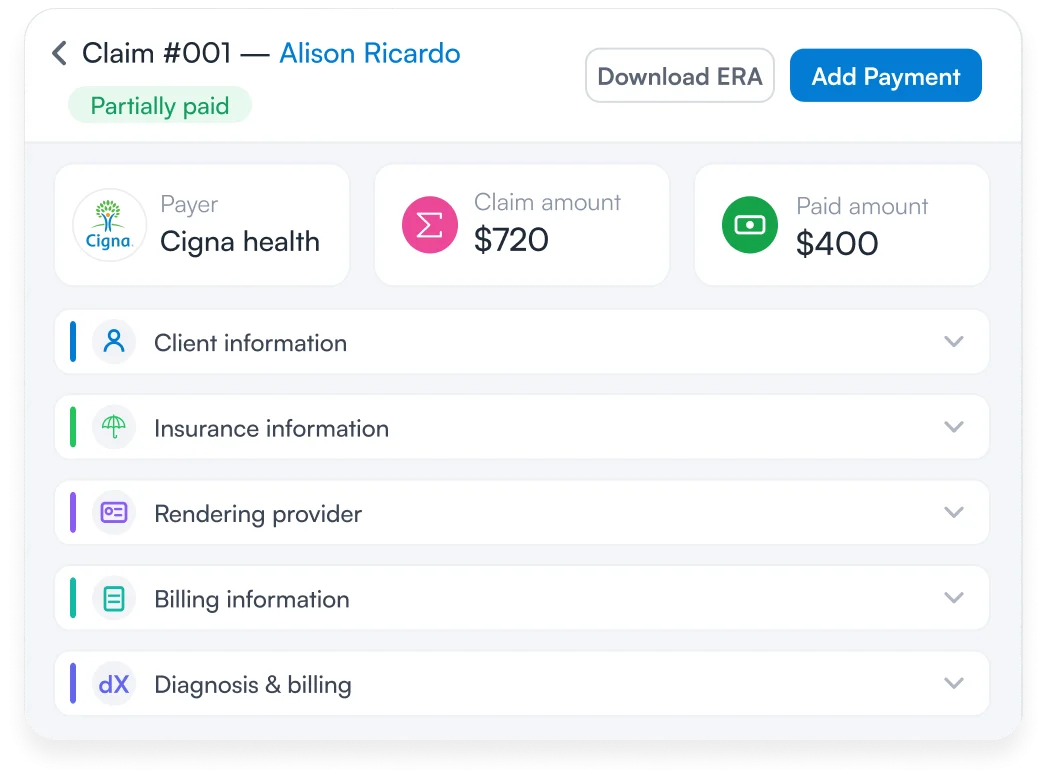
Our claims management software validates the fields a payer needs before submission. The Claim.MD integration then sends and tracks the claim from that same record. Fewer claims come back to be rebuilt, so payment cycles get shorter.
Effective ventilator billing workflows share three habits. Documentation is captured before delivery, not reconstructed after a denial. Every claim line is checked against the modifier rule and the FSS bundling list before it is submitted.
Denied claims then enter a structured clean claim process, with a root cause on every reason code. The upstream problem gets fixed once instead of monthly.
For a large ventilator census, a system that tracks order dates, continued-use reviews and rental months removes the manual calendar work that causes lapsed orders.
Seeing the whole revenue cycle management picture for DME also helps teams design checks that catch errors before claims leave the building. Teams comparing medical billing software options can weigh the ones built for respiratory and DME environments specifically.
Audit your A4618 activity quarterly against three checks. First, no A4618 line exists on any account with an active E0465 through E0468 rental. Second, no claim in the period used E0450, E0460, E0461, E0463 or E0464. Third, every ventilator line carries SC, GA, GY or GZ. Those three checks remove almost all of the avoidable denials in this code family.

Pabau keeps written orders, delivery proof and rental months in one patient record, and validates claim fields before submission. Your team can check whether a month is billable without chasing three systems.

A4618 is a valid code, and on a home ventilator patient it is still not a payable line. The frequent and substantial servicing rules fold the circuit into the E0465 or E0466 monthly rental, alongside every other accessory and service.
So the money comes from billing the ventilator well. There is no circuit line left to find. Use the current code for the interface in use, and carry an SC modifier on every line. Coverage is documented against NCD 240.9 or NCD 280.1, never against an LCD.
The quarterly audit above is worth putting on the calendar, because these denials repeat until the workflow changes. Book a demo to see how Pabau keeps ventilator orders, delivery proof and rental months in one record.

Billing dialysis supplies alongside respiratory ones? A4719 covers Y set tubing for peritoneal dialysis, with its coverage rules, modifiers and 2026 rates.
Need the anesthetic code that travels with dialysis access? A4736 is reported per gram, so the guide walks through units and documentation.
Coding casting supplies rather than respiratory ones? A4590 covers special casting material such as fiberglass, including its coverage and billing rules.
Working out how a drug code gets priced? J7189 shows how billing units and payment basis differ from a DMEPOS supply line.
HCPCS code A4618 reports breathing circuits, the hoses and connectors that carry each ventilator breath to the patient. It sits in the HCPCS Level II A4000-A4999 miscellaneous medical supplies series. The circuit is supplied and replaced as part of home ventilator care, but on a ventilator patient it is not a separately billable line.
Every ventilator claim line needs one of four modifiers: SC, GA, GY or GZ. Lines without one are rejected as missing information. SC attests that the NCD payment criteria are met. GA reports that an Advance Beneficiary Notice was issued, and GY reports a statutorily excluded situation. GZ reports an expected denial where no notice was given. KX is not used, because it attests to LCD requirements and home ventilators have no LCD.
On a ventilator patient there is no separate 2026 payment for A4618. The money arrives as the E0465 or E0466 monthly rental, which runs about $1,156 to $1,360 nationally under the January 2026 DMEPOS fee schedule. A4618 does carry its own inexpensive or routinely purchased line for non-ventilator use, at about $10.78 to $12.68 new. Fee schedule amounts are state-specific, so verify your own line before quoting a figure.
Medicaid coverage for A4618 varies by state, and this is the one place a separate circuit payment is realistic. Each state program sets its own DME fee schedule, covered code list and prior authorization rules for ventilator supplies. Check your state program’s policy and rate before delivering circuits to a Medicaid beneficiary.