

CCSD code G5100: Bypass of duodenum billing guide
CCSD code G5100 bills a bypass that leaves the duodenum in place CCSD code G5100...

Last Updated: Oct 16, 2026
A4590 is the HCPCS Level II code for special casting material (e.g., fiberglass).
Even so, the code itself is still live in the HCPCS Level II set, and some commercial plans and state Medicaid programs still recognize it. For Medicare, though, the replacement is the Q4001-Q4051 cast and splint supply series.
Let Pabau's smart automation suggest the right codes, reduce claim denials, and keep your practice compliant—effortlessly.
Automate repetitive tasks and focus on what matters most—your patients.
Reduce coding errors and ensure compliance with the latest regulations.
Clean claims, fewer denials, and faster reimbursements.
Powerful insights and reporting to help your practice thrive.
HIPAA compliant SOC 2 certified GDPR-compliant Trusted by 4,000+ clinics worldwide

HCPCS Code A4590 describes special casting material such as fiberglass. However, it covers the supply itself, not the casting procedure.
CMS declared A4570, A4580, and A4590 invalid for Medicare use effective July 1, 2001, and that has not changed since.
Medicare and Medicare Advantage claims use the Q4001-Q4051 crosswalk instead, chosen by material, patient age, and cast type.
Casting supplies came out of Physician Fee Schedule practice expense in 2001. As a result, the Q-codes are carrier-priced supply amounts, not fee schedule line items.
A4590 is still a live HCPCS code. Some commercial plans and state Medicaid programs accept it, so confirm the rule payer by payer.
Practice management software like Pabau keeps the note, the material, and the quantity on one record, so claims go out with support behind them.
HCPCS Code A4590 is the Level II code for special casting material (e.g., fiberglass), and it sits in the A-series of HCPCS Level II codes. Specifically, CMS administers that series to describe supplies and equipment the CPT code set does not cover.
The code applies to non-plaster casting materials, and fiberglass is the common example. Beyond that, other synthetic casting composites used for orthopedic and post-surgical immobilization fall under the same code.
For example, the NLM HCPCS Level II API returns A4590 and the full Q4001-Q4051 range, which helps practices that automate code lookup inside their billing software.
A4590 describes the supply used whenever a clinician applies fiberglass or another special casting material. That covers immobilizing a fracture, stabilizing a post-surgical site, or protecting soft tissue while it heals. However, the code never describes the application procedure, which instead stays on a CPT code from the 29000 to 29750 range.
Specifically, these are the clinical scenarios where special casting material is the supply in use:
Which code carries that supply on the claim depends entirely on the payer. For instance, physical therapy practices with casting privileges and sports medicine practices both face the same split: Medicare wants a Q-code, while a plan that still recognizes A4590 wants A4590.
What A4590 never covers: the procedure code for applying the cast, the removal, or supplies used at a separate later encounter. In short, a supply code carries material cost and nothing else.
Medicare has not paid A4590 since 2001. Specifically, CMS Program Memorandum AB-01-60 (Change Request 1641) declared A4570, A4580, and A4590 invalid for Medicare use effective July 1, 2001. In addition, the same memo invalidated L2102, L2104, L2122, and L2124.
Meanwhile, Program Memorandum B-01-29 (Change Request 1607) carried the instruction through the 2001 jurisdiction list.
The dates split by who processed the claim. Specifically, carrier-processed claims lost the codes on July 1, 2001, with a three-month grace period that ran through September 30, 2001, while intermediary-processed claims lost them on October 1, 2001. Either way, no grace period survives today, and no later transmittal reinstated the codes.
The reason was a payment change rather than a clinical one. Specifically, beginning in 2001, CMS removed casting supplies from the practice expense of every HCPCS code, including the CPT codes for fracture management and for casts and splints.
As a result, that left the supply with no payment route inside the procedure code, so CMS created 51 temporary Q-codes, Q4001 through Q4051, to pay for it separately.
Two consequences follow, and both matter at the claim line:
Medicare Advantage follows the same rule. Indeed, the current UnitedHealthcare Medicare Advantage supply policy states that it does not reimburse A4570, A4580, or A4590, and directs billers to the Q-codes. Likewise, the UnitedHealthcare commercial supply policy carries identical language.
Treat an A4590 line on a Medicare claim as a code-selection defect, not a medical-necessity denial. No modifier rescues an invalid code. Appeals on these lines waste staff time, because the correction is always the matching Q-code and a resubmission.
AB-01-60 published a crosswalk from each casting CPT code to its supply codes. Specifically, the Q-codes come in plaster and fiberglass pairs, and split again by patient age. Accordingly, the table below carries the fiberglass members of each pair, which are the codes that replace A4590. Here, adult means 11 years and over, while pediatric means 0 to 10 years.
Two details in that table trip billers up. For example, CPT 29058 crosswalks to Q4003 only, the plaster shoulder cast code, so a fiberglass shoulder cast billed under 29058 needs a call to the carrier. Similarly, CPT 29450 crosswalks only to pediatric codes, which matches the age of most clubfoot patients but leaves adult serial casting to Q4050.
Selecting the Q-code therefore takes three facts from the chart: the material, the patient age band, and the cast or splint type. If any one of them is missing from the note, the biller is left guessing.
Q-code payment does not come from the Physician Fee Schedule. Instead, AB-01-60 set payment under the reasonable charge methodology, and gap-filled the customary and prevailing charge amounts for 2001 from retail pricing data. Since then, carriers have priced and updated the series, alongside the DMEPOS and supply fee schedule files.
This is the single most common sourcing mistake on these codes. Indeed, the Physician Fee Schedule lookup tool returns nothing useful for a cast supply, because AB-01-60 limited fee schedule payment for these items to two bill types: comprehensive outpatient rehabilitation facilities on bill type 75X, and outpatient therapy facilities on bill type 74X.
For every other setting, pull the current allowed amount from your own contractor. Notably, rates for Q4050 and Q4051 are never published at all, since AB-01-60 leaves both to carrier individual consideration, priced item by item from the invoice.
Running insurance eligibility verification before the encounter tells you which plan the patient carries. That way, the code question is answered before anyone applies a cast.
A4590 remains valid outside Medicare, but only where a specific payer says so. Indeed, the code never left the HCPCS Level II set, so claim systems still accept it and clearinghouses still pass it through. In other words, acceptance is a contract question rather than a code question.
Three groups behave differently:
Build the answer into the payer setup in your billing system rather than deciding it per claim. Specifically, record which code each plan wants for cast supplies, and review it whenever contracts renew or a supply policy updates.
Casting supply billing has its own rules, and they differ from procedure code billing in ways that generate predictable rejections. Consequently, submitting a clean claim for cast supplies means working through six checks in order. First, though, the routes below show which code each payer expects before those checks begin.
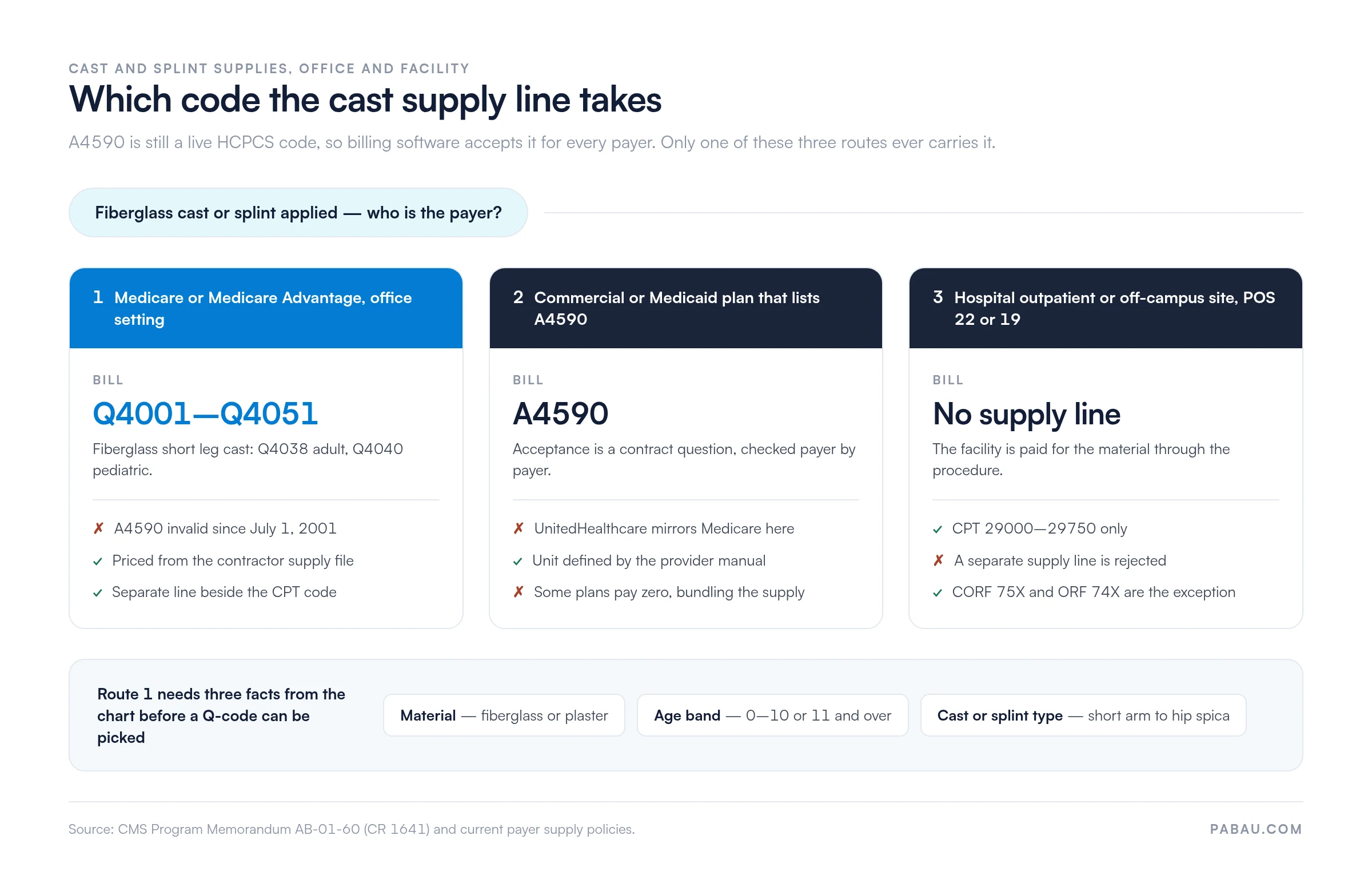
One legacy instruction is worth retiring. Specifically, AB-01-60 moved splint claim jurisdiction away from the old durable medical equipment carriers to the local carriers, effective July 1, 2001. As a result, supply codes for casts and splints applied by a clinician are not DME supplier claims, and routing them that way adds weeks to the cycle.
Cast supply lines need very few modifiers, and the wrong one causes more trouble than the missing one. Therefore, start from what the modifier is for.
In short, modifiers explain coverage decisions and service relationships. None of them makes an invalid code payable, so a rejected A4590 line gets corrected and resubmitted rather than modified and appealed.
Every cast supply line needs a diagnosis that establishes medical necessity, whether it is billed as A4590 or as a Q-code. Typically, fracture codes from the S-chapter are the usual pairing. Accordingly, the table below groups the most frequently submitted ranges by region, with the cast type each one usually generates.
S-chapter fracture codes need a seventh character for the encounter type. For instance, initial encounter for closed fracture is usually A, while a subsequent encounter takes D or later, as in S52.042Q. Otherwise, a truncated fracture code is an invalid code, and it fails before any necessity review happens.
The three A-codes share one Medicare status, yet they carry three different clinical meanings. As a result, payers that still accept them audit the distinction, because the materials carry different costs.
The rule is to bill what was applied. For example, a note reading “fiberglass short leg cast applied” points to A4590 or Q4038, depending on the payer, while a note reading “plaster splint” points somewhere else entirely. Either way, substituting one material for another is upcoding or downcoding, and it creates audit exposure in either direction.
Using both materials at one encounter is legitimate but rare. For instance, a plaster inner layer under a fiberglass overwrap genuinely uses two supplies. In that case, document each material separately before billing two lines.
A4590 sits in a small family of supply codes, and knowing the neighbors prevents both a missing supply line and a wrong one. For reference, the AAPC HCPCS Level II code lookup carries the current descriptor for each.
Cast padding has no dedicated A-code of its own. Instead, stockinette and similar underlayers fall inside Q4051 for Medicare, and inside the payer supply schedule everywhere else. Consequently, billing padding as a separate A-series item is a common and avoidable error.
Documentation decides these claims, because the code cannot be selected without it. Specifically, Q-code selection needs three chart facts before a biller can act, and payers audit the rest. Overall, getting medical billing compliance right at the note costs far less than working the denial later.
Every cast supply claim should rest on the following elements:
Make material, cast type, and roll count required fields in the casting note template, and let the note pull patient age automatically. Those four values are the entire Q-code decision. Capturing them at the point of care removes the back-and-forth between the biller and the clinician.
Cast supply claims fail in a small number of repeatable ways. Consequently, working denials after the fact costs several times the staff time of preventing them at the encounter.
Reading the denial codes that come back on cast supply claims separates the two failure types quickly. Specifically, an invalid-code rejection points at the payer mapping, while a medical-necessity denial points at the note.
Most practices split this work across systems. Typically, the clinical note lives in one place, and the roll count and supplier invoice in another, while the payer rule for cast supplies sits in someone’s head or a spreadsheet.
Every one of those splits is a chance for a detail to go missing. As a result, the material, the age band, or the cast type drops out before the claim is built.
By contrast, Pabau, an all-in-one practice management system, keeps them together. Specifically, the casting note is a structured template, so the material, the cast type, the laterality, and the quantity are recorded fields rather than free text.
In addition, patient age and date of service sit on the same record. So when a biller selects the code, every fact the choice depends on is already in front of them.
From there, claims management pulls what is already on the record into a pre-filled claim. It then submits and tracks that claim through the Claim.MD integration.
Pabau does not choose the code for you. Instead, it makes sure the person who does has the documentation, the invoice, and the claim status in one system instead of four.
The outcome is a shorter loop between the cast being applied and the payment landing. As a result, fewer notes go back to the clinician for a missing word, and fewer claims sit unworked because nobody could tell which code the payer wanted.

Pabau keeps the casting note, the material, the quantity, and the claim status on one patient record, so your billers never chase a missing detail.

A4590 is a valid HCPCS code that Medicare stopped paying a quarter of a century ago. That single fact drives almost every problem billers hit with it. Specifically, the code passes edits, reaches the payer, and comes back unpaid. Billers then work it as a coverage dispute instead of correcting the mapping.
Three habits prevent that. First, map Medicare and Medicare Advantage cast supplies to the Q4001-Q4051 crosswalk in the billing system rather than at the claim. Second, price those Q-codes from the contractor supply file, never the Physician Fee Schedule.
Then capture the material, the cast type, the age band, and the roll count in the note. In short, those four values decide the code.
Get those right and cast supply claims stop being a recurring rework queue. Ultimately, a dependable revenue cycle workflow is what turns a correct code into money in the account. Book a demo to see how Pabau keeps casting documentation and claim status in one place.

Billing the plaster equivalent? A4580 covers the same Medicare crosswalk from the plaster side of the code pair.
Coding the femoral shaft fracture behind a long leg cast? S72.345C breaks down the seventh characters and documentation a femur claim needs.
Billing a subsequent encounter after immobilization? S12.131D shows how aftercare and follow-up encounters change the diagnosis code.
Still billing HCPCS code J0800? HCPCS code J0800 billing guide explains why CMS deleted J0800 for corticotropin injections in 2023 and issued replacement codes.
HCPCS Code A4590 is a Level II supply code for special casting material such as fiberglass. It describes the material cost only, never the application procedure. Medicare has not accepted it since July 1, 2001. Its use today is limited to commercial plans and state Medicaid programs that still list it.
No. CMS declared A4570, A4580, and A4590 invalid for Medicare use effective July 1, 2001, in Program Memorandum AB-01-60, and has never reinstated them. Medicare and Medicare Advantage claims for cast supplies use the Q4001-Q4051 crosswalk instead, selected by material, patient age, and cast type.
The Q4001-Q4051 cast and splint supply series replaced it. Each cast type has a plaster code and a fiberglass code. Most split again between adults aged 11 and over and pediatric patients aged 0 to 10. A fiberglass short leg cast is Q4038 for an adult and Q4040 for a child.
Use your contractor supply fee schedule, not the Physician Fee Schedule search. CMS removed casting supplies from Physician Fee Schedule practice expense in 2001. Fee schedule payment now applies only to CORF bill type 75X and ORF bill type 74X. Q4050 and Q4051 are priced by carrier individual consideration from the invoice.
A4590 covers fiberglass and other special non-plaster casting materials. A4580 covers plaster of Paris cast supplies. The material actually applied decides the code, and the same split runs through the Q-code pairs. Both codes carry identical Medicare status, which is invalid since July 1, 2001.
The note needs the material named explicitly, the cast or splint type, and the anatomical location and laterality. It also needs the patient age, the quantity applied, and the date of application. A supporting ICD-10-CM diagnosis at full character length has to be on the claim. Keep the supplier invoice for quantity audits.
Often yes, but it depends on the payer. CMS removed casting supplies from procedure code practice expense in 2001, which is why the supply bills as its own line in the office. Check the payer provider manual and the current edits before billing the supply, the application code, and a visit together.



