CCSD Code J5520: Total pancreatectomy billing guide
CCSD Code J5520: Definition and procedure scope CCSD Code J5520 describes a tota...

Last Updated: Oct 20, 2026
J7189 is the HCPCS Level II code for factor viia (antihemophilic factor, recombinant), (novoseven rt), 1 microgram.
It is a Level II J-code maintained by the Centers for Medicare and Medicaid Services (CMS) for physician-administered drugs.
The units field is where these claims fail. Every microgram administered counts as one unit, so a dose reported in milligrams lands 1,000 times short. Mapping the dose to the right unit count in claims management software before submission stops that error at the source.
Let Pabau's smart automation suggest the right codes, reduce claim denials, and keep your practice compliant—effortlessly.
Automate repetitive tasks and focus on what matters most—your patients.
Reduce coding errors and ensure compliance with the latest regulations.
Clean claims, fewer denials, and faster reimbursements.
Powerful insights and reporting to help your practice thrive.
HIPAA compliant SOC 2 certified GDPR-compliant Trusted by 4,000+ clinics worldwide

HCPCS Code J7189 covers Factor VIIa (antihemophilic factor, recombinant), the code for NovoSeven RT, billed per 1 microgram.
Units equal the total micrograms administered, so a 1.2 mg dose is billed as 1,200 units rather than 1.2.
Medicare Part B pays J7189 at ASP plus 6% for FDA-approved indications, and commercial payers usually require prior authorization.
Claims management software like Pabau ties the code, the units, and the diagnosis code together before the claim goes out.
The table below summarizes the core attributes of J7189 for the 2026 billing year.
NovoSeven RT (eptacog alfa activated) is a recombinant form of coagulation Factor VIIa. It works by directly activating the extrinsic coagulation pathway, bypassing the need for Factor VIII or Factor IX. This makes it useful specifically in patients whose hemophilia inhibitors block those clotting factors. Feiba NF, an anti-inhibitor coagulant complex billed under HCPCS code J7198, is a plasma-derived bypassing agent for the same inhibitor patients.
The FDA has approved NovoSeven RT for four indications. Billing claims must pair HCPCS Code J7189 with a diagnosis code that reflects one of these approved uses:
Off-label uses of NovoSeven RT are generally not reimbursable under Medicare or most commercial plans. Claims submitted for non-approved indications will deny. Supporting documentation must clearly establish one of the four approved indications above.
One billing unit equals one microgram administered. What trips billers is the milligram-to-microgram conversion that happens before the math. NovoSeven RT vials are labeled in milligrams, while the HCPCS descriptor is written in micrograms.
Conversion formula: milligrams x 1,000 = micrograms = units to bill.
Document the exact dose administered in the clinical record before completing the claim. Payers audit J7189 claims for dose plausibility against the patient’s weight and the approved dosing range. Under-billing wastes revenue, and over-billing invites an audit. The billed units must match the administered dose exactly.
Each J-code sets its own unit, so a conversion learned on one drug does not carry across to the next. J2941 and J2941 and J1438 are are both measured in milligrams, which leaves J7189 as the outlier on most specialty drug claims.
Most J7189 claims run through the buy-and-bill model. The practice acquires NovoSeven RT directly from the manufacturer or distributor, administers it, and then bills the payer for both the drug and administration.
Specialty pharmacy billing (where the pharmacy supplies the drug and bills separately) is less common for this product but exists for some commercial plans.
Submitting through a structured clean claim workflow reduces J7189 denials significantly. Every step above earns its place by removing one denial reason, as the sequence below sets out.
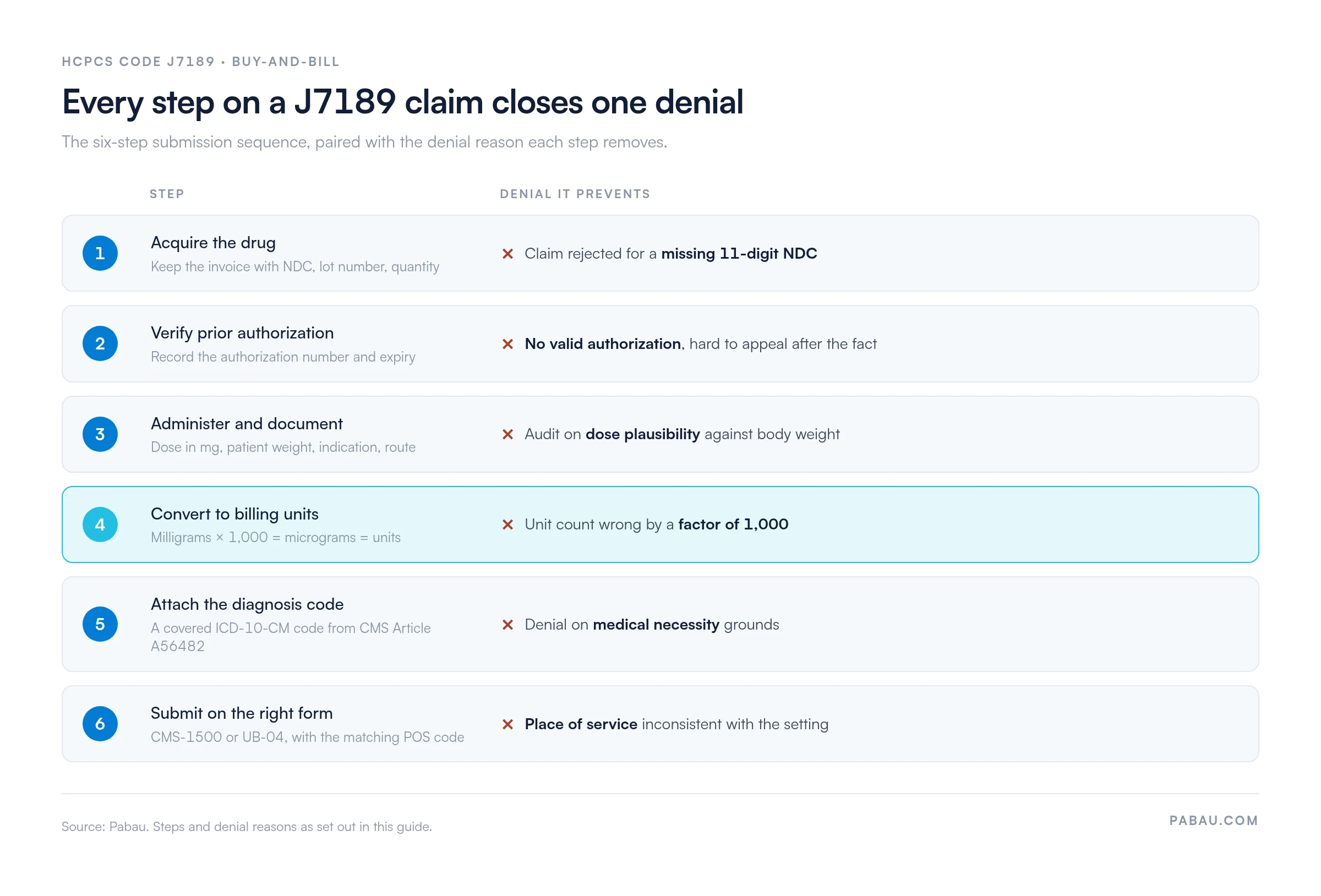
The place of service code has to match where the drug was actually administered. Hospital outpatient departments and infusion centers bill on a UB-04, while a physician office bills on a CMS-1500.
Check with each MAC or commercial payer whether the National Drug Code (NDC) is required on J7189 claims. Some payers deny J7189 claims that lack the 11-digit NDC even when all other fields are correct. Include NDC with qualifier N4 in Loop 2410 of the 837P or in the appropriate CMS-1500 field to avoid this denial reason.
Medicare Part B covers J7189 when the drug is physician-administered and medically necessary. CMS Billing and Coding Article A56482 governs hemophilia factor products under Medicare.
Coverage is limited to FDA-approved indications and requires documentation supporting the medical necessity of recombinant Factor VIIa over standard clotting factor replacement.
Key medical necessity criteria for Medicare coverage include:
Medicare pays on the average sales price the manufacturer reports each quarter, plus a 6% add-on for acquisition and handling. Rates are refreshed every quarter and vary by MAC locality, so a figure checked in January is already stale by April.
Medicare reimburses J7189 under the Part B Drug Reimbursement methodology. Payment equals ASP plus 6%, where ASP is the weighted average of all manufacturer sales to non-exempt purchasers minus rebates and discounts. CMS updates the ASP quarterly (January, April, July, October).
Because NovoSeven RT is a high-cost biologic, even small errors in the units field translate to large reimbursement discrepancies. Use the CMS Physician Fee Schedule lookup tool to confirm the current quarter’s payment rate for J7189 before finalizing claims. The ASP file is published on the CMS website and updated each quarter.
For the current payment rate, search J7189 in the AAPC HCPCS code lookup, which reflects current CMS data. Rates differ by MAC jurisdiction and locality, so check the jurisdiction that processes your claims.
Every J7189 claim must include at least one ICD-10-CM diagnosis code that establishes the medical necessity of recombinant Factor VIIa. CMS Billing Article A56482 specifies the covered diagnoses. The table below lists the primary codes. Verify them against the current CMS billing article before submitting, since covered code lists are updated annually.
D66 and D67 have no decimal subdivisions, so the diagnosis code on its own cannot show inhibitor status. Record the inhibitor titer in Bethesda units in the clinical note instead, since that documentation is what supports a bypassing agent. Payers read it alongside the diagnosis code when they assess medical necessity.
Authorization requirements for J7189 vary by payer and MAC jurisdiction, so the prior authorization process starts before the drug is ordered. Commercial payers typically require authorization for every NovoSeven RT administration, given what the drug costs. Medicare MAC policies differ. Some require authorization for ongoing therapy but not for emergency bleeding treatment.
Typical documentation required for a J7189 prior authorization request:
Proactive insurance eligibility verification before ordering the drug reduces the risk of a post-administration PA denial. If a PA is denied, document the denial reason and appeal with clinical evidence supporting the FDA-approved indication. Track the authorization number and expiration date to avoid claims that fall outside the approved window.
J7189 belongs to a family of J-codes covering hemophilia factor replacement products. Using the correct code for the specific product administered is essential. Billing J7189 for a Factor VIII product or vice versa will result in a denial and potentially a fraud allegation. The table below maps the most commonly used codes in this family.
Every code in this family except J7189 is measured in international units. J7189 is the only one billed per microgram, which is why a Factor VIII habit produces the wrong unit count on a Factor VIIa claim. Always verify the administered drug’s NDC against the HCPCS code before submitting.
J7189 has a higher-than-average denial rate among specialty drug codes. The unit calculation needs a conversion step that most billing systems do not automate by default. Good denial management starts before the claim is filed. These are the most common errors and how to prevent them:
Tracking these claim denial codes after each remittance allows billing teams to identify patterns and correct systemic errors before they accumulate. A structured denial review cycle, ideally weekly for high-cost drug codes, keeps J7189 claim performance within acceptable bounds.
Run a quarterly self-audit on a sample of paid J7189 claims. Compare the milligrams in the clinical note against the units on the claim. Confirm the diagnosis code still appears on the current CMS billing article, since covered code lists change each year. Catching a systematic conversion error at ten claims costs far less than catching it at a hundred.
Manual drug billing relies on billers remembering a conversion factor, an authorization rule, and an NDC format for every specialty drug on the formulary. On a low-volume code like J7189, that memory-dependent approach produces denials at a predictable rate.
Practice management software like Pabau holds the drug code, the administered dose, the unit count, and the diagnosis code on one record. Claims then leave through our Claim.MD integration, so the units documented at the point of care are the units the payer receives. Hematology practices and IV therapy services get the same workflow for every product they administer.
The outcome is fewer first-pass denials and a shorter revenue cycle, because the claim carries what the payer asks for the first time. Practices handling medical billing across many drug codes also keep a traceable record from drug receipt through remittance. That trail is what a HIPAA compliance review asks to see.

Pabau keeps the HCPCS code, the administered dose, the unit count, and the diagnosis code on one record. Specialty drug claims then go out complete the first time.

A J7189 claim is decided before it is submitted. The dose in the note, the unit count on the claim, the diagnosis code, and the authorization number all have to agree. No amount of appeal work repairs a mismatch after the money has been denied.
If you bill this code more than occasionally, the change worth making is structural rather than procedural. Put the milligram-to-microgram conversion inside the billing workflow rather than in a biller’s head. The most expensive error on this code then stops being possible.
Everything else on the claim is documentation you already produce, so the work is in capturing it once rather than chasing it twice. Book a demo to see how Pabau handles specialty drug billing across your practice’s code set.

Billing another injectable drug code? HCPCS code J3365 sets out the descriptor, unit definition, and coverage rules for a different J-code.
Handling a high-cost biologic under Part B? HCPCS code J0885 covers the units and Medicare coverage conditions for an ASP-priced injectable.
Reporting a plasma-derived product? HCPCS code J1562 explains how its units and documentation requirements are set.
Buying and billing an infused drug? HCPCS code J9267 walks through units, documentation, and Medicare coverage for a chemotherapy agent.
HCPCS Code J7189 bills Factor VIIa (antihemophilic factor, recombinant), NovoSeven RT, per 1 microgram administered. It applies when a physician administers this bypassing agent for one of its FDA-approved indications. Those are hemophilia A or B with inhibitors, acquired hemophilia, congenital Factor VII deficiency, and Glanzmann thrombasthenia refractory to platelet transfusions.
Units for J7189 equal the total micrograms administered. NovoSeven RT vials are labeled in milligrams, so multiply the administered milligrams by 1,000 to get micrograms. Bill that figure as the unit count. A 4.8 mg dose equals 4,800 mcg, so the claim carries 4,800 units.
Yes, Medicare Part B covers J7189 for medically necessary administration of NovoSeven RT in FDA-approved indications. Coverage is governed by CMS Billing and Coding Article A56482. Payment is calculated at ASP plus 6%, with rates updated quarterly. The claim must carry a covered ICD-10-CM diagnosis code and documentation supporting medical necessity.
Prior authorization is commonly required by commercial payers for J7189, given what NovoSeven RT costs. Medicare MAC requirements vary by jurisdiction. Some MACs require authorization for scheduled administrations but not for emergency bleeding treatment. Verify the requirement with the specific payer before administering the drug.
The primary ICD-10-CM codes paired with J7189 are D66 for hemophilia A, D67 for hemophilia B, and D68.311 for acquired hemophilia. D68.2 covers hereditary deficiency of other clotting factors, and D69.1 covers Glanzmann thrombasthenia. D66 and D67 are single billable codes with no decimal subdivisions. Claims without a covered diagnosis code deny on medical necessity grounds.
Related codes include J7185 for recombinant Factor VIII (Xyntha), J7186 for Factor VIII/von Willebrand factor complex (human), and J7187 for von Willebrand factor complex (Humate-P). J7188 covers porcine sequence recombinant Factor VIII (Obizur), J7191 covers porcine Factor VIII, and J7192 covers recombinant Factor VIII, NOS. The Factor IX codes are J7193, purified and non-recombinant, and J7195, recombinant and not otherwise specified. All of them bill per international unit, unlike J7189, which bills per microgram.