

CPT Code 98981: RTM Treatment Management Billing Guide
CPT code 98981: Definition and official descriptor CPT code 98981 is an add-on c...

Last Updated: Nov 9, 2026
92558 is the CPT code for evoked otoacoustic emissions, screening (qualitative measurement of distortion product or transient evoked otoacoustic emissions), automated analysis. The device returns a pass or refer result for each ear with no clinician interpretation, and the code is reported once per screening encounter.
A common denial cause is billing 92558 when the payer wanted a diagnostic code, 92587 or 92588. Others are a one-ear test billed without modifier -52 and a wrong ICD-10 link.
Let Pabau's smart automation suggest the right codes, reduce claim denials, and keep your practice compliant—effortlessly.
Automate repetitive tasks and focus on what matters most—your patients.
Reduce coding errors and ensure compliance with the latest regulations.
Clean claims, fewer denials, and faster reimbursements.
Powerful insights and reporting to help your practice thrive.
HIPAA compliant SOC 2 certified GDPR-compliant Trusted by 4,000+ clinics worldwide

CPT Code 92558 covers automated OAE screening with a qualitative pass or refer result, reported once per screening encounter.
Medicare Part B excludes routine hearing screening for adult beneficiaries, while newborn coverage follows Medicaid EPSDT and commercial preventive benefits.
NCCI edits make 92558 mutually exclusive with 92587 and 92588 on the same date, so only one OAE code is billed per encounter.
Pabau, the practice software we build, scrubs 92558 claims for missing or invalid details and checks eligibility through Claim.MD before the visit.
CPT Code 92558 describes “Evoked otoacoustic emissions, screening (qualitative measurement of distortion product or transient evoked otoacoustic emissions), automated analysis.”
The American Medical Association maintains it in the audiologic function tests range (92550-92597).
The procedure captures a brief sound played into the ear canal. A functioning cochlea produces a low-level sound in return, picked up by a probe microphone. Equipment analyzes the response automatically and reports a pass or refer result for each ear. The test takes under five minutes per patient and needs no behavioral response. That is why it dominates universal newborn hearing screening programs.
The code bundles probe placement, automated stimulus delivery, response capture, pass/refer analysis, and documentation for both ears into one billable unit. No separate interpretation or report code is billable on top of 92558.
What 92558 explicitly does not cover:
Sometimes one ear cannot be tested because of canal obstruction, excess vernix (common in neonates), or equipment failure. The encounter still uses 92558, with modifier -52 appended to signal reduced services. Billing 92558 without -52 for a documented one-ear test is an accuracy issue that can trigger a payer audit.
The Joint Committee on Infant Hearing (JCIH) Year 2019 Position Statement recommends screening every newborn for hearing loss before hospital discharge. That makes universal newborn hearing screening the standard of care, and it drives most 92558 billing volume.
Beyond the routine newborn screen, payers recognize 92558 for these additional indications:
Accurate ICD-10 coding is essential to establishing medical necessity. The most commonly accepted diagnosis codes for 92558 claims include:
Payer LCD requirements vary by MAC jurisdiction. Confirm accepted ICD-10 pairings with your MAC’s local coverage determination before submitting 92558 on non-newborn encounters. The ICD-10 codes above are widely accepted but not universally guaranteed across all payer policies.
All three codes cover OAE testing, but each describes a different procedure scope. Picking the wrong one can trigger a bundling denial or a payer audit.
If the instrument reports only pass or refer, with no frequency-specific data and no interpretation and report, the correct code is 92558. Once the record carries an interpretation and report, the code is 92587 or 92588, depending on the frequencies tested. Per ASHA, a DPOAE run of fewer than 12 frequencies is reported with 92587.
NCCI edits make 92558 and 92587 mutually exclusive on the same date of service. Billing both for one encounter, even with different ear designations, results in a denial. The diagram below walks the same rule in two questions.
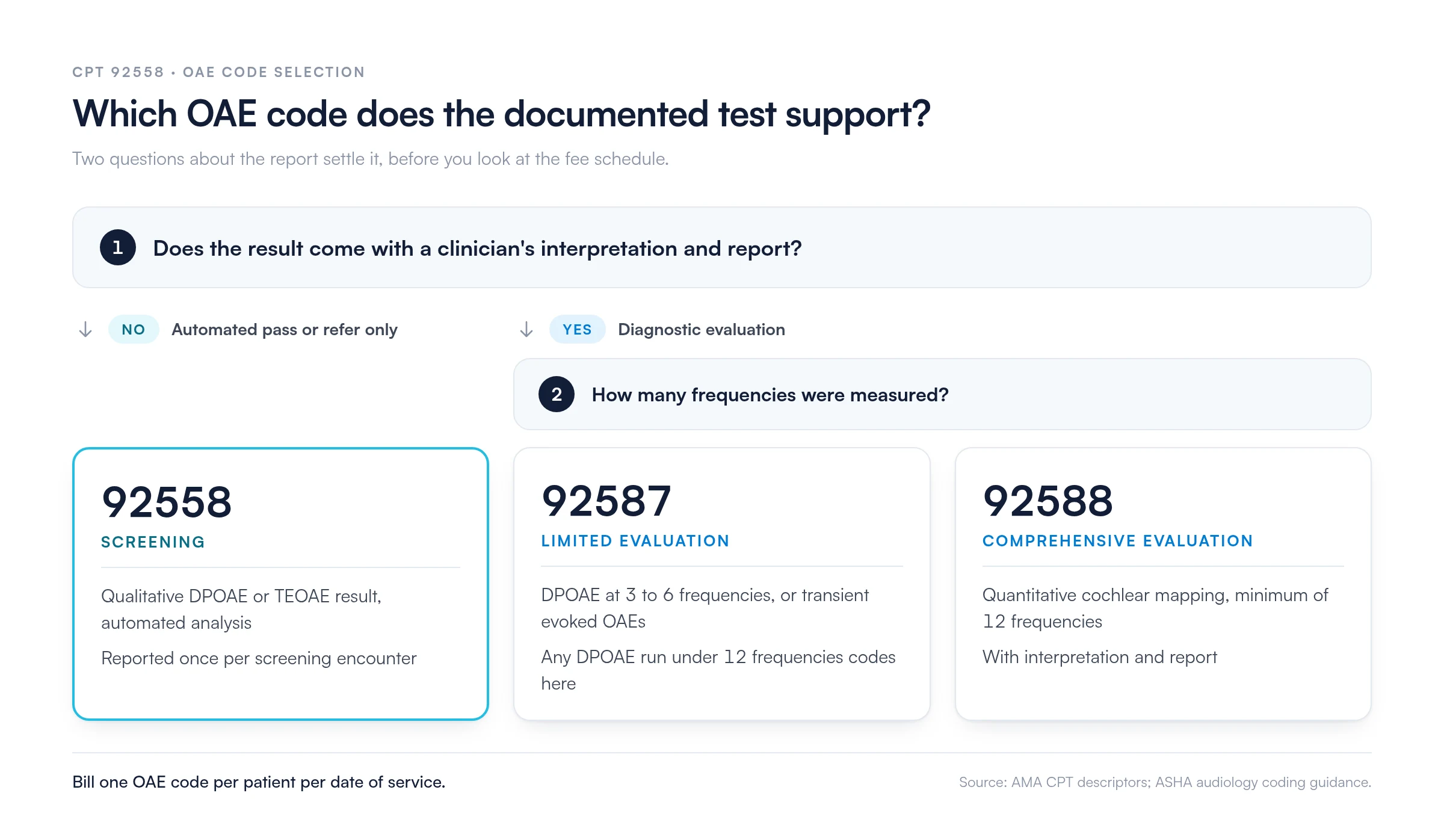
OAE screening (92558) and auditory brainstem response (ABR) testing are two distinct pathways for neonatal hearing assessment. Each has its own clinical indications, equipment, and billing rules.
JCIH 2019 recommends ABR-based screening for all NICU graduates, because OAE testing cannot detect auditory neuropathy spectrum disorder. That condition is more prevalent in this population. Hospitals screening NICU infants with 92558 alone face both a clinical risk and a coverage risk if the payer’s LCD reflects the JCIH recommendation.
92558 is reported once per screening encounter and, by convention, covers both ears. When the encounter differs from that, a modifier describes the difference.
The -25 modifier belongs on the evaluation and management code, not on 92558 itself. A common charting error puts -25 on the procedure instead. The E/M then denies while the OAE code pays, leaving the more valuable service unpaid.
Medicare Part B does not cover routine hearing screenings for adult beneficiaries. Section 1862(a)(7) of the Social Security Act excludes routine hearing exams. Chapter 16 of the Medicare Benefit Policy Manual lists them among the general exclusions. Chapter 15, §80.3 covers diagnostic audiology tests only when a physician orders them to guide treatment, not to fit hearing aids. An audiologist or ENT billing 92558 for an adult Medicare patient in an office should expect a non-covered-service denial.
Coverage for newborns and pediatric patients follows different pathways. Running insurance eligibility verification before the encounter heads off coverage denials on 92558.
Reimbursement rates for CPT Code 92558 vary by payer contract and geographic area. The CMS Physician Fee Schedule lookup tool provides the Medicare-based benchmark rate by locality, which commercial payers often use as a starting reference. Because 92558 carries a low relative value unit (RVU) weight appropriate for its brief automated nature, the absolute reimbursement per claim is modest.
Key reimbursement considerations for commercial payers:
Pabau integrates with the Claim.MD clearinghouse, so practices can run real-time eligibility checks (270/271) before the patient arrives. That cuts down on same-day coverage surprises.
Run a real-time eligibility check for every newborn patient before the OAE screening encounter. Verify the payer, plan type (grandfathered vs. non-grandfathered), and coverage tier. A five-second eligibility check catches coverage exclusions that take 45 minutes to appeal after a denial.
Documentation errors are a common cause of 92558 denials. The medical record must contain each of these elements to support a clean claim. Clean claim submission for OAE screening depends on capturing this information at the point of care, not reconstructing it later from memory.
For medical billing compliance, practices running high volumes of newborn screens should document the supervision framework in the medical record. This matters most when trained screeners who are not audiologists operate the equipment. Payer audits on 92558 frequently focus on provider credential documentation when the volume per provider is high relative to expected clinical capacity.
Most 92558 denials trace back to a fixable step in the workflow. The table below maps frequent denial patterns to their root cause and the correction for each one.
For structured denial management workflows, review 92558 denial patterns monthly. A denial rate above 5% on a high-volume screening code like 92558 signals a systematic documentation or coding process issue. Use this guide to medical billing denial codes to match the CARC/RARC codes on each EOB to the root cause above.
NCCI (National Correct Coding Initiative) edits govern which codes can be billed together on the same date of service. For 92558, the key bundling relationships are:
NCCI edits are updated quarterly. Confirm the pairings above against the current quarter’s edit tables before billing several audiology codes on one date.
Audiologists, physicians (including pediatricians and ENT surgeons), nurse practitioners, and physician assistants can bill CPT Code 92558. State scope-of-practice rules and payer credentialing still apply. Who may perform the test is a separate question. Many hospitals use trained non-licensed screeners to run the OAE equipment. The claim still goes out under a credentialed provider NPI, with the supervision relationship documented.
Provider type and setting considerations:
Place-of-service codes that support 92558 billing:
Facility and non-facility rates differ for 92558, so the same screen pays differently by setting. A grasp of medical billing fundamentals helps practices set realistic reimbursement expectations for each one.
Audit your 92558 claims quarterly by rendering provider NPI. If a single non-physician NPI shows unusually high volume, verify the supervision documentation is in the medical record for each encounter. ZPIC and RAC auditors target high-volume low-cost codes like OAE screening.
Practices that run newborn or well-child screens bill 92558 in volume, often keying the code, modifier, and diagnosis by hand after the visit. A missing -52 or a wrong place-of-service code then surfaces weeks later as a denial.
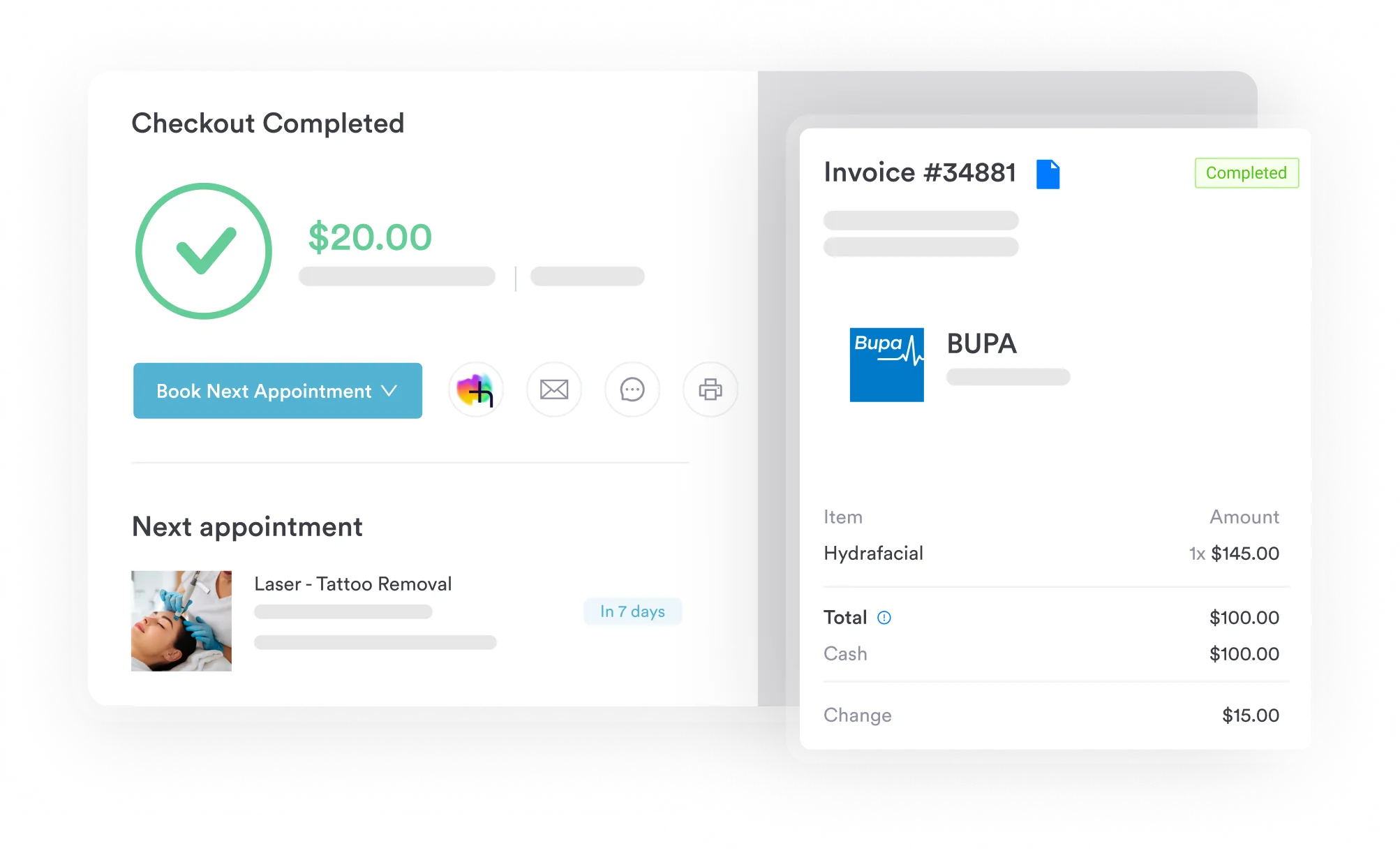
With Pabau’s claims software for audiologists, each claim is scrubbed for missing or invalid details before it goes out. Through the Claim.MD clearinghouse, the front desk runs a 270/271 eligibility check before the visit. The plan type and coverage status are known before the probe goes in.
The outcome is fewer resubmissions on a low-fee code, where every reworked claim eats into a modest payment.

Pabau’s claims management software scrubs each claim for missing or invalid details. It also checks eligibility through Claim.MD before the visit.

Treat 92558 as a documentation decision before it is a billing one. If the record shows only an automated pass or refer, 92558 is the code. Once a clinician interprets frequency data, the claim belongs to 92587 or 92588.
Settle the payer’s rules before the screen rather than after the denial: eligibility, any preventive modifier, and the place of service. That order keeps a five-minute test from turning into weeks of appeals.
Pabau’s claims management software scrubs claims for missing or invalid details and, through Claim.MD, checks eligibility before the visit. Book a demo to see how Pabau handles audiology and pediatric billing from check-in to payment.

Need to understand how clearinghouse submission works? The Claim.MD clearinghouse guide covers how electronic claims move from practice management software to payer adjudication.
Seeing recurring denial patterns across your audiology claims? Revenue cycle management fundamentals explains how to build a denial tracking and appeals process that reduces write-offs systematically.
Want to submit cleaner 837P files? The 837 electronic claim file guide breaks down claim loop structures and the format errors that get audiology claims rejected at the clearinghouse.
CPT Code 92558 covers automated evoked otoacoustic emissions (OAE) screening. The test measures cochlear outer hair cell function and reports a pass or refer result for each ear. It is reported once per screening encounter and, by convention, covers both ears.
No. Social Security Act §1862(a)(7) excludes routine hearing screenings for adult Medicare beneficiaries. Chapter 16 of the Medicare Benefit Policy Manual repeats the exclusion. An ABN is optional for statutorily excluded services, so use a voluntary ABN or notice of exclusion and tell the patient before the service. Newborn and pediatric coverage follows Medicaid EPSDT and commercial plan rules.
92558 is a screening code that returns only a qualitative pass or refer result, with no interpretation and report. 92587 is a limited evaluation of distortion product OAEs at 3-6 frequencies, or of transient evoked OAEs, with interpretation and report. 92588 is a comprehensive diagnostic evaluation that maps outer hair cell function at a minimum of 12 frequencies, with interpretation and report. NCCI edits make all three mutually exclusive on the same date of service.
Modifier -52 (reduced services) applies when only one ear is tested instead of both. Modifier -59 may be needed when 92558 and a same-day service such as tympanometry (92550) are distinct. It goes on the column-2 code in the NCCI edit. Some payers require modifier -33 to flag 92558 as a preventive service. Modifier -25 belongs on a same-day E/M code, not on 92558, and some payers accept -LT or -RT instead of -52.
Yes. NCCI does not bundle 92558 with ABR codes 92585 or 92586. Both can be billed on the same date when each service is clinically indicated and separately documented. The JCIH recommends ABR-based screening for NICU graduates because OAE testing cannot detect auditory neuropathy spectrum disorder.
Frequent denial reasons are Medicare non-coverage for adult patients and missing or invalid ICD-10 codes. NCCI bundling conflicts with 92587 or 92588 on the same date also cause denials. So do a missing modifier -52 after a one-ear test and a wrong place-of-service code. An inpatient newborn screen billed as POS 11 instead of POS 21 is a typical example.




